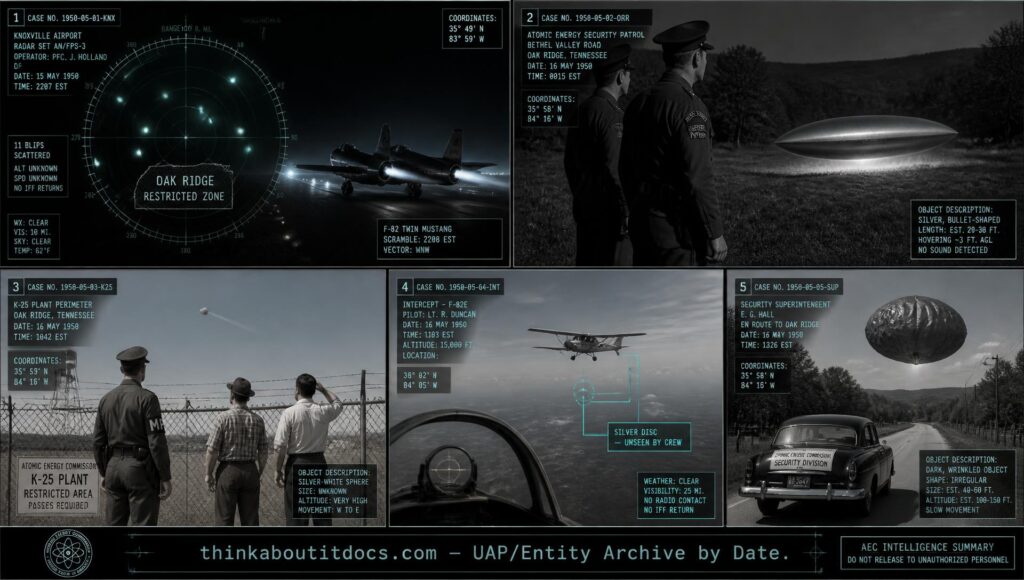
A twelve-day series of radar detections, fighter intercepts, and close-range sightings gripped the Oak Ridge, Tennessee atomic facility in October 1950.
THINK ABOUTIT UFO|UAP SIGHTINGS REPORT
The Oak Ridge / Knoxville Flap — Tennessee (October 1950–January 1951)
For nearly four months spanning October 1950 through January 1951, the skies over the Atomic Energy Commission’s Oak Ridge facility and the nearby Knoxville radar station produced an unusual concentration of military radar detections, scrambled fighter intercepts, and close-range visual sightings by security personnel guarding one of the country’s most sensitive nuclear installations. It began on the night of October 12, 1950 with eleven radar targets over a restricted flight zone and an F-82 sent up to chase them; it built, as one contemporary account put it, until “the dam broke” on October 13 or 15, when two Atomic Energy Security Patrol employees watched a silver, bullet-shaped object descend to within 210 feet of them and hover just six feet off the ground. The flap continued through radar-and-visual events on October 16, 20, and 24, a further sighting by a Fairchild Aircraft illustrator on November 5, the pattern’s most striking incident on November 29-30 — hours of radar targets blanketing the restricted area alongside a documented, unexplained spike in radiation readings at the site itself — three more radar-and-intercept incidents in December, including a case where seven NEPA Division officials watched an object visually just minutes before radar independently picked up a target in the same restricted area, and, finally, one further radar-intercept attempt on January 21, 1951, confirming the pattern carried into the new year rather than ending with 1950. Each incident was followed by an intercept attempt that found nothing — a pattern of near-misses that has made Oak Ridge one of the most frequently revisited government-facility UFO cases in the record.
Overview
Oak Ridge, Tennessee was built during World War II as a secret Manhattan Project site for uranium enrichment, housing the K-25, Y-12, and S-50 plants; by 1950 it remained a closely guarded Atomic Energy Commission facility under the watch of its own Atomic Energy Security Patrol, backed by a nearby military radar station at Knoxville Airport. That combination — a high-value nuclear target, a dedicated security force trained to report anomalies, and functioning radar coverage — makes Oak Ridge one of the best-instrumented and most consistently documented UFO “flap” locations of the entire Cold War period, with incidents recorded not only in October 1950 but recurring in subsequent years (including a well-documented sequence in 1952). The October 1950 events are unusual even by Oak Ridge’s own standards for their density: five separate radar-and-visual incidents within twelve days, several within days or hours of active fighter intercept attempts, none of which succeeded in visually identifying the detected targets.
The Incidents
October 12, 1950
Location: Knoxville Airport radar station and the Oak Ridge restricted flight zone, Tennessee
Time: 11:25 p.m. (radar detection); F-82 scrambled at 11:30 p.m.
Summary: A military radar unit at Knoxville Airport suddenly detected eleven, “and possibly more,” unidentified targets moving over the restricted flight zone at Oak Ridge. The radar station commander scrambled an F-82 fighter, which was airborne within nine minutes and vectored toward two of the targets. Radar indicated the fighter closed with the targets, but the pilot saw nothing, and ground observers likewise failed to detect anything visually. Separately, local press reported a saucer-shaped object over the K-25 area near the NEPA Project the same night: round, roughly the size of a four-room house, silver, with a blister on top and visible windows, which rose about 100 feet, moved forward, rose again, and then departed at high speed.
Source: McDonald list; Blue Book files; The Knoxville Journal, October 26, 1950
October 13 or 15, 1950 (sources disagree on the date)
Location: Oak Ridge, Tennessee (BBU 819)
Time: Afternoon (approximately 3:20-3:25 p.m.)
Summary: Atomic Energy Security Patrol Trooper Edward D. Rymer, University of Tennessee Research Farm caretaker John Moneymaker, and Capt. Zarzecki saw two shiny, silver, bullet- or bladder-shaped objects dive with a smoke trail from roughly 12,000-15,000 feet. One vanished; the other continued descending in a controlled dive, leveled off, and flew slowly parallel to the ground — coming within 210 feet of the two ground observers while paralleling the terrain at approximately six feet of altitude, moving away and returning several times. Knoxville radar showed unusual targets at the same time as the visual sighting; another aircraft was scrambled and again saw nothing. The Air Technical Intelligence Center was unable to explain the visual sighting.
Source: Berliner; Hynek, UFO Report, pp. 142-143; NICAP Oak Ridge case files
October 16, 1950
Location: K-25 Plant, Oak Ridge, Tennessee
Time: Approximately 1:30 p.m. (also recorded as 3:20 p.m./1520 EST in some files)
Summary: AEC Patrol Trooper John Isabell and four civilian employees observed a silver-white, spherical object traveling from the southwest to the northeast at high altitude, passing over the K-25 restricted area. FBI Special Agent William S. Price, present when the report reached the radar station, documented that the radar screen picked up an indistinct target roughly every three or four sweeps. An F-82 was sent to attempt an intercept; its airborne radar picked up a target that later proved to be an unrelated light aircraft. Ground observers reported that the F-82, while pursuing the light plane, passed directly beneath the reported “silver disc” — but the fighter’s crew saw nothing unusual.
Source: National Archives documents; Fran Ridge; Dan Wilson
October 20, 1950
Location: Oak Ridge / Knoxville area, Tennessee
Time: 3:27 p.m. (radar detection and intercept) and 4:55 p.m. (ground sighting)
Summary: The Knoxville radar unit detected targets and scrambled a fighter piloted by a Lt. Wolf of the 5th Air Weather/Fighter Squadron, who radioed that the objects were 20-25 miles from Knoxville Airport but could not identify them. Roughly ninety minutes later and in the same general vicinity, Larry Riordan, Superintendent of Security for the X-10 control zone, was driving to a residential area when he saw a round object he initially took for a balloon that had lost its basket — wrinkled at the bottom, something hanging below, roughly 8-10 feet long, and lead or gunmetal in color. Riordan did not believe it was a standard weather balloon, though he considered it might have been a gas-bag balloon launched from the nearby University of Tennessee Agricultural Research Farm; he could not be certain whether it was moving, having seen it only briefly while driving. A fighter search of the area, spanning roughly ninety minutes and including the time of Riordan’s sighting, found nothing.
Source: The Ghost Doctor (Oak Ridge historical account); unsourced in original Blue Book compilation
October 24, 1950
Location: Oak Ridge, Tennessee
Time: Radar targets appeared 6:23 p.m.; fighter scrambled 6:26 p.m.; visual sighting reported 6:30 p.m.; radar contact lost 7:20 p.m.
Summary: FBI documents describe a further round of visual sightings at Oak Ridge alongside a radar track at Knoxville. An unidentified object appeared at approximately 5,000 feet in the same general area as an earlier witness sighting; a fighter scrambled minutes after the radar detection failed to see anything, and the radar target itself was tracked for roughly an hour before disappearing from the scope.
Source: Fran Ridge, FBI documents
November 5, 1950 (BBU 829)
Location: Oak Ridge, Tennessee
Time: 11:55 a.m.
Summary: Fairchild Aircraft illustrator Don Patrick saw a translucent object, light grey with a dark core, shaped like a pear or bean, flying with rapid, darting movements over a period of five to ten minutes.
Source: Berliner
November 29-30, 1950
Location: McGhee Tyson Airport radar station and the Oak Ridge restricted area, Knoxville, Tennessee
Time: Beginning 5:55 p.m. November 29, continuing intermittently into November 30
Summary: Numerous unidentified radar “paints” appeared at the 662nd Aircraft Warning Radar Detachment at McGhee Tyson Airport, almost entirely covering the Oak Ridge restricted area. A fighter aircraft sent to the area made no visual contact, though most targets remained visible on the radar scope for two to three hours. At 7:00 p.m. the same evening, a background Geiger counter monitoring the restricted area recorded a pronounced rise in Alpha particles and a smaller rise in Gamma rays at the same time as the radar activity; the AEC confirmed no known “Argon releases” occurred on either date that could account for the readings. On November 30, a single unidentified target appeared 12-21 miles west-northwest of the station between 1:51 and 2:05 p.m.; at 4:30 p.m. that day, numerous further unidentified paints appeared — so dense they could not be counted or individually plotted — remaining visible until approximately 11:30 p.m. to midnight. At least nine qualified personnel witnessed the targets across the two-day period.
Source: McDonald list; Dan Wilson
December 14, 1950
Location: Knoxville, Tennessee
Time: 4:05 p.m.
Summary: A group of targets blanketed the radar scopes in the area directly over the Oak Ridge AEC projects. These targets could not be identified from the radar image, and a fighter interception attempt met with negative results.
Source: Fran Ridge
December 18, 1950
Location: Oak Ridge, Tennessee
Time: Visual sighting 8:20-8:30 a.m.; radar detection 8:39-8:45 a.m.
Summary: Seven officials of the NEPA Division, traveling in two cars, visually observed an unidentified flying object between 8:20 and 8:30 a.m. Fourteen minutes later, a small radar “paint” appeared on the scopes of the 663rd Aircraft Control and Warning Squadron at Knoxville Airport, near the southeast corner of the Oak Ridge Controlled Area — on a magnetic bearing of 190 degrees, moving at roughly 60 mph, at an estimated altitude of 2,500 feet. A fighter interception attempt was made with negative results. This is the clearest case in the whole flap of an independent visual sighting and a subsequent radar detection occurring in close time and space, rather than the more usual radar-first pattern.
Source: Blue Book files; McDonald list; FUFOR Index
December 20, 1950
Location: Oak Ridge, Tennessee
Time: Unknown
Summary: The log of the 663rd Aircraft Control and Warning Squadron records a further unidentified radar track, followed by an F-82 intercept attempt.
Source: McDonald list; FUFOR Index
January 21, 1951
Location: Oak Ridge, Tennessee (BBU)
Time: 4:20 p.m.
Summary: An unidentified object was sighted on the radar scope of an F-82 fighter over the controlled area at Oak Ridge. The radar operator intercepted an indication of an airborne target at roughly 18,000 yards; GCI gave the go-ahead to intercept, the F-82’s radar locked on, and the run began. The interception was unsuccessful and the fighter returned to base. In all, three passes were made at radar-indicated targets, but none could be completed since the target remained over the restricted area of Oak Ridge, including the X-10 plant. The final documented incident of this flap, confirming the pattern continued into 1951 rather than ending with 1950.
Source: McDonald list; FUFOR Index
Detailed Report
What distinguishes the October 1950 Oak Ridge flap from most contemporary sighting waves is the consistency of its witness pool and its documentary trail. These are not scattered, unrelated members of the public reporting lights in the sky from different towns; they are Atomic Energy Security Patrol troopers, civilian AEC employees, and Air Force radar and fighter crews, all operating within the same restricted security perimeter, all reporting to the same chain of command, and all cross-referenced in the same FBI, AEC, and Air Force paper trail. That institutional consistency gives the case a coherence that most 1950-era flying saucer waves lack, and it is precisely why Oak Ridge has remained a recurring subject of FOIA requests and archival research in the decades since.
The case’s defining structural feature is the repeated failure of intercept attempts to resolve what radar and ground observers were reporting. On at least three separate occasions in this twelve-day window — October 12, October 16, and October 24 — a fighter was scrambled in direct response to a radar detection, and on each occasion the pilot reported seeing nothing, even when radar indicated the aircraft had closed to visual range with the target. The October 16 incident is particularly striking in this respect: ground observers specifically reported watching the intercepting F-82 pass directly beneath the reported silver disc while the fighter crew, focused on a nearby light aircraft their own radar had also picked up, saw nothing unusual at all. Whether this reflects a genuine, radar-resolvable but visually elusive phenomenon, a systematic radar-tracking error compounded by the challenge of visually acquiring a small or distant target from a fast-moving aircraft, or some combination of both, the pattern itself is well documented across multiple independent incidents rather than resting on a single ambiguous case.
The October 13/15 incident stands out as the flap’s most detailed and lowest-altitude sighting: Rymer and Moneymaker’s account of an object descending to within 210 feet of them and hovering at roughly six feet above the ground, moving away and returning several times, is a close-range, extended observation by two named, professionally positioned witnesses, and it was the incident the Air Technical Intelligence Center itself was unable to explain — a notable admission given the Air Force’s general institutional preference for mundane explanations wherever one could plausibly be offered.
The Riordan sighting on October 20 illustrates the case’s more ambiguous edge: a security superintendent’s brief, uncertain glimpse of an object he suspected but could not confirm was a lost weather or research balloon, seen for only a few seconds while driving. Riordan’s own honesty about the limits of his observation — he could not be sure whether the object was moving, and he actively considered and weighed the balloon explanation himself — is a useful reminder that not every incident within a documented flap carries equal evidentiary weight, even when it occurs in close temporal and geographic proximity to more striking sightings.
The November 29-30 incident is, by a wide margin, the flap’s most evidentially unusual episode, and the detail that most distinguishes Oak Ridge from an ordinary radar-visual UFO wave: a claimed correlation between the radar activity and a real, simultaneously recorded rise in background radiation readings — specifically Alpha particles, with a smaller rise in Gamma rays — at the exact time the radar targets covered the restricted area. The Atomic Energy Commission’s own confirmation that no scheduled “Argon release” (a known, mundane source of localized radiation readings at nuclear facilities) occurred on either date removes the single most obvious innocent explanation for the reading, though it does not by itself establish any particular alternative cause. A background radiation excursion at an active nuclear enrichment site is, by its nature, exactly the kind of data point most likely to have been carefully logged and cross-checked at the time, given how seriously the AEC would have needed to treat an unexplained radiological reading regardless of any UFO context — which lends this specific claim more built-in institutional scrutiny than most other details in this flap.
The December 18 incident is, structurally, the cleanest single case in the entire flap: seven named-by-role NEPA Division officials, traveling in two separate vehicles, independently watched an unidentified object, and only fourteen minutes later — not simultaneously, not after the fact — did the Knoxville radar station pick up a small, slow-moving target near the same restricted area. Most of the flap’s other incidents involve radar detection triggering a search for a visual correlate, or a visual sighting with no radar confirmation at all; December 18 is the one case where an independent ground sighting and a subsequent, geographically consistent radar detection line up in a genuinely suggestive sequence. The target’s very modest speed (roughly 60 mph) and low altitude (roughly 2,500 feet) are also worth noting — this is a far more sedate profile than the flap’s earlier high-speed radar targets, and it sits closer to what a slow-moving balloon or small aircraft might produce, though no such mundane candidate is confirmed in the surviving record.
The January 21, 1951 incident closes out the documented pattern on a structurally familiar note: a radar-indicated target over the restricted area, a “locked on” intercept run by an F-82, and three separate passes that all failed to complete because the target stayed within the Oak Ridge controlled airspace itself — a detail worth pausing on, since it means the fighter crews were, in effect, constrained by the very security perimeter the object appeared to be violating. That the pattern persisted essentially unchanged three and a half months after it began, with the same radar station, the same aircraft type, and the same failure mode, argues for a stable, recurring phenomenon (of whatever origin) rather than a short-lived cluster of unrelated misidentifications.
RESEARCHER’S NOTES
The Oak Ridge / Knoxville Flap — Tennessee 1950 and the Limits of Radar-Visual Correlation
- Classification issues: This is a wave case rather than a single sighting, and individual incidents span categories from distant radar-only detections to a genuine close-range, low-altitude visual observation (the October 13/15 incident). No single Hynek classification can honestly cover the whole flap; each incident should be read on its own evidentiary terms rather than the wave being assigned one blanket category.
- Source chain assessment: The case benefits from an unusually institutional documentary trail — FBI memoranda, National Archives records, Project Blue Book files, and Hynek’s own published account of the October 13/15 incident — but individual dates and details are inconsistently reported across sources (the October 13 vs. 15 date discrepancy for the Rymer/Moneymaker sighting is preserved here honestly rather than resolved, since the available sources genuinely disagree).
- Pattern context: Oak Ridge’s UFO history did not begin or end in October 1950 — the same Knoxville radar station recorded similar unexplained detections as early as March 1-2, 1950, and the facility would go on to produce another well-documented sighting cluster in 1952, including a case in which a fighter pilot reported an object making “ramming attacks” on his aircraft. This recurring pattern at a single, consistently monitored nuclear facility is one of the more methodologically interesting long-term threads in the broader 1950s UFO record.
- Physical evidence and evidentiary weight: No photograph, film, or recovered physical trace exists from any incident in this flap. The evidentiary weight instead rests on the professional standing of the witnesses (security patrol officers, an FBI special agent, military radar and fighter crews), the multiple independent radar corroborations, and the documented institutional seriousness with which the incidents were investigated at the time — a stronger evidentiary profile than most 1950 sightings, even without physical evidence.
- Geographic and historical context: Oak Ridge’s status as a top-secret nuclear weapons production site during the early Cold War places this flap within the broader, well-documented pattern of UFO activity clustering around U.S. nuclear facilities in this period — a correlation this archive records elsewhere (Los Alamos, Kirtland AFB, Holloman AFB) without asserting a causal explanation.
- Scope note (corrected, final): This page was built to cover October 12-24, 1950, then extended to include November 5 and November 29-30, extended a third time to include three December incidents (14th, 18th, 20th), and extended a fourth and final time to include the January 21, 1951 incident. An earlier version of this note stated that no further Oak Ridge/Knoxville events were documented into 1951 — that statement was incorrect and has been corrected here rather than left standing; the January 1951 monthly archive page surfaced the January 21 incident, confirming the pattern crossed the year boundary. January 21, 1951 is the last dated incident in the sources this archive has reviewed to date, but that should be read as the current state of research, not a claim that the pattern is confirmed to have ended there.
The October 1950-January 1951 Oak Ridge flap endures as one of the best-institutionally-documented UFO waves of the early Cold War era — not because any single incident produced conclusive proof, but because a trained security force, backed by working radar and repeated fighter intercepts, generated a consistent, cross-referenced paper trail across nearly four months without ever managing to visually resolve what its own radar kept detecting, and, in its strangest chapter, recorded an unexplained radiological anomaly alongside the radar activity itself. It is preserved here as Insufficient Data: a genuinely strange and thoroughly documented pattern of near-misses at one of the country’s most sensitive nuclear facilities, never explained and never definitively left unexplained either.
“No unusual objects were seen visually or on radar for the next two days. Then the ‘dam broke.'”
— Contemporary account of the October 1950 Oak Ridge, Tennessee flap