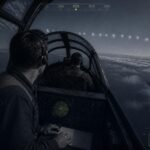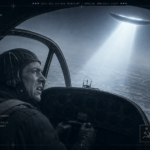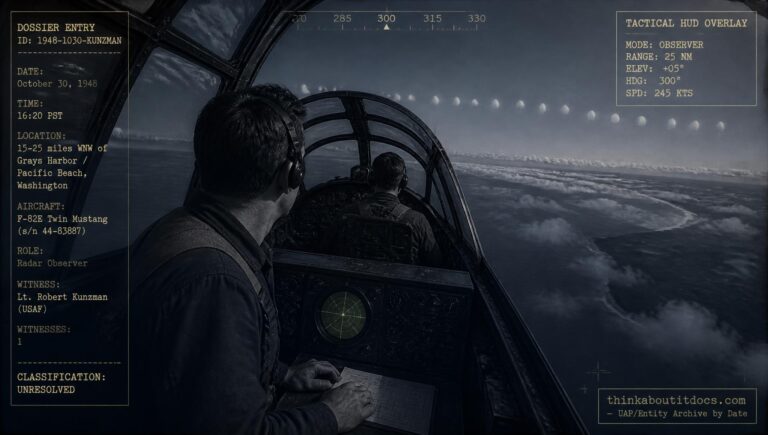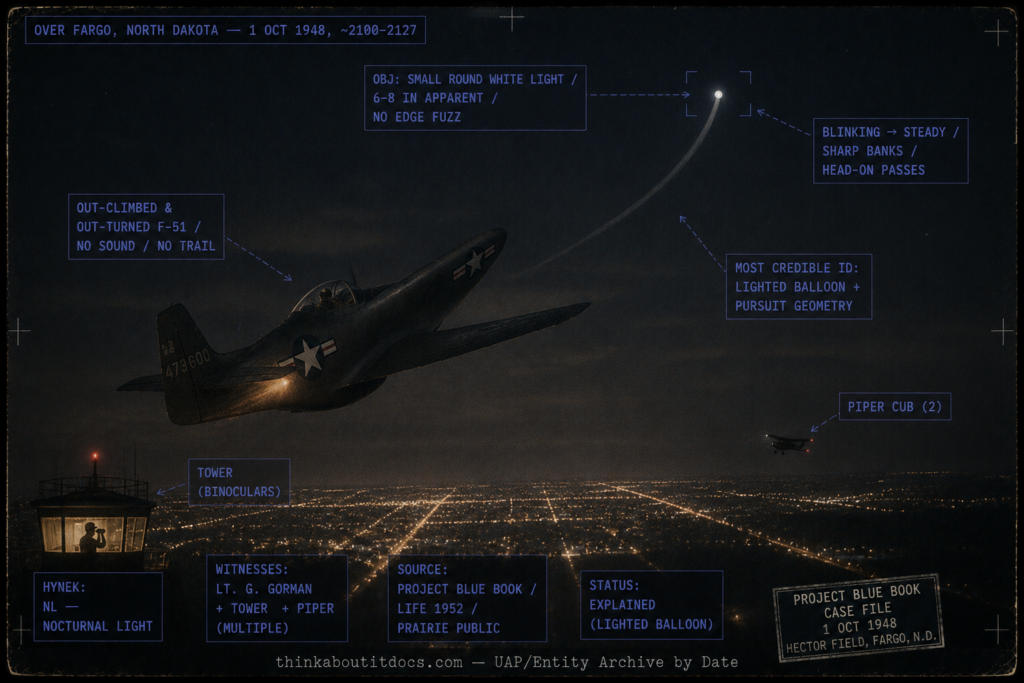
Lt. George Gorman duels a small white light over Fargo for 27 minutes, October 1, 1948 — witnessed from the ground and a Piper Cub, and most credibly a lighted balloon.
THINK ABOUTIT UFO | UAP SIGHTING REPORT
1948: The Gorman Dogfight
Lieutenant George F. Gorman had stayed up to log a little night flying over Fargo when a blinking white light flashed past his F-51, and the Hector Field tower swore there was no other aircraft up there but a Piper Cub far below. For the next twenty-seven minutes the decorated combat veteran and flight instructor threw his Mustang through everything he had — climbs, dives, tight banks, head-on passes — chasing a small, clear-white ball of light, six to eight inches across, that out-turned and out-climbed him, twice bored straight at his canopy until he flinched away, then shot vertically into the dark and was gone. Gorman landed shaking, barely able to set the plane down. And he was not the only witness: the tower chief had tracked the whole “combat” through binoculars, and the two men in the Piper had seen it too. The Air Force called it a lighted weather balloon. Gorman called it something that seemed, for twenty-seven minutes, to be thinking.
Date: October 1, 1948 (Project Blue Book Unknown — “BBU”)
Sighting Time: ~9:00–9:27 p.m. (local)
Day/Night: Night (evening)
Location: Over Fargo, North Dakota (Hector Field area)
Urban or Rural: Over a city, observed from the air and ground
No. of Entity(‘s): None reported
Entity Type: Not applicable — no occupants or entities
Entity Description: Not applicable
Hynek Classification: NL (Nocturnal Light) — a luminous point-source object pursued at night. (Not CE-I: there was no object within close range leaving physical traces; the object was a maneuvering light.)
Duration: ~27 minutes
No. of Object(s): 1
Description of the Object(s): A small, clear-white, completely round light, about six to eight inches in apparent diameter with no fuzz at the edges, initially blinking on and off and then becoming steady. It performed sharp banks, climbs, dives, and apparent head-on passes, appeared to maneuver intelligently, made no sound, and left no exhaust trail before climbing vertically out of sight.
Shape of Object(s): Round (point/ball of light)
Size of Object(s): ~6–8 inches apparent diameter at ~1,000 yards
Color of Object(s): Clear white (with no edge blur)
Distance to Object(s): As close as ~1,000 yards; passes reported as close as ~500 feet over the canopy
Height & Speed: Maneuvered between low altitude and ~7,000+ ft; estimated to move faster than Gorman’s F-51 (the F-51 capable of ~300–400 mph); out-climbed and out-turned the fighter; departed in a steep vertical climb
Number of Witnesses: Multiple — Lt. George F. Gorman (pilot); the chief of the Hector Field control tower (and tower staff), who followed the pursuit through binoculars; and the two occupants of a Piper Cub airborne nearby
Special Features/Characteristics: Multiple independent witnesses (air and ground); apparent intelligent evasive maneuvering, including head-on passes; the pilot’s F-51 entered a power stall trying to follow; no sound, no exhaust trail; the object out-performed a front-line fighter; the case became a Project Blue Book entry; Gorman reported the Air Materiel Command classified the information Secret and raised the prospect of court-martial for disclosure
Case Status: Explained (most credibly a lighted weather/research balloon, with the apparent “maneuvers” arising from the geometry of a fast aircraft circling a near-stationary light; officially debated, and retained by Blue Book as a noted early case)
Source: Dakota Datebook / Prairie Public (North Dakota Public Radio), Dec. 10, 2003; LIFE Magazine, April 1952 (“Have We Visitors From Space?”); U.S. Air Force Project Blue Book / Project Sign records
Summary/Description: On the evening of October 1, 1948, Lt. George F. Gorman of the North Dakota Air National Guard was logging night-flying time over Fargo when he saw a blinking white light the tower could not account for. He gave chase in his F-51 for about 27 minutes as the small, clear-white, round light banked, climbed, dived, and made apparent head-on passes, out-maneuvering and out-climbing his fighter before shooting straight up and vanishing; his plane went into a power stall during the pursuit. The encounter was corroborated by the Hector Field tower chief (watching through binoculars) and the two occupants of a Piper Cub. The Air Force’s explanation was a lighted weather balloon. The case entered Project Blue Book as a noted early classic, with Gorman reporting that the information had been classified Secret.
Related Cases: 1948 Thomas Mantell incident (Kentucky; pilot pursuit, balloon explanation) | 1948 Chiles-Whitted (Alabama; airliner crew, the third 1948 pilot classic) | 1949 Gorman-type luminous-light pursuits | Project Sign/Blue Book balloon and astronomical misidentifications
DETAILED REPORT
The Gorman Dogfight is the third of the trio of 1948 pilot cases — alongside Mantell and Chiles-Whitted — that shaped the early Air Force investigation, and in one respect it is the most evidentially interesting of the three, because it was corroborated from both the air and the ground. The witness was First Lieutenant George F. Gorman, a North Dakota Air National Guard pilot, World War II veteran, and flight instructor. On the evening of October 1, 1948, returning with his squadron from a cross-country flight, Gorman elected to stay aloft over Fargo to log night-flying time, circling his F-51 Mustang around the city. As he prepared to land, the Hector Field tower advised that a Piper Cub was airborne 500 feet below him; Gorman saw the Cub, but then what looked like the taillight of another aircraft flashed past on his right. The tower insisted no other aircraft were up, and Gorman radioed that he was going to investigate.
What followed was a twenty-seven-minute aerial pursuit that Gorman described in vivid, specific terms. Closing to within about 1,000 yards, he saw a light “about six to eight inches in diameter, clear white, and completely round without fuzz at the edges,” blinking on and off. As he approached, the light steadied and pulled into a sharp left bank, seeming to make a pass toward the tower; Gorman dived after it, pushing his manifold pressure up to sixty inches, and could not catch it. It gained altitude, banked left again, and Gorman hauled his Mustang into a sharp turn to cut it off; by then they were at about 7,000 feet. The object then made a sharp right turn and the two closed head-on — Gorman, by his own admission, lost his nerve and dived as the light passed perhaps 500 feet over his canopy. He turned and engaged again; again it came at him; again, on the brink of collision, the object shot straight up in a steep climb-out and disappeared overhead. Gorman pursued once more, but his fighter went into a power stall and the light was gone. He was so shaken that he had difficulty landing — striking, given that he was a veteran combat pilot and instructor.
The corroboration is what lifts the case above a single-pilot account. The chief of the Hector Field control tower followed the entire “combat” through binoculars, and the two men in the Piper Cub also saw it; multiple independent observers, air and ground, witnessed the maneuvering light. Gorman reported that the object made no sound and left no exhaust trail, and that it moved faster than his F-51 (capable of 300–400 mph). The LIFE Magazine treatment of April 1952 — at a moment when the Air Force publicly conceded that some sightings still defied explanation — featured the Gorman case as a leading example, and it became one of the most noted encounters in Project Blue Book’s files. Gorman further stated, in a letter, that the Air Materiel Command had classified the information Secret and that he and his commanding officer had been threatened with court-martial for what they had already released.
The Air Force’s explanation was that the object was a lighted weather balloon, and despite the case’s drama this remains the most economical account of the facts. A small, bright, white, near-stationary or slowly drifting lighted balloon, pursued at night by a fast aircraft, can produce exactly the perceptual signature Gorman described: the “blinking” of a swaying light, the apparent “banks” and “passes” generated by the geometry of a Mustang circling and closing on a fixed point, the seeming intelligent evasion arising from the pilot’s own motion relative to the light, and the final “vertical climb-out” as the fighter stalled and fell away while the balloon stayed put. The absence of sound and exhaust trail is consistent with a balloon rather than a craft. That Gorman, a skilled pilot, was genuinely convinced the light was responding to him is not evidence of intelligence in the object; closing geometry against a point light at night is notoriously deceptive even to experienced aviators, as the broader 1948 pursuit cluster (Mantell included) demonstrates. The multiple witnesses confirm that a real luminous object was present and was genuinely difficult to identify — they do not establish that it maneuvered under its own intelligence.
RESEARCHER’S NOTES
Twenty-Seven Minutes Over Fargo — The Gorman Dogfight and the Geometry of an Apparent Intelligence
- Classification Basis: NL (Nocturnal Light) is the correct category: a luminous point-source object observed and pursued at night, with no resolved structure, no occupants, and no physical traces. The live page’s CE-I does not apply — a CE-I requires a structured object within roughly 500 feet leaving physical or physiological effects, which is not what occurred here. The closest passes are part of an aerial pursuit of a light, not a close-encounter landing.
- Source Assessment: The sourcing is solid for the period. The case is documented in Project Blue Book, featured in LIFE Magazine (April 1952), and recounted via Prairie Public’s Dakota Datebook drawing on Gorman’s own statements. Crucially, it is multiply-witnessed: Gorman in the air, the tower chief and staff on the ground with binoculars, and the two Piper Cub occupants. This corroboration is the case’s real strength and the reason it endured as a “classic.” Gorman’s letter regarding the Secret classification and court-martial threat reflects the genuine official sensitivity of 1948, which — as in the Mantell case — fed cover-up impressions even where the underlying object was mundane.
- The Balloon Explanation and the Perception Problem: The Air Force’s lighted-balloon identification is the most economical fit and should be the archive’s standing. The decisive analytical point is perceptual: when a fast aircraft maneuvers around a small, near-stationary light at night, the pilot’s own motion is projected onto the light, which then appears to bank, climb, close, and evade. Head-on “passes” occur as the pilot turns back toward the fixed point; the dramatic “vertical climb-out” coincides with the fighter’s power stall and fall-away. Gorman’s sincerity and skill are not in question — but skilled pilots are precisely the witnesses most prone to reading a stationary light as a maneuvering adversary, because they instinctively interpret relative motion as the other object’s behavior. The lit research/weather balloon (a category genuinely aloft and sometimes lit in this era) supplies the steady white point; the “dogfight” was supplied by Gorman’s own flying.
- Pattern Context: Gorman completes the 1948 pilot-pursuit triptych with Mantell (January, Kentucky) and Chiles-Whitted (July, Alabama). All three involve credible aviators, all three entered the Air Force investigation, and two of the three (Mantell, Gorman) resolve most credibly to balloons. The triptych established the template of the “pilot vs. UFO” encounter and, through the real secrecy surrounding contemporaneous balloon programs, helped seed the cover-up narrative that would define the field. Its enduring value is as a near-perfect case study in how multiple honest witnesses can correctly report a real, hard-to-identify light while incorrectly inferring intelligent behavior from pursuit geometry.
- Physical Evidence and Evidentiary Weight: There is no physical evidence — no photograph, no radar trace, no recovered object. The weight rests on strong multiple-witness testimony, which establishes that a genuine luminous object was present and difficult to identify, and on the perceptual analysis, which accounts for the apparent maneuvering without an exotic cause. The balance supports Explained (lighted balloon), while honestly crediting the case as a sincere, multiply-witnessed, and genuinely puzzling encounter rather than a fabrication or simple error.
The Gorman Dogfight is the rare early case that is both well-witnessed and well-explained: a decorated pilot, corroborated by a tower chief with binoculars and two men in a Piper Cub, spent twenty-seven white-knuckle minutes convinced a small white light was out-flying and out-thinking him over Fargo — and landed too shaken to taxi. A real luminous object was unquestionably there, and it was genuinely hard to identify in 1948. But the most economical account of every reported feature — the blinking, the banks, the head-on passes, the final vertical escape — is a lighted balloon and the deceptive geometry of a fast fighter circling a near-stationary point at night, the apparent intelligence supplied by Gorman’s own maneuvering. The archive logs the case as NL (Nocturnal Light), Case Status Explained (lighted balloon), while preserving it as the third panel of the 1948 pilot-pursuit triptych and one of the field’s clearest lessons in how honest, skilled witnesses can correctly see a real light and still mistake their own motion for an adversary’s mind.