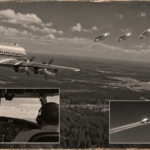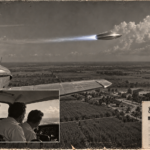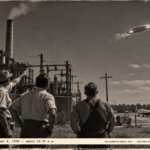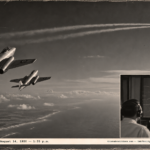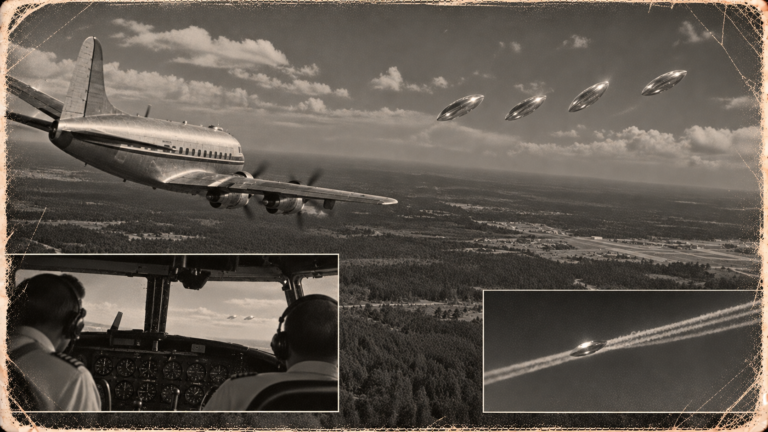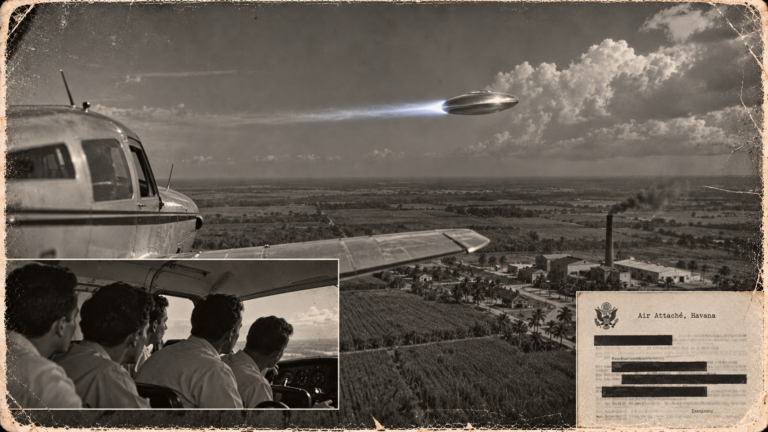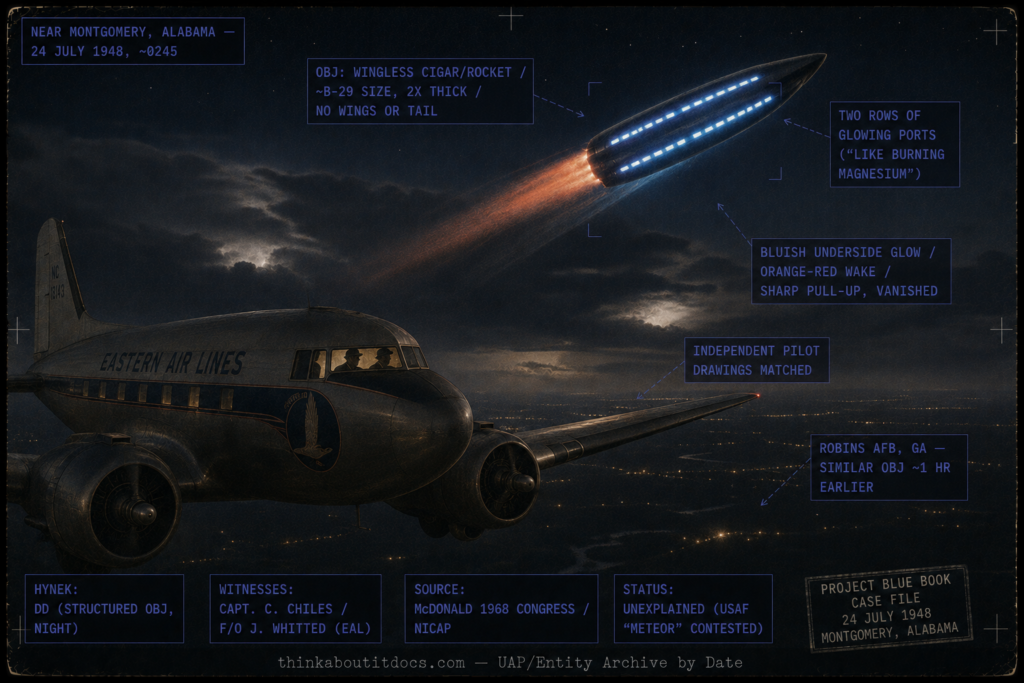
Two Eastern Air Lines pilots meet a wingless, port-windowed craft head-on over Alabama, July 24, 1948 — the 1948 case whose official "meteor" explanation breaks against the evidence.
THINK ABOUTIT UFO SIGHTING REPORT
1948: The Chiles-Whitted Case
At a quarter to three on the morning of July 24, 1948, an Eastern Air Lines DC-3 was droning over Alabama at 5,000 feet when a red glow appeared dead ahead and closed on the airliner in seconds. Captain Clarence Chiles banked hard left as the thing flashed down the starboard side — a wingless, torpedo-shaped craft about the size of a B-29 but twice as thick, with a pointed nose, a soft blue glow running its underside, an orange-red wake trailing behind, and two rows of windows or ports blazing a light “like burning magnesium.” Then it pulled up sharply and was gone. Both pilots were combat-seasoned professionals with thousands of hours; both drew what they saw, independently, and the drawings matched. An hour earlier, a ground crewman at Robins Air Force Base in Georgia had watched a rocket-like object streak overhead on the same line. The Air Force first logged it as Unidentified, then — years later — quietly downgraded it to “meteor.” The scientist who interviewed both pilots and took the case to Congress thought that explanation was, on the evidence, impossible.
Date: July 24, 1948 (Project Blue Book — “BBU”)
Sighting Time: ~2:45 a.m.
Day/Night: Night
Location: Near Montgomery, Alabama (Eastern Air Lines DC-3 in flight, Houston–Atlanta route)
Urban or Rural: In the air (over Alabama)
No. of Entity(‘s): None reported
Entity Type: Not applicable — no occupants or entities
Entity Description: Not applicable
Hynek Classification: DD (Daylight Disc category, applied here to a structured craft despite the night hour; the case is the canonical DD/structured-object airline sighting). Strictly a nocturnal structured-object observation; logged DD per established usage with the night timing noted.
Duration: Several seconds (rapid approach, pass, and pull-up)
No. of Object(s): 1
Description of the Object(s): A wingless, cigar- or “rocket-shaped” craft with a pointed nose, roughly the size of a B-29 but about twice as thick. Two rows of windows or openings emitted a brilliant glow “like burning magnesium”; a bluish glow ran along the underside from nose to rear; an orange-red exhaust/wake trailed from the rear about one body-length. No wings or tail surfaces (empennage) were seen. It approached head-on, passed off the starboard wing, pulled up sharply, and (per co-pilot Whitted) vanished instantaneously after a fast vertical ascent.
Shape of Object(s): Wingless cigar / rocket / torpedo
Size of Object(s): Approximately B-29 size, perhaps twice as thick (rough impression; true distance uncertain)
Color of Object(s): Dark body with bluish underside glow, brilliant white “burning magnesium” light from the port rows, orange-red trailing wake
Distance to Object(s): Disputed by the witnesses — one estimated under 1,000 ft off the starboard wing, the other several times that
Height & Speed: DC-3 at ~5,000 ft; object at roughly the same altitude, closing very fast head-on, then an abrupt steep pull-up and rapid vertical climb
Number of Witnesses: 2 primary (Capt. Clarence S. Chiles and First Officer John B. Whitted), plus reported sleeping passengers (at least one passenger reportedly glimpsed the light); partial independent corroboration at Robins AFB, Georgia ~1 hour earlier
Special Features/Characteristics: Two highly experienced airline pilots (Chiles ~8,500 hrs, both WWII military fliers); independent matching drawings; structured craft with rows of “ports”; possible wake-rocking of the DC-3 (uncertain, masked by Chiles’ evasive turn); abrupt instantaneous disappearance; same-night Robins AFB ground sighting on a consistent track; part of a recurring “wingless cigar with glowing ports/wake” report type (Puckett 1946 Tampa; others); officially reclassified by the USAF from Unidentified to Meteor following Donald Menzel’s argument
Case Status: Unexplained (officially downgraded to “Meteor” by the Air Force after 1963, but the meteor explanation is strongly contested on the evidence — large azimuth change, structured detail, and a non-ballistic 90° pull-up)
Source: Dr. James E. McDonald, “Prepared Statement on Unidentified Flying Objects,” U.S. House Committee on Science and Astronautics Hearings, 1968 (pp. 42–43), based on McDonald’s own 1968 interviews with both pilots; contemporaneous Atlanta Journal, July 25, 1948; NICAP case file
Summary/Description: At about 2:45 a.m. on July 24, 1948, Eastern Air Lines Flight (DC-3) en route Houston–Atlanta at 5,000 ft near Montgomery, Alabama, was approached head-on by a wingless, cigar-shaped craft emerging from a distant squall area. Captain Clarence Chiles and First Officer John Whitted, both veteran pilots, watched it pass off the starboard side: a B-29-sized, rocket-shaped object with a pointed nose, a bluish underside glow, two rows of brightly glowing ports “like burning magnesium,” and an orange-red trailing wake. It pulled up sharply and disappeared. The pilots independently drew matching images. A ground observer at Robins AFB, Georgia had seen a similar rocket-like object about an hour earlier. The Air Force first listed the case Unidentified, later reclassifying it as a meteor — an explanation Dr. James McDonald, who interviewed both pilots, argued the evidence contradicts.
Related Cases: 1948 Thomas Mantell incident (Kentucky) | 1948 Gorman Dogfight (North Dakota) — completing the 1948 pilot triptych | 1946 Capt. Jack Puckett C-47 sighting (Tampa; similar wingless cigar with ports/wake) | 1948 Robins AFB, Georgia ground sighting (same night) | broader “rocket-shaped craft with luminous ports” report type
DETAILED REPORT
The Chiles-Whitted case is the third of the three landmark 1948 pilot encounters and, on the evidence, the most resistant to conventional explanation. The witnesses were Captain Clarence S. Chiles and First Officer John B. Whitted of Eastern Air Lines, flying a DC-3 from Houston to Atlanta. Both were highly experienced professional aviators with substantial wartime military flying behind them — Chiles alone had some 8,500 flight hours — and both were still flying (by then jets) for Eastern when Dr. James E. McDonald re-interviewed them two decades later to cross-check the record for his 1968 Congressional statement, which remains the authoritative account.
At about 2:45 a.m. near Montgomery, Alabama, cruising at roughly 5,000 feet, the pilots first saw the object emerging from a distant squall line they had been skirting. A red glow caught their eyes; their first thought was a jet whose exhaust might explain the advancing light. But the object came almost directly at them at nearly their own altitude and passed off the starboard wing — the two men disagreed on the miss distance, one judging it under 1,000 feet and the other several times that. What they saw, and agreed on both in 1948 and again in McDonald’s 1968 interviews, was a wingless, cigar- or rocket-shaped vehicle with a pointed nose, roughly the size of a B-29 but perhaps twice as thick. It had no wings and no tail surfaces. Two rows of windows or openings emitted a brilliant glow the pilots compared to burning magnesium; a bluish glow ran along the underside from nose to tail; and an orange-red exhaust or wake streamed from the rear, extending back about one body-length. As it passed, Chiles instinctively threw the DC-3 into a left turn; there is some uncertainty in the record as to whether the airliner was rocked by a wake, an effect that would have been masked by the evasive maneuver. Both men saw the object pass aft and pull up sharply; only Whitted, on the right, saw the end of it — and he was emphatic to McDonald that the object did not recede into the cloud deck above but vanished instantaneously after a short, fast vertical climb.
The case carries unusually good corroboration for its era. The two principal witnesses were credentialed and consistent, and they produced independent drawings that closely matched each other. At least one passenger reportedly glimpsed the bright light as it passed. And roughly an hour earlier, ground personnel at Robins Air Force Base in Georgia had watched a rocket-like object shoot overhead on a westerly track consistent with the airliner’s sighting. McDonald further situated the report within a recognizable pattern: Air Force Captain Jack Puckett, flying a C-47 near Tampa on August 1, 1946, described a long cylindrical object “approximately twice the size of a B-29 with luminous portholes” trailing fire, seen also by his co-pilot and flight engineer; similar wingless-cigar-with-ports reports recur in the record (a 1956 TWA case over New Orleans; a 1953 daylight bullet-shaped object over Truk; others). The morphology was not unique to Chiles and Whitted.
The explanatory history is the crux. The Air Force initially carried the case as Unidentified. Astronomer Donald Menzel proposed first a mirage and then, in successive books, a meteor — ultimately suggesting a Delta Aquarid fireball — and the official classification was changed from “Unidentified” to “Meteor” following Menzel’s 1963 discussion. McDonald, who specialized in scrutinizing exactly these analyses, considered the meteor explanation untenable on several grounds, and his objections are substantive rather than rhetorical: the large change in azimuth of the pilots’ line of sight as the object approached and passed is not how a distant fireball behaves; there was no obvious light source to account for the detailed structure (the two rows of ports, the defined nose, the body) the experienced witnesses described; the sharp, essentially 90-degree pull-up is non-ballistic and unlike any meteor trajectory; the radiant of the Delta Aquarid stream lay more than 90 degrees from the object’s origin point; and bright fireballs are, with rare exceptions, not characteristic of that meteor stream. A horizontally-moving fireball beneath a 5,000-foot cloud deck, exhibiting two rows of structured lights and then executing a vertical pull-up, McDonald noted, would be a very strange fireball indeed.
The honest reading is that this is a structured-object airline case that the best conventional candidate — a meteor — does not comfortably fit. The mirage hypothesis fails on the azimuth change and structural detail; the meteor hypothesis fails on geometry, structure, the pull-up, and the radiant. The principal limitation is the brevity of the encounter (a few seconds) and the witnesses’ own uncertainty about distance, which makes size and speed rough impressions rather than measurements. But the witness quality, the matching independent drawings, the partial ground corroboration, and the failure of the offered prosaic explanations leave the case genuinely open.
RESEARCHER’S NOTES
The Rocket With Two Rows of Ports — Chiles-Whitted 1948 and the Meteor That Doesn’t Fit
- Classification Basis: The case is carried as DD (the canonical structured-object airline sighting), though strictly it was a nocturnal observation at 2:45 a.m. of a structured, self-luminous craft — an NL/DD-boundary case in which the structure (rows of ports, defined nose, body, wake) rather than a mere point of light is what was reported. DD is retained per established usage for this famous case, with the night timing noted. No Close Encounter category applies: there was a near pass but no landing, occupants, or confirmed physical trace (the possible wake-rocking is unresolved).
- Source Assessment (Strong): This is a high-tier source chain. The authoritative account is Dr. James McDonald’s 1968 prepared statement to the U.S. House Committee on Science and Astronautics, based on his own re-interviews of both named, credentialed pilots, supported by the contemporaneous Atlanta Journal (July 25, 1948) and the NICAP file. The witnesses are experienced professional aviators; their independent drawings match; and there is partial independent corroboration from Robins AFB the same night. Under the archive hierarchy this sits firmly in the primary/strong band.
- The Explanation Fight — Why “Meteor” Is Contested: The official downgrade from Unidentified to Meteor rests on Donald Menzel’s analysis, and McDonald’s rebuttal is the stronger of the two on the specifics. A meteor explanation must account for: (1) the large azimuth change of the line of sight, atypical of a distant fireball; (2) the detailed structure — two rows of ports, a defined nose and body — reported by trained observers, with no light source to manufacture such an illusion; (3) the sharp ~90° pull-up, which is non-ballistic; and (4) the Delta Aquarid radiant lying >90° from the object’s origin, with bright fireballs uncharacteristic of that stream. Menzel’s account does not meet these; the reclassification reads as a resolution by authority rather than by evidence. (A bright Delta Aquarid-season fireball remains the strongest conventional candidate and cannot be excluded with certainty given the few-second duration — but it is a poor fit, and the archive does not adopt it as settled.)
- Pattern Context: Chiles-Whitted completes the 1948 pilot triptych with Mantell (January) and Gorman (October), but stands apart from the other two: where Mantell and Gorman resolve most credibly to balloons, Chiles-Whitted resists its offered prosaic explanation. It also anchors a distinct morphological class — the wingless cigar/rocket with luminous portholes and a trailing wake — exemplified by the 1946 Puckett C-47 case and recurring through the 1950s. This recurrence cuts two ways: it lends the description a certain consistency across independent witnesses, while also raising the possibility of a shared (if unidentified) stimulus or a shared perceptual template among pilots.
- Physical Evidence and Evidentiary Weight: There is no physical evidence — no photograph, no radar, no recovered trace; the possible wake-buffeting is unconfirmed. The weight rests on two credentialed, consistent, independently-corroborated eyewitnesses with matching drawings, plus a same-night ground sighting, set against conventional explanations (mirage, meteor) that fail on specific, articulable grounds. That combination supports Unexplained as the archive’s standing, with the official “Meteor” reclassification recorded as contested rather than accepted.
Chiles-Whitted is the 1948 pilot case that did not resolve. Two veteran Eastern Air Lines aviators, head-on with a wingless, B-29-sized rocket-shaped craft trailing fire and blazing from two rows of ports, banked away at 5,000 feet over Alabama and then drew, independently, the same machine — with a ground crew at Robins AFB having watched a matching object cross the sky an hour before. The Air Force first called it Unidentified, then downgraded it to “meteor,” but the scientist who interviewed both pilots showed that a meteor cannot account for the azimuth change, the structured detail, the wrong radiant, or the sharp vertical pull-up. The archive holds the case as DD (a nocturnal structured-object sighting), Case Status Unexplained, with the official meteor reclassification noted as contested. Of the three great 1948 pilot encounters, it is the one whose best conventional explanation breaks against the evidence — and the one, accordingly, that remains most genuinely open.
Full Report
Another one of the famous airline sightings of earlier years is the Chiles-Whitted Eastern Airlines case (Refs. 3, 5, G, 10, 23, 24, 25, 26). An Eastern DC-3, en route from Houston to Atlanta, was flying at an altitude of about 5,000 ft.. near Montgomery at 2:45 a.m. The pilot, Capt. Clarence S. Chiles, and the co-pilot, John B. Whitted, both of whom now fly jets for Eastern, were experienced fliers (for example, Chiles then had 8500 hours in the air, and both had wartime military flying duty behind them.). I interviewed both Chiles and Whitted earlier this year to crosscheck the many points of interest in this case. Space precludes a full account of all relevant details.
Chiles pointed out to me that they first saw the object coming out of a distant squall line area which they were just reconnoitering. At first, they thought it was a jet, whose exhaust was somehow accounting for the advancing glow that had first caught their eyes. Coming almost directly at them at nearly their flight altitude, it passed off their starboard wing at a distance on which the two men could not closely agree: one felt it was under 1000 ft., the other put it at several times that. But both agreed, then and in my 1968 interview, that the object was some kind of vehicle. They saw no wings or empennage, but both were struck by a pair of rows of windows or some apparent openings from which there came a bright glow “like burning magnesium.”
The object had a pointed “nose”, and from the nose to the rear along its underside, there was a bluish glow. Out of the rear end came an orange-red exhaust or wake that extended back by about the same distance as the object’s length. The two men agreed that its size approximated that of a B-29, though perhaps twice as thick. Their uncertainty as to true distance, of course, renders this only a rough impression.
There is uncertainty in the record, and in their respective recollections, as to whether their DC-3 was rocked by something like awake. The perception of such an effect would have been masked by Chiles’ spontaneous reaction of turning the DC-3 off to the left as the object came in on their right. Both saw it pass aft of them and do an abrupt pull-up; but only Whitted, on the right side, saw the terminal phase in which the object disappeared after a short but fast vertical ascent. By “disappeared”, Whitted made clear to me that he meant just that; earlier interrogations evidently construed this to mean “disappeared aloft” or into the broken cloud deck that lay above them. Whitted said that was not so; the object vanished instantaneously after its sharp pull-up. (This is not an isolated instance of abrupt disappearance. Obviously I cannot account for such cases.)
Discussion. This case has been the subject of much comment over the years, and rightly so. Menzel (Ref. 24) first proposed that this was a “mirage”, but gave no basis for such an unreasonable interpretation. The large azimuth-change of the pilots’ line of sight, the lack of any obvious light source to provide a basis for the rather detailed structure of what was seen, the sharp pull-up, and the high flight altitude involved all argue quite strongly against such a casual disposition of the case. In his second book, Menzel (Ref. 25) shifts to the explanation that they had obviously seen a meteor. A horizontally-moving fireball under a cloud-deck, at 5000 ft., exhibiting two rows of lights construed by experienced pilots as ports, and finally executing a most non-ballistic 90-degree sharp pull-up, is a strange fireball indeed. Menzel’s 1963 explanation is even more objectionable, in that he implies, via a page of side-discussion, that the Eastern pilots had seen a fireball from the Delta Aquarid meteor stream. As I have pointed out elsewhere (Ref. 2), the radiant of that stream was well over 90-degrees away from the origin point of the unknown object. Also, bright fireballs are, with only rare exceptions, not typical of meteor streams. The official explanation was shifted recently from “Unidentified” to “Meteor”, following the publication of Menzel’s 1963 discussion (see Ref. 20, p.88).

Chile’s drawing

Whitted’s drawing

Chiles-Whitted Drawings

Wingless, cigar-shaped, or “rocket-shaped” objects, some emitting glowing wakes, have been reported by other witnesses. Thus, Air Force Capt. Jack Puckett, flying near 4000 ft. over Tampa in a C-47 on August 1, 1946 (Ref. 10, p.23), described seeing “a long, cylindrical shape approximately twice the size of a B-29 with luminous portholes”, from the aft end of which there came a stream of fire as it flew near his aircraft.
Puckett states that he, his copilot, Lt. H. F. Glass, and the flight engineer also saw it as it came in to within an estimated 1000 yards before veering off. Another somewhat similar airborne sighting, made on January 22, 1956, by TWA Flight Engineer Robert Mueller at night over New Orleans, is on record (Ref. 27).
Still another similar sighting is the AAL case cited below (Sperry case). Again, over Truk Is., in the Pacific, a Feb. 6, 1953, mid-day sighting by a weather officer involved a bullet-shaped object without wings or tail (Ref. 7, Rept. No.10). Finally, within an hour’s time of the Chiles-Whitted sighting, Air Force ground personnel at Robins AFB, Georgia, saw a rocket-like object shoot overhead in a westerly direction (Refs. 3, 5, 10, 6). In none of these instances does a meteorological or astronomical explanation suffice to explain the sightings.
Atlanta Journal, July 25, 1948
Source: Dr. James E. McDonald, Prepared Statement on Unidentified Flying Objects, Page 42-43, Hearings, 1968.