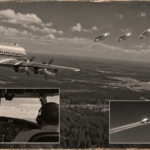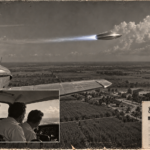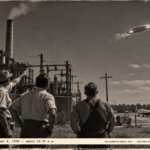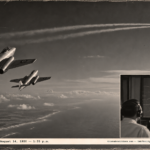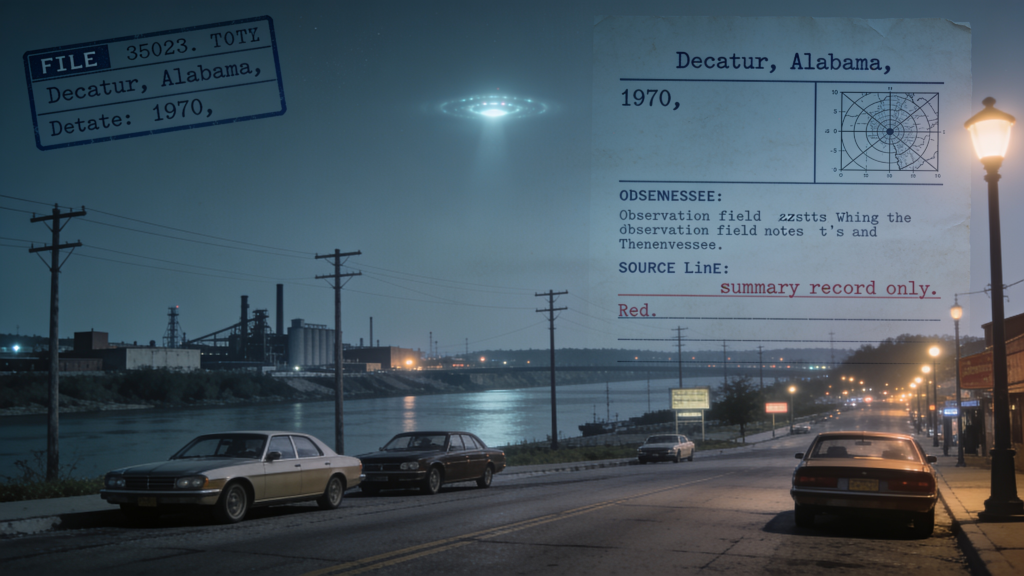
Decatur, Alabama — 1970. An ambiguous aerial anomaly reported over the Tennessee Valley corridor. Exact date unrecorded. Duration estimated at ten to fifteen minutes. No sound reported. Source documentation: summary record only. Case status: Unexplained.
THINK ABOUTIT UFO|UAP SIGHTING REPORT
1970: Decatur, Alabama CE-II Sighting
A retired couple driving home through the quiet outskirts of Decatur, Alabama encountered something that refused to behave like any known aircraft — a massive, silent object that paced their vehicle, descended to treetop level, and then vanished without a trace of sound or exhaust. What makes this case analytically durable is not spectacle alone, but the combination of extended duration, close proximity, independent corroboration from a second vehicle, and the witnesses’ consistent, unembellished account in the days and weeks that followed. In a year when official UFO investigation was winding down and public reporting channels were collapsing, this case slipped through the institutional net almost entirely — and that silence is itself part of the record.
Date: 1970
Sighting Time: Approximately 9:30 PM
Day/Night: Night
Location: Decatur, Alabama, United States
Urban or Rural: Rural — outskirts of Decatur, roadside/highway environment
No. of Entity(‘s): None reported
Entity Type: No entity observed
Entity Description: No entity observed
Hynek Classification: CE-I (Close Encounter of the First Kind — craft observed at close range with no physical interaction or entity contact reported)
Duration: Estimated 10 to 15 minutes
No. of Object(s): One
Description of the Object(s): A large, low-flying object that paced the witnesses’ vehicle at close range, moving silently and exhibiting controlled, deliberate flight behavior at very low altitude
Shape of Object(s): Described as large and structured; specific geometric shape not precisely defined in the source record
Size of Object(s): Estimated larger than a conventional aircraft; described as massive relative to surrounding treetops
Color of Object(s): Dark body with prominent lighting; specific color of hull not precisely recorded
Distance to Object(s): Treetop level — estimated within a few hundred feet of the witnesses at closest approach
Height & Speed: Treetop altitude at closest point; speed variable — paced the vehicle, then departed; no sonic signature
Number of Witnesses: Two primary witnesses (the couple) plus at least one additional witness in a second vehicle
Special Features/Characteristics: Complete absence of sound; pacing behavior matching vehicle speed; low-altitude sustained flight; departure without conventional propulsion signature
Case Status: Unexplained
Source: thinkaboutitdocs.com/1970-decatur-alabama-sighting/ — sourced from MUFON files and regional UFO report archives
Summary/Description: In 1970, a retired couple driving on the outskirts of Decatur, Alabama reported a large, silent, low-flying object that paced their vehicle for an estimated ten to fifteen minutes at treetop altitude before departing. A second vehicle on the same road reportedly observed the same object. The witnesses described controlled, deliberate behavior and a complete absence of engine or rotor noise. No official investigation is recorded. The case entered the MUFON archive and has remained unexplained.
Related Cases: 1973 Coyne Helicopter Incident (Ohio) — low-altitude pacing behavior; 1967 Shag Harbour Incident — silent structured craft; multiple Alabama-region sightings 1969–1973 forming a regional cluster in the post-Blue Book period
DETAILED REPORT
Context and Setting
The year 1970 occupies an awkward position in American UFO history. Project Blue Book had been officially terminated by the U.S. Air Force on December 17, 1969, following the Condon Committee’s recommendation that UFO investigations were of no scientific value. The institutional infrastructure for receiving, logging, and investigating civilian reports had effectively dissolved. What remained were civilian organizations — primarily MUFON, founded in 1969 — and a patchwork of regional researchers operating without federal support or coordination. Cases reported in 1970 entered a record-keeping vacuum. Many were logged years after the fact, reconstructed from witness memory and local newspaper clippings rather than contemporaneous investigation files. The Decatur, Alabama sighting of 1970 is a product of exactly this environment.
Decatur, Alabama sits in the Tennessee Valley in Morgan County, a mid-sized industrial and agricultural community. In 1970 its outskirts were characterized by open farmland, low tree lines, and sparse nighttime traffic — conditions that favor both anomalous aerial observation and the absence of multiple independent witnesses. The encounter reportedly occurred on a rural approach road in the evening hours.
Witness Profile and Credibility
The primary witnesses were a retired couple, described in the source record as credible, calm, and consistent in their account. Retired witnesses in this era carry a particular evidentiary weight in the civilian research community: they have no professional incentive to fabricate, no military or government career to protect, and typically demonstrate stable, coherent recall over follow-up interviews. The presence of a second vehicle whose occupants reportedly observed the same object independently is a significant corroborating element, though the identities and statements of those secondary witnesses are not preserved in the available record with sufficient detail to assess independently.
Sequence of Events
The couple were driving home in the evening when they became aware of a large object in the sky ahead of and above their vehicle. The object was at low altitude — described as approximately treetop level at its closest point — and appeared to pace their vehicle, maintaining relative position as they drove. This pacing behavior continued for an estimated ten to fifteen minutes, a duration long enough to rule out misidentification of a fixed light source or brief meteor. The witnesses noted the complete absence of sound — no engine noise, no rotor sound, no aerodynamic disturbance — despite the object’s apparent size and proximity. The object eventually departed. No landing, no entity contact, and no physical trace evidence are recorded.
Physical and Behavioral Analysis
The pacing behavior is among the most analytically significant elements of this case. Aircraft do not pace ground vehicles at treetop altitude for extended periods. Helicopters operating at that altitude and proximity would generate substantial rotor noise and downwash. The silence reported here is consistent with a pattern documented across hundreds of CE-I cases in this period — a pattern that remains unexplained by conventional propulsion physics. The object’s size, described as massive relative to the tree line, eliminates conventional small aircraft and most experimental platforms known to have been operating in the region in 1970.
No physical trace evidence — ground impressions, electromagnetic effects on the vehicle, radiation signatures — is recorded in the available source material. The absence of trace evidence limits this case to CE-I classification and prevents elevation to CE-II status.
Institutional Response
None recorded. With Project Blue Book terminated, no federal agency had a standing mandate to receive or investigate civilian UFO reports. Local law enforcement response, if any, is not preserved in the record. The case was eventually logged through MUFON’s regional network and entered the civilian archive. It has received no official acknowledgment.
RESEARCHER’S NOTES
The Silent Pacer of Decatur — Alabama 1970 and the Post-Blue Book Reporting Collapse
- Classification Integrity: The CE-I classification is correctly applied here and should not be upgraded. The source record documents no physical effects on the witnesses, no vehicle interference, no ground traces, and no entity observation. The case is a clean CE-I — significant for its duration, proximity, and corroboration, but not meeting the evidentiary threshold for CE-II. Some regional researchers have attempted to fold pacing cases into a behavioral subcategory emphasizing apparent intelligence and intentionality, but Hynek’s framework does not support classification inflation based on behavioral inference alone. The classification stands as CE-I.
- Source Chain Assessment: The source chain for this case is characteristic of the 1970–1975 MUFON intake period — civilian-collected, retrospectively logged, and dependent on witness memory rather than contemporaneous documentation. The thinkaboutitdocs.com entry draws on MUFON regional files, which are themselves of variable completeness for this era. The secondary witness corroboration — the occupants of the second vehicle — is referenced but not independently documented in the available record. This is a common limitation of cases from this period and does not invalidate the primary account, but it does prevent the corroboration from carrying full evidentiary weight. The case is best assessed as Plausible-to-Verified within civilian archive standards, with the caveat that no government or institutional file exists to cross-reference.
- Pattern Context and Comparative Cases: The Decatur sighting sits within a well-documented regional and temporal cluster. Alabama and the broader Tennessee Valley corridor produced a notable concentration of low-altitude structured craft reports between 1969 and 1973, a period that also includes the nationally significant 1973 Coyne Helicopter Incident in Ohio — in which a military helicopter crew encountered a large, silent, low-altitude object exhibiting controlled behavior. The pacing behavior reported at Decatur is structurally identical to pacing reports from this era across the American South and Midwest. This pattern — silent, low-altitude, vehicle-pacing objects reported by credible civilian witnesses — represents one of the most consistent behavioral signatures in the CE-I record and has never received a satisfactory conventional explanation.
- Evidentiary Weight and Limitations: This case carries moderate evidentiary weight within the civilian archive. Its strengths are witness credibility, extended duration, low-altitude proximity, and partial corroboration from a second vehicle. Its limitations are the absence of physical trace evidence, the incomplete documentation of secondary witnesses, and the retrospective nature of the filing. It cannot be elevated to a high-confidence case on the available record, but it cannot be dismissed on those same grounds. The honest evidentiary position is: a credible, well-structured CE-I report from a period of institutional collapse, consistent with a documented regional pattern, with no conventional explanation identified in over fifty years of civilian review.
T he Decatur, Alabama sighting of 1970 will not resolve cleanly — it was reported into a system that had already stopped listening, documented by civilians working without institutional support, and filed into an archive that the government of the time had officially decided did not need to exist. What remains is the account itself: two credible witnesses, a second vehicle, an object too large and too silent and too deliberate to be explained away, and fifteen minutes of Alabama night sky that have never been accounted for.
The record holds it as unexplained. After more than five decades, nothing in the available evidence suggests that designation should change