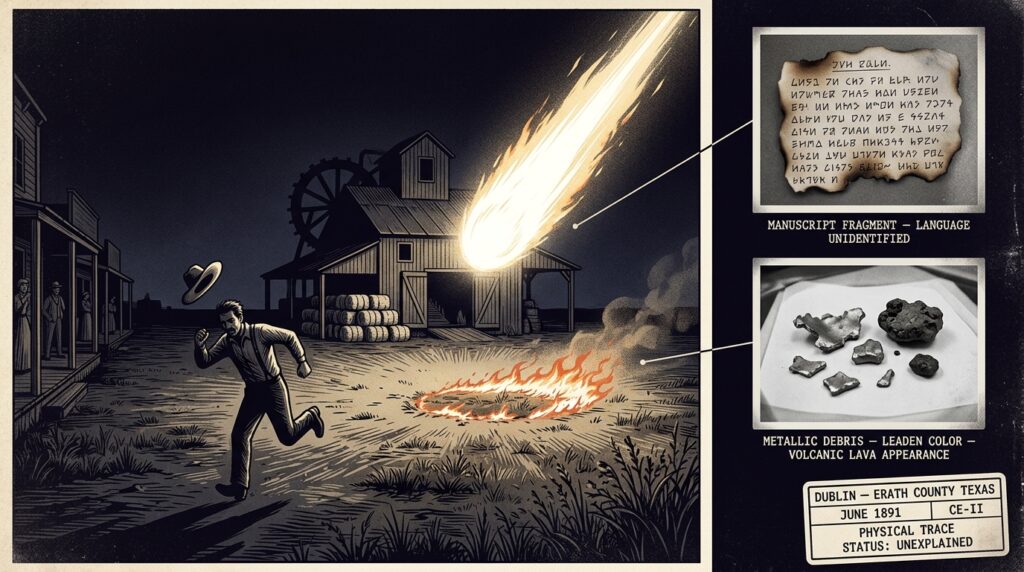
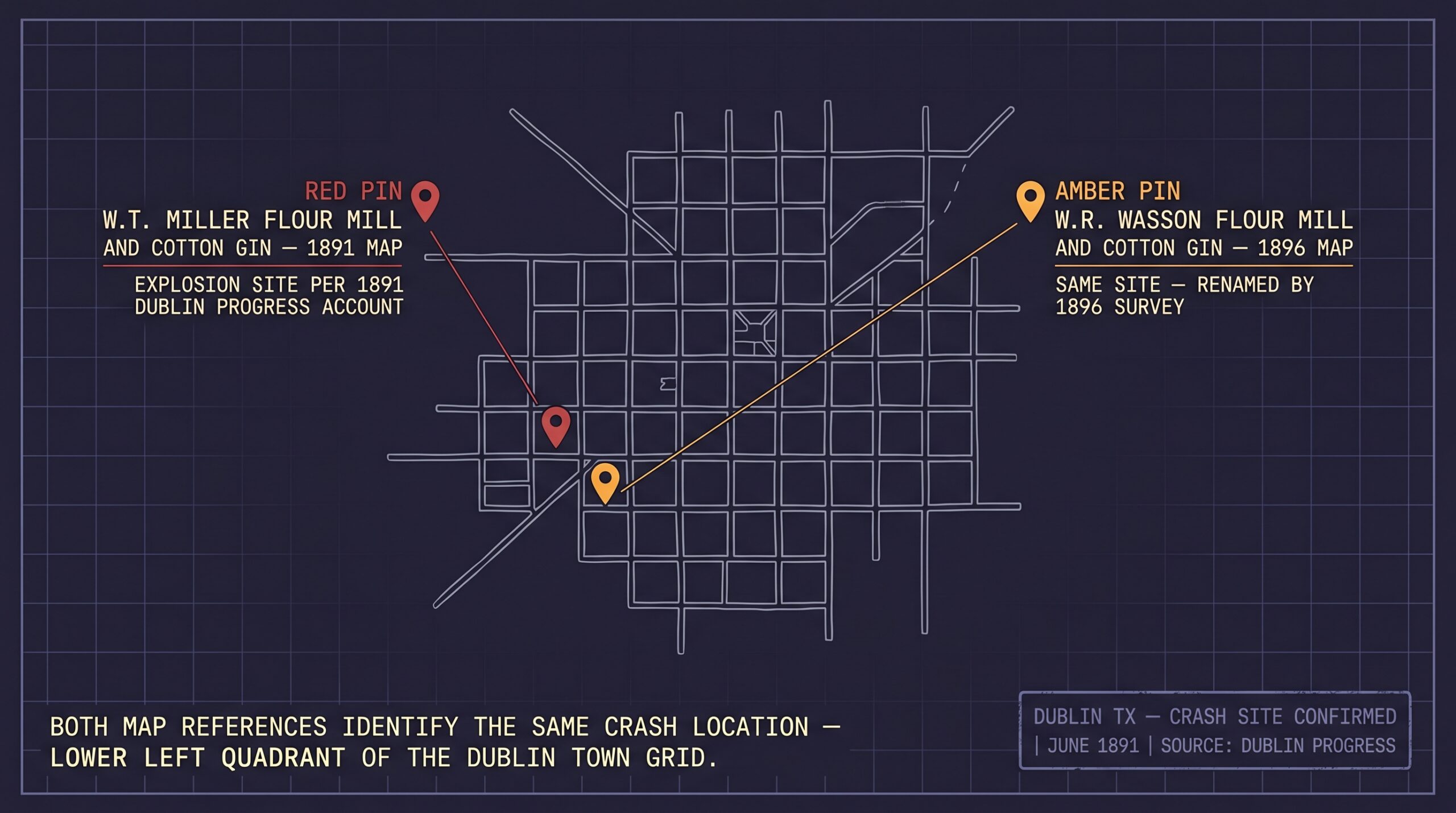
Dublin, Erath County, Texas, June 1891 — a dazzling object exploded near Wasson and Miller's Gin leaving burned vegetation, metallic debris, and manuscript fragments in a language no one could identify. Reported by the Dublin Progress, June 20th, 1891. Case status: Unexplained.
THINK ABOUTIT CRASH REPORT
1891: UFO Crash in North Texas
On a Saturday night in June 1891, something dazzling — described as a bale of cotton soaked in kerosene and set alight, except far brighter — came down over Dublin, Texas and exploded near Wasson and Miller’s gin with a sound like a bomb shell. The eyewitness ran. The next morning he came back and found everything burned to the ground for many yards in every direction. He also found metallic debris of a leaden color, stones resembling volcanic lava, and — most significantly — fragments of manuscript and what appeared to be part of a newspaper, both in a language no one in Dublin had ever seen, that no one who examined them could identify, and that no scholar was ever found who could read. The Dublin Progress published the account on June 20th, 1891. The debris was in someone’s hands. Then it was not.
Date: Saturday night, June 1891 — published Dublin Progress, June 20, 1891; event described as last Saturday night
Sighting Time: Night — exact hour not recorded
Day/Night: Night
Location: Near Wasson and Miller’s Gin — Dublin, Erath County, Texas, USA
Urban or Rural: Urban fringe — described as that portion of the city near the gin works; Dublin was a small North Texas town
No. of Entity(‘s): None observed
Entity Type: None
Entity Description: None
Hynek Classification: CE-II (Close Encounter II) — UAP event leaving physical trace evidence; physical debris recovered including metallic fragments, stones, and manuscript material in an unidentified language. Note: the primary event could also be classified as a crash event given the physical debris recovery. CE-II is applied as the closest standard classification for a physical trace case without direct craft observation.
Duration: Visual event — seconds to minutes for the descent and explosion; physical trace investigation the following morning
No. of Object(s): 1
Description of the Object(s): Object observed at more than three hundred feet altitude before detonation; described as bearing a striking resemblance to a bale of cotton suspended in the air after having been saturated in kerosene oil and ignited, except creating a much brighter light, almost dazzling to observers; exploded near ground level with a report described as sounding somewhat like the report of a bomb shell
Shape of Object(s): Bale-like — elongated, suspended; exact shape obscured by luminosity
Size of Object(s): Sufficient to produce widespread ground burn pattern of many yards radius and scatter metallic debris across the site
Color of Object(s): Brilliant white — dazzling luminosity described as significantly brighter than burning kerosene-saturated cotton
Distance to Object(s): Observed from ground level at less than three hundred feet altitude before explosion; witness was at close enough range to be frightened into flight
Height & Speed: Observed descending from above three hundred feet; exploded near ground level; descent speed not recorded
Number of Witnesses: Multiple — a number witnessed the explosion; nearly everyone in that portion of the city heard the report; one primary eyewitness named only as a gentleman who usually tells the truth and is identified as a contributor to the Dublin Telephone
Special Features/Characteristics: Physical burn pattern extending many yards in all directions from explosion point — weeds, grass, bushes, and all vegetation burned to a crisp; metallic debris of a leaden color recovered — described as presenting much the appearance of lava thrown out by volcanic eruptions; stones of similar appearance recovered; most analytically significant — fragments of manuscript and a scrap described as part of a newspaper recovered from the site, both written in a language entirely foreign to the witness and to every person in Dublin who subsequently examined them; no scholar or linguist was found who could identify the language; the Dublin Progress reporter requested to examine the fragments but the witness was too agitated to comply; the postscript to the article notes the information originated with a contributor to the Dublin Telephone, suggesting the account was in circulation before formal publication
Case Status: Unexplained
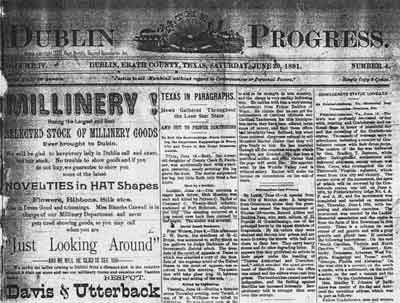
Source: Dublin Progress, June 20, 1891; Dallas Morning News, April 19, 1897
Summary/Description: On a Saturday night in June 1891 a brilliantly luminous object descended over Dublin, Erath County, Texas and exploded near Wasson and Miller’s Gin with a sound described as bomb-like. The following morning the primary witness returned to the site to find all vegetation burned for many yards radius and physical debris including metallic and stone fragments of volcanic lava appearance and — critically — manuscript fragments and what appeared to be newspaper scraps in a completely unidentified language that no person in Dublin and no scholar subsequently consulted could read or identify. The Dublin Progress published the account on June 20th, 1891. The physical debris was in the witness’s possession at time of interview but was not produced for examination. Its subsequent fate is unrecorded. Case status: Unexplained.
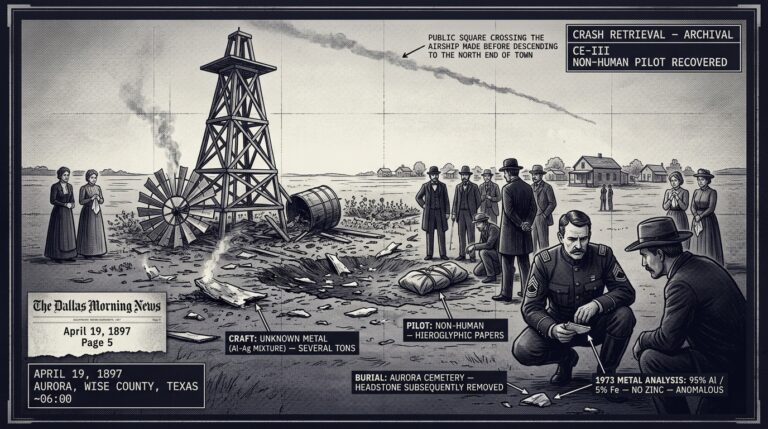
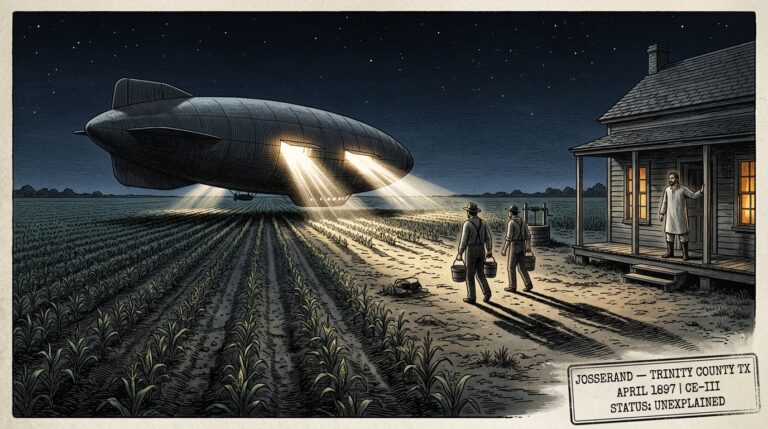
Related Cases: 1897: Aurora, Texas Crash | 1897: Josserand, Texas — Airship Crew Contact | 1897: Hot Springs, Arkansas | Texas Pre-Aviation UAP Archive
Detailed Report
Meteoric Explosion — Near Wasson and Miller’s Gin, Dublin Texas Dublin Progress — June 20, 1891, Page 4
METEORIC EXPLOSION
A Meteor Explodes in the City — An Eye Witness Describes the Scene to a Progress Reporter — Scared.
Quite a little excitement was created last Saturday night by the bursting of what is supposed by those who were present to have been a meteor, near Wasson and Miller’s gin. Quite a number witnessed the explosion and nearly everyone in that portion of the city heard the report emanating therefrom, which is said to have sounded somewhat like the report of a bomb-shell.
Our informant — who, though a little nervous at times, is a gentleman who usually tells the truth, but did not give us this statement with a view to its publication — says he observed the meteor when it was more than three hundred feet in the air, before bursting, and that it bore a striking resemblance to a bale of cotton suspended in the air after having been saturated in kerosene oil and ignited, except that it created a much brighter light, almost dazzling those who perceived it.
The gentleman in question seems to have been so badly frightened that it was utterly impossible to obtain an accurate account of the dimensions and general appearance of this rare phenomenon, but we are convinced from his statements that his position at the time must have been very embarrassing and that very little time was spent in scientific investigations.
However, on the following morning he returned to the scene so hastily left the previous night, to find the weeds, grass, bushes, and vegetation of every description for many yards around the scene of the explosion burned to a crisp, also discovering a number of peculiar stones and pieces of metal, all of a leaden color, presenting much the appearance of the lava thrown out by volcanic eruptions. He also picked up some small fragments of manuscript and a scrap, supposed to be part of a newspaper, but the language in both was entirely foreign to him, and, in fact, no one has yet been found who has ever seen such a language before, hence no information could be gained from their examination.
At this juncture your reporter requested that he be shown these wonderful fragments of such a miraculous whole, but the narrator had worked himself up to such a pitch of excitement that it was impossible to get him to grasp the significance of our request, and were compelled to leave him a victim to his own bewildered fancy and to ruminate the seemingly miraculous story he had just related. This was a reportorial zealot denied the boon of seeing fragments of the most remarkable substance ever known to explode near Wasson and Miller’s gin.
P.S. Since the above was put in type we learn that our reporter was given the above information by a contributor to the Dublin Telephone, but the information came too late to prevent its insertion in this paper.
RESEARCHER’S NOTES
The Language No One Could Read — Dublin Texas 1891 and the Physical Trace Case Six Years Before Aurora
- The Manuscript Fragments as the Evidentiary Core: Every element of the Dublin 1891 account has a conventional explanation available — a brilliant nocturnal object could be a bolide, the explosion could be an airburst, even the metallic debris could be meteoritic material. The manuscript fragments cannot. Meteorites do not carry printed text. Bolides do not deposit newspaper scraps. Whatever descended over Wasson and Miller’s Gin that Saturday night left behind physical written material in a language that no person in Dublin — and no scholar subsequently consulted — could identify or had ever seen. The archive holds this detail as the central evidentiary fact of the case. If the fragments existed as described, they represent the single most significant physical artifact of any 19th century UAP case in the Texas record. If they were fabricated, the fabricator chose the one detail that no journalist of 1891 would invent — because it made the story impossible to verify and therefore professionally dangerous to print.
- Source Chain and the Postscript Problem: The Dublin Progress postscript is analytically significant and underappreciated. The editor noted after going to press that the account originated with a contributor to the Dublin Telephone — a competing local paper — rather than a direct witness interview. This means the Progress reporter was working from a secondhand account at publication. However, the detail level, the specific location, the physical description of the debris, and the reporter’s own frustrated attempt to examine the fragments all suggest direct access to someone who had handled the material. The postscript does not invalidate the account. It establishes that the story was already in circulation in Dublin before formal publication — which argues against fabrication for press purposes and toward an actual event that people in the community were already discussing.
- The Debris Fate — The Missing Physical Record: The primary witness had the manuscript fragments and metallic debris in his possession at the time of the interview. The Progress reporter explicitly requested to examine them and was refused — not because the witness denied having them but because he was too agitated to respond coherently. The fragments existed at that moment. What happened to them afterward is completely unrecorded in available sources. No subsequent examination, no donation to a collection, no reappearance in any Dallas Morning News follow-up coverage is documented. Physical evidence that existed in a named Texas town in June 1891, handled by at least one named witness and known to local journalists, simply drops out of the record. The archive flags this disappearance as significant without speculating about its cause.
- Six Years Before Aurora — The North Texas Pre-Wave Pattern: The Dublin 1891 account predates the 1897 Aurora, Texas crash by six years and predates the Josserand, Texas CE-III contact case by six years. North Texas in the late 19th century produced three of the most significant UAP cases in the pre-aviation American record within a six-year window — a physical debris crash with unidentified language artifacts in 1891, a close contact CE-III with crew in 1897, and a crash with reported non-human occupant in Aurora also in 1897. The archive notes this geographic and temporal clustering without asserting a causal connection. Patterns in the record are data. What they mean is a question the record does not yet answer.
A man in Dublin, Texas picked up pieces of metal and scraps of writing from a burned field on a June morning in 1891 and could not read a word of what was written on them. Nobody in Dublin could. Nobody anywhere could. The Dublin Progress printed the story and moved on. The fragments went somewhere. The language has never been identified. The archive keeps the record and the question open.