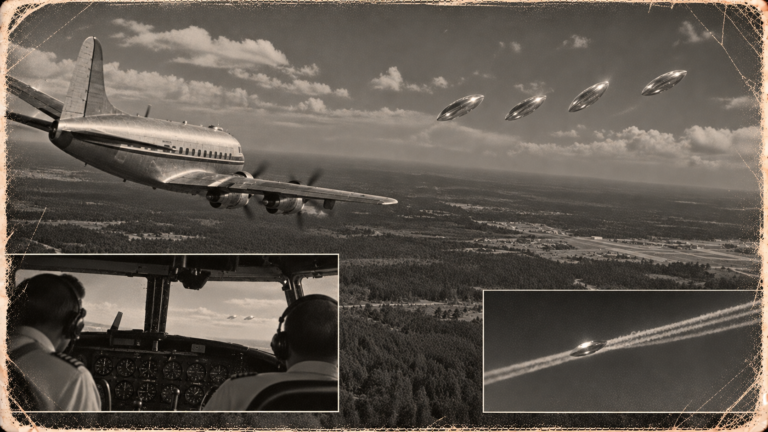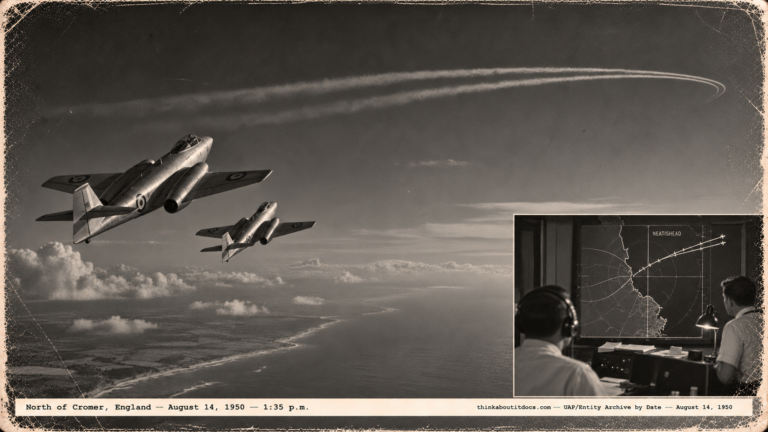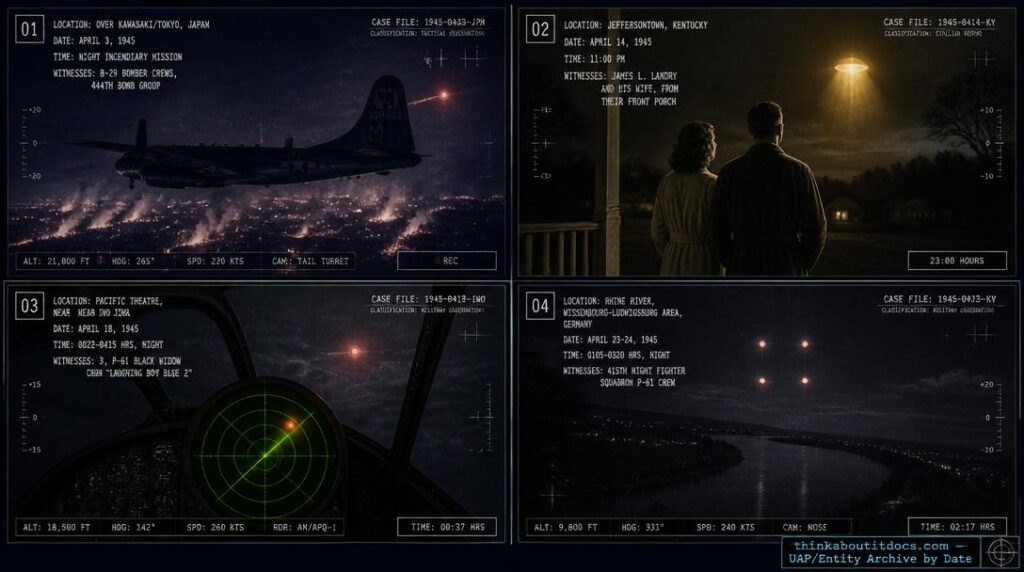
April 1945 — Four anchor cases: RAF-corroborated balls of fire over Kawasaki and Tokyo, a Kentucky civilian's porch sighting, a 549th Night Fighter Squadron radar chase near Iwo Jima, and a vanishing square of lights over the Rhine. thinkaboutitdocs.com.
1945: April UFO & Entity Sightings Archive
April 1945 is the month the “balls of fire” phenomenon crossed from the European theatre to the Pacific in full official force. B-29 crews returning from raids on Kawasaki and Tokyo reported basketball-sized, phosphorescent red spheres pursuing them for up to six minutes at a time — one followed a bomber 30 miles out to sea, and only one crew managed to outrun theirs, and only by pushing to 295 mph. The report reached RAF Fighter Command’s own intelligence summary two months later, an unusual cross-service documentation trail for a phenomenon that had started as European night-fighter slang five months earlier. Closer to home, a Kentucky man wrote his local newspaper about a pulsing light over his farm that “receded in brilliance like a heart throb.” And at the Pentagon, a two-star general was quietly arranging for infrared viewers to be shipped to the XXI Bomber Command to get a real look at whatever was out there.
Date: Apr. 3, 1945
Location: Kawasaki and Tokyo, Japan
Time: Night incendiary mission
Case Status: Unexplained
Summary: The records of the 20th Air Force reveal that as early as this date, flying from the Marianas on a night incendiary mission, some crews reported “Balls of fire followed our aircraft.” Less than two weeks later, after an early morning attack on Tokyo, an intelligence resume notes: “Several balls of fire observed.” This fireball account was related by Richard M. Keenan, member of the 444th Bomb Group, 58th Wing, at West Field on Tinian. An official RAF intelligence summary later corroborated and expanded on the pattern: during a raid on the Tachikawa aircraft plant and the Kawasaki industrial area, multiple Superfortresses reported basketball-sized red balls of fire with phosphorescent glow and blinking tails, appearing from nowhere and matching every evasive maneuver; one bomber outran its pursuer only by accelerating to 295 mph, after which the object turned back; individual pursuits lasted as long as six minutes, and one ball followed a B-29 thirty miles out to sea. [Full Report]
Source: Sky Giants Over Japan: A Diary of a B-29 Combat Crew In WWII, by Chester Marshall, pages 184-185 (article: “A Flashback — Great Balls of Fire”); Headquarters, U.S.A.F.P.O.A. G-2 Periodic Report No. 67, quoted in RAF Fighter Command Intelligence and Operational Summary No. 30, dated 15 May 1945 Source Status: VERIFIED — corroborated by an official Allied intelligence document independently summarizing the same pattern of encounters.
Date: Apr. 3/4, 1945
Location: Honshu, Japan
Time: Unknown
Summary: Multiple balls of fire sightings: one the size of a basketball with a streamer of light behind it; a ball of fire emitting a steady phosphorescent glow; a wing observed in connection with a ball of fire and an amber-colored searchlight; a stream of fire emanating from an object twelve inches in diameter, which followed the aircraft through evasive action.
Source: Undocumented
Date: Apr. 7, 1945
Location: North Sea
Time: Unknown
Summary: A wingless object, able to stop in mid-flight and travel thousands of miles per hour.
Source: Undocumented
Date: Apr. 7, 1945
Location: Nagoya, Japan
Time: Unknown
Summary: Ball of fire changing colors, orange to red.
Source: Undocumented
Date: Apr. 14, 1945
Location: Jeffersontown, Kentucky
Time: 11:00 PM (reported as occurring “Tuesday night”)
Summary: James L. Landry, writing to the Louisville Times, described stepping onto his front porch to see “the most beautiful light I had ever seen” hanging high in the eastern sky, apparently over nearby Fisherville. He described it as roughly the size of a large cantaloupe, glowing and receding in brilliance “like a heart throb,” casting a downward light “like a lamp shade.” It appeared to move toward his house before he and his wife stepped aside, fearing a collision; it went out “like a snuffed candle” after about ten minutes. A neighbor in Jeffersontown had also seen it and believed it was a meteor.
Source: Letter to the editor, Louisville, Kentucky Times, April 14, 1945, signed James L. Landry, Jeffersontown, Ky. Source Status: VERIFIED — primary contemporaneous published source, named witness.
Date: April 17, 1945
Location: Washington, DC (Pentagon)
Time: Unknown
Summary: A memorandum for General H.H. Arnold from Major General James P. Hodges, Assistant Chief of Air Staff, Intelligence, notes: “In connection with the ‘Balls of Fire’ observed in the Pacific Ocean Areas, information has been submitted to the Twentieth Air Force of the development by the Signal Corps of the infra red viewer. This device can reproduce a picture of objects illuminated by an infra red source so that the number and placement of heat sources can be determined. A few of these are available for shipment to the XXI Bomber Command for trial.” A rare piece of documentary evidence that the “balls of fire” reports were being taken seriously enough at the highest levels of Army Air Forces intelligence to warrant deploying specialized detection equipment.
Source: Memorandum for General H.H. Arnold, Major General James P. Hodges, Assistant Chief of Air Staff, Intelligence, 17 April 1945 Source Status: VERIFIED — primary official military document.
Date: April 18, 1945
Location: Pacific theatre (549th Night Fighter Squadron area of operations, near Iwo Jima)
Time: Take-off 0022, landing 0415
Summary: A P-61 Black Widow crew — pilot Lt. F.L. Williams (call sign “Laughing Boy Blue 2”), radar observer Lt. J.H. Richardson, gunner Sgt. S. Forman — was vectored by Ground Control Intercept onto a possible bogie, made radar contact at 7 miles, and pursued for approximately five minutes. The contact repeatedly shifted position relative to the P-61, closing to 2,500 feet at one point before increasing distance again; the crew was ultimately forced to abandon the chase due to fuel shortage. At close range the contact appeared on the radar scope as two blips; the gunner visually confirmed a reddish round light matching the radar operator’s tracked movements.
Source: 549th Night Fighter Squadron Mission Report No. 4-28, 18 April 1945, filed by Lt. Archie Beattie, Assistant Intelligence Officer Source Status: VERIFIED — primary squadron mission report.
Date: April 23/24, 1945
Location: Rhine River, Wissembourg-Ludwigsburg area, Germany
Time: Mission 5, 0105-0320 hrs
Summary: A 415th Night Fighter Squadron P-61 crew on patrol between Wissembourg and Ludwigsburg observed four lights arranged in a square formation over the Rhine River. The lights extinguished as the aircraft approached.
Source: 415th Night Fighter Squadron Mission Reports, recovered from NARA (Suitland, MD) by researcher Barry Greenwood, Citizens Against UFO Secrecy (CAUS), 1992 Source Status: VERIFIED — primary squadron mission report.
Editorial note: Replaces a previously blank placeholder entry on this archive dated simply “April, 1945” with no further detail.
Date: April 23, 1945
Location: Washington, DC
Time: Unknown
Summary: A memorandum for the Secretary of War from General L. R. Groves, “Atomic Fission Bombs,” states: “1. Within four months we shall in all probability have completed the most terrible weapon ever known in human history, one bomb of which could destroy a whole city…. 5. The world in its present state of moral advancement compared with its technical development would be eventually at the mercy of such a weapon. In other words, modern civilization might be completely destroyed.”
Source: Undocumented
Editorial note: Not a UFO sighting; retained as historical context, consistent with this archive’s practice of including directly adjacent atomic-program milestones (see also the September 1944 Oak Ridge entry, 1944 archive) alongside the UFO record of the same period.
EXECUTIVE SUMMARY
April 1945 — The Balls of Fire Go Official in the Pacific
The month’s anchor case is Kawasaki and Tokyo, April 3 — not because it’s the most dramatic entry in the archive, but because it’s one of the best cross-corroborated. What survives as a single named veteran’s account (Richard Keenan, via Chester Marshall’s B-29 memoir) turns out to be independently backed by an actual RAF Fighter Command intelligence summary quoting a U.S. Army Air Forces Pacific G-2 report — official language describing basketball-sized phosphorescent red spheres that matched every evasive maneuver a B-29 could make, with individual pursuits running up to six minutes and one object trailing a bomber thirty miles out to sea. Two weeks later, a Pentagon memo shows Major General James P. Hodges quietly arranging to ship infrared viewers to the XXI Bomber Command specifically to get a technical read on the phenomenon — proof this wasn’t dismissed as aircrew nerves at the highest levels of Army Air Forces intelligence.
The European front kept producing its own late-war entries: a 415th Night Fighter Squadron P-61 crew watched four lights arranged in a precise square over the Rhine near Wissembourg extinguish themselves the moment the aircraft closed in, while in the Pacific, a 549th Night Fighter Squadron crew chased an unidentified radar contact for five minutes before running low on fuel. And on the home front, a Kentucky man’s letter to his local paper — describing a cantaloupe-sized light that “receded in brilliance like a heart throb” — stands as a reminder that April 1945’s record wasn’t confined to combat theatres. This revision also replaces a blank placeholder entry with the dated, sourced Rhine River case it likely represented.
“No amount of evasion of the most violent nature succeeded in shaking the balls. They succeeded in following the Super-Fortresses through rapid changes of altitude and speed and sharp turns, and held B-29s’ courses through clouds. One B-29 reported outdistancing a ball only by accelerating to 295 mph, after which the pursuing ball turned around and headed back to land.”
Headquarters, U.S.A.F.P.O.A. G-2 Periodic Report No. 67, quoted in RAF Fighter Command Intelligence and Operational Summary No. 30, 15 May 1945, describing the Kawasaki/Tokyo balls of fire.