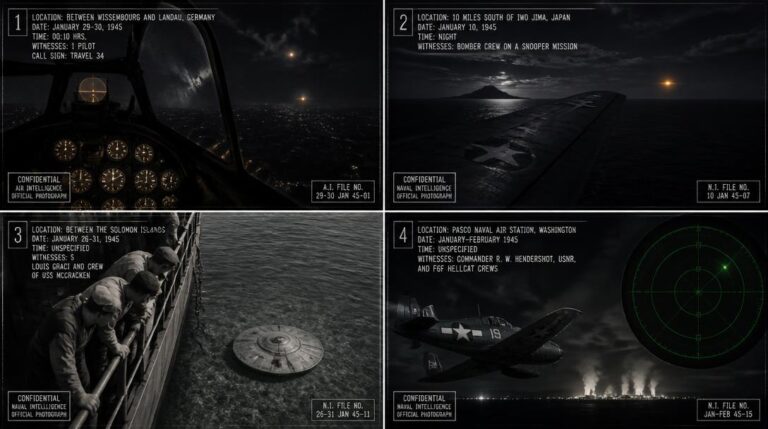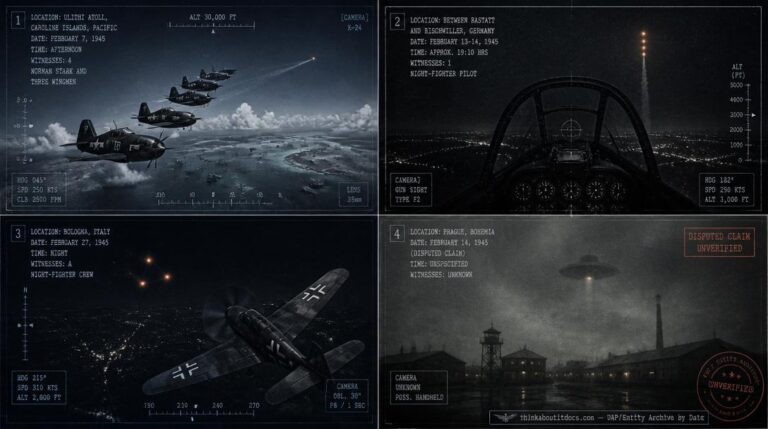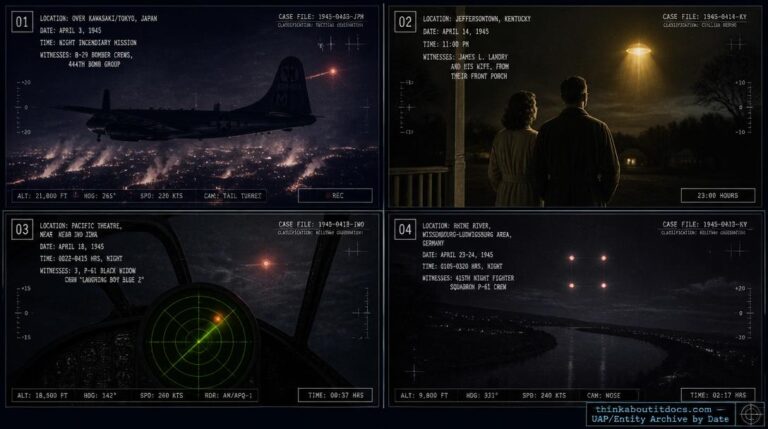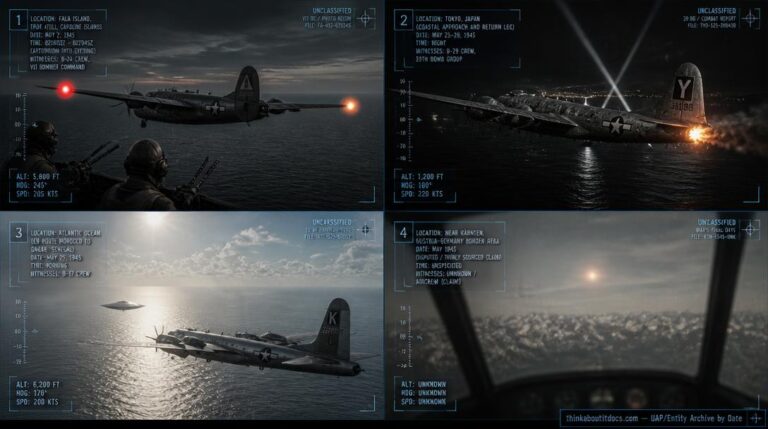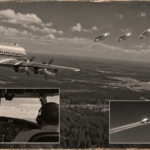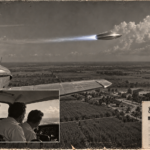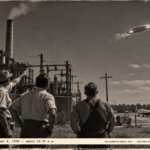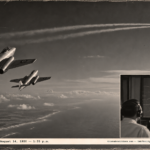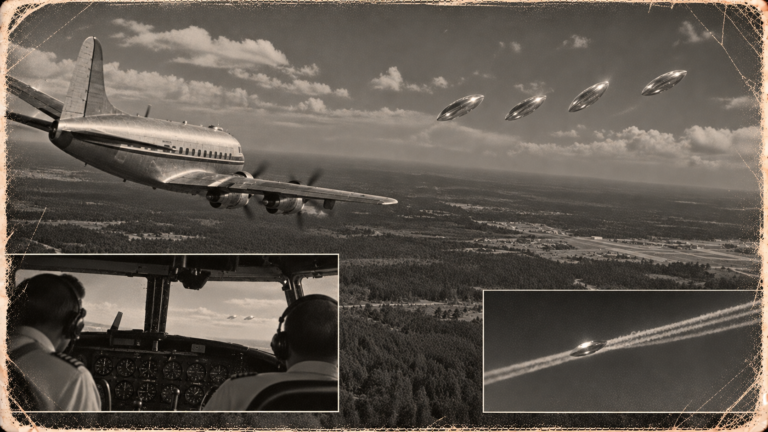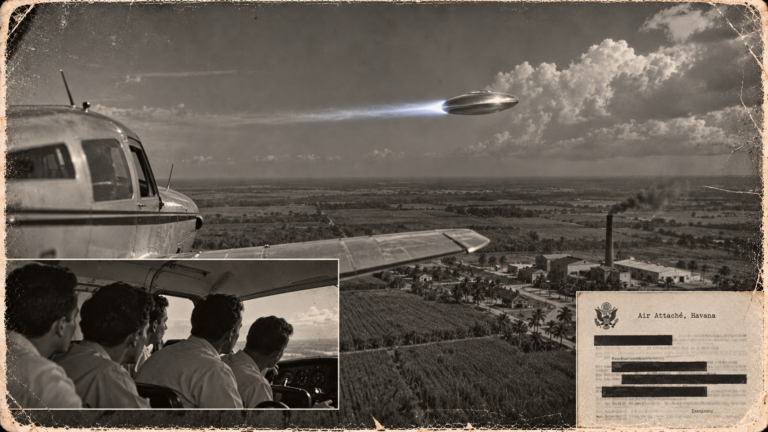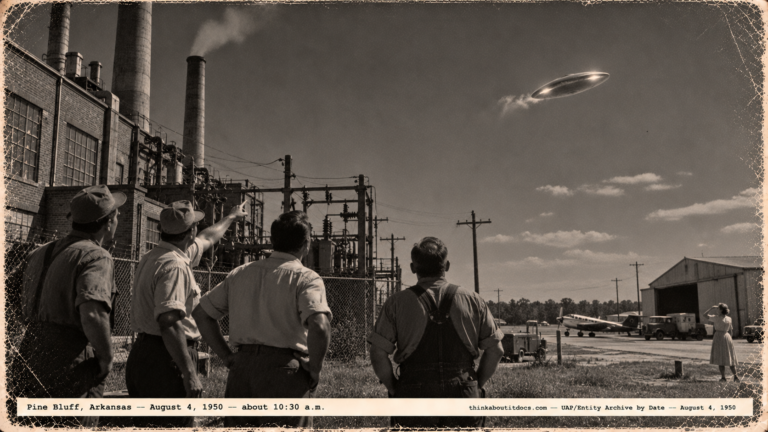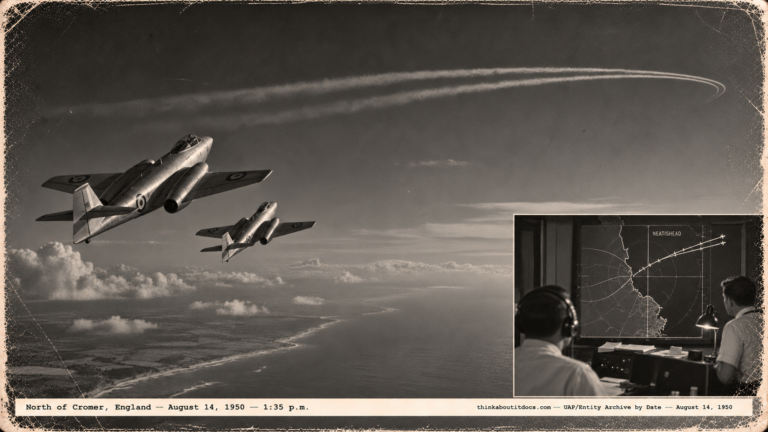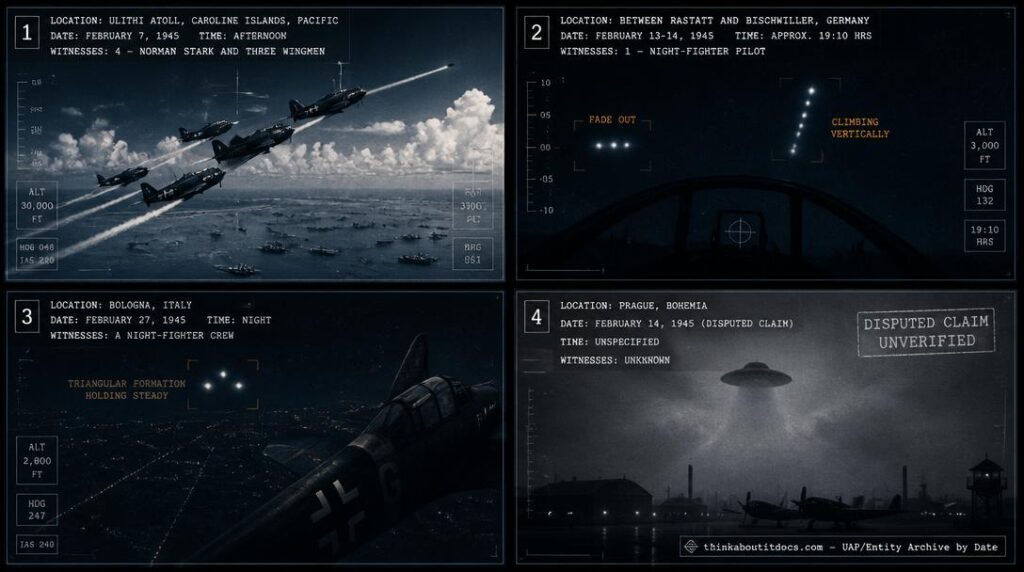
February 1945 — Four anchor cases spanning the Pacific, European, and Italian fronts: Norman Stark's outrun radar intercept at Ulithi, the 415th Night Fighter Squadron's Rastatt-Bischwiller encounter, Bologna's pursued triangle of lights, and the unverified Prague saucer claim, shown deliberately hazier to reflect its disputed status. thinkaboutitdocs.com.
1945: February UFO & Entity Sightings Archive
February 1945 is the Italian theatre’s month in this archive — nine of the seventeen entries below come from the Fifth Air Force’s Foo Fighter reports over Pisa, Viareggio, La Spezia, the Po Valley, Piacenza, Leghorn, and Bologna, a concentration found nowhere else in the record. It’s also the month a named Navy fighter pilot, LCDR Norman Stark, put his own account on the record: flying Combat Air Patrol over the Ulithi anchorage on February 7, he and three other F6Fs pushed their engines into water-injection emergency power chasing a radar contact at 30,000 feet — and still watched it pull away. He spent the rest of his life wondering if he’d seen an early Japanese jet. Over Germany, the 415th Night Fighter Squadron’s own mission reports, recovered from NARA decades later, describe two sets of lights near Rastatt splitting apart under pursuit and reforming — documented with the same clinical precision as every other mission that week. And somewhere in the noise, a single, unverifiable postwar German engineer’s claim about a Prague test flight adds a very different kind of story to the month, one this archive flags rather than endorses.
Date: Feb. 2, 1945
Location: Colmar, France
Time: Unknown
Summary: Unusual green light, moving rapidly.
Source: Undocumented
Date: Feb. 7, 1945
Location: Ulithi Atoll, Caroline Islands, Pacific
Time: Afternoon
Case Status: Unexplained
Summary: Lt. Commander Norman P. Stark, USNR, then an Ensign flying an F6F Hellcat on Combat Air Patrol over the Fifth Fleet at anchor in Ulithi, was vectored by the Fighter Director to intercept a radar contact (“bogie”) at 30,000 feet, roughly 10 miles west of the fleet. By the time Stark’s flight reached altitude, the contact had already passed over the fleet and turned back west. Flying at full military power with water injection engaged, the F6Fs could not close the gap; the object continued to widen its lead and was visually observed moving away at great speed before it could be identified. Stark, writing decades later, speculated it may have been an early Japanese jet reconnaissance aircraft. [Full Report]
Source: “A WWII F6F Navy Fighter Pilot’s Experiences In The Pacific,” LCDR Norman P. Stark USNR(R), January 1, 2000, battleofsaipan.com Source Status: VERIFIED — named, first-person primary memoir with specific date, location, and operational detail.
Editorial note: Previously listed on this archive under the location “Alethea, Pacific.” Stark’s memoir uses “Alethea” throughout as his own idiosyncratic spelling of Ulithi Atoll — where his account independently confirms he was stationed and flying CAP that week. Corrected to Ulithi Atoll, Caroline Islands.
Date: Feb. 8, 1945
Location: Near Strasbourg, France
Time: Unknown
Summary: Yellow light.
Source: Undocumented
Date: Feb. 9/10, 1945
Location: Riegel, Germany
Time: Unknown
Summary: Very bright light moving slowly.
Source: Undocumented
Date: Feb. 13/14, 1945
Location: Between Rastatt and Bischwiller, Germany
Time: Approximately 19:10 hrs (Mission 2, 18:00-20:00)
Summary: A 415th Night Fighter Squadron crew encountered two sets of lights at 3,000 feet. When the pilot turned into them, one set went out; the other climbed 2,000-3,000 feet straight up before also going out.
Source: 415th Night Fighter Squadron Mission Report, recovered from NARA (Suitland, MD) by researcher Barry Greenwood, Citizens Against UFO Secrecy (CAUS), 1992 Source Status: VERIFIED — primary squadron mission report, one of fifteen recovered by CAUS covering September 1944 to April 1945.
Date: Feb. 14, 1945
Location: Prague, Bohemia (then Reichsprotektorat)
Time: Unknown
Summary: A postwar claim, attributed to a German engineer identified as “Klein,” alleges he personally witnessed the first manned test flight of a circular “flying saucer” craft near Prague, reaching an altitude of 12,400 meters in three minutes and a speed of 2,200 km/h.
Source: Undocumented CIA-attributed document, widely circulated in secondary Nazi-UFO literature
Source Status: DISPUTED / HOAX-ADJACENT — This claim belongs to the broader “Nazi flying saucer” mythology (Haunebu/Vril/Schriever-Habermohl disc programs) for which no verified wartime engineering documents, wreckage, or contemporaneous corroboration have ever surfaced. The performance figures given (12,400m in 3 minutes, 2,200 km/h) exceed any confirmed German aviation technology of the period by a wide margin. Retained for the historical record of the claim itself, not as an established event.
Date: Feb. 15/16, 1945
Location: Pisa, Italy
Time: Unknown
Summary: Multiple sightings: a flare, and a flare that seemed to spiral.
Source: Undocumented
Date: Feb. 15/16, 1945
Location: Viareggio, Italy
Time: Unknown
Summary: Alleged jet; multiple spurts of flame; no radar return.
Source: Undocumented
Date: Feb. 16, 1945
Location: La Spezia, Italy
Time: Unknown
Summary: Possible jet; dropped what looked like white flares; no radar contact.
Source: Undocumented
Date: Feb. 17, 1945
Location: Central Po Valley, Italy
Time: Unknown
Summary: Two very bright lights observed appearing directly in front of the aircraft; fired upon without result.
Source: Undocumented
Date: Feb. 17/18, 1945
Location: La Spezia, Italy
Time: Unknown
Summary: Multiple sightings: (1) a blinking light; (2) a reddish-white light going on and off in spurts, fading during a chase; (3) a glow alternating between weak and bright, chased several times but never caught.
Source: Undocumented
Date: Feb. 21, 1945
Location: Po Valley, Italy
Time: Unknown
Summary: Alleged flares: a cluster of 11 or more colored flares that remained motionless, and a cluster of 15 orange balls of fire.
Source: Undocumented
Date: Feb. 21, 1945
Location: Piacenza, Italy
Time: Unknown
Summary: Two large red balls of fire, hovering.
Source: Undocumented
Date: Feb. 22, 1945
Location: Near Leghorn, Italy
Time: Unknown
Summary: Three lights, red-orange in color, that did not appear to be flares.
Source: Undocumented
Date: Feb. 27, 1945
Location: Bologna, Italy
Time: Unknown
Summary: Chased three lights in the shape of a triangle; no radar contact.
Source: Undocumented
Date: Feb. 1945
Location: Chemnitz, Germany
Time: Unknown
Summary: Flying wing, giving off a yellowish-red intermittent glow.
Source: Undocumented
EXECUTIVE SUMMARY
February 1945 — The Italian Front and a Fleet That Couldn’t Catch Up
February 1945 shows a phenomenon fully embedded across three active fronts. Over Italy, night-fighter crews supporting the Fifth Army’s push logged nine separate encounters in eighteen days — flares that spiraled, lights that faded mid-chase, an alleged jet dropping white flares with no radar return, and on February 27 near Bologna, three lights in a fixed triangular formation that a crew pursued without ever closing the distance. Over Germany, the 415th Night Fighter Squadron’s mission reports — since recovered from the National Archives — describe the same clinical, unremarkable-sounding encounters that by this point in the war had become simply part of the squadron’s logged activity: two sets of lights near Rastatt on the night of February 13-14, one vanishing, one climbing straight up and out.
The month’s most personally documented case comes from the Pacific. On February 7, at the vast fleet anchorage at Ulithi, Navy pilot Norman Stark and three wingmen pushed their F6F Hellcats to full military power chasing a radar contact at 30,000 feet — and the object simply out-ran them, its identity never established. Stark wrote about it himself, more than half a century later, still turning the question over: Japanese jet, or something else. Set against that firsthand account sits an unverifiable postwar claim of a German saucer test flight over Prague — a story from the same mythology that produced the Haunebu and Vril legends, with no surviving documentation to support it. This archive carries both, clearly labeled for what they are.
“We had all advanced our throttles past the normal stop into the range where we were using water injection, but the bogie continued to widen the distance. An object was seen, at a distance, moving away at great speed, but it could not be identified.”
LCDR Norman P. Stark, USNR, describing the February 7, 1945 intercept attempt over Ulithi Atoll.