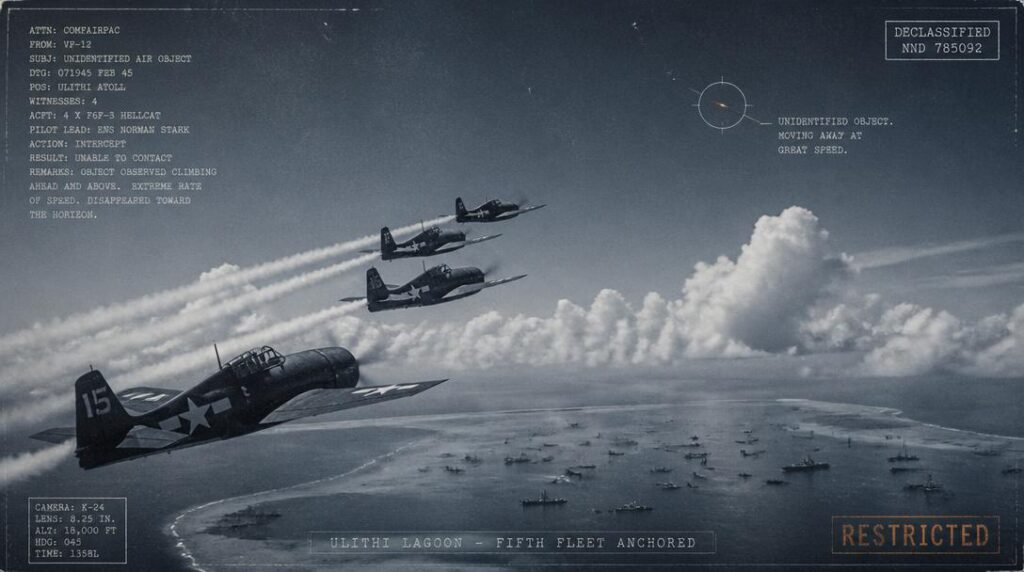
February 7, 1945 — Ulithi Atoll, Caroline Islands. Ensign Norman Stark and three wingmen pushed their F6F Hellcats to water-injection emergency power chasing a 30,000-foot radar contact — and still couldn't close the distance.
THINK ABOUTIT UFO SIGHTINGS REPORT
1945: The Ulithi Bogie — Norman Stark’s Outrun Intercept
On a February afternoon in 1945, four F6F Hellcats pushed their engines past the normal throttle stop into water-injection emergency power, straining for every last mile per hour they had, chasing something their own radar had put ten miles out and 30,000 feet up. They never closed the gap. More than fifty years later, the pilot who was there — by then a retired Lieutenant Commander — sat down and wrote the story into his own memoir, in his own words, still without an answer.
Date: February 7, 1945
Sighting Time: Afternoon
Day/Night: Day
Location: Airspace over and around Ulithi Atoll, Caroline Islands — the U.S. Fifth Fleet’s principal forward anchorage in the Pacific
Urban or Rural: Not applicable — open ocean and fleet anchorage airspace
No. of Entity(s): Not Applicable
Entity Type: Not Applicable
Entity Description: Not Applicable
Hynek Classification: RV — Radar-Visual. The object was tracked on fleet radar and separately confirmed by direct visual observation from the intercepting aircraft, meeting the standard definition of a radar/visual corroborated case, though the object was never closed with or identified.
Duration: Not precisely stated; the intercept attempt, from initial vector to the object outrunning pursuit, appears to have lasted several minutes based on the climb-and-chase sequence described
No. of Object(s): 1
Description of the Object(s): Not resolved in detail; the object was seen at a distance “moving away at great speed” and could not be identified visually beyond that. No structure, shape, or color is described in the surviving account — the object was observed only as a rapidly receding form, its outrunning speed being the salient, recorded characteristic.
Shape of Object(s): Not resolved
Size of Object(s): Not resolved
Color of Object(s): Not resolved
Distance to Object(s): Initially detected roughly 10 miles west of the fleet; distance at closest approach not specified, though the F6Fs never closed to identification range
Height & Speed: Held at approximately 30,000 feet; speed not numerically recorded, but described as sufficient to continually widen the distance from four F6F Hellcats flying at full military power with water injection engaged — meaning the object was faster than the fastest sustained speed available to a WWII-era carrier fighter under maximum boost
Number of Witnesses: 4 — Ensign (later LCDR) Norman P. Stark and three other F6F pilots of his flight, along with the ship-based Fighter Director who tracked the contact on radar and vectored the intercept
Special Features/Characteristics: Independently corroborated by shipboard radar and direct aircrew visual observation; the intercepting aircraft were flown at maximum available power (water injection, a 15% power boost via alcohol-water mixture injected into the carburetor beyond the normal full-throttle stop) and still could not close the distance; the same patrol day included a confirmed instance of Japanese “Window” (metallic chaff) being used as a decoy, which the Fighter Director correctly identified and did not confuse with this contact; Stark speculated decades later that the object may have been an early Japanese jet reconnaissance aircraft, a technology that existed only in very limited prototype form on the Japanese side at this stage of the war.
Case Status: Unexplained
Source: “A WWII F6F Navy Fighter Pilot’s Experiences In The Pacific,” LCDR Norman P. Stark, USNR(R), January 1, 2000, published at battleofsaipan.com — a first-person memoir written by the named participant
Related Cases: 1945: February UFO & Entity Sightings Archive | 1945: The Wissembourg-Landau Foofighter — “Travel 34” (same month, European theatre)
Detailed Report
By February 1945, Ensign Norman Stark had already survived a hurricane at sea, a carrier deck landing in 40-to-50-foot swells, and a shoot-down over Okinawa that put him in a life raft for hours before rescue. On February 7, his combat team, part of Air Group 81 aboard USS Wasp, drew the duty of flying Combat Air Patrol over the Fifth Fleet’s anchorage at Ulithi Atoll — routine protective coverage for the enormous fleet gathered there between operations.
The morning patrol had already produced one false alarm: the Fighter Director vectored Stark’s flight toward a radar contact 15 miles west of the fleet, which turned out to be Japanese “Window” — metallic chaff dropped to produce false radar returns and lure fighters away from their protective stations. The Fighter Director correctly identified it as such and did not repeat the mistake when more chaff appeared elsewhere.
The afternoon patrol was different. The Fighter Director reported a bogie at 30,000 feet, roughly 10 miles west of the fleet, and ordered Stark’s flight to climb and intercept. By the time the F6Fs reached altitude, the contact had already passed over the fleet and turned back to the west. The Fighter Director urged the pilots to add speed and close the distance; the flight pushed their throttles past the normal full-power stop into water-injection range — a wartime F6F emergency boost that injected an alcohol-water mixture into the carburetor for roughly a 15% power increase, at the cost of engine wear the pilots were told not to worry about in combat conditions. Even at that maximum available power, the bogie continued to widen its lead. Stark’s own account states plainly: an object was seen at a distance, moving away at great speed, but it could not be identified.
Stark’s memoir, written and published on his own initiative more than fifty years after the war, offers his own retrospective theory — that the object may have been an early Japanese jet reconnaissance aircraft — while explicitly framing it as speculation (“I have wondered if this could have been…”) rather than a claim of certainty.
RESEARCHER’S NOTES
What Four Hellcats at Full Power Couldn’t Catch
- On why this account carries unusual weight for a WWII-era case: Most cases in this archive from the WWII period survive as brief squadron mission-report entries or secondhand press accounts. This one is different: it is a full, signed, first-person memoir, written by the named participant for his own reasons, decades after the fact, with no UFO researcher or publication soliciting the story. Stark wasn’t writing for a UFO audience — the account appears embedded in a much longer, entirely conventional combat memoir covering hurricanes, dogfights, and a near-fatal water landing. The sighting is one paragraph in a much larger, mundane, credible narrative, which is itself a point in favor of its reliability: there’s no evident motive to embellish a single unidentified radar contact within an otherwise ordinary war story.
- On the significance of “outran four F6Fs at water-injection power”: The F6F Hellcat at full military power with water injection was among the fastest carrier aircraft the U.S. Navy could put in the air in early 1945. For a contact to open distance against four of them simultaneously, at that power setting, means whatever it was outperformed the best available American carrier fighter performance of the war to that point. That’s a specific, falsifiable claim about relative performance — not a vague “it was fast,” but a direct comparison against a known, well-documented aircraft envelope.
- On the “Japanese jet” explanation, weighed honestly: Japan did have limited jet aircraft programs by early 1945, including early reconnaissance variants, but confirmed operational Japanese jet aircraft did not see combat service until very late in the war, and none are documented as operating from land bases within range of Ulithi in February 1945. Stark’s own speculation is reasonable as a hypothesis but is not independently confirmed by any Japanese wartime records located for this report. The explanation remains plausible but unverified.
- On what this case does and doesn’t establish: This is a solid radar/visual case with a credible, named, first-person witness and clear operational corroboration (the Fighter Director’s vector, the water-injection chase, the correct same-day identification of a decoy chaff contact showing the crew and controller were capable of distinguishing real threats from false ones). What it does not establish is any detail about the object itself — no shape, no color, no size, nothing beyond speed and radar altitude. This is a case defined entirely by what the object could do, not by what it looked like.
Four Hellcats, full power, water injection, and a fleet’s worth of radar — and the object simply pulled away. Norman Stark carried the question for the rest of his life and never claimed more certainty than he had. The object he and his wingmen chased over Ulithi in February 1945 remains, by his own account and by the record he left behind, unidentified.
“We had all advanced our throttles past the normal stop into the range where we were using water injection, but the bogie continued to widen the distance. An object was seen, at a distance, moving away at great speed, but it could not be identified.”
LCDR Norman P. Stark, USNR, describing the February 7, 1945 intercept attempt over Ulithi Atoll.