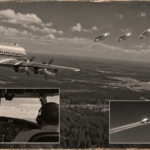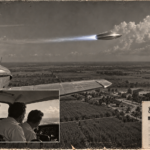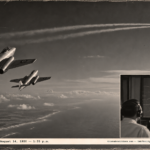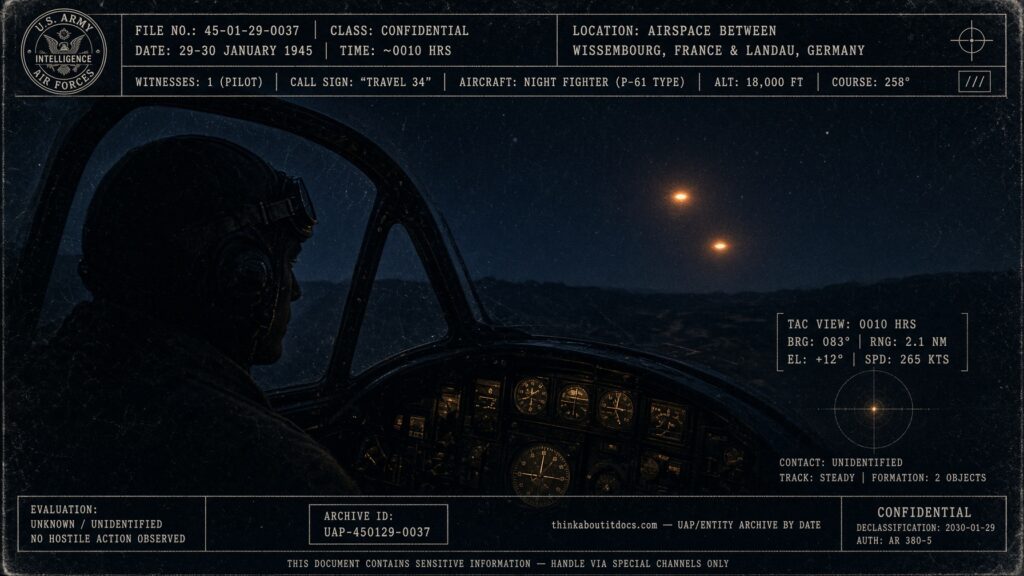
January 29-30, 1945 — between Wissembourg and Landau. Pilot "Travel 34" reported two amber lights pacing his aircraft for 30 seconds before vanishing on approach — an encounter his squadron's own intelligence officer wrote up the next day using the term "Foofighter."
THINK ABOUTIT UFO SIGHTINGS REPORT
1945: The Wissembourg-Landau Foofighter — “Travel 34”
Just after midnight on January 30, 1945, a 415th Night Fighter Squadron pilot flying under the call sign “Travel 34” logged something over the Rhine borderlands that his own squadron already had a name for. Two amber lights paced his aircraft, held position, and vanished the instant he turned toward them. What makes this case different from most of the WWII UFO record isn’t the sighting itself — it’s what happened the next morning, when Capt. F.B. Ringwald wrote it up, by the squadron’s own term, in an official intelligence report that still sits in the National Archives.
Date: January 29-30, 1945
Sighting Time: Approximately 00:10 hrs (12:10 AM)
Day/Night: Night
Location: Airspace roughly halfway between Wissembourg (Alsace, France) and Landau (Rhineland-Palatinate, Germany), near the France-Germany border
Urban or Rural: Not applicable — airborne night-fighter patrol over contested front-line territory
No. of Entity(s): Not Applicable
Entity Type: Not Applicable
Entity Description: Not Applicable
Hynek Classification: NL — Nocturnal Light. Two point-source lights observed at night with no structural detail resolved; no landing, physical trace, or close-range structural detail is claimed.
Duration: Approximately 30 seconds, per the official report
No. of Object(s): 2
Description of the Object(s): Two amber lights, each approximately one foot in diameter, one positioned 20 to 50 feet above the other. The pair held formation off the aircraft’s starboard rear at a reported altitude of “Angels 2” (2,000 feet) and a distance of roughly 1,000 feet, following the aircraft for about 30 seconds before disappearing the instant the pilot turned to close on them.
Shape of Object(s): Point-source lights; no structure resolved
Size of Object(s): Approximately one foot in diameter, per the pilot’s estimate
Color of Object(s): Amber
Distance to Object(s): Approximately 1,000 feet
Height & Speed: Held at “Angels 2” (2,000 feet altitude); speed not separately recorded, though the lights matched the aircraft’s position closely enough to be described as “following”
Number of Witnesses: 1 — the pilot flying under the call sign “Travel 34”; the account was written up by squadron intelligence officer Capt. F.B. Ringwald based on the pilot’s post-mission report
Special Features/Characteristics: The squadron’s own coined term “Foofighter” appears directly in the official intelligence report — not as a later gloss or press paraphrase, but as the term used by the reporting officer himself; Ground Control Intercept was contacted per standing squadron procedure and confirmed no friendly or hostile (“Bogey”) aircraft in the area, a negative result the report notes was consistent with “every case” the squadron had logged; the lights vanished the moment the pilot maneuvered toward them rather than fleeing beforehand or continuing to approach.
Case Status: Unexplained
Source: USAAF, Report from Capt. F.B. Ringwald, Intelligence Officer, 415th Night Fighter Squadron, to AC of S, A-2, XII Tactical Air Command, January 30, 1945, held at the National Archives and Records Administration (NARA); Keith Chester, Strange Company: Military Encounters with UFOs in World War II (Anomalist Books, 2007), which reproduces and contextualizes the report
Related Cases: 1945: January UFO & Entity Sightings Archive (see also the January 10, 1945 Iwo Jima entry, same archive, another primary-document-sourced case from the same month) | 1944: The First Foo Fighter — Strasbourg, November 27
Detailed Report
By late January 1945, the U.S. 415th Night Fighter Squadron had been logging encounters with unidentified aerial lights for two months, ever since the November 27, 1944 case near Strasbourg that gave the phenomenon its name. On the night of January 29-30, a squadron pilot flying under the call sign “Travel 34” was on patrol in the airspace roughly halfway between Wissembourg, in Alsace, and Landau, just across the Rhine in Germany — a stretch of front-line sky the squadron patrolled regularly that winter.
At approximately 00:10 hours, the pilot spotted two amber lights off the aircraft’s starboard rear, holding at roughly 2,000 feet altitude and about 1,000 feet distant. One light sat 20 to 50 feet above the other. The pair paced the aircraft for approximately 30 seconds. When the pilot turned into them — a standard maneuver to close distance and identify a contact — the lights disappeared.
What survives from this encounter is not secondhand retelling but the squadron’s own paperwork. The report filed the following day by intelligence officer Capt. F.B. Ringwald to the Assistant Chief of Staff, A-2, XII Tactical Air Command, records the pilot’s account essentially verbatim, including the plain statement: “Foofighter was about 1000 ft. away and following. The lights were about a foot in diameter. Lights disappeared when Travel 34 turned into them.” The report also notes standard squadron procedure: in every case where a pilot called Ground Control Intercept to check for a “Bogey” aircraft in the area, the answer came back negative. This case was no exception.
The report is held at the National Archives and Records Administration and is reproduced and discussed in Keith Chester’s Strange Company, a research-grade history of WWII military UFO encounters built substantially from period documents obtained through archival research. Unlike many cases in this era’s record, which survive only as postwar interviews or press retellings, this one exists as a document written by a named officer, one day after the fact, using the squadron’s own operational vocabulary.
RESEARCHER’S NOTES
When “Foofighter” Became a Word an Intelligence Officer Would Actually Write Down
- On why this case matters more for its paperwork than its content: As a sighting on its own, the Wissembourg-Landau encounter is unremarkable by the standards of this archive — two amber lights, no structure, no physical effect, gone within half a minute. What makes it significant is documentary: this is a case where the term coined informally two months earlier by radar observer Donald Meiers had, by January 30, 1945, become vocabulary an intelligence officer used without explanation or scare quotes in an official report to a higher command. That’s a fast institutionalization of a slang term, and it says something about how routine these sightings had become within the squadron by this point in the war.
- On the GCI negative result: The report’s note that Ground Control Intercept came back negative “in every case” is a small detail with real weight. It means the squadron had a standing procedure — call GCI, rule out friendly or enemy aircraft — that they applied consistently, and that this procedure never once turned up a conventional explanation across the cases the report references. That’s not proof of anything extraordinary, but it does establish that the squadron was actively trying to rule out mundane explanations as a matter of routine, not just reporting lights and moving on.
- On the behavior pattern — following, then vanishing on approach: The lights held position and paced the aircraft, then disappeared the moment the pilot turned toward them. This same behavior — sustained pacing followed by immediate disengagement on any approach — recurs across many 415th Squadron reports from this period, including the November 27, 1944 origin case. Whether that consistency reflects a genuinely intelligent, evasive phenomenon or simply reflects a common perceptual or reporting pattern among pilots trained to react the same way to unidentified contacts is not resolved by this case alone, but the repetition across independent reports is itself worth noting.
- On timing relative to the Time magazine story: This encounter occurred just two weeks after Time’s January 15, 1945 “Foo-Fighter” article brought the phenomenon to national American attention. The squadron’s report shows no sign that the pilot or intelligence officer were performing for a press audience — the language is flat, procedural, and consistent with reports filed before the story broke. If anything, the press coverage seems to have had no effect on how the squadron documented the case, which argues against the idea that later 415th reports were shaped by public interest in the phenomenon.
Thirty seconds of amber light over the Rhine borderlands, written up the next morning by a squadron intelligence officer using a word his own unit had invented two months before — that’s the entirety of the Wissembourg-Landau case. It is not the most dramatic Foo Fighter encounter on record. It may be one of the most quietly telling: proof that by the last winter of the war, an American night-fighter squadron had a name, a procedure, and a paper trail for something it still could not identify.
“Foofighter was about 1000 ft. away and following. The lights were about a foot in diameter. Lights disappeared when Travel 34 turned into them.”
Capt. F.B. Ringwald, 415th Night Fighter Squadron intelligence report, January 30, 1945.