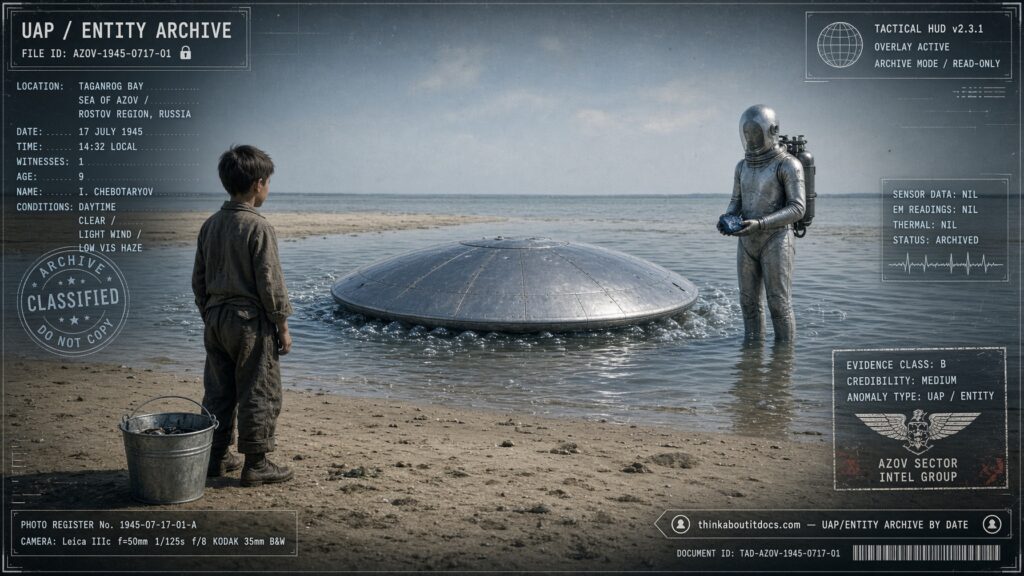
Summer 1945 — Taganrog Bay, Russia. Nine-year-old I. Chebotaryov reportedly spoke with a silver-suited occupant who invited him aboard a submersible disc — an invitation he declined so he wouldn't miss dinner.
THINK ABOUTIT UFO SIGHTINGS REPORT
1945: The Taganrog Bay Encounter — I. Chebotaryov
A nine-year-old boy, a bucket of fish, and a fifteen-foot disc that smashed into the shallows of a Russian bay in the summer of 1945 — this is one of the most fully recorded entity-contact conversations from the entire WWII era, complete with a courteous alien apology when the boy turned down a ride to another planet. It is also, by this archive’s own standards, thinly sourced: a single secondary compilation and one further website reproduction, no named investigator, no contemporaneous Soviet document. This report presents the account in full while being direct about what isn’t there to back it up.
Date: Summer 1945 (exact date not recorded in any located source)
Sighting Time: Daytime
Day/Night: Day
Location: Taganrog Bay, Sea of Azov, Rostov region, Russia (then RSFSR, Soviet Union), on a sandbar near the witness’s fishing spot
Urban or Rural: Rural/coastal — a shallow fishing area away from settlement
No. of Entity(s): 1
Entity Type: Humanoid, of undetermined origin; described only via its suit and the claim, made in its own words, of coming “from another planet”
Entity Description: Human in general build and bipedal gait, dressed in a silvery one-piece overall. The head was fully enclosed in a non-transparent, oval-shaped helmet, obscuring any facial features. A large tank or “can”-like device, made of a dark, tinted-glass-like material, was worn on the back, resembling a backpack. The figure carried a blue stone in one hand and had a small sack hanging from the chest area. Notably, the figure was barefoot, with long feet ending in unusually long toes, otherwise resembling human feet.
Hynek Classification: CE-III — Close Encounter of the Third Kind. A landed/submerged craft with a direct, close-range occupant encounter including verbal communication, meeting the standard definition for this classification tier.
Duration: The full encounter, from the craft’s impact to its final submersion, is estimated at several minutes based on the pacing of the recorded dialogue; the silent standoff between witness and entity alone lasted approximately three minutes per the account
No. of Object(s): 1
Description of the Object(s): A metallic disc, described as a “giant plate,” with a hull that reflected sunlight. It descended from the sky and struck the water with enough force to throw up a fountain of spray that soaked the witness, then came to rest on a sandbar in only a few feet of water. After the encounter concluded, it rose, hovered briefly, and submerged directly into the bay “like a submarine.”
Shape of Object(s): Disc/plate-shaped
Size of Object(s): Approximately 15 feet (roughly 5 meters) in diameter
Color of Object(s): Metallic, reflective
Distance to Object(s): The witness was standing only a few feet from the point of impact; the entity itself approached to within approximately 20 feet of the witness
Height & Speed: Descended from the sky to water impact; speed and prior altitude not recorded
Number of Witnesses: 1 — nine-year-old I. Chebotaryov, alone at the time
Special Features/Characteristics: Direct two-way verbal communication in fluent Russian; the entity offered an explicit invitation to travel to its home planet, which the witness declined for a mundane, entirely believable reason (an expected dinner at home); the entity expressed apparent disappointment at the refusal rather than any hostile or coercive response; the entity explicitly told the witness he could share the story but predicted, accurately as it turned out within the ufological record, that he would not be believed; the craft’s mode of departure — submerging directly into the bay rather than flying off — is unusual among entries in this archive and suggests, if taken at face value, an amphibious or fully submersible operating capability.
Case Status: Insufficient Data
Source: Rullan (original compilation, publication details not further identified in sources located by this archive); thenightskyii.org, “Russian Youth Meets Aliens,” which names the witness as I. Chebotaryov and preserves the full recorded dialogue
Related Cases: 1945: June UFO & Entity Sightings Archive
Detailed Report
In the summer of 1945, with the Great Patriotic War in Europe just ended and the war against Japan still underway, a nine-year-old boy named I. Chebotaryov was fishing alone along the shore of Taganrog Bay, on the northeastern arm of the Sea of Azov in Russia’s Rostov region, gathering his family’s evening meal. As he was preparing to head home, he watched a “giant plate” descend from the sky and strike the water nearby with enough force to throw up a fountain of spray that soaked him completely. The object, roughly 15 feet in diameter with a reflective metallic hull, had come to rest on a sandbar covered by only a few feet of water, just steps from where the boy had been fishing.
According to the account, bubbles began rising around the disc, and a figure emerged, dressed in a silver one-piece suit with a fully enclosed, non-transparent oval helmet and a dark, tank-like device on its back. The figure jumped down from the top of the craft and walked toward the boy, stopping at a distance of roughly 20 feet. For approximately three minutes, according to the account, the two stood in silence — until the boy’s patience gave out and he asked whether the figure had come from the Moon.
After a pause, the figure reportedly answered in fluent Russian: “No, I am from another planet.” When the boy asked the name of that planet, the figure did not answer directly, instead saying, “Many surprises await terrestrials, and they will be happy for them.” Pressed again to describe its home world, the figure once more declined to elaborate, instead gesturing to the craft and offering: “If you want, come into my ship and soon you will be on my planet.”
The boy, concerned about missing dinner and uncertain whether he would ever return from such a trip, declined — telling the figure plainly that his mother was expecting him home to eat the fried fish in his bucket. The figure’s reported response was simple: “It’s a pity that you do not want to come.” It then turned and walked back toward its craft, at which point the boy noticed it was barefoot, with unusually long toes on otherwise human-looking feet. Before entering the craft, the figure told the boy he could tell others about what had happened, but warned that no one would believe him. It then climbed inside, the craft rose, hovered briefly, and submerged into the bay like a submarine. The boy picked up his bucket and went home.
RESEARCHER’S NOTES
A Remarkable Story, Honestly Weighed Against Its Sourcing
- On why this case is treated as Insufficient Data rather than Unexplained: The distinction this archive draws between these two statuses matters here. “Unexplained” is reserved for accounts that, whatever their ultimate truth, are backed by enough independent documentation or corroboration to establish that something specific was reported by identifiable people through a traceable chain. This case does not currently clear that bar: this archive has located only one original compilation (“Rullan,” with no further publication detail recovered) and one further website that reproduces essentially the same text with the witness named. No contemporaneous Soviet document, no named investigator who interviewed Chebotaryov directly, and no second independent account of the same event have been located. That doesn’t mean the story is false — it means it cannot currently be verified beyond the level of “a compelling account exists.”
- On the specificity of the recorded dialogue: Unlike many entity-contact accounts, which summarize communication in vague terms (“the being communicated telepathically” or “conveyed a sense of peace”), this account preserves a specific, multi-exchange conversation with distinct lines attributed to each party. That level of narrative detail is unusual for a secondhand account of a decades-old event and could reflect either an unusually well-preserved oral history or, equally plausibly, literary elaboration introduced somewhere between the original 1945 event (if it occurred) and its eventual publication. The archive cannot currently distinguish between these possibilities.
- On the entity’s characterization: The figure in this account is notably non-threatening and almost wistful — expressing regret rather than insistence when refused, offering a genuine warning about disbelief rather than a demand for secrecy, and departing without incident. This behavioral pattern (non-coercive invitation, graceful acceptance of refusal) recurs across a number of contactee-adjacent accounts from this era and later decades, which is worth noting as a pattern in the broader literature without treating it as evidence either for or against this specific case’s authenticity.
- On the submersible departure: A craft that descends from the sky, operates on a sandbar, and then submerges into open water like a submarine is a distinctive combination of capabilities rarely claimed together in this archive’s WWII-era entries. If taken at face value, it describes a genuinely tri-medium vehicle (air, land/shallow water, submerged); this detail neither confirms nor undermines the account on its own, but it is the kind of specific, unusual claim that a future investigator with access to Soviet-era regional archives might be able to independently check against any period reports from the Taganrog area.
A boy went fishing, came home with a bucket of fish and a story nobody would believe — and, as far as this archive’s current research can determine, he may have been right about that. The Taganrog Bay encounter remains one of the most vivid entity-contact narratives from the WWII era in this archive, and one of the least independently verified. Both things are true at once, and this report holds them that way rather than resolving them by omission.