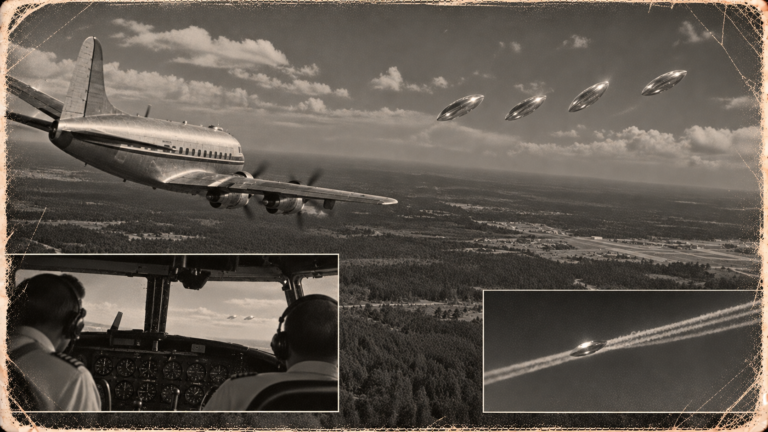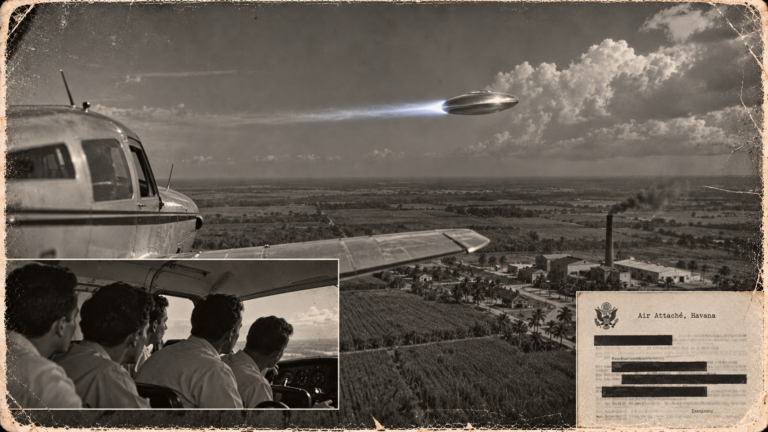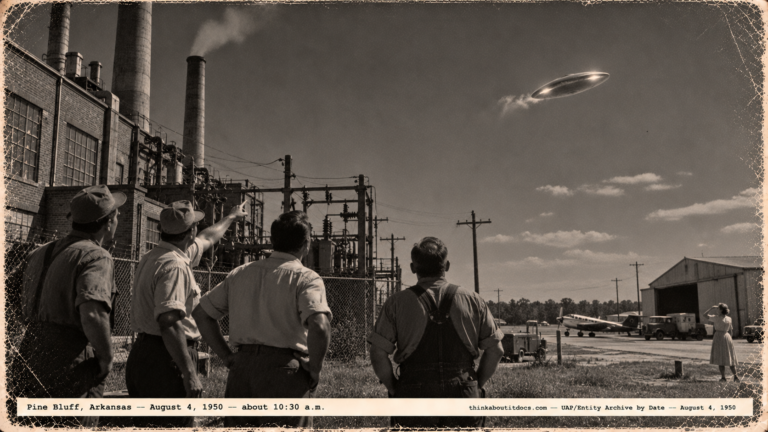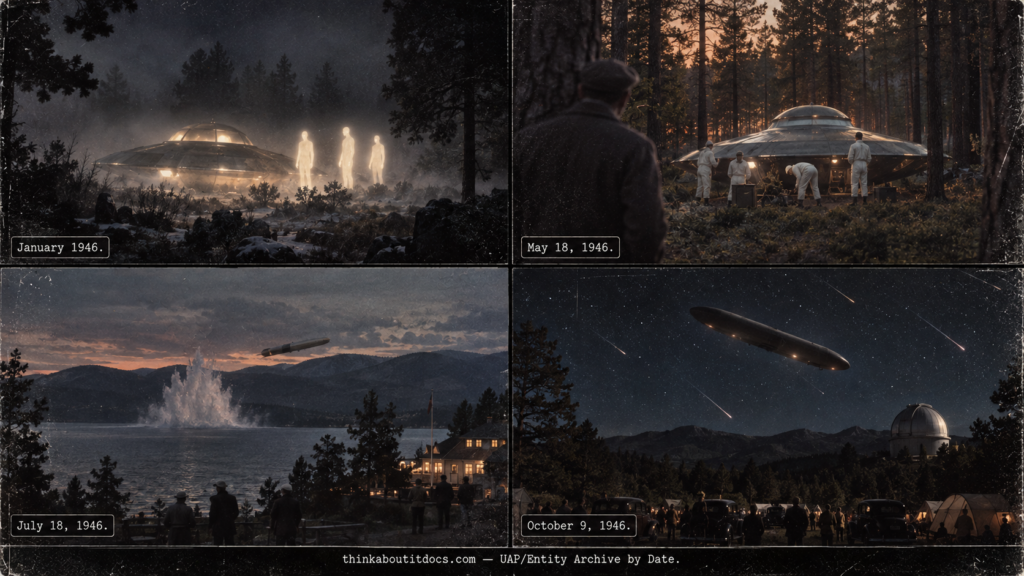
1946 — Four anchor cases from the year the ghost rocket wave began: Flagstaff (January), Ängelholm (May), Lake Mjøsa (July) and Palomar Mountain (October). thinkaboutitdocs.com.
1946: UFO | UAP & Entity Sightings by Date Hub
In 1946, the postwar UFO record opened quietly and ended as a continent-wide wave. January’s most striking case is also its strangest: two young men on a foggy Arizona mountainside near Flagstaff encountered a domed disc and three luminous beings, and lost roughly ten hours they could only account for under hypnosis — a “missing time” narrative structure that would not become a recognizable genre in ufology until Betty and Barney Hill’s case fifteen years later. That same winter, a Swedish railway worker named Gösta Carlsson had an encounter near Ängelholm that would become the country’s single most famous UFO contact claim, and by May the first scattered reports of cigar-shaped and rocket-like objects began appearing over Scandinavia.
By August, that trickle had become the Scandinavian “ghost rocket” wave — cigar- and rocket-shaped objects logged almost daily across Sweden, Norway, Denmark, Finland and beyond, peaking on August 9 and 11 with roughly 2,000 sightings recorded for the year, some 200 of them on radar. The same year produced, almost incidentally, the origin point of an entirely different strand of ufology: on October 9, hundreds of witnesses over Palomar Mountain, California watched a large cigar-shaped object maneuver for over an hour, and among them was a struggling philosophy teacher named George Adamski, who would spend the next six years turning that night into the foundation of the American contactee movement. This is the complete 1946 UFO sightings archive: twelve monthly indexes and an Unknown Date page, tracing the year the wave began.
1946: January UFO & Entity Sightings Archive
The Flagstaff, Arizona case: a domed disc, three luminous beings, and roughly ten hours of missing time recovered only under hypnosis, fifteen years before the Hill abduction gave the pattern its name. A misdated 1947 RAF radar case is also removed and reassigned.
1946: February UFO & Entity Sightings Archive
One of the thinnest months on record, with only two bare-bones entries. The Gävle, Sweden case sits roughly three months ahead of the main ghost rocket wave, worth flagging for its timing alone.
1946: March UFO & Entity Sightings Archive
The Araçariguama, Brazil case: farmer João Prestes Filho, struck by a silent beam of light inside his own home and dead within hours, often cited as Brazil’s first fatal UFO encounter.
1946: April UFO & Entity Sightings Archive
A family of ice fishermen on a remote Ontario lake watched a dozen small discs land, spin and lift off over two hours — an account that wasn’t published anywhere until eleven years later.
1946: May UFO & Entity Sightings Archive
Gösta Carlsson’s encounter near Ängelholm, Sweden’s most famous UFO contact claim, still marked by a monument he built himself. The month closes with the ghost rocket wave’s first stirrings over Sweden and Denmark.
1946: June UFO & Entity Sightings Archive
The ghost rocket wave builds over Katrineholm and Eskilstuna, and in rural New Jersey, future contactee Howard Menger says he watched a bell-shaped saucer land in an apple orchard.
1946: July UFO & Entity Sightings Archive
The wave turns near-daily: more than two dozen Swedish and Norwegian sightings, anchored by the July 18 Lake Mjøsa incident, tracked by local police and investigated by Norway’s Defense High Command.
1946: August UFO & Entity Sightings Archive
The wave’s peak, on August 9 and 11, and its most extraordinary American entry: an Oklahoma City woman who watched a disc tilt onto its edge in her own yard, close enough to count twelve silhouetted figures behind its windows.
1946: September UFO & Entity Sightings Archive
The wave goes international, spreading to Italy, France, Portugal and Morocco, with a Florence case that a single secondary source claims prompted a formal Italian government investigation.
1946: October UFO & Entity Sightings Archive
The October 9 Palomar Mountain mass sighting, witnessed by hundreds and reported live on San Diego radio — and by a philosophy teacher named George Adamski, who would spend six years building it into the birth of the American contactee movement.
1946: November UFO & Entity Sightings Archive
A single, thinly sourced entry: a pre-dawn Baltimore street sighting with occupants reportedly seen aboard, known only from a later catalogue with no contemporary press coverage located.
1946: December UFO & Entity Sightings Archive
Paula Jean Welden’s disappearance on Vermont’s Long Trail, the case that turned Middie Rivers’s lonely 1945 vanishing into a pattern, drew in the FBI, and led directly to the founding of the Vermont State Police.
1946: Unknown Date UFO & Entity Sightings Archive
Three entries with no month: a Florida sighting cross-referenced to its full August report, a Romania wreckage claim tied to the disputed Zhitkur legend, and a general Sweden ghost-rocket summary standing alone.
THE GHOST ROCKET WAVE AND ITS INVESTIGATORS
Who Was Watching in 1946
Sweden and Norway: The wave that began building in May and peaked in August drew official attention as it grew — Norway’s Defense High Command formally investigated the July 18 Lake Mjøsa incident, though its report, if it survives, has never been recovered. By year’s end the wave had generated roughly 2,000 sightings, about 200 of them corroborated by radar.
Italy: A single secondary source credits the September 22 Florence sighting with prompting a formal Italian government investigation, a claim this archive flags as unconfirmed by any independent record located so far.
The United States: No formal U.S. government study existed yet in 1946 — Project Sign was still a year away. What the U.S. produced instead was the raw material for a different kind of investigation entirely: Ted Bloecher, later a co-founder of Civilian Saucer Intelligence and a NICAP officer, personally investigated the August Oklahoma City case and built a 14-page file on it, a level of documentary rigor unusual for the period.
Read in order, 1946 is two stories running in parallel. One is institutional: a wave of aerial objects that grew from isolated spring reports into a near-daily pattern by midsummer, serious enough to draw Norwegian military investigation and, if the Florence claim holds up, an Italian government inquiry — a full year before Kenneth Arnold’s sighting made the subject a household word in America. The other is personal: a hypnosis-recovered missing-time account in Arizona that anticipated a genre by fifteen years, a Swedish contact claim that became a national landmark despite its investigators’ own doubts, and a night over Palomar Mountain that one witness would spend six years turning into the foundation of American contactee lore. Neither story yet had an official American investigator watching. That would begin the following year.
“They went so low that trees were left swaying after they passed. Nearly midway out in Mjøsa… the water took a big splash and the spray stood many meters high in the air where the objects disappeared.”
Aftenposten (Oslo), July 20, 1946, describing the July 18 Lake Mjøsa ghost rocket incident.