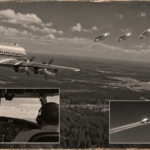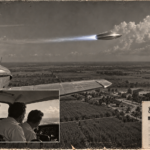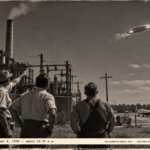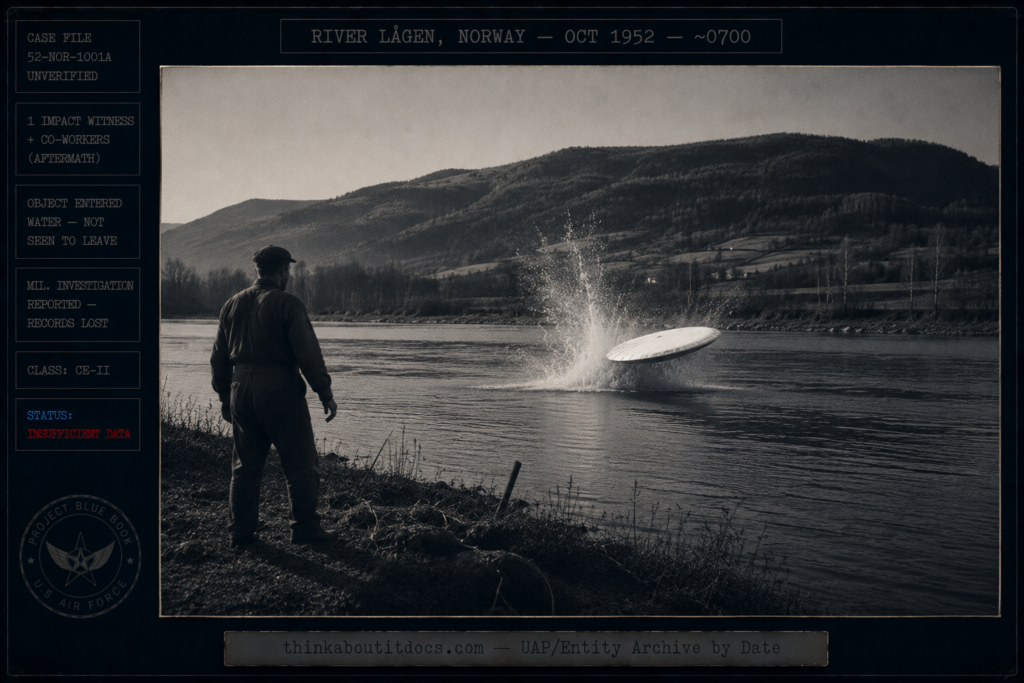
The October 1952 Lågen River event — Johannes Nordlien watched a 4-meter white disc strike the river and vanish; Norway's Defense Command reportedly investigated, but the records are lost. Logged Insufficient Data. (thinkaboutitdocs.com — UAP/Entity Archive by Date)
THINK ABOUTIT UFO|UAP|ENTITY SIGHTINGS REPORT
1952: Object Into the Lågen River, Norway (Johannes Nordlien)
Just before seven on an October morning in 1952, a Norwegian worker named Johannes Nordlien heard a howling, jet-like sound, and a four-meter, snow-white saucer shape tore in low from the west, passed him about a hundred meters off, and struck the River Lågen with a violent splash that threw water meters into the air. There was no fire, no exhaust, no light, no explosion — and the object never came back up. When his co-workers reached the spot the water was still churning. What lifts this above a lone account is what the cited investigator records around it: according to period press reports, the Norwegian Defense High Command actually investigated the incident, and the documents have since vanished — possibly destroyed along with the files on Norway’s 1946 ghost-rocket wave. The archive keeps the case as exactly that: a sober, well-sourced report of an object entering water, with corroborated aftermath, a real-but-lost official inquiry, and no recovered evidence to settle what it was.
Date: October 1952 (a Thursday; exact date not recorded)
Sighting Time: Shortly before 0700
Day/Night: Day (early morning, clear sky)
Location: River Lågen, Norway (rural)
Urban or Rural: Rural
No. of Entity(‘s): None reported
Entity Type: Not applicable
Entity Description: Not applicable
Hynek Classification: CE-II (Close Encounter II) — object at close range associated with a physical effect (the violent splash and churning water); the CE-II rests on that water disturbance, and the daylight structured-disc observation could alternatively support a DD reading
Duration: Seconds (the object crossed and impacted very quickly; the water disturbance persisted briefly before calming)
No. of Object(s): 1 (some witnesses thought they saw two, one behind the other)
Description of the Object(s): A flat, round, saucer-shaped object about four meters in diameter, white as snow, traveling at high speed from the west with a loud howling, jet-like sound that ceased the moment it was seen; it struck the river with a violent splash, threw water several meters up, and did not reappear; no fire, exhaust, light, or explosion was observed
Shape of Object(s): Saucer (flat and round)
Size of Object(s): About four meters in diameter
Color of Object(s): White (snow-white)
Distance to Object(s): About 100 meters as it passed the primary witness
Height & Speed: Low and very fast (described as high speed; no instrument measurement)
Number of Witnesses: Primary witness Johannes Nordlien saw the impact; co-workers arrived immediately after and saw the water still churning, corroborating the aftermath
Special Features/Characteristics: Object entered water and was never seen to leave (a USO-type impact); loud howling sound that stopped on sighting; violent splash with no fire or explosion; water still “boiling”/churning when co-workers arrived, then quickly calming; per period press, the Norwegian Defense High Command investigated, but the documents have never been recovered
Case Status: Insufficient Data
Source: Ole Jonny Brænne, “Observations of Unidentified Submarine Objects in Norway” (catalog of Norwegian USO reports)
Summary/Description: Shortly before 7 a.m. on a Thursday in October 1952, Johannes Nordlien heard a howling, jet-like sound and saw a four-meter, snow-white saucer come in fast from the west, pass about 100 meters away, and strike the River Lågen with a violent splash before disappearing beneath the surface. No fire, exhaust, or explosion accompanied it; co-workers arriving moments later found the water still churning. Some witnesses thought there were two objects. Period press reports indicate the Norwegian Defense High Command investigated, but those records are lost. With one primary witness to the impact, corroborated aftermath, and no recovered evidence, the case is logged as Insufficient Data.
Related Cases: 1946 & 1952: The Legends of UFO Crashes at Spitzbergen, Norway | Observations of Unidentified Submarine Objects in Norway (source article) | the 1958 Alta fjord “unknown aircraft” water-impact report
DETAILED REPORT
The account comes from the Norwegian researcher Ole Jonny Brænne, whose survey of Unidentified Submarine Objects in Norway gathered the country’s reports of objects associated with water. Shortly before 7 a.m. on a Thursday in October 1952, Johannes Nordlien was waiting for co-workers when he heard a howling, jet-like sound. A saucer-shaped object about four meters across came in at high speed from the west and passed roughly 100 meters from him. It was white as snow, and he saw clearly that it was flat and round. It struck the River Lågen with a violent splash that threw water several meters into the air. There was no fire, no exhaust, no light, and no explosion; the loud howling stopped the instant he saw the object. By the time his fellow workers arrived, the water was still churning, and it soon calmed. Some of those present thought they had seen two objects, one behind the other.
Two features make this more than a fleeting glimpse. First, the aftermath was witnessed by more than one person: whatever Nordlien alone saw of the impact, his co-workers independently saw the disturbed, still-churning water, which corroborates that something struck the river hard moments before they arrived. Second, and more important, this was not merely a private anecdote. Brænne records that, according to press reports of the period, the Norwegian Defense High Command conducted an investigation into the incident. That is the detail the prior version of this page omitted, and it is the most consequential thing about the case: a national military command considered the event worth looking into.
The frustration is that the inquiry’s records cannot be found. Brænne notes the documents have never been recovered, and raises the real possibility that they were destroyed along with Norway’s files on the 1946 ghost-rocket wave — a loss he describes as a serious one for historians, leaving newspaper accounts as the only surviving source material. So the case sits in an unusual position: better attested than a lone sighting, because an official body engaged with it, yet unverifiable in its particulars, because the official record is gone.
The prior page leaned on the churning water as a CE-II physical trace and labeled the event a “crash.” Both need a lighter touch. The disturbed water is a genuine reported effect, but it is the ordinary consequence of any heavy, fast object hitting a river, and it calmed quickly; it is not a burn, an impression, or recovered debris. And “crash” is an inference, not an observation — the object was simply never seen to leave the water, and no search of the riverbed was conducted, so whether it sank, submerged under control, or was something mundane that entered the water cannot be determined. The honest description is an object that entered the river at speed and did not visibly reappear.
What it was remains open, and the prosaic candidates deserve a fair hearing precisely because the object was small (four meters), fast, and seen only briefly before impact: a meteorite fall, a jettisoned drop tank or other aircraft component, or experimental ordnance in an era when Norway’s coasts and interior saw considerable Cold War military activity. None of these fits perfectly — a meteorite would not typically be described as a flat, snow-white disc, and the howling sound that stopped on sighting is odd for any of them — but none can be excluded on the surviving evidence either. The military investigation might have settled the question; its disappearance is why the case stays unresolved.
RESEARCHER’S NOTES
The Lågen River Impact — Norway 1952 and the Investigation That Vanished
- Classification, held with a caveat: CE-II is defensible and is retained — an object observed at close range (about 100 meters) in association with a physical effect on the environment, the violent splash and churning water. But the classification rests entirely on that water disturbance, which is the expected result of any fast, heavy object striking a river rather than a distinctive trace like a burn or ground impression. Because the encounter was a daylight observation of a structured disc, a DD (Daylight Disc) reading is a reasonable alternative. The CE-II is kept as the prior classification, with the basis for it stated plainly so readers can weigh it.
- Source-chain assessment — a good source, underused: Ole Jonny Brænne is a serious, skeptically-minded Norwegian investigator, and his USO survey is sober catalog work, not sensational compilation. The prior page drew on it but stripped out its two most valuable elements: the corroborating co-workers who saw the churning water, and the reported Norwegian Defense High Command investigation. Restoring those changes the case’s weight. It also means the witness count of “1” was wrong — Nordlien was the sole witness to the impact itself, but he was not the only person on the scene, and a possible second object was reported.
- The lost records and what they cost: The defining problem here is archival, not evidential in the usual sense. An official military inquiry reportedly existed; its documents are gone, perhaps destroyed with the 1946 ghost-rocket files. That loss is why the case cannot be resolved in either direction: the one body that gathered contemporaneous evidence left nothing recoverable behind. A careful archive should neither treat the vanished investigation as proof of significance (“the military covered it up”) nor ignore it; it should record that the inquiry happened, that the records are lost, and that this is precisely what prevents a firmer conclusion.
- Evidentiary weight and why Insufficient Data: In favor of the case: a clear daylight observation by a named witness, independent corroboration of the aftermath, and a reported official investigation. Against a firm verdict: a single witness to the impact itself, no recovered physical evidence, no surviving documentation, brief observation of a small fast object, and several unexcluded mundane explanations (meteorite, aircraft component, ordnance). That balance is Insufficient Data — genuinely interesting, better-grounded than most single-witness reports because of the official inquiry, but impossible to resolve with the record that survives. It is neither a documented anomaly to call Unexplained nor a demonstrated mundane event to call Explained.
The Lågen River case is a small, sober, and quietly tantalizing entry: no occupants, no glow, no drama beyond a snow-white disc that came in howling, hit the water hard, and never came back, watched by a man whose co-workers arrived to find the river still churning. Its strength is that a national military command thought it worth investigating; its limit is that the investigation’s records are gone. Told straight — corroborated aftermath restored, the lost inquiry named, the “crash” softened to an unconfirmed water entry, the physical-trace claim kept in proportion — it stands as Insufficient Data, an honestly-sourced Norwegian USO report the surviving evidence cannot close.