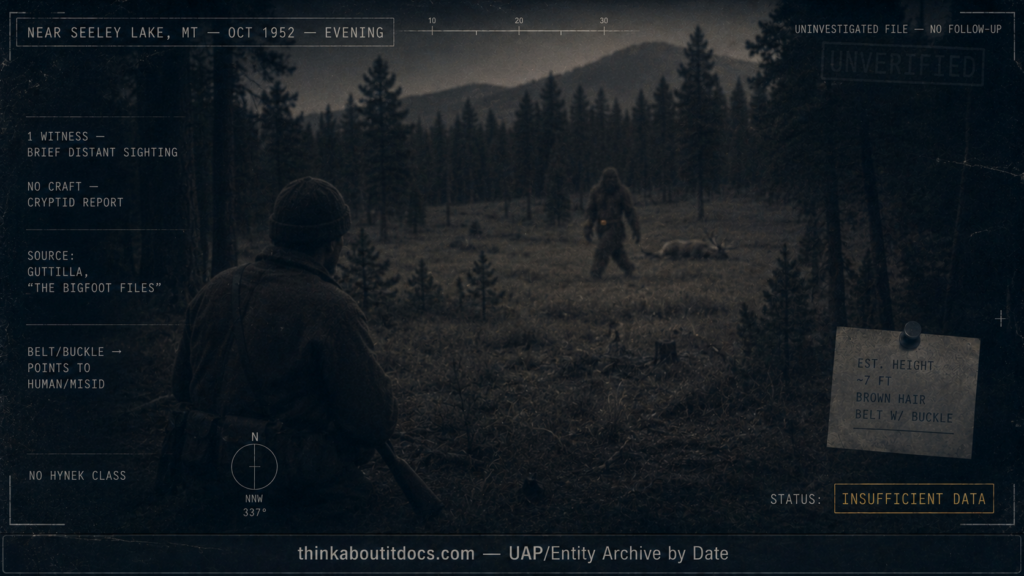
The October 1952 Seeley Lake, Montana report — elk hunter Lyle Slade described a 7-foot hairy creature wearing a belt and buckle. A cryptid sighting with no craft; the buckle points to a human or misID. Logged Insufficient Data. (thinkaboutitdocs.com — UAP/Entity Archive by Date)
THINK ABOUTIT UFO|UAP|ENTITY SIGHTINGS REPORT
1952: Seven-Foot Hairy Creature near Seeley Lake, Montana (Lyle Slade)
CRYPTID / UNASSOCIATED HUMANOID REPORT
no craft, no UFO, no light. A Bigfoot-type sighting, retained as high-strangeness archive content and classified accordingly.
It is a classic piece of Montana Bigfoot lore with one detail that refuses to fit. In October 1952, elk hunter Lyle Slade saw what he first took for a wounded elk across a clearing near Seeley Lake — then watched a seven-foot, cinnamon-brown, hair-covered creature cross the clearing toward it, “jabbering” as it went. The detail that has kept the case in circulation is that the creature was said to be wearing a leather belt with a brass buckle. Bigfoot writers cite that as eerie evidence of a cryptid that mimics human dress; read plainly, it points the other way — a manufactured belt and buckle are exactly what you would expect on a person, not an unknown animal. There is no craft here and nothing aerial; this is a cryptid report, not a UFO encounter, and the archive files it as such. It rests on a single brief, distant sighting, collected later into a Bigfoot book, and is logged as Insufficient Data.
Date: October 1952 (specific date not recorded)
Sighting Time: Evening
Day/Night: Evening (daylight failing)
Location: Mountains near Seeley Lake, Missoula County, Montana
Urban or Rural: Rural (forested mountains)
No. of Entity(‘s): 1
Entity Type: Large hair-covered “hairy hominid” / Bigfoot-type creature (no craft associated)
Entity Description: About 7 feet tall, covered in cinnamon-brown hair, making “jabbering” vocalizations, and reported to be wearing a leather belt with a brass buckle
Hynek Classification: None — no craft or object is involved; this is an unassociated cryptid/humanoid report, not a close encounter of the third kind (the prior CE-III is incorrect, as CE-III requires beings associated with a craft)
Duration: Brief (the creature crossed a clearing)
No. of Object(s): None — no object or craft reported (the prior page mistakenly listed the creature itself as an “object”)
Description of the Object(s): Not applicable
Shape of Object(s): Not applicable
Size of Object(s): Not applicable (the creature was about 7 feet tall)
Color of Object(s): Not applicable (the creature was cinnamon-brown)
Distance to Object(s): Across a clearing (the exact distance not recorded)
Height & Speed: Not applicable (a walking ground creature)
Number of Witnesses: 1 (Lyle Slade)
Special Features/Characteristics: Initially mistaken context of a wounded elk; “jabbering” vocalizations; reported leather belt with brass buckle — a manufactured human accessory that points toward a person or misidentification rather than an unknown animal; no tracks, hair, photographs, or other physical evidence collected; no contemporaneous investigation
Case Status: Insufficient Data
Source: Peter Guttilla, “The Bigfoot Files” (cryptozoology compilation)
Summary/Description: In October 1952, while elk hunting in the mountains near Seeley Lake, Montana, Lyle Slade reportedly saw what he first took for a wounded elk across a clearing, then watched a roughly 7-foot, cinnamon-brown, hair-covered creature cross the clearing toward it while making “jabbering” sounds. The creature was said to be wearing a leather belt with a brass buckle. No craft or light was involved, no physical evidence was collected, and the account rests on a single witness recorded later in a Bigfoot compilation. It is logged as Insufficient Data.
Related Cases: 1952: Three White Forms, Central Point, Oregon (also an entity report with no craft) | the broader corpus of Pacific Northwest and Rocky Mountain hairy-hominid reports | Montana Sightings archive
DETAILED REPORT
The account comes from Peter Guttilla’s cryptozoology compilation “The Bigfoot Files.” In October 1952, Lyle Slade was hunting elk in the mountains near Seeley Lake, in Missoula County, Montana. Across a clearing he saw what he initially took to be a wounded elk. Then a large, hair-covered creature emerged and crossed the clearing in the direction of the elk, making sounds Slade described as “jabbering.” He put its height at about seven feet, its hair a cinnamon brown — and, in the detail that has defined the case ever since, he reported that it wore a leather belt with a brass buckle.
The first and most important correction is one of category, not credibility. The prior page classified this as a CE-III — a close encounter of the third kind. That classification is for animate beings associated with a UFO or craft, and there is no craft anywhere in this report: no disc, no light, nothing in the sky, nothing landed. There is only a creature crossing a clearing. Under the archive’s own standard, a hairy-hominid or other entity report with no associated object is an unassociated cryptid/humanoid sighting and carries no Hynek classification at all. The page compounded the error by entering the creature into the “object” fields — listing “No. of Object(s): 1” and “Size of Object(s): 7-feet tall” — which mistakes the animal itself for a craft. Those fields are not applicable here; the seven-foot height belongs to the entity description.
The case is legitimately part of the high-strangeness record, and the archive keeps such cryptid reports. But it should be read for what it is. It is a single-witness sighting, brief, across a clearing, in failing evening light, by a hunter whose first interpretation of the scene was an ordinary elk. No tracks were cast, no hair recovered, no photograph taken, and no contemporaneous investigation conducted; the report survives because it was later gathered into a Bigfoot book. That is the ordinary evidentiary profile of a fleeting backcountry “monster” sighting, and it cannot bear much weight.
The belt and buckle deserve direct treatment, because the prior page built its whole “historical context” around them — calling the case “one of the most anomalous reports in the Bigfoot archives” and suggesting the human-like accessories imply “a level of intelligence or interaction with human culture rarely documented.” That reading inverts the evidence. A leather belt with a brass buckle is a manufactured human article. The most economical explanation for a seven-foot hairy figure wearing one, glimpsed briefly across a clearing in low light, is not an intelligent tool-using cryptid but a human being — a very tall or bulkily-dressed person, a hunter in fur or a hide coat, even a deliberate hoaxer — or a misperceived animal onto which the “belt” was read from a band of differently-colored hair, a shadow, or a trick of the fading light. The buckle does not deepen the mystery; it is the single strongest pointer in the account toward a mundane source. Bears, too, are abundant around Seeley Lake and can stand and move in ways that briefly suggest a tall biped, though a bear fits the “belt” detail less naturally than a person does.
None of this disproves what Slade believed he saw, and sincere hunters do encounter things they cannot immediately explain. But between a single brief distant sighting, no physical evidence, a source that is a popular cryptid compilation rather than an investigation, and a signature detail that actually argues for a human or a misidentification, there is nothing here that can be confirmed and nothing that compels an anomalous reading. The honest verdict is Insufficient Data.
RESEARCHER’S NOTES
The Seeley Lake Creature — Montana 1952 and a Cryptid Filed as a UFO
- Classification correction (CE-III to none): This is the central repair and a straightforward one. CE-III denotes animate beings associated with a UFO, and this account contains no craft, light, or aerial object of any kind — only a creature crossing a clearing. Under the archive’s standard, that is an unassociated cryptid/humanoid report with no Hynek class. The prior page’s listing of the creature as an “object” with a “size” of seven feet was a category error and has been corrected; the height now sits in the entity description, and the object fields are marked not applicable. The same correction has been applied to other craftless entity entries in the archive, and consistency requires it here.
- Source-chain assessment: The source, Peter Guttilla’s “The Bigfoot Files,” is a genuine and reasonably well-known cryptozoology compilation, not a tabloid fabrication — so the entry is a real catalogued report rather than an invented one. But a popular compilation is a collection of accounts, not an investigation of them; inclusion documents that Slade told this story, not that the events occurred as described or that alternative explanations were ruled out. For a single-witness backcountry sighting with no physical evidence, that places the evidentiary value low.
- The buckle, weighed honestly: The most analytically important point is that the case’s signature detail cuts against its own mystique. The prior page treated the brass buckle as evidence of an intelligent, culture-mimicking cryptid; in fact a manufactured belt and buckle are precisely what a human wears, and their presence on a briefly-glimpsed “hairy giant” is a strong indicator of a person or a misperception rather than an unknown hominid. An honest entry names that plainly instead of spinning the oddity into deeper anomaly. It is the clearest example in this case of the difference between cataloguing a report and endorsing its most dramatic interpretation.
- Why Insufficient Data: Pulling toward an anomaly: a sincere-seeming hunter and a specific description. Pulling against it: one witness, a brief distant sighting in failing light, no tracks or physical trace, a popular-book source, and a defining detail that points toward a human or a misidentified animal. There is also no positive proof of deliberate hoax. That balance is Insufficient Data — not a documented unknown to call Unexplained, and not a demonstrated hoax or misidentification to call Explained. The classification fix, not the verdict, is the entry’s main repair.
The Seeley Lake creature is a durable piece of Montana cryptid lore, and it has a rightful place in the high-strangeness record. But it is a Bigfoot-type report, not a UFO case: there is no craft, so the CE-III is wrong and the class is none, and the creature was never an “object.” Stripped of the inflating “buckle mystery” gloss — and with that buckle noted for what it most likely signifies, a human or a misperception rather than a tool-using monster — it stands, honestly classified and proportionately weighed, as Insufficient Data.