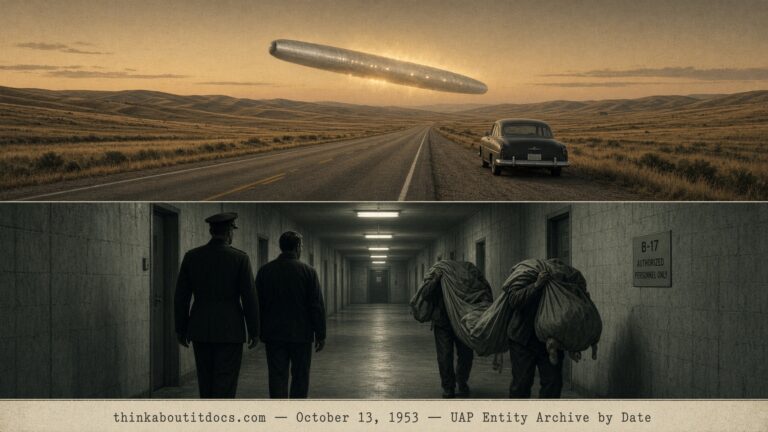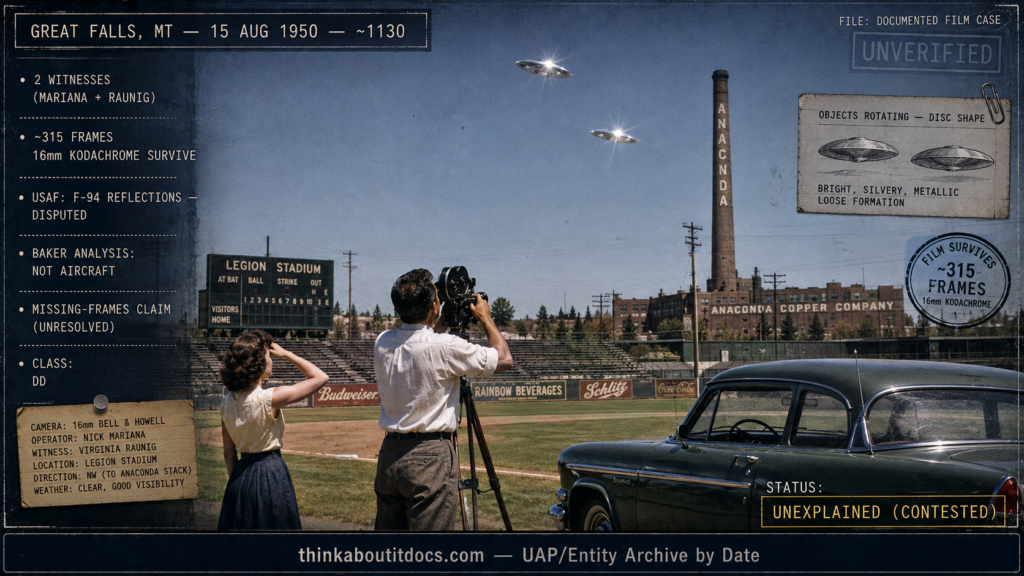
The August 15, 1950 Mariana film — Nick Mariana and Virginia Raunig watched two silvery rotating objects over Great Falls, Montana, and he captured ~16 seconds of color footage. Blue Book said jet reflections; an independent analyst disagreed. Logged Unexplained (contested). (thinkaboutitdocs.com — UAP/Entity Archive by Date)
THINK ABOUTIT UFO|UAP|ENTITY SIGHTINGS REPORT
1950: The Great Falls, Montana UFO Film (Nicholas Mariana)
It is one of the oldest pieces of motion-picture footage in the entire UFO record, and it has never been cleanly resolved in seventy-five years. Late on the morning of August 15, 1950, Nick Mariana, the manager of the Great Falls minor-league baseball team, was checking the wind at the empty ballpark with his young secretary when two bright silvery objects crossed the northwestern sky. He ran to his car, grabbed a 16mm movie camera, and captured about sixteen seconds of color film of the pair before they moved off — roughly 315 frames that still exist today. Project Blue Book eventually called the objects reflections from two Air Force jets; an independent scientist who studied the film concluded their motion did not fit the jets and left them unexplained; and Mariana insisted to his death that the Air Force had returned his film with its sharpest opening frames removed. With a named and credible witness, an independent second witness, surviving footage, and a serious dispute that official explanations never fully closed, this is a genuinely strong case — and the archive’s task is to fix the page’s errors and lay the controversy out straight.
Date: August 15, 1950
Sighting Time: About 11:25–11:30 a.m.
Day/Night: Day
Location: Legion Stadium (the baseball park), Great Falls, Montana — near the Anaconda Copper Company smokestack; Malmstrom AFB lies just east of the city
Urban or Rural: Urban
No. of Entity(‘s): None reported
Entity Type: Not applicable
Entity Description: Not applicable
Hynek Classification: DD (Daylight Disc) — two structured objects filmed in daylight; the prior “CE-I” is incorrect, as there was no close-range proximity, entity, or physical trace
Duration: About 16 seconds of film (the sighting itself slightly longer)
No. of Object(s): 2
Description of the Object(s): Two bright, silvery objects, described by the witness as disc-shaped and rotating, that appeared on the film as bright circular points of light; Mariana and others who saw the earliest frames said those frames showed the discs with a notch or band around the rotating rim; he estimated them at roughly 50 feet across, about 150 feet apart, moving fast and then briefly slowing or hovering before departing
Shape of Object(s): Disc / oval (rotating)
Size of Object(s): Estimated about 50 feet across (witness estimate)
Color of Object(s): Bright silvery-white
Distance to Object(s): Not precisely determined; the objects were at aerial distance, captured with a telephoto lens
Height & Speed: Airborne; witness estimated roughly 200–400 mph, slower than a jet, with an apparent pause in flight
Number of Witnesses: 2 (Nicholas Mariana and his secretary, Virginia Raunig, age 19)
Special Features/Characteristics: Among the earliest UFO motion films on record; ~315 frames of 16mm Daylight Kodachrome survive; independent photogrammetric analysis by Dr. Robert M.L. Baker, Jr.; an official Air Force “aircraft reflection” verdict that is widely disputed; the witness’s enduring claim that the Air Force removed the sharpest opening frames; footage now held in the U.S. National Archives with the Project Blue Book files
Case Status: Unexplained (contested)
Source: Nicholas “Nick” Mariana; NICAP, “The UFO Evidence” (1964); USAF Project Blue Book file; photogrammetric analysis by Dr. Robert M.L. Baker, Jr. (Douglas Aircraft); the Condon/Colorado study (Dr. Roy Craig, 1967)
Summary/Description: On August 15, 1950, around 11:30 a.m., Nick Mariana, general manager of the Great Falls Electrics baseball team, and his secretary Virginia Raunig saw two bright silvery, rotating objects over Great Falls, Montana. Mariana filmed about sixteen seconds of 16mm color footage, some 315 frames of which survive. Project Blue Book ultimately attributed the objects to reflections from two F-94 jets; independent analyst Dr. Robert Baker found their motion inconsistent with the aircraft and left them unexplained. Mariana long claimed the Air Force removed the sharpest opening frames before returning the film. With credible dual witnesses, surviving footage, and an unresolved dispute, the case is logged as Unexplained (contested).
Related Cases: 1952: The Tremonton, Utah UFO Film (Delbert Newhouse) | 1950: McMinnville, Oregon UFO Photographs | Montana Sightings archive
DETAILED REPORT
Nicholas Mariana — Nick to everyone in Great Falls — was a known and reasonably trusted local figure. He had studied journalism, served in the Army Air Forces from 1943 to 1945, leaving as a corporal, and by 1950 managed the Great Falls Electrics, the city’s Class D minor-league baseball club, and worked as a local sports broadcaster. (The team’s name is given as “Selectrics” in the old NICAP write-up and on many sites that copied it; the club was the Electrics, and the error has simply been recopied for decades.) On the morning of August 15, 1950, a little before 11:30, he was at Legion Stadium preparing for that afternoon’s game, his nineteen-year-old secretary Virginia Raunig with him. He looked toward the northwest — toward the tall Anaconda Copper smokestack, to read the wind — and saw two bright silvery objects in the sky, “like two new dimes,” moving fast.
He realized at once they were not aircraft. He shouted to Raunig, ran the sixty-odd feet to his car, pulled his 16mm movie camera from it, and began filming with a telephoto lens. He captured about sixteen seconds of the two objects on Daylight Kodachrome color film — roughly 315 frames — as they crossed the sky and moved off. Raunig saw the objects too, giving the film an independent human witness alongside the footage itself. To the naked eye, Mariana said, the objects were disc-shaped and rotating, perhaps fifty feet across and a hundred and fifty apart; on the developed film they register mainly as two bright circular points of light.
The film made Mariana briefly famous; he showed it around Great Falls, and it eventually drew the Air Force’s attention. An officer from Wright-Patterson interviewed Mariana and Raunig and, with permission, sent the film east for analysis. This is where the case’s enduring controversy begins. When the film came back, Mariana said, its first roughly thirty-five frames were gone — the very frames that, he and several people who had seen the film before it shipped insisted, showed the objects largest and clearest, with a distinct notch or band rotating around each disc’s rim. The Air Force’s position was that only a single frame had been damaged in handling. The dispute has never been settled: those who saw the early footage backed Mariana’s account, but Mariana, when pressed years later by the Condon study’s investigator, could not produce the correspondence in which he said the Air Force had admitted removing film.
The official explanation, reached by Project Blue Book, was that the two objects were sunlight reflecting off a pair of F-94 jet fighters that had taken off from the local air base around that time, seen from below at an angle that made them flare. On that basis Blue Book marked the case identified. But the explanation has always been considered strained, and not only by enthusiasts. In 1955–56 Dr. Robert M.L. Baker, Jr., a scientist at Douglas Aircraft, obtained copies of the footage and performed a careful photogrammetric analysis; he concluded that the objects’ motion and appearance were not consistent with the known jets and that the film could not be explained as conventional aircraft. When the University of Colorado (Condon) study revisited the case in 1967, its investigator Roy Craig leaned back toward the aircraft hypothesis but could not fully close the question either. The result is a genuine standoff: an official “identified” verdict that a qualified independent analyst rejected on technical grounds, with neither side able to deliver a knockout.
Two clarifications keep the entry honest. The prior page described the film as “listed as Top Secret” and stated as fact that “much of the early footage was apparently removed by the Air Force.” The footage was examined at Wright-Patterson and is today openly held in the U.S. National Archives with the rest of the Blue Book files, where it can be viewed; the “Top Secret” language comes from the older NICAP write-up. And the removed-frames claim, while genuinely supported by several people who saw the film early, remains a disputed claim rather than an established fact — the Air Force acknowledged only one damaged frame, and the documentary proof Mariana cited was never produced. The archive records the claim, and the corroboration for it, without asserting it as settled.
What remains after all the back-and-forth is substantial. Two credible witnesses saw two rotating silvery objects in clear daylight; one of them captured them on color film that still exists; a qualified scientist analyzed that film and rejected the official aircraft explanation; and a credible, if unproven, allegation that the most diagnostic frames were lost in official hands has hung over the case for decades. The F-94 reflection hypothesis is a real candidate that has never been conclusively ruled out — which is exactly why the case cannot be called a clean “unknown,” but also cannot honestly be called solved.
RESEARCHER’S NOTES
The Mariana Film — Great Falls 1950 and a Verdict Still Contested
- Classification correction (CE-I to DD): The prior page’s CE-I is inapplicable. A close encounter of the first kind requires an object at close range — within a few hundred feet — and there was nothing close here: two objects filmed at aerial distance with a telephoto lens, no entity, no physical trace. This is the textbook Daylight Disc (DD), and specifically a photographic/film case, which is among the more evidentially valuable categories precisely because it leaves a physical artifact to analyze. The classification is corrected to DD.
- Witness and record corrections: Several factual fixes matter. The witness was Nicholas “Nick” Mariana, not “Nicolas.” His baseball club was the Great Falls Electrics, not the “Selectrics” — a copied error. And the case was not single-witness: his secretary Virginia Raunig independently saw the objects, which materially strengthens it. The prior page’s “single” witness entry understated one of the case’s real assets, the human corroboration standing behind the film.
- The status question, weighed honestly: This case sits in the genuinely contested middle, and the prior page oversimplified it in the “unknown” direction just as Blue Book oversimplified it in the “identified” direction. The honest picture has three parts: Blue Book officially attributed the objects to F-94 reflections and closed the case; Dr. Robert Baker’s independent photogrammetric work concluded the jets did not fit and the objects were unexplained; and the Condon study later leaned toward the aircraft view without resolving it. A qualified analyst’s technical rejection of the official answer is why “Unexplained (contested)” is the accurate label — the aircraft hypothesis is a live, unrefuted candidate, but it is not established, and the case is widely regarded as open.
- The missing frames — claim, corroboration, and dispute: The allegation that the Air Force returned the film minus its sharpest opening frames is the case’s most charged element, and it must be handled as what it is. In its favor: several people who viewed the film before it was sent away supported Mariana’s account that the early frames showed the discs larger and with a rotating rim-notch. Against it: the Air Force said only one frame was damaged, and when the Condon investigator pressed Mariana in 1967, he could not produce the letter in which he claimed the USAF admitted removing footage. The archive records both the claim and its corroboration without certifying it; it is a serious, unresolved allegation, not a documented fact, and it cuts to the heart of why the case still matters — the most diagnostic evidence may simply no longer exist.
The Great Falls film endures because it is early, because it is real film that still survives, because it has two credible witnesses behind it, and because the official explanation was rejected by a qualified scientist who studied it. Stripped of the errors the old page carried — the misspelled name, the wrong team, the phantom “single witness,” the flat assertion that footage was definitely removed — and reclassified as the Daylight Disc film case it is, it stands where the evidence honestly leaves it: Unexplained, and still contested seventy-five years on.
Source