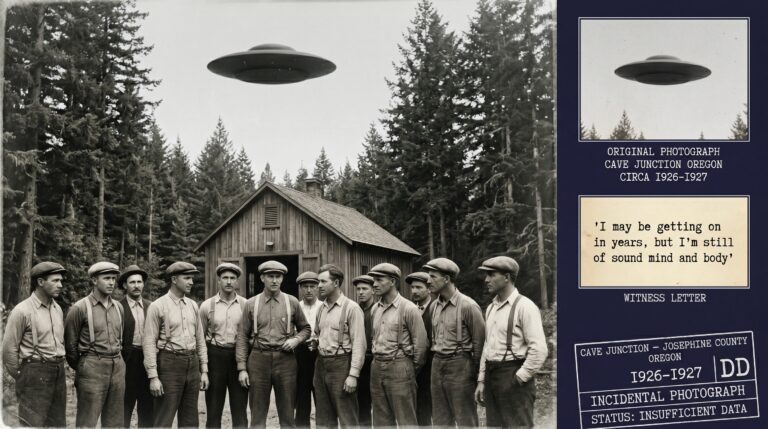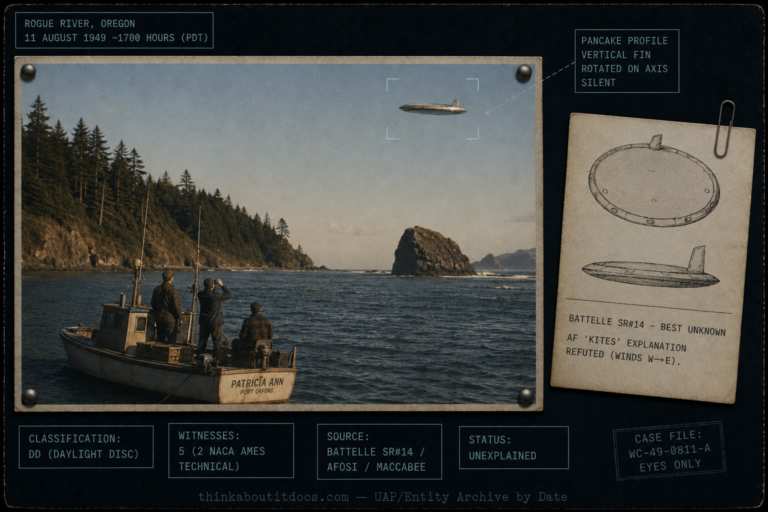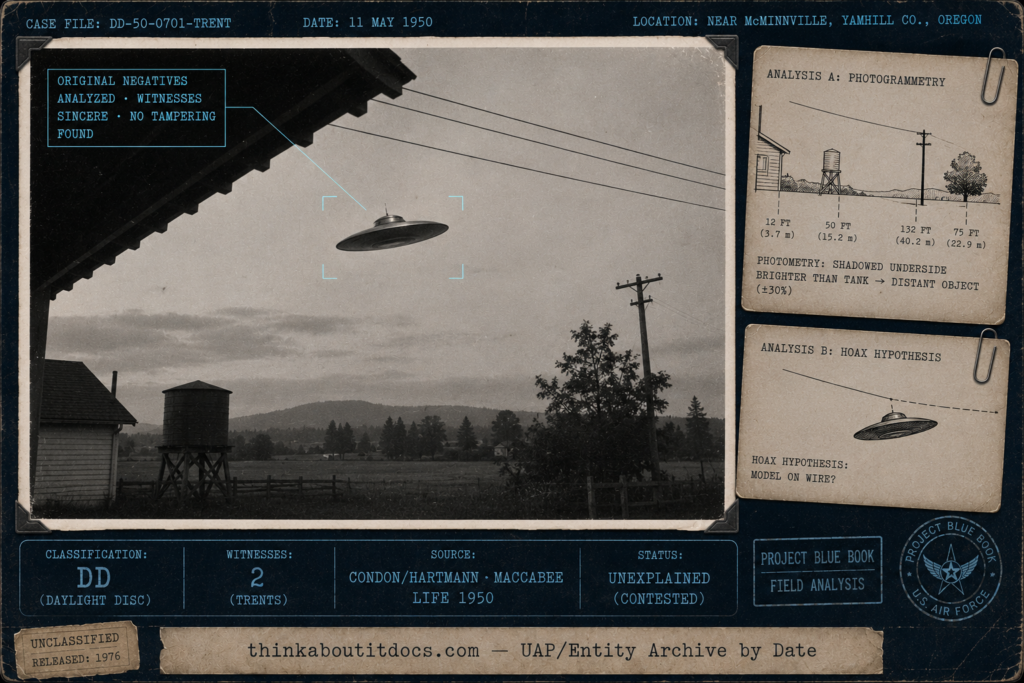
The Trent photographs, near McMinnville, Oregon, May 11, 1950 — a silvery disc photographed by farmers Paul and Evelyn Trent, backed by the Condon astronomer and disputed by skeptics; classified DD, status Unexplained (contested).
THINK ABOUTIT UFO | UAP SIGHTING REPORT
1950: The McMinnville (Trent) Photographs — Oregon
Just before sunset on May 11, 1950, Evelyn Trent was walking back from feeding the rabbits on the family farm near McMinnville, Oregon, when she looked up and saw a large, silvery, disc-shaped object gliding silently in from the northeast. She called her husband Paul, who took one look, ran inside for the camera, and managed two photographs from a few feet apart before the thing tilted and slid away to the west. The Trents were not seeking attention — the film sat in the camera until the roll was finished, the prints ended up tacked on a wall in their bank, and only then did a local reporter coax the story out of them. Those two frames went to Life magazine and into history. Seventeen years later, the U.S. government’s own Condon Committee handed the negatives to a professional astronomer, who measured them and concluded that the simplest reading of the data was precisely what the Trents had said: a real, shiny, metallic disc, tens of meters across, evidently artificial, at considerable distance. Three-quarters of a century and several rounds of expert combat later, the McMinnville photographs remain unresolved — and remain among the best the field has.
Date: May 11, 1950
Sighting Time: Early evening, just before sunset (about 7:30 p.m.)
Day/Night: Day (dusk; full daylight photography)
Location: The Trent farm near McMinnville (Yamhill County), Oregon
Urban or Rural: Rural — a working farm
Hynek Classification: DD (Daylight Disc)
Duration: A few minutes (long enough to summon a second witness, fetch a camera, and expose two frames)
No. of Object(s): 1
Description of Object(s): A large, silvery, metallic, disc-shaped object with a slight off-center superstructure or “mast” rising from the upper surface (visible in the photographs); it approached from the northeast, hung in view, then tilted and departed silently to the west
Shape: Disc (with a small raised structure on top)
Size: On the order of tens of meters in diameter, per the Condon Committee’s photogrammetric analysis (if the object was genuinely at distance)
Color: Silvery / metallic, shiny
Distance: Not precisely fixed; photometric scaling placed it at “considerable distance,” with a stated accuracy of about ±30% (worst case a factor of four)
Height & Speed: Airborne; silent; no sound or exhaust reported
No. of Witnesses: 2 primary — Paul A. Trent and Evelyn Trent — with Paul’s father reportedly catching a brief glimpse before it vanished
Special Features/Characteristics: Two original negatives preserved and subjected to formal scientific analysis; no money sought by the witnesses, who maintained their account for the rest of their lives; analyzed for the U.S. government’s Condon Committee by astronomer William K. Hartmann, who found the data consistent with a real distant object; later challenged by skeptics as a possible small model suspended from overhead wires
Case Status: Unexplained (contested)
Source: McMinnville Telephone-Register (June 8, 1950); Life magazine (June 26, 1950); William K. Hartmann’s photographic analysis in the Condon Report, Scientific Study of Unidentified Flying Objects (1969); detailed analyses by Dr. Bruce Maccabee; skeptical re-analyses by Robert Sheaffer, Philip J. Klass, and (later) the IPACO group
Summary/Description: On the evening of May 11, 1950, Evelyn Trent spotted a large silvery disc over the family farm near McMinnville, Oregon, and called her husband Paul, who photographed it twice with the family camera from positions a few feet apart before it departed to the west. The Trents were reluctant to publicize the images; they surfaced weeks later, ran in the local newspaper on June 8 and then in Life on June 26, 1950, and the negatives were not returned to the family for seventeen years. In 1967–68, astronomer William K. Hartmann analyzed the original negatives for the University of Colorado (Condon) UFO Project, using foreground objects of known distance to estimate scale and brightness; he concluded that the photographs were consistent with a distant, shiny, metallic, disc-shaped object tens of meters across and “evidently artificial,” while acknowledging that a fabrication could not be positively excluded. The case has since been defended in detail by Bruce Maccabee and challenged by skeptics who argue the object may be a small model hung from the power lines visible in the frames. No analysis has definitively resolved it.
Related Cases: 1950 — Mariana film, Great Falls, Montana (iconic 1950 daylight UFO motion film) | 1949 — Rogue River, Oregon daylight disc (Battelle best-unknown; regional and technical-witness parallel) | 1952 — Tremonton, Utah / Newhouse film (major analyzed motion-picture case)
Full Report
The McMinnville photographs occupy a peculiar place in the record: they are among the most scrutinized images in the history of the subject, and that scrutiny has produced not a verdict but a permanent, high-quality standoff. The reason the case has lasted is that both the circumstances and the physical evidence are unusually good for the era, and yet a credible mundane hypothesis has never been fully eliminated.
The circumstances first. By the Trents’ account, Evelyn saw the object while finishing her evening chores, summoned Paul, and he photographed it twice with the family’s folding camera from slightly different positions before it left to the west. The behavior afterward is part of what impressed investigators: the Trents did not rush to the press. Paul finished the roll on ordinary family snapshots before developing it, the prints were displayed casually — reportedly in their bank — and the story emerged only because a local reporter, Bill Powell, saw them and persuaded the couple to go public, which they did with visible reluctance, fearing official trouble. The images ran in the McMinnville Telephone-Register on June 8, 1950, and in Life on June 26. The negatives then vanished into the magazine’s and investigators’ hands and were not returned to Paul Trent for seventeen years. Everyone who dealt with the Trents over the decades came away describing them as sincere, unsophisticated, and entirely consistent — they never altered their story, never sought payment, and never capitalized on the fame.
The physical analysis is the case’s spine. When the University of Colorado’s federally funded Condon Committee took up UFOs in the late 1960s, the original Trent negatives were handed to William K. Hartmann, a professional astronomer at the University of Arizona. Hartmann performed a careful photometric and photogrammetric study, using foreground features of measurable distance — the house, a metal water tank, a telephone pole, a tree — to establish an atmospheric attenuation factor and a scaling method, which he judged accurate to roughly ±30 percent. His key finding was about brightness: the underside of the object in shadow was substantially brighter than the shadowed side of the nearby water tank, which is what one expects of a distant object lit by scattered atmospheric light rather than a small nearby model. He concluded that the photographs were consistent with a real, shiny, metallic, disc-shaped object on the order of tens of meters across and “evidently artificial,” and noted pointedly that the simplest, most direct reading of the images matched exactly what the witnesses had described. He stopped short of declaring a fabrication impossible — but for a Condon investigator, whose project largely concluded UFOs did not merit further study, this was a striking endorsement, and McMinnville became one of the report’s genuinely unexplained cases.
The case did not rest there, because skeptics mounted serious counter-arguments. Robert Sheaffer and Philip J. Klass scrutinized the shadows on the Trents’ garage and argued that the lighting indicated a morning exposure rather than the claimed evening, implying the account was unreliable and the object might have hung from the overhead wires for some time. More recently, the French photo-analysis group IPACO argued from image geometry that the object is consistent with a small model suspended from the power line that crosses the upper part of the frame. Against this, Dr. Bruce Maccabee — an optical physicist who has analyzed the negatives more exhaustively than anyone — has defended their authenticity for decades, rebutting the shadow argument and maintaining that the photometry favors a genuine distant object.
What survives all of this is a true impasse between competent analysts. The hoax hypothesis is plausible and has never been ruled out; the authenticity case is supported by the official photometric analysis and by the witnesses’ unimpeachable behavior, and has never been overturned. No examination has found tampering on the negatives or a thread or wire on the object. The case is neither proven nor debunked — it is genuinely undecided, which, given seventy-five years of effort, is itself remarkable.
RESEARCHER’S NOTES
The Trent Photographs — McMinnville 1950 and the Unbroken Standoff
- Classification. This is a textbook DD (Daylight Disc): a metallic, disc-shaped object photographed in daylight (at dusk, but in full photographic light), with no occupants and no close-approach traces. The classification describes the observation type and is not in dispute; the controversy is entirely about authenticity, not category. The live page’s “Air” entry under Urban/Rural has been corrected to Rural, since the site was a working farm.
- Source chain. The provenance is, by 1950 standards, excellent. Original negatives survived and were formally analyzed; the case was published contemporaneously in local and national press; and it was studied by the U.S. government’s own Condon Committee through a named professional astronomer, with the analysis preserved in the published report. It has since been worked over by serious analysts on both sides — Maccabee for authenticity, Sheaffer, Klass, and IPACO for the hoax hypothesis. This is among the best-documented photographic cases of the era, with primary-tier sourcing throughout.
- Pattern context. McMinnville belongs to the small, elite set of early photographic and film cases that survived rigorous study — alongside the 1950 Mariana film from Great Falls and the 1952 Tremonton film, both also examined by the Condon Committee, and the 1949 Rogue River daylight disc from elsewhere in Oregon. These are the cases the field returns to precisely because they cannot be easily dismissed. The Trent images in particular became a benchmark for the debate over what counts as physical evidence in UFO studies.
- Physical / evidentiary weight. High and genuinely double-edged. In favor of authenticity: surviving original negatives, a formal photometric analysis by a professional astronomer that supports a distant real object, no detectable tampering, and two manifestly sincere witnesses who profited nothing and never wavered. Against: a credible, unrefuted hoax hypothesis involving a small model suspended from the visible overhead wires, plus a contested shadow-timing argument. Because neither side has been able to close the case, the honest disposition is Unexplained — not as a claim that the object was extraordinary, but as an accurate statement that decades of expert analysis have failed to resolve it either way. It remains one of the strongest and most legitimately debated photographic cases on record.
The McMinnville photographs endure because they refuse to break. They have the things most cases lack — original negatives, a formal government-commissioned analysis that came down on the side of the witnesses, and a farm couple whose conduct gave investigators nothing to distrust — and yet they also have a plausible, stubborn alternative in the overhead wires that has never been ruled out. After seventy-five years, the most accurate thing that can be said is the least dramatic: the simplest reading of the images matches what Paul and Evelyn Trent always said they saw, and no one has proven otherwise. The case belongs in the chronological record as a benchmark Unexplained daylight-disc photograph — its strengths and its open question both stated plainly.
Pictures