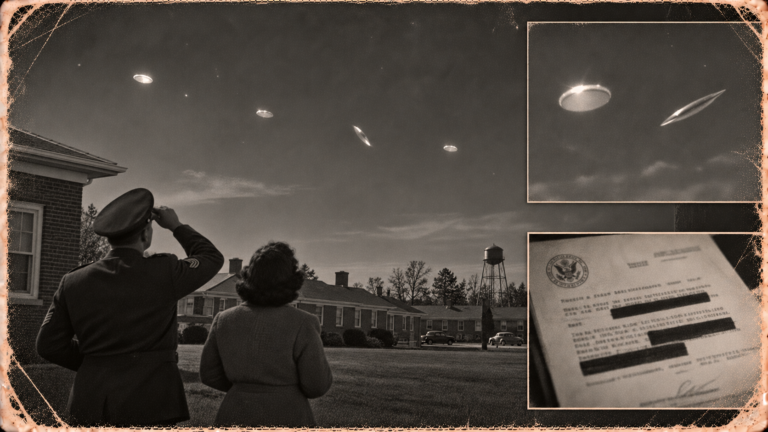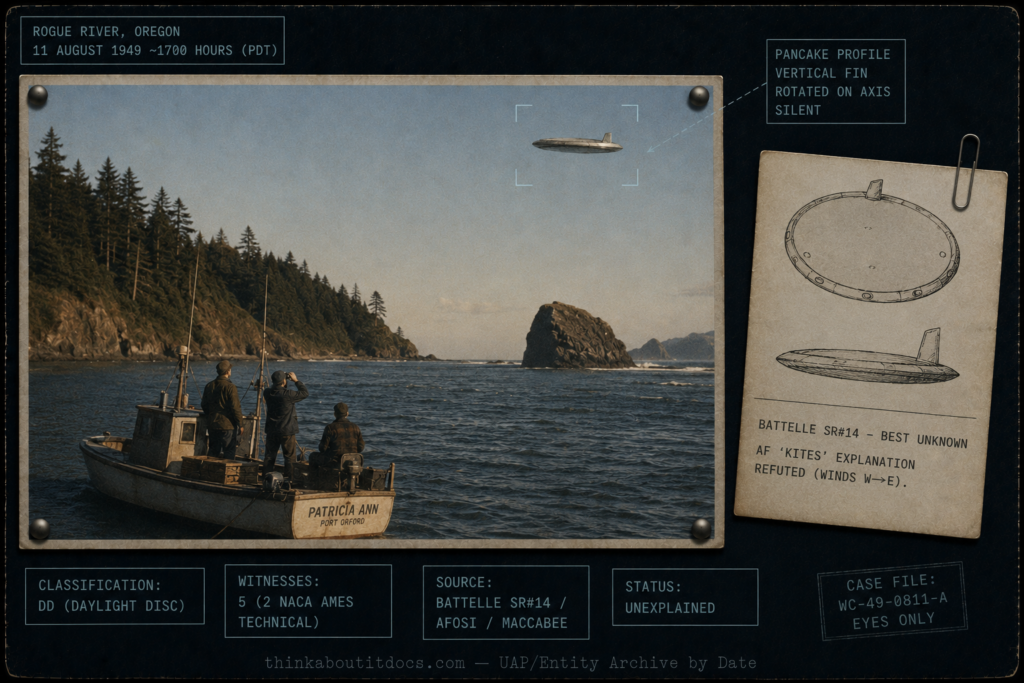
The Rogue River disc, near Gold Beach, Oregon, May 24, 1949 — a finned silver disc watched through binoculars by NACA Ames employees and ranked Battelle's best unknown; classified DD, status Unexplained.
THINK ABOUTIT UFO | UAP SIGHTING REPORT
1949: The Rogue River Disc — Aeronautical Laboratory Employees, Oregon
Late on the afternoon of May 24, 1949, five people were drifting in a boat near the mouth of Oregon’s Rogue River, scanning the water with 8-power Navy binoculars for jumping fish, when a silver, coin-shaped object slid in from the northeast and hung in the clear sky east of them. Two of the men passed the glasses back and forth and got a good, deliberate look: a thin disc like a pancake, silvery and faintly dirty along its trailing edge, with a small vertical fin on top — no wings, no tail, no engine, no exhaust, no sound. It pivoted on its vertical axis without tilting, then accelerated away to the south at something near jet speed and was gone. What lifts this above an ordinary disc report is who was holding the binoculars: two of the witnesses were technically trained employees of the NACA’s Ames Aeronautical Laboratory. When the Air Force later filed the case away as “aircraft” and “kites,” its own contracted scientists at Battelle refused the explanation and ranked Rogue River as the single best of their dozen finest unknowns.
Date: May 24, 1949
Sighting Time: Approximately 1700 hours (late afternoon)
Day/Night: Day (late afternoon, clear sky, sun at the witnesses’ backs)
Location: Near the mouth of the Rogue River, by Elephant Rock, about 1.5 miles above the US-101 highway bridge at Gold Beach, Oregon
Urban or Rural: Rural — on the river near the coast
No. of Entity(‘s): None reported
Entity Type: Not applicable
Entity Description: Not applicable — daylight object sighting, no occupants
Hynek Classification: DD (Daylight Disc)
Duration: 2½ to 3 minutes
No. of Object(s): 1
Description of Object(s): A circular object, thin relative to its diameter — likened to a pancake or a coin seen with its flat face parallel to the ground — silvery and metallic, with a small vertical fin on the upper surface at the trailing edge and a trailing edge that looked wrinkled and dirty. No wings, tail, antenna, lights, propellers, or jet engines were seen, and no exhaust. It hovered, made a turn on its vertical axis with no tilting or banking, then accelerated smoothly to roughly jet speed and departed to the south.
Shape: Disc (pancake/coin profile with a small vertical trailing-edge fin)
Size: Comparable to a C-47 aircraft by one witness’s estimate (uncalibrated)
Color: Silvery / metallic
Distance: At closest, an estimated couple of miles distant and about a mile high
Height & Speed: ~1 mile altitude; hovered, then accelerated to approximately the speed of a jet in a few seconds
No. of Witnesses: 5 (three men and two women); two of the men — a draftsman and a wind-tunnel mechanic — were employees of the NACA Ames Aeronautical Laboratory at Moffett Field, California, and shared the binoculars
Special Features/Characteristics: Observed through 8× Navy binoculars by technically trained witnesses; structureless except for a single trailing-edge fin; rotated on its vertical axis without banking; completely silent; reported privately to the Moffett Field security office rather than the press, prompting an AFOSI investigation
Case Status: Unexplained
Source: U.S. Air Force Project Blue Book Special Report #14 (Battelle Memorial Institute / Project Stork study, released 1955); AFOSI case investigation; Dr. Bruce Maccabee, The UFO-FBI Connection
Summary/Description: At about 5:00 p.m. on May 24, 1949, five people fishing near the mouth of the Rogue River at Gold Beach, Oregon, watched a silver, coin-shaped disc approach from the northeast, hover to their east for about two and a half minutes, and then depart at high speed to the south. Two of the witnesses — a draftsman and a wind-tunnel mechanic from the NACA Ames Aeronautical Laboratory — studied it through 8× binoculars, each for about a minute. They described a thin, circular, pancake-like object with a small vertical fin at the trailing edge, a wrinkled and dirty-looking rim, and no wings, engines, exhaust, or sound. It turned on its vertical axis without banking before accelerating away. The witnesses reported the sighting privately to the Moffett Field security office about three weeks later, which referred it to the AFOSI for investigation. Project Grudge later split the case in two and labeled the parts “aircraft” and “kites,” but the Battelle scientists who reviewed it for Special Report #14 rejected those explanations and listed Rogue River among their best unidentified cases.
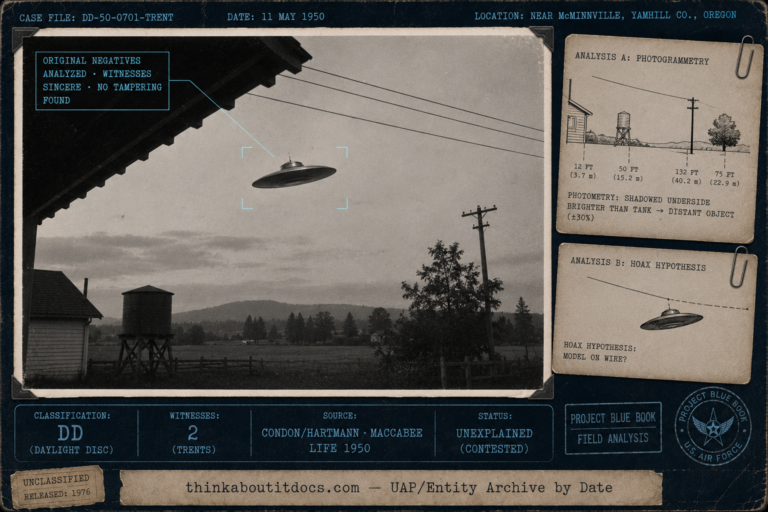
Related Cases: 1950 — McMinnville (Trent) photographs, Oregon (daylight disc, regional) | 1952 — Tremonton, Utah / Newhouse film (another Special Report #14 best case) | the Project Blue Book Special Report #14 “Unknowns” set (Battelle / Project Stork)
Full Report
The Rogue River case is unusual in the early record for the combination of credible, technically trained witnesses, a deliberate optically aided observation, and a documented official mishandling that later analysts were able to expose.
The observation itself was unhurried. Five people — three men and two women — were in a boat near the river’s mouth at Gold Beach late on a clear May afternoon, the sun behind them, using 8-power Navy binoculars to spot jumping fish. A circular object came in from the northeast and hovered to their east. Two of the men, a draftsman and a wind-tunnel mechanic from the NACA Ames Aeronautical Laboratory at Moffett Field, traded the glasses, each getting roughly a minute of magnified viewing. They agreed on a thin, circular object like a pancake or a coin held flat to the ground, silvery, with a small vertical fin on the upper surface near the back and a trailing edge that looked wrinkled and dirty. There were no wings, no tail, no antenna, no lights, no propellers, no jet engines, and no exhaust. At one point it rotated on its vertical axis without tilting or banking. Then, over a few seconds, it accelerated to about the speed of a jet and vanished to the south — in total silence. They put its nearest approach at a couple of miles, its altitude near a mile, and its apparent size on the order of a C-47.
The reporting behavior is itself part of the evidence. Rather than calling a newspaper, the Ames men reported the sighting to the security office at Moffett Field about three weeks later, and the security office requested an AFOSI investigation. As Maccabee observed, this is the opposite of how a hoaxer behaves: no one whose livelihood depended on a security clearance would fabricate a flying-saucer story for the security officer at his own workplace, and the case never surfaced in the popular press. AFOSI agents interviewed all the witnesses, and the two Ames employees twice, and came away rating the report highly credible.
The official handling is where the case turns instructive. When Project Grudge processed it, the sighting was divided into two separate entries. One — built around an August interview with one of the two women, who candidly said she was not familiar with aircraft — was labeled “aircraft,” on the reasoning that nothing proved the object could not have been one; this required ignoring her description of it as circular and treating her account in isolation from the others. The second entry was labeled “kites,” after the investigating agent learned that radar kites — small diamond-shaped aluminum reflectors carried aloft by gas balloons — were launched twice daily from military installations near San Francisco, and speculated that one might have drifted as far north as Gold Beach.
That explanation collapses on contact with the description and the physics. A radar kite is not pancake-shaped; it hangs beneath a balloon roughly its own size that the witnesses would have seen; and it can move no faster than the wind. A deflating kite would be observed falling, not accelerating to jet speed and shrinking into the distance. The Battelle scientists, reviewing the case for Special Report #14, did not accept the Air Force’s explanation. Decades later, Maccabee added the decisive point: he obtained the regional weather records for the day of the sighting and the day before, and the winds at all altitudes were blowing from west to east — they could not have carried a balloon some 300 miles north-northwest from San Francisco to the Rogue River. The agent could have checked that in 1949; he appears to have stopped once a “possible” label was in hand.
What remains is a clean, optically aided, multiple-witness daylight observation of a structured disc by trained observers, with the official explanations refuted on their own terms. Battelle, having explained roughly seventy percent of the thousands of cases it studied, set Rogue River at the head of the dozen it judged the most descriptive and least explicable — and included two sketches of the finned pancake disc in the final report.
RESEARCHER’S NOTES
The Rogue River Disc — Oregon 1949 and the Best of the Unknowns
- Classification. This is a clear DD (Daylight Disc): a metallic, disc-shaped object observed in full afternoon light, studied through binoculars, with no occupants and no close-approach landing. The structural detail the witnesses resolved — the pancake profile, the single trailing-edge fin, the wrinkled rim — strengthens rather than complicates the category; this is exactly the kind of well-seen daytime disc the DD class was meant to capture. No close-encounter or radar designation applies.
- Source chain. The provenance is top-tier. The case rests on a contemporaneous AFOSI field investigation, was selected and analyzed by the Battelle Memorial Institute for the Air Force’s own Special Report #14, and was later researched in depth by Dr. Bruce Maccabee, a Navy optical physicist working from the original government microfilm. The chain is government-documented from end to end, and the most important reanalysis — the weather check that sank the kite theory — is independently verifiable from public records. There is no enthusiast intermediary and no reliance on memory.
- Pattern context. Rogue River sits among the elite of the Special Report #14 “unknowns,” the residue of well-documented cases that survived Battelle’s systematic effort to explain sightings away. It belongs with the period’s strongest daylight-disc reports — the 1950 McMinnville photographs from elsewhere in Oregon, the 1952 Tremonton film analyzed by the Navy and later by Maccabee — cases distinguished by credible witnesses or instrumentation and by explanations that did not hold. Its profile, a thin finned disc that hovered and then accelerated silently, recurs across the better daytime cases of the era.
- Physical / evidentiary weight. High. There is no photograph, but the case offers much of what photographs usually lack: multiple witnesses, two of them technically trained; an optically aided, minutes-long observation in good light; consistent independent descriptions; a documented investigation; selection as a best unknown by the Air Force’s own contractor; and the affirmative refutation of both official explanations, the “kites” version by hard meteorological data. The honest disposition is Unexplained, and unusually well-earned — this is not an absence of explanation but a positive failure of the conventional ones.
The Rogue River sighting is the kind of case the Battelle study existed to find: a sober, optically aided, multiple-witness daylight observation by trained people who reported it through the quietest possible channel and gained nothing by it. The Air Force’s “aircraft” and “kites” labels did not survive scrutiny — the second undone by the simple fact that the wind blew the wrong way — and Battelle itself placed the case at the top of its finest unknowns. It stands in the chronological record as one of the strongest daylight-disc reports of the 1940s, catalogued plainly as Unexplained, with the official explanations noted for exactly what they were.
Full Report
Summary from USAF Project Blue Book Special Report #14:
An employee in the supersonic laboratory of an aeronautical laboratory and some other employees of this lab, were by a river, 2-1/2 miles from its mouth, when they saw an object. The time was about 1700 hours on May 24, 1949. The object was reflecting sunlight when observed by naked eye. However, it then looked at it with 8-power binoculars, at which time there was no glare (Did glasses have filter?) It was of metallic construction and was seen with good enough resolution to show that the skin was dirty. It moved off in horizontal flight at a gradually increasing rate of speed, until it seemed to approach the speed of a jet before it disappeared. No propulsion was apparent. Time of observation was 2-1/2 to 3 minutes.
The Rogue River Incident
by Bruce Maccabee, from “UFO FBI Connection”
The sighting is important because of the quality of the observations by the several observers, and because the witnesses reported the sighting only to their local security agency, and to the AFOSI.
During the afternoon of May 24, 1950 (sic), five people, three men and two women, were fishing in a boat near the mouth of Oregon’s Rogue Riven At about 5:00 P.M., they were scanning the river with 8x Navy binoculars looking for signs of jumping fish, when they first noticed a strange circular object approaching from the northeast. They watched it for about two-and-a-half minutes as it hovered east of them before it departed at high speed in a southward direction. The sky was clear and the afternoon sun was at their backs. To the naked eye, it appeared shiny and shaped like a coin with the flat surface parallel to the ground. At its closest it seemed to be only a couple of miles away and about a mile high. They heard no noise.
Two of the witnesses, a draftsman and a wind-tunnel mechanic, were employees of the Ames Research Laboratory at Moffett Field, south of San Francisco.* These two men shared the binoculars. Each man had about a minute to look at the object through the binoculars. The men observed that the object was circular and thin relative to its diameter, with a shape similar to that of a pancake, and with some sort of a vertical fin on the upper surface at the trailing edge. They could see no wings, no antenna, no lights, no propellers, and no jet engines. According to the AFOSI report:
[The] object appeared round and shiny, something like a fifty-cent piece, viewed from below and to one side. Object’s color was silvery and it appeared round in plan view . . . Just before Mn [name censored in the publicly available copy of the original Air Force document] handed the glasses to Mr. , the object made a turn on its vertical axis with no tilting or banking … The trailing edge of the object as it traveled appeared somewhat wrinkled and dirty looking.
* The Ames Research Laboratory carries out research on jet engines, among other things. Employees have Secret or Top Secret security clearances.
The trailing edge looked “wrinkled and dirty;’ but there were no exhaust ports. Then they saw it speed off in a southeasterly direction, “accelerating to the approximate speed of a jet plane” in a few seconds without making any noise. About three weeks later the Ames employees reported their sighting to the security office at Moffett Field. The security office then requested that AFOSI agents investigate the sighting.
In 1952, Project Blue Book hired the Battelle Memorial Institute of Columbus, Ohio, to carry out a statistical study of flying saucer reports that occurred between 1947 and the end of 1952. The main intent of the study, called Project Stork, was to determine whether or not there were consistent differences between sighting reports that were explained and those which could not be explained as mundane phenomena. To carry out this study, the Battelle scientists, working along with the Air Force personnel at ATIC, first analyzed each sighting to determine whether or not it could be identified. The scientists were able to do much better in explaining sightings than the Air Force had done in 1948 and 1949; they were able to explain about seventy percent of the 3,201 sightings they studied. About ten percent of the sightings had too little information for a positive identification. However, about twenty percent had sufficient information for identification, yet resisted explanation. Of these they found a dozen they considered the most descriptive of the sighted phenomena. The Rogue River sighting is the best of that dozen. The two main witnesses were technically trained and, as nearly as can be deter mined from the case file, thoroughly reliable. In the final report of the study, called Project Blue Book Special Report Number 14, the scientists included two rough sketches, based on the verbal descriptions of the Ames employees, showing two views of a circular object with a thickness much less than its diameter, no wings, no tail, and no engine, but a ”wrinkled” outer edge.
The object’s description by the witnesses is very clear: it was neither an ordinary aircraft nor a hallucination. It either was a hoax or the real thing-a flying saucer. Could it have been a hoax? I would say unequivocally “no” because the two Ames employees reported their sighting to the security officer at Moffett Field. A hoaxer might report a sighting to the press, radio, or TV, but no person of reasonable intelligence whose job depended upon holding a security clearance would try to hoax the security officer at his place of employment. Furthermore, there is no evidence that this sighting was ever mentioned in the popular literature. Apparently these witnesses reported the sighting to no one but the Ames security officer The security officer then requested an investigation by the AFOSI. The AFOSI investigators interviewed all of the witnesses once, and interviewed the Ames employees a second time. The inter views established the high degree of credibility of this sighting.
The Project Blue Book microfilm at the National Archives is supposed to contain all the records collected by the Air Force. In that microfilm two sightings are listed for May 24, 1949. One sighting, case number 402, is explained as “aircraft]’ The second sighting, not numbered, is explained as “kites?’ The second sighting is not numbered because, according to a handwritten note, the “cards” are missing. This means that the copy of the AFOSI investigation report, which originally was sent to Project Grudge, had been removed from the sighting file by someone many years before the file was microfilmed and released in 1975. Fortunately, the original AFOSI investigation report was not kept at Blue Book headquarters, but rather at the headquarters of AFOSI, so when the Air Force released the combined AFOSI and Blue Book records to the National Archives, I was able to find the record of this case investigation in the AFOSI section of the microfilm.
How did Project Grudge personnel explain this multiple witness sighting, you may ask? First, accidentally (or intentionally?) they divided it into two parts and treated each separately. The sighting numbered 402 in the master case list contains the interview of one of the two women. According to the AFOSI report, this woman was interviewed on August 8 (the last of the witnesses to be interviewed). The report, in part, read:
… at approximately 1700 hours, 24 May 1949, she and four other persons, while fishing on the Rogue River near Elephant Rock, approximately 1 ‘/2 miles above the highway bridge near Gold Beach, Oregon, sighted an object described as being round in shape, silver in color, and about the size of a C-47 aircraft. when first brought to Mrs. [name censored] attention by one of the other witnesses, the object appeared to be three or four miles away. It was coming from the east but later turned to the southwest. It appeared to be traveling at the same rate as a C-47. It made no noise, left no exhaust trail, and made no maneuvers. The interviewee stated that she was not familiar with aircraft; therefore she could not estimate with any accuracy the speed or altitude at which the object was traveling. Mrs. made the comparison between the object and a C-47 because she is familiar with that type of aircraft. Her son has pointed out C-47s to her as they flew over the Gold Beach.
( Note: The names of the witnesses are unknown since they were expunged from the AFOSI records before the records were released to the National Archives in 1975.)
Based on this verbal evidence the Project Grudge personnel identified the object as an “aircraft” because, “No data [were] presented to indicate object could NOT have been an aircraft [capitalization in the original].” The Grudge personnel were able to “get away with” that explanation only because they (1) ignored her claim that the object was circular, and (2) treated her description separately from the descriptions by the other witnesses.
In order to explain the sighting by the other four witnesses, the Grudge personnel used information provided by the AFOSI investigator. This man checked airport records for air traffic or anything else that could conceivably have been in the area at that time. There were no known aircraft in the area. However, the agent learned that radar kites, which are balloons supporting thin metallic radar reflectors, were launched twice a day from military radar installations near San Francisco. He wrote in his report:
These devices are of aluminum sheet, approximately five feet on a side, roughly diamond shaped and containing a double set of triangular fins on the top side. These are carried aloft by gas-filled balloons approximately two feet in diameter when they leave the earth. When these devices reach high enough altitude, the expanding gases cause the balloon to burst and the devices known as “kites” fold and drift earth ward. It is possible that one of these devices from one of these radar installations may have been blown as far north as Gold Beach, Oregon, on 24 May 1949.
This is where the official “kites” explanation comes from. (I don’t know why the explanation is plural.) Based on this information it is immediately obvious to the most casual observer that what they saw was a radar kite, right?
Think again. The description given above is sufficient to make it clear that a radar kite is not pancake shaped. Furthermore, such a kite, if traveling through the air would be supported by one or more balloons which would have been obvious to the witnesses since the balloons are about the same size as the kite, and it could have moved no faster than the wind. If the kite were falling because the balloons had deflated, the witnesses would have seen it fall rather than accelerate to a high speed and disappear in the distance.
As illogical as it may seem, the Project Grudge and Blue Book analysts, acting on the behalf of the U.S Air Force, have officially accepted “kites” as the explanation for the sighting.
However, the Battelle scientists knew better. They did not accept the Air Force explanation. Neither do I.
I have found another reason to reject the Air Force explanation. An errant radar kite launched from the San Francisco area would have had to be carried north-northwestward a distance of about 300 miles. About thirty years after the AFOSI closed their investigation of this case, I reopened it and completed it by obtaining the weather records for the coast of northern California and Oregon. These records show that the winds at all altitudes for the day of the sighting and the day preceding were blowing from the west to the east, and could not have carried a balloon from San Francisco northward to the Rogue Riven The AFOSI agent who conducted the investigation of this case could have discovered that for himself in 1949. Apparently he decided to end the investigation once he had found a “possible” explanation.