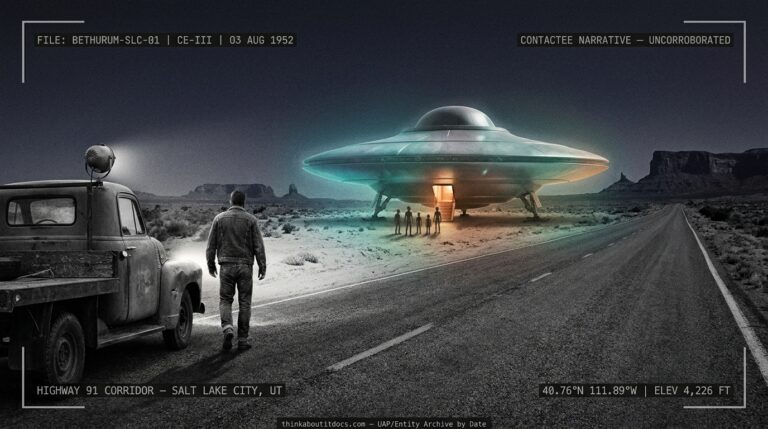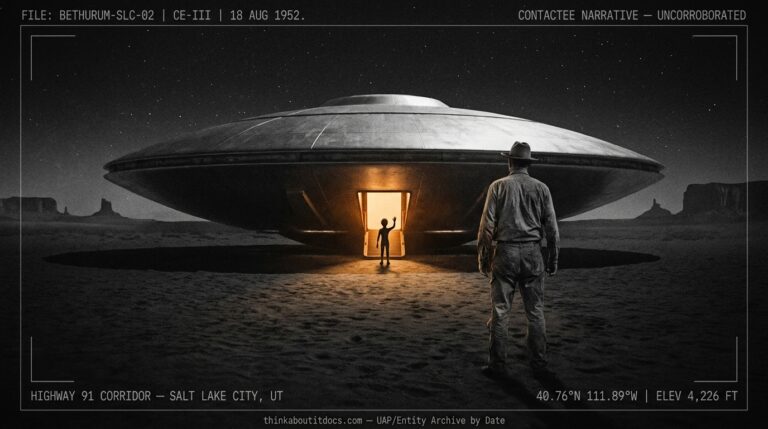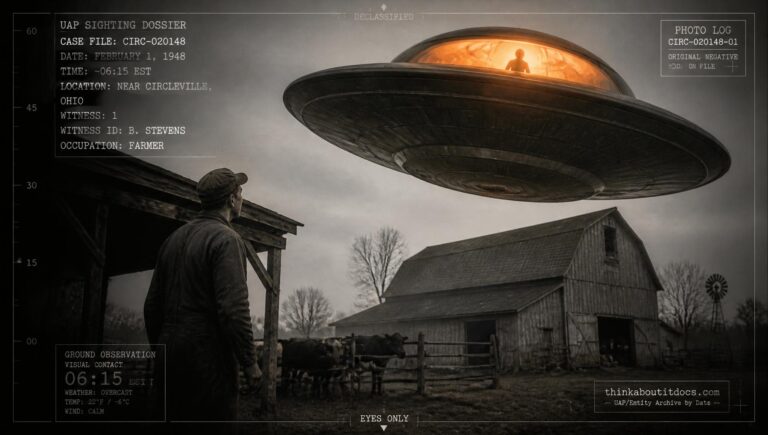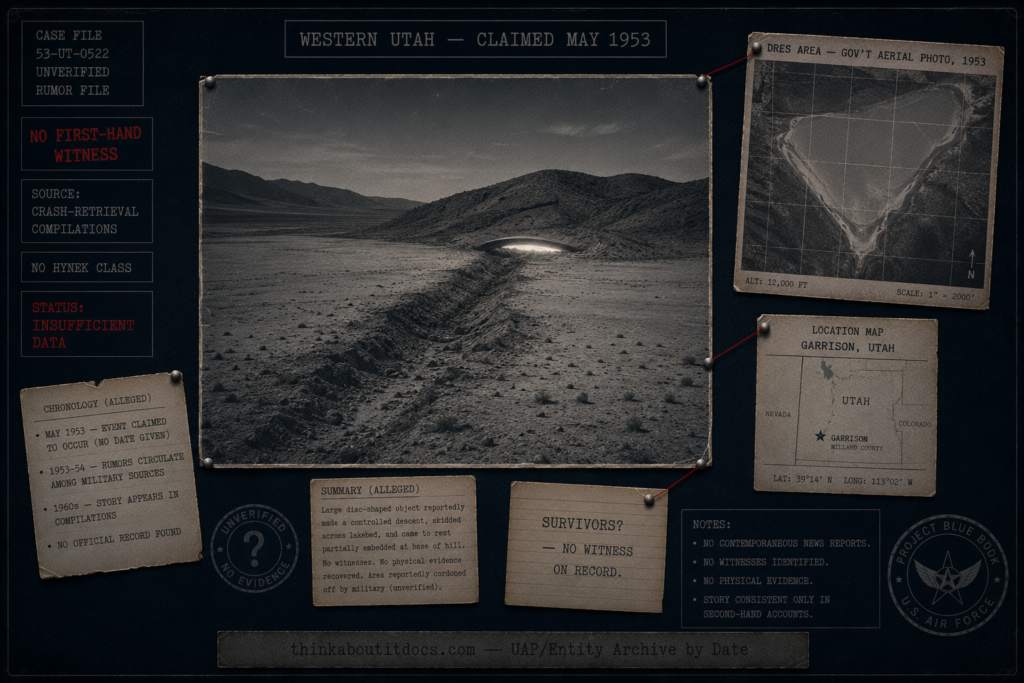
The alleged 1953 western Utah crash near the Garrison-area DRES facility — an uncorroborated crash-retrieval rumor with no named witness, logged as Insufficient Data. (thinkaboutitdocs.com — UAP/Entity Archive by Date)
THINK ABOUTIT UFO|UAP|ENTITY SIGHTINGS REPORT
1952: Crash in Western Utah
The story is striking: a disc several hundred feet across clips a hilltop, gouges the valley floor, comes to rest too large to move, and its surviving crew slip away to hide in the surrounding desert, where they are said to be glimpsed for years afterward. What the story does not have is a single named witness, a contemporaneous newspaper line, a recovered fragment, or a date everyone agrees on. The account did not surface in 1952 or 1953; it was assembled decades later by latter-day researchers and has circulated through crash-retrieval compilations ever since, usually dated to May 1953 and tied to a remote government range station near Garrison, Utah. The archive keeps the entry because the rumor is part of the record — but it logs it as exactly that: an uncorroborated crash-retrieval tale built backward from later interest, not a documented event.
Date: Most commonly given as May 20, 1953 (the prior “late spring 1952” is the weaker variant)
Sighting Time: Not recorded
Day/Night: Not recorded
Location: Western Utah — near Garrison, by the Desert Range Experimental Station (DRES), close to the Utah–Nevada line
Urban or Rural: Rural (remote high desert)
No. of Entity(‘s): Unspecified — “some” survivors claimed
Entity Type: Undescribed humanoids (per the rumor)
Entity Description: Not described in any source
Hynek Classification: None — not classifiable; an uncorroborated crash-retrieval rumor with no first-hand witnessed observation (prior CE-II removed)
Duration: Not applicable
No. of Object(s): 1 (claimed)
Description of the Object(s): A disc said to have clipped a hillside and gouged the valley floor before coming to rest, reportedly too large to recover or transport (claim only)
Shape of Object(s): Disc (claimed)
Size of Object(s): Several hundred feet in diameter (claimed)
Color of Object(s): Not recorded
Distance to Object(s): Not applicable
Height & Speed: Not applicable
Number of Witnesses: None named — “various sources,” all second- or third-hand
Special Features/Characteristics: Claimed surviving humanoids said to be “holed up” in the area with ongoing ground sightings; craft reportedly too large to recover; later associated with the DRES facility and a large triangular dry-lakebed feature photographed by a U.S. government aircraft in 1953
Case Status: Insufficient Data
Source: Text copied from the Utah UFO Hunters (UUFOH / aliendave.com) “1953 DRES” writeup; the case also appears in Ryan Wood, “Majic Eyes Only,” and in Linda Moulton Howe / Earthfiles (2005). The prior “CSETI” attribution could not be substantiated as the origin
Summary/Description: By various uncorroborated accounts, a disc-shaped craft several hundred feet across crash-landed in remote western Utah, clipping a hillside and gouging the valley floor, with some occupants said to have survived and taken refuge nearby. No first-hand witness, contemporaneous record, or physical evidence supports the account, which surfaced through latter-day crash-retrieval research rather than in 1952–53. It is most often dated May 1953 and placed near the Garrison-area DRES facility, and is recorded here as an unverifiable rumor.
Related Cases: 1953: Kingman, Arizona crash (Stringfield) | 1948: Aztec, New Mexico crash | 1947: Roswell incident
DETAILED REPORT
Stripped to what can actually be sourced, the case is a short paragraph that has been recopied from one website to the next. As told, a large craft — several hundred feet in diameter — came down in a remote valley in western Utah, struck the top of a hill, plowed a gouge across the valley floor, and settled, so massive that recovery was deemed impossible at the time. Some of the occupants are said to have survived and to be hiding in the surrounding country, accounting for a string of later entity sightings on the ground. That is the whole of the narrative, and the wording on the prior page matches, almost to the letter, the “1953 DRES” writeup published by the Utah UFO Hunters group.
The provenance is the problem. There is no named witness to any part of this — no one who saw the craft fall, no one who saw it on the ground, no one who saw an occupant. The phrase that introduces it, “according to various sources,” is doing all the work, and those sources are themselves second- and third-hand. The account did not appear in 1952 or 1953; it was assembled in the 2000s by crash-retrieval researchers, notably the Utah UFO Hunters, and was folded into Ryan Wood’s crash compilation “Majic Eyes Only” and a 2005 Earthfiles investigation by Linda Moulton Howe. The “CSETI” credit carried on the prior page cannot be substantiated as the origin of the story.
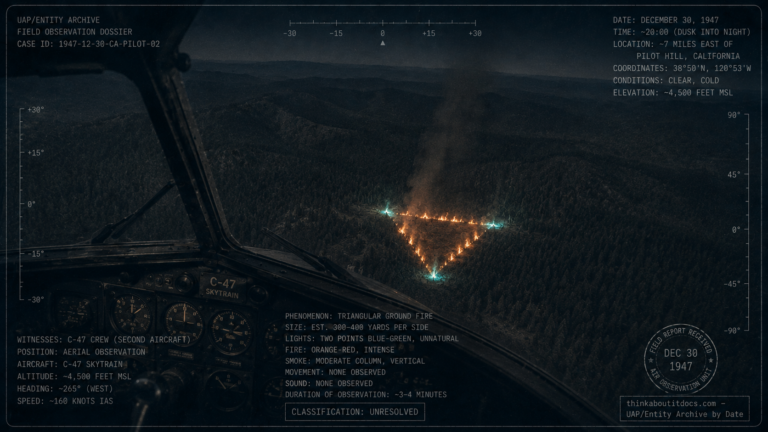
What is real is the setting. The Desert Range Experimental Station near Garrison is a genuine federal range-research facility in remote western Utah, and in 1953 a U.S. government aircraft did photograph the area, including a large triangular feature in a nearby dry lakebed measured at roughly 4,400 by 2,700 feet. Crash-retrieval researchers have pointed to that feature and the facility’s seclusion as circumstantial support. But a triangular mark on a dry lakebed near an agricultural research station is not evidence of a downed craft; it is an ambiguous landscape feature that the rumor has been wrapped around. The leap from “remote government land with an odd ground feature” to “a several-hundred-foot disc crashed here and aliens are still hiding nearby” is exactly the leap the record does not support.
It is worth separating this from the better-known crash claims it travels with. The 1953 Kingman, Arizona case, whatever its own problems, rests on named investigators (Leonard Stringfield, Raymond Fowler) and at least first-hand-claimed sources who described a specific craft and recovered bodies. The Utah story has none of that scaffolding — no investigator’s interview on record, no claimed participant, no description of the supposed survivors beyond the word “humanoids.” It is the thinnest tier of crash lore: a place, a dramatic image, and an open-ended promise that the beings are still out there.
RESEARCHER’S NOTES
The Garrison Crash — Western Utah 1953 and a Rumor Built Backward
- Classification, why none is assigned: The prior page listed CE-II, and the tag block contradictorily also carried CE-III. Neither holds. A close-encounter classification describes a witnessed object at close range — CE-II specifically requires observed physical traces tied to a witnessed object. Here there is no witness at all, only a retrieval rumor. There is nothing to classify, so the field is correctly set to None, with the reason stated plainly: this is hearsay about an aftermath, not a documented observation.
- Source-chain assessment: The case is a recopy. The prior page’s text mirrors the Utah UFO Hunters “1953 DRES” article almost word for word, and the broader story lives in crash-retrieval compilations — Ryan Wood’s “Majic Eyes Only,” Earthfiles — rather than in any 1950s record. The “CSETI” attribution appears to be a label applied along the way, not a traceable origin, and has been corrected to the actual chain. This is the archive’s recurring lesson in concentrated form: an attribution to an organization or a confident “various sources” is not a source, and recopying it forward only launders a rumor into apparent provenance.
- Pattern and comparative context: The story sits in the post-Roswell crash-retrieval genre that expanded sharply after Stringfield began publishing status reports in the late 1970s, and especially in the 2000s wave of crash cataloguing. Its hallmarks are diagnostic: an enormous craft, a dramatic ground scar, a secure government location, and survivors who conveniently remain at large to explain continuing sightings. The real DRES facility and the 1953 aerial photo give it a veneer of specificity, but compared with cases that carry named investigators and first-hand-claimed witnesses, the Utah account is unusually unanchored even by crash-lore standards.
- Evidentiary weight and why Insufficient Data: There is no documentation, no named witness, no recovered material, and no contemporaneous report — and equally no positive proof of deliberate hoax or identified mundane cause. That balance is precisely Insufficient Data. “Unexplained” would imply a documented anomaly that resists explanation, which this is not; “Explained” would require grounds the record does not supply. The honest position is to keep the entry, date and locate it as accurately as the sources allow, name the real source chain, and decline to dress an unverifiable rumor as a confirmed crash.
The western Utah crash is less an event than a story about a place — a remote stretch of desert, a real government station, an ambiguous mark on a dry lakebed, and a rumor that grew up around them long after the fact. No one is on record as having seen the craft, the occupants, or the recovery, and the account reached print through compilers decades later rather than through anyone who was there. The archive keeps it, corrects its date, location, and source, strips the classification it never earned, and files it where the evidence puts it: Insufficient Data, an unverified crash-retrieval rumor, told honestly for once.