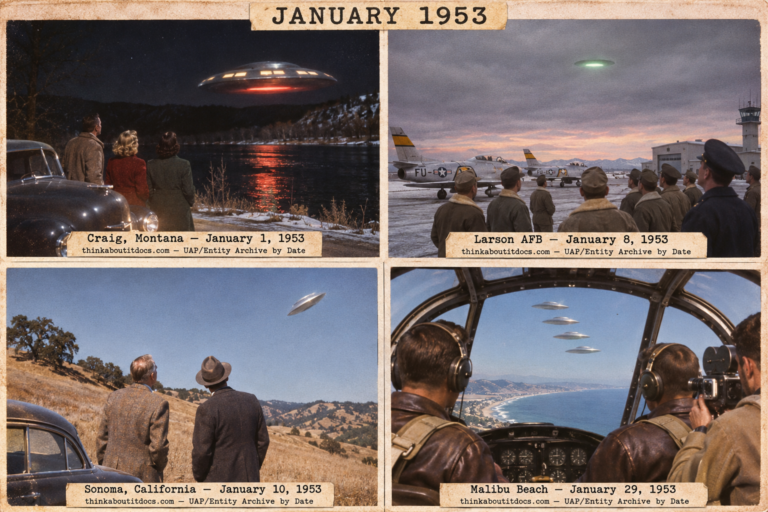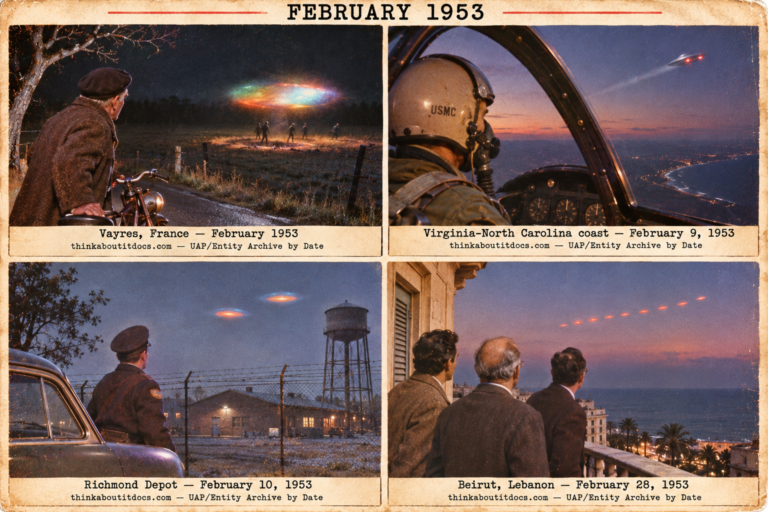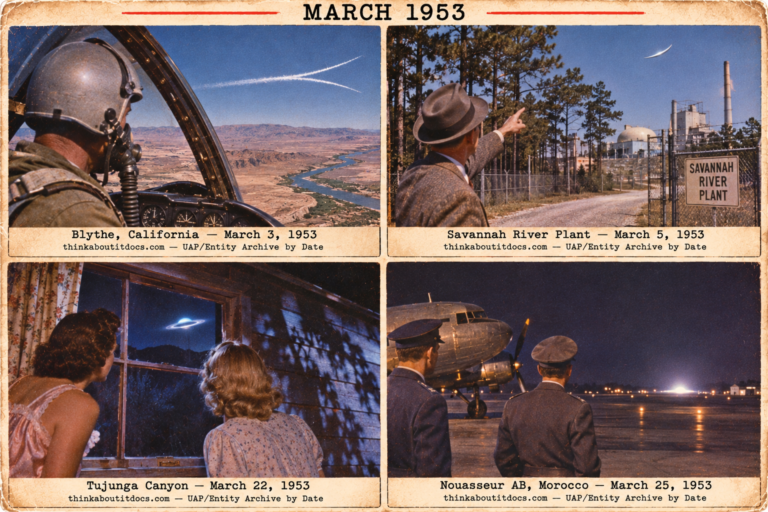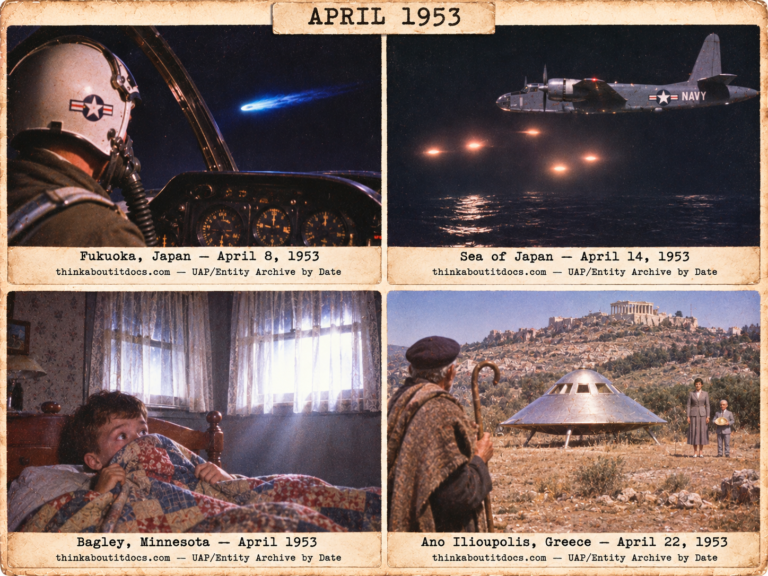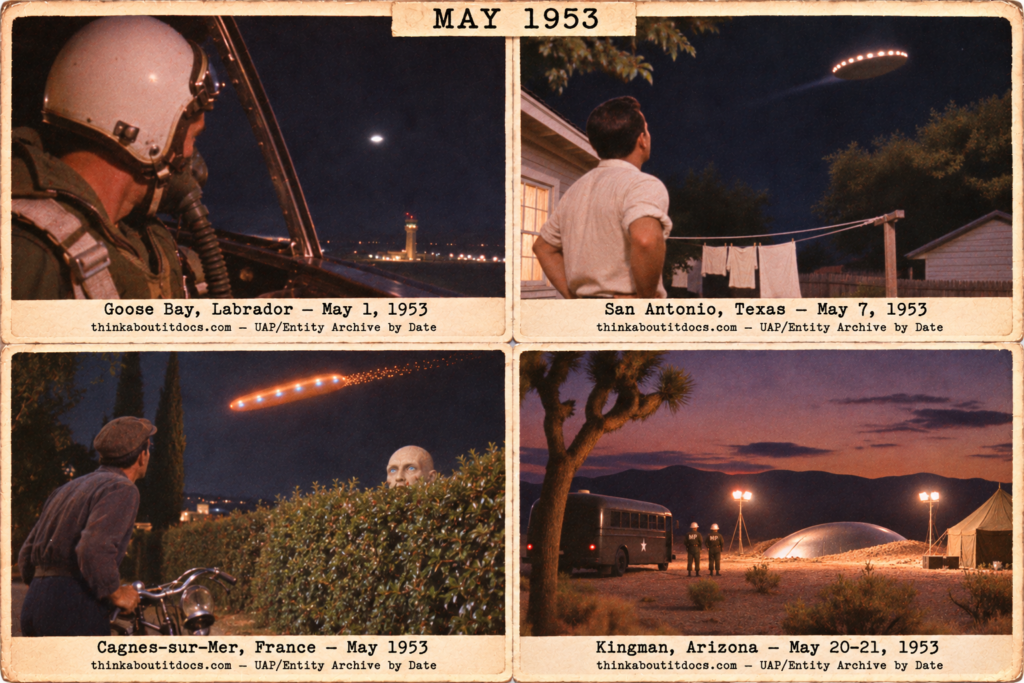
May 1953: an F-94 pursuit, lights over San Antonio, an entity at Cagnes-sur-Mer and the Kingman crash claim.
1953: May UFO|UAP & Entity Sightings Archive
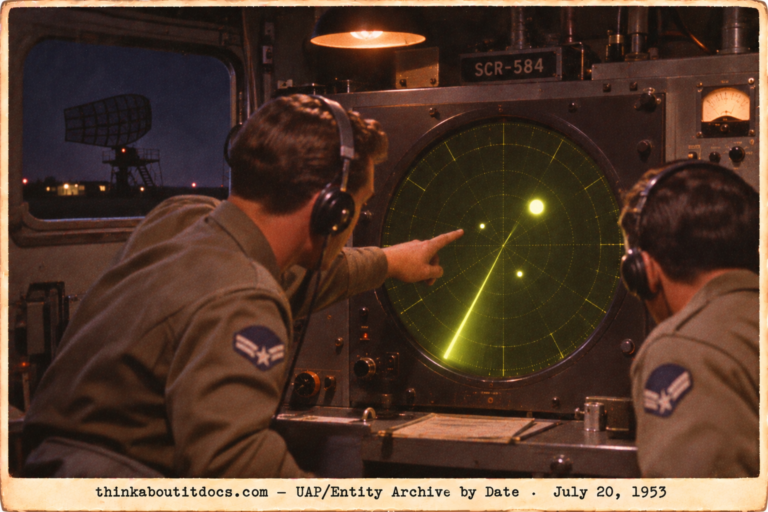
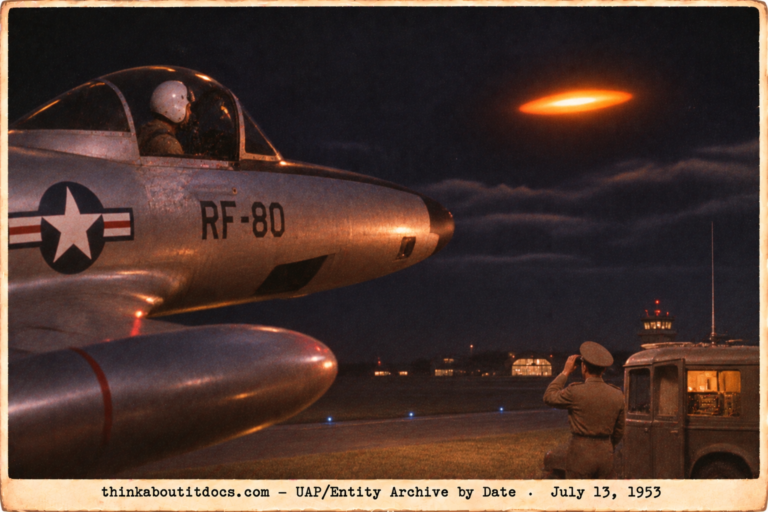
May 1953 opens with an F-94 chasing a white light over Labrador and closes with nine meandering lights over San Antonio. Between them sit the month’s entity and crash claims: a Cagnes-sur-Mer cinema projectionist who reported an orange cigar followed by a pale, bald face over a hedge, and an engineer who swore in 1973 that he was bused to a crashed craft near Kingman, Arizona.
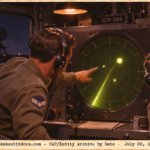
The military record in these May 1953 UFO sightings includes the Goose Bay pursuit, a Pacific Northwest radar episode lasting more than two hours, radar tracks over Monclova, Mexico, and six Ellington AFB airmen watching a fast yellow-orange object. Reports from Tehran, Helsinki and South Africa, a Brush Creek, California saucer-and-bucket report that Blue Book closed as a hoax, an Ojibwa, Wisconsin airliner-sized object that split into four, and an eight-hour Wisconsin light later tied to Venus complete the month, each with its Blue Book evaluation where one exists.
Date: May 1953 (day not recorded)
Location: Cagnes-sur-Mer, Alpes-Maritimes, France
Time: 12:30 a.m. (0030A)
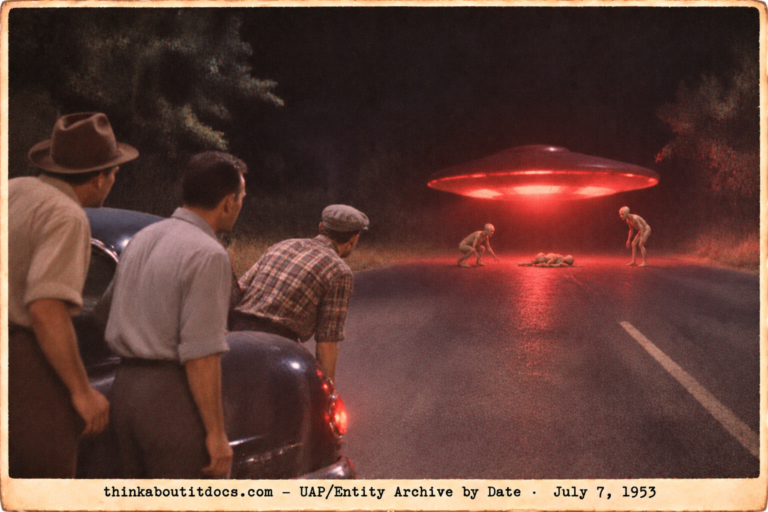
Summary: Pierre Cavallo, 50, a cinema projectionist, was walking home, pushing his bicycle and collecting snails, when he was surprised by an orange, luminous cigar-shaped object with blue spangles inside it, passing silently overhead in 20-30 seconds and leaving a trail of orange sparks. Astounded, Cavallo remained frozen for about 40 seconds. He then sensed a presence nearby and, turning, saw a face of extreme pallor with blue eyes, a perfectly bald head, and a “sanctimonious smile” — a hedge only 3 ft high hid the body. After staring for several seconds, Cavallo got on his bicycle and sped away. [Full Report]
Source: Christian Hycnar & Eric Zurcher; Albert Rosales (Humcat 1953-12)
Source Status: The month is the only date given in the catalog entry.
Date: May 1, 1953 (0305Z, May 2 in the Blue Book record)
Location: 10 miles south of Goose Bay AFB, Labrador, Canada
Time: About 11:05 p.m. AST (0305Z); the catalogs give 11:05 p.m.
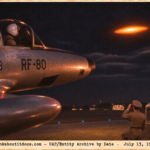
Summary: Capt. R.L. Embery of the 59th FIS, flying an F-94 (Pintail 40) at 24,000 ft, saw a white light about 10,000 ft below him that looked like an F-94 with its afterburner lit, though he saw no exhaust. For about 30 minutes it orbited him at 10 to 15 miles and evaded his approach. His radar operator and ground control never got a radar contact, and tower personnel saw a purple light moving very fast. [Full Report]
Source: Project Blue Book file 6384753 (telex from COC Pepperrell AFB, NEOCOC-I-0013; Blue Book summary card; Hynek letter of June 22, 1953); Berliner; Sparks, Blue Book Unknowns Catalogue, case 964; Joel Carpenter (BBU #2555)
Source Status: Project Blue Book lists this report as Unidentified, and D/I NEAC found no correlation with flight plans. The telex gives 6,000 knots and the Blue Book card 600 mph. A reviewer note asks why there was no radar contact and compares it with the Gorman sighting, and Hynek asked for a much fuller report. The F-94 radar observer is not named in the file; the catalogs’ Morin is from Eberhart and Sparks. The May 2 entry below is the Maritime Central Airways crew from the same telex.
Date: May 2, 1953
Location: About 130 miles southwest of Goose Bay AFB, Labrador, Canada
Time: 0825Z (about 4:25 a.m. AST)
Summary: Maritime Central Airways flight 64, piloted by Warden with the co-pilot confirming, saw a luminous object about 500 ft off the starboard wing for 3 to 4 seconds before it sped away. A second moon-shaped object was directly in front of the aircraft. Visibility was unlimited and radar (AN/CPS-5) had no contact.
Source: Project Blue Book files 6384762 (AF Form 112, 130 Mi SW of Goose AFB) and 6384753 (telex NEOCOC-I-0013); Project Blue Book list
Source Status: The preparing officer said lack of sufficient information precluded evaluation, matching the Blue Book list entry of Insufficient Data. The telex treats it as possibly related to the F-94 sighting above, which D/I NEAC evaluated as unidentified. The SACINTSUM places the position southeast; the AF Form 112 and telex say southwest.
Date: May 4, 1953 (listed as May 3 in the Blue Book list)
Location: Goose Bay AFB or Harmon AFB, Labrador, Canada (exact base uncertain in the source record)
Time: 1:50 a.m.
Summary: A Canadian civilian woman saw a football-shaped, light metal-colored object reflected in a rotating beacon, traveling south at high speed and low altitude before disappearing into a stratus cloud over the base. She described the sound as like tins striking together.
Source: Sparks, Blue Book Unknowns Catalogue, case 968; Rutkowski, “Canada’s UFOs: Declassified”; Joel Carpenter
Source Status: The Project Blue Book list carries a Harmon AFB, Newfoundland report by an anonymous civilian on May 3 as Other (bird); it is probably this report, but the location is marked uncertain in the catalogue.
Date: May 5, 1953
Location: Yuma, Arizona
Time: Unknown
Summary: A scientist observed a silvery disc, with concentric rings visible when viewed through Polaroid glasses.
Source: UFOE, VI
Date: May 7, 1953
Location: San Antonio, Texas (615 Dallas Street)
Time: About 8:55 p.m. CST (2055)
Summary: H.C. Reischling, a civil service cost accountant at Fort Sam Houston, saw a round, dark gray object about 40 to 50 ft across with 8 to 10 evenly spaced lights in an arc across its forward part and a faint vapor trail beneath it. It crossed in straight, level flight at over 300 mph for 20 to 30 seconds without sound; he said its hull looked “as large as a house.” [Full Report]
Source: Project Blue Book file 6384775 (Kelly AFB telex and AF Form 112, May 11, 1953; ATIC form); Project Blue Book list
Source Status: The Air Force Form 112 evaluation reads Unknown, while the Project Blue Book list evaluates the report as aircraft. An ATIC reviewer wrote “Follow Up! Lubbock Lights?” on the form, and J. Allen Hynek’s June 22, 1953 letter said the case had many similarities to the Lubbock Lights. Brooks AFB reported no balloons and Kelly AFB one known C-54.
Date: May 11, 1953
Location: Tehran, Iran (about 36°43′ N, 51°27′ E)
Time: 3:00 p.m. local (1130Z; one line gives 1220Z)
Summary: Lt. Col. Dayton C. Casto Jr., a USAF adviser to the Iranian air force, said his wife, sunbathing on the roof, saw a group of five objects (three in trail formation per the cable) and called him, but by the time he arrived only one was visible. It was metallic and aluminum-colored, about the size of a B-45, at 20,000 to 25,000 ft above scattered cumulus, flying east at 300 to 600 mph and rolling side to side. It made no sound or contrails and disappeared south of Mt. Damavand after about a minute.
Source: Project Blue Book file 6384827 (Air Intelligence Information Report and ATIC memo of June 16, 1953); Project Blue Book list
Source Status: Casto’s own opinion was that it was definitely an aircraft. A June 16, 1953 memo by Maj James W. Tisdale Jr. of ATIC’s Aircraft & Propulsion Branch said it may very possibly be a Soviet overflight of Il-28 aircraft, and the Project Blue Book list evaluates the report as aircraft.
Date: May 12 or 13, 1953
Location: Approximately 39 miles northwest of Goose Bay AFB, Labrador, Canada
Time: Unknown
Summary: Unidentified radar tracking by pilot Lt. D.C. Rogers and radar operator Lt. J.A. Lane, who attempted an interception but were unable to make visual contact with the target.
Source: McDonald list; Joel Carpenter
Source Status: No matching entry appears in the May 1953 Project Blue Book list, and the date is given as May 12 or 13 in the McDonald list, the only source seen.
Date: May 12, 1953 (tracks May 13, 0415Z to 0636Z)
Location: Pacific Northwest, Washington and Oregon states
Time: 8:15 p.m. PST (0415Z)
Summary: Air defense radar tracked two unknown targets at about 6,000 ft, B-97-G at about 90 knots and B-14-G at about 80 knots, over the Pacific off Washington and Oregon for 2 hours 21 minutes. Three scrambled flights, including Pronto Red with Capt S.D. Tate and 2nd Lt D.L. Rodgers, got radar lock-ons on targets 12,000 to 15,000 yards out but none of the 5 aircraft made visual contact. [Full Report]
Source: Project Blue Book file 6384863 (25th Air Division (Defense) report, prepared by Maj Neil A. Vosburgh; Tate and Rodgers statements); Dan Wilson
Source Status: The Project Blue Book card conclusion is radar interference due to inversion. The 25th Air Division said it was unable to further evaluate the tracks and reached no firm conclusions; the crews believed their contacts were chaff or sea return, a 6-degree inversion was measured at 1,500 to 1,700 ft, and the Neah Bay station never painted the unknowns.
Date: May 13, 1953
Location: Helsinki, Finland (also reported at Stockholm, Sweden)
Time: 11:50 p.m. (2350) per the Helsinki newspaper; a separate reliable source gives 8:47 p.m. (2047)
Summary: A Helsinki daily reported a shuttle-shaped, greenish-white light that crossed the city horizontally in a few seconds and, at a nearby airfield, crossed the field in 4 seconds; the paper said similar phenomena were seen in Stockholm at about the same time. A reliable source at an airport reported a greenish light traveling very rapidly due west of the tower, about 30 degrees above the horizon, before it disappeared behind clouds after a few seconds.
Source: Project Blue Book file 6384877 (ATIC document 124303 translation; Blue Book summary card); Project Blue Book list
Source Status: ATIC commented that it appeared to be a standard description of a meteor, and Dr. Robinson of ATIC reviewed it and believed it probably was one. The Blue Book card conclusion is Astronomical (meteor). The newspaper time (2350) and the second report (2047) are different observations.
Date: May 15, 1953
Location: Near Ojibwa, Wisconsin (about 45°50′ N)
Time: 11:10 p.m. CST (0510Z to 0533Z, May 16)
Summary: Joel Sands and Bill Olsen of Ojibwa, each with about five years of military service and none as a pilot, watched from a car on a highway as black oblong objects the size of a large airliner passed directly overhead heading east at an estimated 2,500 ft. One object broke into four that continued in a straight line at about 120 mph, with no trail, exhaust or sound and no maneuvers, until out of sight. The telex gives the length as about 100 ft and the observation as 23 minutes.
Source: Project Blue Book file 6384880 (telex from the 674th AC&W Squadron, Osceola, WI, May 16, 1953; Blue Book summary card); Project Blue Book list
Source Status: The Project Blue Book card conclusion is Conflicting Data, with a reviewer note asking how objects traveling a straight line at 120 mph could stay visible for 23 minutes. Weather was clear, winds aloft from the NNW, no known traffic in the area and no interception was attempted. The Project Blue Book list carries it as Other.
Date: May 19, 1953
Location: Base Operations, Ellington AFB, Houston, Texas
Time: Between 10:30 p.m. and 10:45 p.m. (2230 to 2245)
Summary: Six personnel of the 3605th Air Base Group, led by A/3C Wendell C. Smith, an aircraft dispatcher, went outside after an off-base caller asked what aircraft was over Houston and Ellington. They saw a round, bright yellowish-orange object, not as bright as the stars, pass directly overhead and fly a straight course from 90 to 270 degrees for one to two minutes. It made no sound and left no exhaust trail. A theodolite could not get a fix, and the 149th AC&W Squadron on the base was contacted without result. [Full Report]
Source: Project Blue Book file 6384903 (Intelligence Report IR-1-53, May 25, 1953, 3605th Observer Training Wing; AF Form 112; witness statement of A/3C Smith); Project Blue Book list
Source Status: Skies were clear, speed was very fast, and size and altitude were unknown. The preparing officer judged that the airmen did observe some unidentified object, and what it was a matter of conjecture; he found no meteor or planet explanation. ATIC replied that the object may have been aircraft traveling at high speed and high altitude and asked for a check of local flight service. The Project Blue Book list evaluates the report as aircraft.
Date: May 20, 1953 (March 20 and June 20 also reported)
Location: Brush Creek, California (junction of the Jordan and Marble Creeks, Butte County)
Time: About 6:30 p.m.
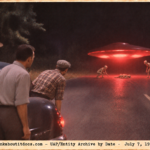
Summary: Two Butte County miners, John Q. Black and John Van Allen, told Sheriff’s Capt Fred Preston that a saucer about 7 ft across landed on a sandbar at the junction of Marble and Jordan Creeks on May 20 and again on June 20 at about 6:30 p.m. Each time a broad-shouldered man about 4 ft tall in a green parka scooped a pail of water with an aluminum bucket, handed it to someone inside and the craft left without sound. Later Fate accounts give only Black and a March 20 first sighting. [Full Report]
Source: Project Blue Book file 6384924 (OSI 19D 24-180 inquiry of July 26, 1953; United Press dispatches of June 24 and 25, 1953; San Francisco Chronicle, July 19; Appeal-Democrat, July 21); Wallace Kunkel for Fate; Ted Bloecher
Source Status: The Project Blue Book card conclusion is Hoax. OSI found the miners unknown in Oroville and the ranger said they had never filed a claim; about 300 people waited on July 20 and nothing appeared. The 1953 press names two witnesses and an occupant on both landings, while the later Fate account has Black alone with an occupant first on June 20; the two versions are not reconciled.
Date: May 20-21, 1953
Location: Desert near Kingman, Arizona
Time: Approximately 9:00 p.m. (per one source; not specified in the affidavit itself)
Summary: Engineer Arthur G. Stansel, on loan to the Atomic Energy Commission for Operation Upshot-Knothole at the Nevada Test Site, claimed he was bused with fifteen other specialists to a desert site near Kingman and shown an oval craft roughly 30 ft in diameter, embedded 20 inches into the sand with no structural damage, along with the body of a 4-foot-tall being in a silvery metallic suit inside a nearby tent. Stansel signed a legal affidavit for researcher Raymond Fowler twenty years later, in 1973. None of the other fifteen alleged witnesses have ever come forward, and no contemporary 1953 documentation has surfaced. [Full Report]
Source: Arthur G. Stansel via Raymond E. Fowler; “Casebook of a UFO Investigator”
Source Status: Unsubstantiated crash-retrieval claim resting on one affidavit signed June 7, 1973, with no contemporary documentation. Rosales names the witness “Fritz A. Werner” and adds crew, beam-weapon and Area 51 details attributed to Anton Anfalov and Bill Uhouse; those are problematic sources and are not part of this entry.
Date: May 23, 1953
Location: Radar over Monclova, Mexico, tracked by the 741st AC&W Squadron, Lackland AFB, San Antonio, Texas
Time: 8:43 a.m. CST (0843); a second source gives a 1 hour 5 minute observation, and ATIC states 39 minutes of intermittent contact
Summary: Radar operators of the 741st AC&W Squadron’s AN/FPS-3 set at Lackland AFB tracked five or more targets near Monclova, Mexico, starting at 0843 CST. Track N94 held five or more aircraft at an estimated 35,000 ft or more, and a second track (N97) of three or more went into orbit. None appeared to make directional progress, and they stayed in orbit as if grouping. The targets looked the same size and speed as conventional aircraft on the scope, and the scope photos were unreadable because of a camera malfunction.
Source: Project Blue Book file 6384961 (741st AC&W Squadron AF Form 112 and radar questionnaire; ATIC requests of June 22 and July 16, 1953; Air Attache Mexico reply of August 25, 1953); Project Blue Book list
Source Status: The observers’ general opinion was definitely aircraft, possibly Mexican. San Antonio ARTCC found no aircraft at Del Rio and said a Laredo flight doing touch-and-go landings at Eagle Pass should not have been in the area. The Assistant Air Attache in Mexico City learned that Mexican Air Force F-47 aircraft were doing cloud seeding with the Secretariat of Agriculture near Monclova at the time, and the Project Blue Book list evaluates the report as aircraft.
Date: May 23, 1953
Location: Union of South Africa
Time: Unknown
Summary: South African headquarters announced in November that on May 23, radar had tracked an unidentified object near the Cape at over 1,000 mph.
Source: Prescott Evening Courier, May 22; UFOE, VIII
Source Status: The Prescott Evening Courier date of May 22 precedes the event, and the summary says the announcement came in November, so the date and source are unreconciled. The entry stands as listed in UFOE, VIII.
Date: May 27, 1953
Location: San Antonio, Texas
Time: 8:30 p.m. to 8:45 p.m. CST (2030 to 2045)
Summary: Seven civilians, three couples and one more, watched orange-white lights move southwest to northeast at about 45 degrees for about 15 minutes. Eight lights flew in an evenly spaced chain, three zigzagged four or five times before going straight, and one reportedly circled San Antonio and returned at great speed while a ninth turned aside to avoid it. The principal observer had flown B-26s in World War II. [Full Report]
Source: Project Blue Book file 6384775 (Randolph AFB Wing Intelligence Office report, June 1, 1953, with witness statements); Berliner (BBU #2577)
Source Status: Project Blue Book lists this report as Unidentified. The Randolph evaluation reads Reliable, and ATIC found no balloons, fragments or conditions to explain it; a Navy SNB and a B-25 were in the area, though their times are garbled in the copy. The May 7 entry above is a separate San Antonio report.
Date: May 31, 1953
Location: Darlington and Monroe, Wisconsin
Time: 3:15 a.m. to about 11:30 a.m. CST (0320 to 1130 in the ATIC report)
Summary: Eleven people, including police officers and Ground Observer Corps members, watched a steady bright white light rise in the east and cross the sky for about eight hours; some said it hovered, others that it moved at great speed. Darlington officer Glenn Winslow reported it overhead at 0315 bright enough to light the surroundings, and two officers chased it in a squad car at about 75 mph without gaining ground. A telescope was used, jets were scrambled by the Chicago filter center and could not find it, and a radar contact was logged at about 1005. [Full Report]
Source: Project Blue Book file 6385021 (ATIC report, Chicago Filter Center special action report of June 1, 1953, Lt R.M. Olsson memo of June 8, 1953); Project Blue Book list
Source Status: ATIC concluded the path closely paralleled Venus, which rose at 0310 CST near maximum brilliancy, and the Project Blue Book list evaluates the report as astronomical (Venus). The file is not uniform: Winslow, who knew Venus, said it was not Venus and almost as large as the moon, while Lt Olsson’s memo judged that some observers saw Venus and others probably a balloon.
EXECUTIVE SUMMARY
Labrador Intercepts, Texas Lights and Two Unproven Claims
May 1953 rests on multi-witness and instrument-backed reports. The Goose AFB pilot chased a white light for about 30 minutes while neither his radar nor ground control saw it, and an airline crew reported luminous objects off its wing the same night. In San Antonio, a Fort Sam Houston accountant described an arc of 8 to 10 lights on a dark body on May 7, and on May 27 seven civilians reported nine lights that Randolph AFB rated reliable. The radar items split: the 25th Air Division could not evaluate the Pacific Northwest tracks while Blue Book listed inversion effects, and the Air Attache found Mexican cloud-seeding aircraft working near Monclova when the Lackland tracks appeared.
The entity and crash-related entries are weaker. Cavallo’s Cagnes-sur-Mer account reaches the archive through Hycnar, Zurcher and Rosales, the Kingman claim rests on an affidavit signed twenty years after the date, and the Brush Creek landings were closed by Blue Book as a hoax after an OSI inquiry. Blue Book’s unknowns for the month are Goose AFB (#2555) and San Antonio (#2577); the Darlington, Wisconsin light was evaluated as Venus although the file records witnesses who disagreed.
“a face of extreme pallor, with blue eyes”
— Christian Hycnar & Eric Zurcher