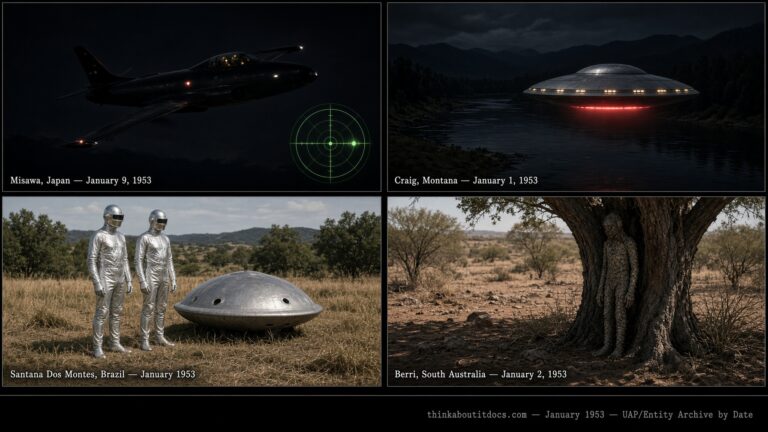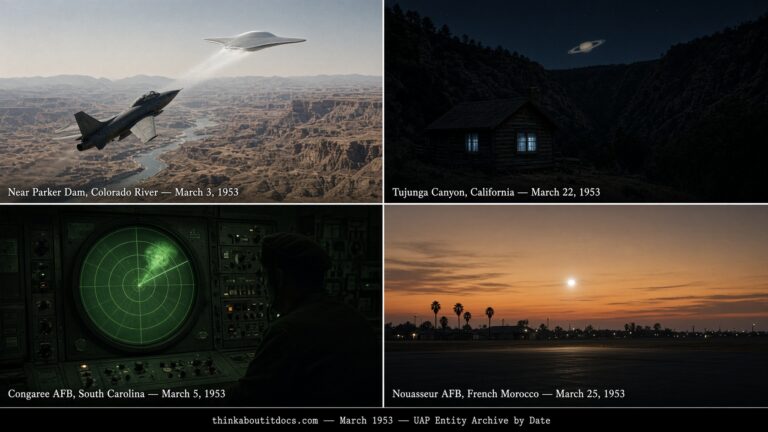
February 1953's radar-visual pursuits and entity encounters, archived by date, just ahead of the Robertson Panel.
1953: February
UFO|UAP & Entity Sightings Archive
Five days before the Robertson Panel sat down in Washington to decide what to make of the phenomenon, a Marine Corps jet pilot near the Virginia-North Carolina border was already chasing an object that outclimbed him by 10,000 feet in seconds. February 1953 is a month of pursuits and radar tracks — Iceland, Alaska, Tunisia, Japan, Missouri, Texas — punctuated by two accounts that fit no radar log at all: a burned circle of grass and shadowy figures in rural France, and two impossibly tall, blue-green-skinned visitors who dented solid steel in a Los Angeles law office and vanished before the FBI arrived.
Date: February 1953
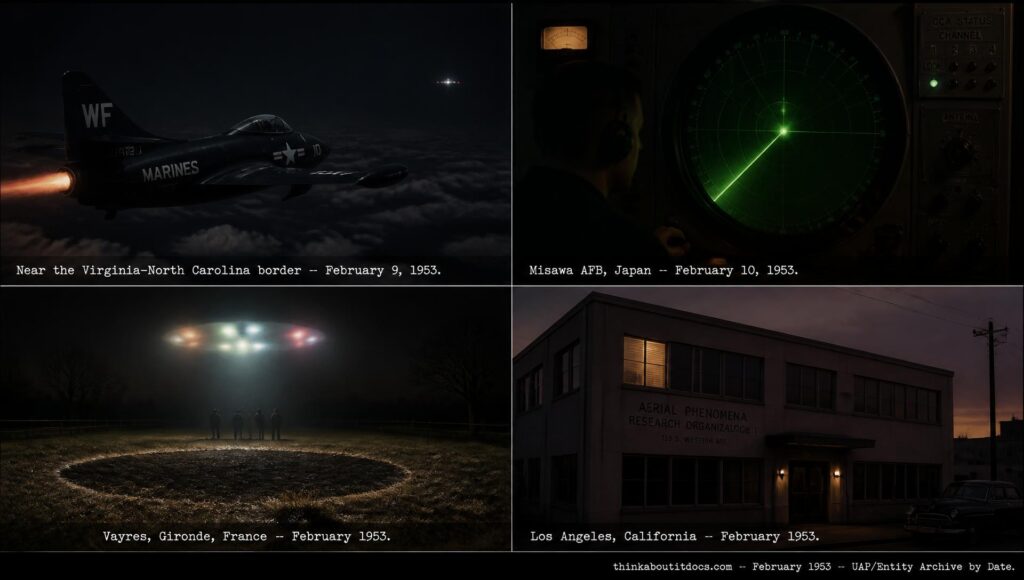
Location: Vayres, Gironde, France
Time: 0200A
Summary: 63-year-old Marcial Grillet was riding his moped on Route 89 along a field when he noticed multi-colored flashes of light nearby amid total silence. Approaching, he saw the lights were on an oval-shaped “colorful mass” hovering 10-15 meters off the ground, with several shadowy figures visible moving beneath it. The witness suffered anxiety and general malaise following the encounter, and an area of burned grass about 60 meters wide was found at the site.
Source: Denys Breysse, Project Becassine
Date: February 1953
Location: Los Angeles, California
Time: Afternoon
Summary: A pair of strange men, over 6’2″ tall, with bluish-green skin and pointed ears, visited a local attorney’s office wearing old, tattered clothing. Both claimed to be experts at locating missing persons. One man pressed a bare hand into the top of a metal cabinet, denting it at least half an inch deep. Unnerved employees called the FBI; by the time agents arrived, both men had vanished. [Full Report]
Source: Scott Corrales, quoting Harold T. Wilkins
Date: February 1, 1953
Location: Terre Haute, Indiana
Time: 2130 EST
Summary: A military aircraft on a 270° heading 10 miles west of Terre Haute sighted a close group of moving lights changing color from red to blue to green to yellow. The T-33 pilot estimated their altitude between 15,000 and 30,000 ft, flying in a manner similar to conventional aircraft. Searchlights from the St. Louis area appeared to be following the unidentified lights.
Source: Dan Wilson
Date: February 3, 1953 BBU 2384
Location: Keflavik Airport, Iceland
Time: 5:25 p.m.
Summary: Unidentified radar plots were observed on the scopes of the 932nd AC&W Squadron: the first at 5:25 p.m. (bearing 345°, range 90 nautical miles), a second at 5:27 p.m. that faded after remaining motionless for two full minutes, a third at 5:36 p.m. (bearing 341°, range 112 nautical miles), and a fourth at 5:49 p.m. (bearing 348°, range 118 nautical miles). No aircraft were operating in the area according to all military and civilian sources contacted; the apparent two-minute stationary period remains unexplained.
Source: Dan Wilson
Date: February 4, 1953 BBU 2388
Location: Yuma, Arizona
Time: 1:50-1:55 p.m.
Summary: U.S. Weather Bureau observer Stanley H. Brown, using a theodolite, tracked a solid, dull-white, oblong-to-round object edged with a thin white mist, flying straight up before leveling off at roughly 107° azimuth, 53° elevation. After 20 seconds a second, similar object joined it, twice flying away and returning to the first. Both were lost to sight behind clouds to the southwest, five minutes after first sighting, timed with a stopwatch.
Source: Berliner; McDonald 1968
Date: February 6, 1953 [CCL#34] BBU
Location: Rosalia, Washington
Time: 1:34 a.m. PST
Summary: A B-36 aircraft flying near Spokane, Washington sighted one round, white, omnidirectional light at about 7,000 ft, on a southeast course, circling and rising as it proceeded, flashing at short intervals. Visually observed for three to five minutes, the light was estimated moving at 150-200 knots. The B-36 made a 180° descending turn toward it while inbound to Spokane, 15 miles out, over Rosalia.
Source: Project 1947; McDonald list
Date: February 6, 1953
Location: Truk Island
Time: 11:10 p.m. local time
Summary: An Air Force officer in charge of the Weather Bureau Station on Truk sighted a bullet-shaped, shiny object traveling at 150 mph at an approximate altitude of 400-500 ft. The object appeared larger than a C-47 aircraft.
Source: Unknown
Date: February 7, 1953 BBU
Location: Okinawa
Time: 9:22 p.m.
Summary: A USAF F-94 crew and other witnesses saw a bright orange object change color to red and green at intervals before disappearing behind a cloud, with ground radar tracking the object.
Source: UFOE, III, VIII; Project 1947; McDonald list; FUFOR Index
Date: February 8, 1953 BBU
Location: Barter Island, Alaska
Time: 4:50 a.m. (AHST)
Summary: A military pilot working at an airstrip heard a deep, heavy sound and saw a brilliant round white object with small ray-like appendages descending in a falling-leaf motion (without the usual upward swings), then hovering and moving about 50 ft against the wind back to its original position. After 45 seconds, it began to climb using a reverse falling-leaf maneuver, picking up speed and changing to an orange tint.
Source: Hynek-CUFOS re-eval; Jan Aldrich; FUFOR Index
Date: February 9, 1953
Location: Near the Virginia-North Carolina border
Time: Unknown
Summary: A Marine Corps pilot chased a rocket-like object near the Virginia-North Carolina border. (See the full Balocco intercept entry below — likely the same incident.)
Source: UFOE, IV
Date: February 9, 1953
Location: Near Washington, D.C. (Virginia-North Carolina border)
Time: Evening
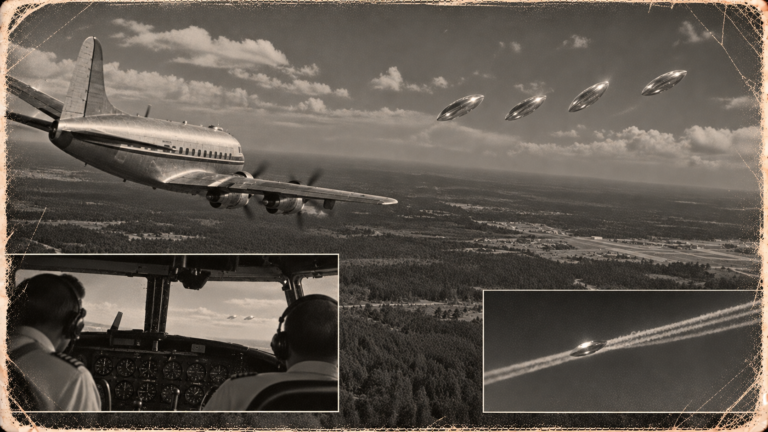
Summary: A Marine Corps F9F Panther pilot, alerted by a Norfolk naval facility after ground witnesses reported a silver, maneuvering object, searched the area and initially saw nothing. While returning to base, 1st Lt. Ed Balocco spotted what looked like an airplane with red lights below him — “what caused me to look back,” he said, “was the fact that it moved from below me 10,000 feet vertically in a matter of seconds.” He turned to pursue, chasing the object at speeds over 500 mph for three to four minutes without closing the distance. [Full Report]
Source: Contemporary press/military account; 1st Lt. Ed Balocco, USMC
Date: February 10, 1953 BBU
Location: Misawa AFB, Japan
Time: 6:45 p.m.
Summary: Unidentified radar targets were spotted on the GCA scope, seen on both the 2-mile and 10-mile azimuth scopes. The targets were solid and definite, reportedly flying at 50 knots. An F-94 was scrambled but did not plot or visually see the objects, and reported radar interference.
Source: Dan Wilson, McDonald list; FUFOR Index
Date: February 11, 1953 CCL #37 BBU
Location: Between Tunis, Tunisia and Tripoli, Libya
Time: 8:45 p.m. (GMT)
Summary: A USAF C-119 transport crew saw a disc pass the plane.
Source: Project 1947; FUFOR Index
Date: February 12, 1953 BBU
Location: Vichy, Missouri
Time: 8:30 p.m.
Summary: USAF Capt. Robert Bailey, his flight officer, and the crew chief of a C-47 transport, at 7,000 ft and 170 knots heading 43° (NE), saw a small round light near the Vichy Radio Range Station that appeared to be on a collision course. Bailey flashed his landing lights to signal it; the light stopped its approach and flew off the left wing about a mile away, changing color from red to amber to green. After 5-10 minutes it dropped back, increased speed, made three dives and zooms on a parallel course, then disappeared.
Source: NARCAP; FUFOR Index
Date: February 13, 1953 BBU
Location: Carswell AFB, Fort Worth, Texas
Time: 2:35 a.m. (CST)
Summary: Pilots and crew of a B-36 aircraft saw three bright lights of equal intensity in stacked vertical echelon formation, approaching at moderately high speed. One object suddenly accelerated, then came to a complete halt; the other two did the same before all three returned to formation and repeated the maneuver, ending in a horizontal echelon with the center object as pivot, then climbing steeply in a “swinging” motion at high speed. Possible ground radar contact was also noted.
Source: Hynek-CUFOS re-eval; Jan Aldrich; FUFOR Index
Date: February 16, 1953 BBU
Location: Ramer, Alabama
Time: 5:30 p.m. (EST)
Summary: Sparse surviving detail; witnesses recorded only as Hawk and Stern.
Source: McDonald list; FUFOR Index
Date: February 16, 1953 BBU
Location: Willow, Alaska
Time: 11:50 p.m.-12:05 a.m. (possibly 11:45 p.m. AHST)
Summary: A C-47 crew pursued a nocturnal light that was below the horizon, then ascended, hovered, and maneuvered before disappearing. Initially to the east, the light was pursued by the C-47 on a 345° heading after it began accelerating, brightening, and decreasing in apparent size; the crew chased it on a 270°-290° heading until it vanished after 45 seconds.
Source: Willy Smith pp. 43-48; FUFOR Index
Date: February 17, 1953 BBU
Location: Elmendorf AFB, Alaska
Time: 6:55 p.m. (AHST)
Summary: Ground observers and a fighter interception recorded a nocturnal light with a rapid vertical takeoff.
Source: Berliner; FUFOR Index
Date: February 17, 1953 BBU 2419
Location: Port Austin, Michigan
Time: 10:04-10:25 p.m.
Summary: Two officers and three airmen of a USAF AC&W squadron saw an object larger and brighter than a star, changing color, moving slowly until 10:09. Radar tracked a target at 10:08 moving in a similar direction for 17 minutes at similar speed.
Source: Berliner
Date: February 18, 1953
Location: Avellaneda, Quilmes, Argentina
Time: Night
Summary: Witness Eustaqui Zagorski claimed to have been abducted by several human-like extraterrestrials and flown to Ganymede, a moon of Jupiter, where he reported extensive contact and learned the “varkulets,” or alien writing (understood by researcher Galindez as coded Spanish). Zagorski reportedly experienced a second abduction on June 20, 1968, at the height of that year’s Argentine UFO wave.
Source: Eustaqui Zagorski, “Yo viaje en un plato Volador” (unpublished manuscript); Phenomenes Spatiaux #30
Date: February 20, 1953 BBU 2426
Location: Pittsburgh-Stockton, California
Time: Unknown
Summary: Two sightings by USAF B-25 bomber pilots. In the first (time unknown), a bright yellow light was seen for 8 minutes. In the second, around 10:30-11:30 p.m., a bright light flew on a collision course, dimmed, and climbed away fast.
Source: Berliner; FUFOR Index
Date: February 22, 1953
Location: Erie, Pennsylvania
Time: 3:30 p.m. (EST)
Summary: Claire Range, on duty station with the Ground Observer Corps at Lake Erie and a former Navy gunner, reported to the Buffalo Filter Center the observation of a silvery, chrome, saucer-shaped object 100-150 ft in diameter, about 1.25 miles out over Lake Erie, heading west. No propulsion system or sound was observed; the object was reflecting light brightly.
Source: Blue Book, Dan Wilson
Date: February 24, 1953 BBU 2441
Location: Sherman, Texas
Time: 7:43 p.m.
Summary: A warrant officer and his wife, the Aldens, saw two bright red, round objects with large halos fly in small circles, climb, and fade.
Source: Berliner
Date: February 25, 1953 BBU
Location: Charleston, West Virginia
Time: 3:30 p.m. (EST)
Summary: An unusual target — oblong, roughly 2 miles wide and 7 miles long — was sighted on the FPS-3 radar of the 783rd AC&W Squadron. Fade-out occurred in a manner resembling a gain or loss of altitude. The observation lasted 15 minutes.
Source: McDonald list; FUFOR Index, Dan Wilson
Date: February 26, 1953
Location: Thule AFB, Greenland
Time: 1:50 a.m. local time
Summary: Sgt. Lucas, while tracking a MATS C-124 five miles northeast of Thule Air Base, saw a prominent blip emerge from the normal clutter area on the GCA Planned Position Indicator scope. The object’s speed was estimated at 180 knots or better, at an altitude of 5,000-6,000 ft. It was tracked for three minutes before fading from the scope.
Source: Dan Wilson
Date: February 27, 1953 BBU
Location: Great Falls AFB, Montana
Time: 3:16 a.m. (MST)
Summary: An object appeared on an AN/FPS-3 radar scope, fading and reappearing over a period of 11 minutes.
Source: Dan Wilson, McDonald list; FUFOR Index
Date: February 27, 1953 BBU 2543
Location: Shreveport, Louisiana
Time: 11:58 a.m.-12:02 p.m.
Summary: A USAF airman and private pilot saw five yellow discs make circular turns and flutter; three vanished first, then the remaining two flew erratic square turns.
Source: Berliner
EXECUTIVE SUMMARY
Pursuits and Radar Tracks, Bookended by Two Cases the Radar Never Touched
February 1953’s record is dominated by the military — F-94s, B-36s, C-47s, and a Marine Corps Panther jet chasing something it could never catch, spread from Iceland to Alaska to Tunisia to Japan. Several of these cases (Carswell AFB’s stacked-formation maneuvers, the Balocco intercept, the Barter Island falling-leaf descent) show real sophistication of flight behavior that contemporary aircraft simply couldn’t replicate, and they arrive in the same narrow window the Robertson Panel was convened to evaluate.
Set against that military backdrop, the month’s two purely civilian entity cases stand out for having no radar signature at all: a burned circle of grass and shadowy figures beneath a hovering “colorful mass” in rural France, and two towering, blue-green-skinned visitors who dented solid steel in a Los Angeles office before vanishing ahead of the FBI. Neither fits the month’s dominant pattern, and neither is explained by it.
“What caused me to look back at the object was the fact that it moved from below me 10,000 feet vertically in a matter of seconds.”
— 1st Lt. Ed Balocco, USMC, February 9, 1953