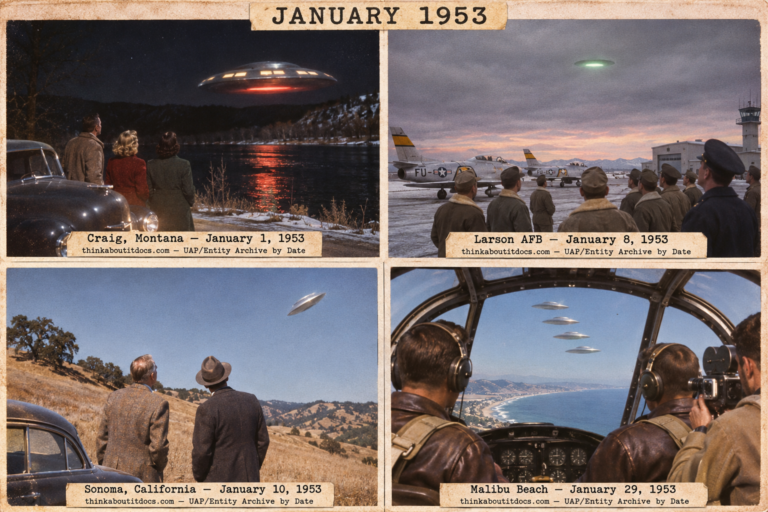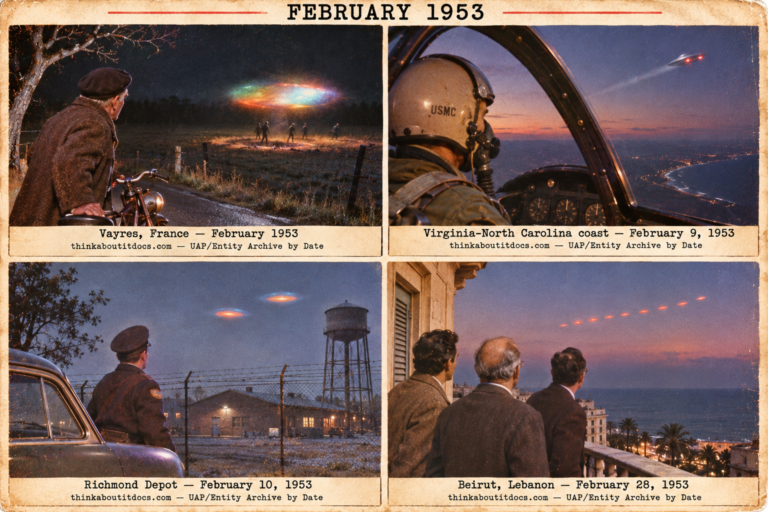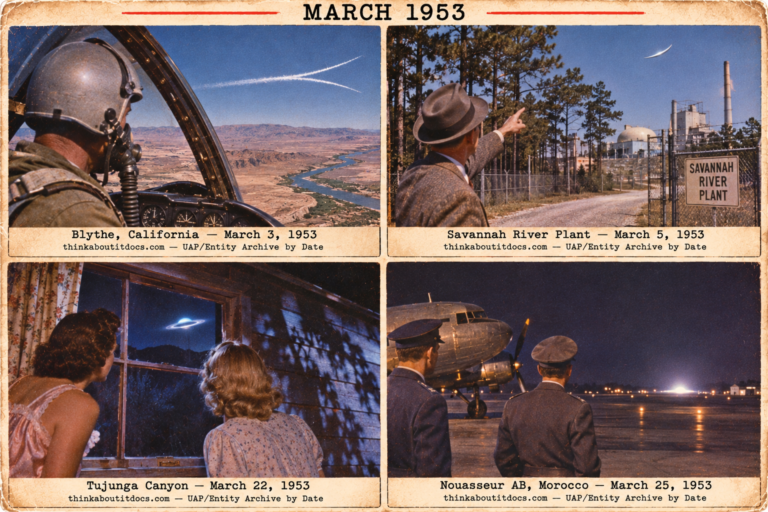
April 1953: a jet intercept, a Navy crew shadowed for two hours, and two entity accounts
1953: April UFO|UAP & Entity Sightings Archive
April 1953 is a month where the archive’s strangest entries came without a single military witness attached. In Bagley, Minnesota, a three-year-old recalled breaking free from entities who told him he would never remember them, and a neighbor saw a light hovering over his house. In Angatuba, Brazil, Dino Kraspedon answered a knock at his door and met a visitor who claimed Ganymede as home and spoke to him in Latin and Greek. And in Ano Ilioupolis, Greece, a strange woman with a shadow for a dog and a landed aluminum hut full of dwarfs fill the Greek account.
The month’s military record runs from a Fukuoka F-94B intercept on April 8 to a Navy P2V Neptune over the Sea of Japan that was shadowed for more than two hours by about ten unidentified objects, with radar plots and at least 70 passes. A C-47 crew over Nevada, a Tucson staff sergeant, Army observers over Korea and an extreme-speed radar chase over Lake Superior complete these April 1953 UFO sightings, listed in date order with every Project Blue Book unknown of the month.
Date: April 1953
Location: Bagley, Minnesota
Time: Night
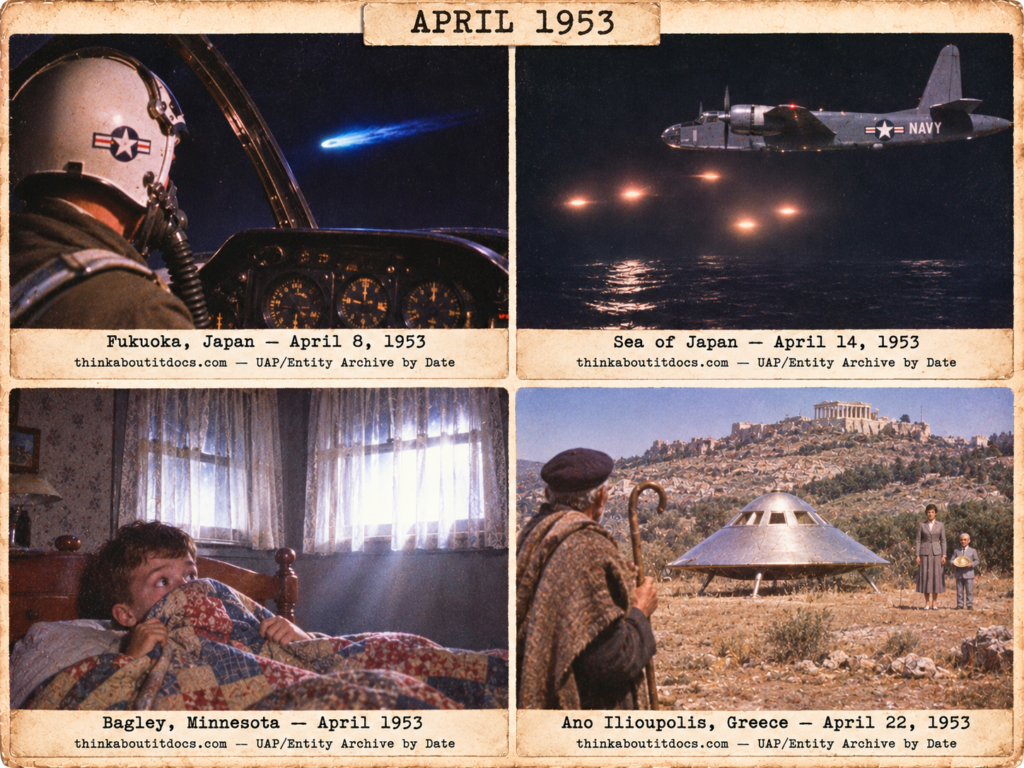
Summary: The witness, three years old at the time, recalled being taken from his bedroom by several entities. His next impression was of the entities telling him that neither he nor his family would remember the encounter — a suggestion that made him angry enough to break free of their control. He then woke suddenly as a brilliant white light shone through both bedroom windows, and hid under the covers while still able to see the light, feeling a presence in his own mind. A neighbor independently reported seeing a bright light hovering over the witness’s house that same night. [Full Report]
Source: Craig R. Lang, MUFON
Date: April 1953
Location: Angatuba, Brazil
Time: Sunday morning
Summary: Dino Kraspedon answered loud knocking at his front door and was met by a tall (approximately 1.80m) humanoid man who addressed him in Latin, Greek, and Portuguese, with only limited, heavily-accented English. The visitor identified himself as being from Ganymede, one of the moons of Jupiter. Kraspedon reported numerous further contacts with the same entity afterward, sometimes in public places (the witness had also claimed an earlier UFO contact in November 1952). [Full Report]
Source: Kraspedon, “My Contacts with The Flying Saucers”
Date: April, 1953
Location: Fort Monmouth, New Jersey
Time: Unknown
Summary: An object was observed and videotaped. Animal reactions to the object were reported. A crashed disc was reported at a military facility.
Source: Eberhart, George M., “A Geo-Bibliography of Anomalies,” Greenwood Press, Westport, 1980
Source Status: This thinly sourced claim is separate from the well-documented September 10, 1951 Fort Monmouth radar and T-33 case, which has its own standalone. The source’s wording “videotaped” is anachronistic for 1953, since videotape was not introduced until 1956.
Date: April, 1953
Location: Laredo, Texas
Time: Unknown
Summary: Lt. Edward B. Wilford III, a jet pilot instructor at Laredo AFB, watched a distinct, solid-brown, circling, cigar-shaped object leaving a contrail as it passed over his T-33, turned sharply, circled the base, and sped away at an estimated 1,200 mph.
Source: Gross, “UFOs: A History, 1953: March-July”; report to NICAP; UFOE, III
Date: April 8, 1953
Location: Fukuoka, Japan
Time: 7:55 p.m. (1955 hrs)
Summary: 1st Lt. D.J. Pichon, pilot of a 68th Fighter-Interceptor Squadron F-94B returning to Itazuke at 30,000 ft on a heading of 155 degrees at 200 knots indicated, saw a dark object in his peripheral vision that lit into an intense blue flame about 4,000 to 5,000 ft above him and 20 degrees right of his nose. It crossed in front of the aircraft right to left, descending and gaining speed, turned back, and paralleled his course about 1,000 to 2,000 ft above and about a mile away for about 20 seconds before the light went out; the whole sighting lasted about 45 seconds. Pichon first wondered whether it was an F-94 afterburner but saw no orange glow, and GCI reported no jet aircraft above 16,000 ft. His radar observer, busy trying to lock on, did not see the object and got no radar contact on a working set. Lt. H.L. Skinner began climbing toward the position but made no further transmission, and Pichon, troubled by a tip tank that would not feed, descended and did not see the object again. [Full Report]
Source: Air Intelligence Information Report IR-1-53, 68th Fighter-Interceptor Squadron, April 9, 1953; Berliner; FUFOR Index (BBU #2535)
Source Status: FEAF comment: Itazuke AB releases rawinsonde balloons about 1600 daily but they carry no lights, and no other information accounts for the sighting. The report rates the pilot a steady, reliable all-weather interceptor pilot.
Date: April 8, 1953
Location: Between Goose Bay, Labrador, and Sondrestrom AFB, Greenland
Time: 7:00 p.m. (AST)
Summary: USAF MATS transport pilot Swenson and his copilot saw a white light at 15,000 ft holding a steady course in a shallow, descending turn.
Source: NARA PBB85-860; Project 1947; FUFOR Index
Source Status: Project Blue Book evaluated this report as a meteor; J. Allen Hynek’s letter of May 19, 1953 confirmed it as an obvious meteor.
Date: April 10, 1953
Location: Chariton, Iowa
Time: 1:00-2:00 p.m.
Summary: Two brothers, looking to the northwest, watched what they described as a “flying wing” being refueled in flight by a tanker aircraft, at an estimated distance of 3-5 miles and an altitude of roughly 4,000-5,000 ft. One of the two witnesses noted years later that no large flying-wing aircraft were believed to be in service at that time, and did not learn what he had seen until much later. Duration was estimated at 10 minutes.
Source: NUFOC; NUFORC
Date: April 12, 1953
Location: Torbay Airport, Newfoundland
Time: 10:31 a.m. local time
Summary: An unidentified target appeared on the GCA radar scope on a magnetic course of approximately 270°. One of the observers looked outside and initially thought he saw a B-29 aircraft. When the object disappeared from view, the observer returned to the radar set and watched it make a 180° turn 8 miles west of the airport. It faded from the scope 30 miles away, moving northeast. The sighting was logged as a vital intelligence sighting incident.
Source: Dan Wilson; Project Blue Book list
Source Status: Project Blue Book evaluated the ground-visual and radar report as aircraft.
Date: April 12, 1953
Location: Sweetwater, Nevada
Time: 3:10 p.m. PST (1510)
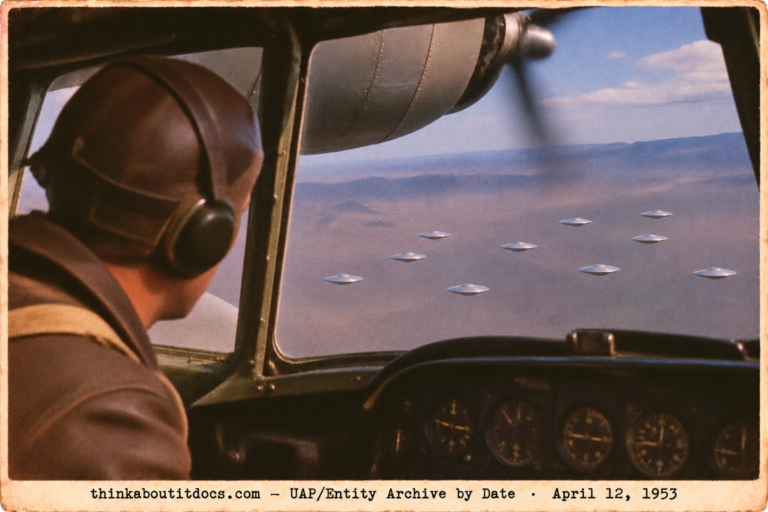
Summary: The crew of a USAF C-47 of the 8th Air Rescue Squadron, flying from Long Beach, California to Stead AFB, Reno, at about 12,500 ft over Sweetwater Airport saw ten round, flat, metallic objects, about the size of T-6 trainers, flash beneath the right engine nacelle on a heading of about 110 degrees. Maj. Fred G. Padelford, flight commander of A Flight with thirteen years’ service, took control and made a tight right turn of about 300 degrees to watch. Two more crew members, 2nd Lts. Frank E. White and John Cripe, then picked the objects up unassisted in a loose, changing formation making a right turn of larger radius and at lower altitude than the C-47. They followed about 120 degrees of that turn until the objects disappeared on a heading of about 300 degrees, about two minutes after first sighting. There was no sound, trail or exhaust, and speed could not be estimated. Padelford felt the speed was too great for ducks. [Full Report]
Source: Air Intelligence Information Report and Air Force Form 112, 3904th Composite Wing, Stead AFB, April 12-21, 1953; Sparks; McDonald list; Gross, “UFOs: A History, 1953: March-July”
Source Status: Project Blue Book evaluated this report as “possibly aircraft (probably trainers)” on the basis of color, maneuvers and distance, although the crew saw no aircraft in the area and Sweetwater Airport had no radio facilities. The wing intelligence officer rated the witnesses usually reliable and the observation probably true, and the Deputy Director of Intelligence wrote that the significance of the sighting could not be determined and that the qualifications of the principal observer were significant. The live page’s 4:10 p.m. MST is corrected to 1510 PST per the file.
Date: April 14-23, 1953 (individual dates April 14, 19, 21 and 23)
Location: An Tung, Manchuria, China
Time: Unknown
Summary: USAF pilots over Manchuria reported 20 to 25 triangular objects, with air-visual and air-radar observations across several dates. Far East Air Forces Air Intelligence Information Report 53-74, dated April 29, 1953, covers the April 23 sighting, and intelligence officials concluded the objects were most likely balloons carrying radar reflectors.
Source: McDonald list; FUFOR Index; Project Blue Book file xxxx-04-6384221-Manchuria
Source Status: Project Blue Book evaluated this report as a balloon with radar reflectors. The individual details of the April 14, 19 and 21 sightings are not preserved in the sources available here.
Date: April 14, 1953
Location: Sea of Japan, from about 200 miles east of Vladivostok (43°07′ N, 135°40′ E) toward North Korea, ending about 100 nautical miles off Niigata, Japan
Time: 9:23-11:50 p.m.
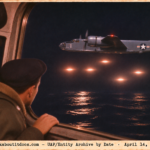
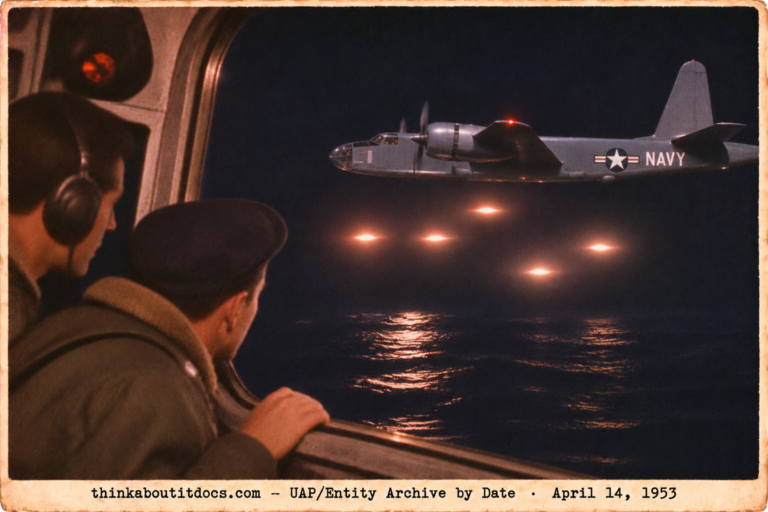
Summary: An unarmed U.S. Navy P2V-3W electronic-intelligence aircraft at about 9,000 feet was approached by lights flashing what may have been a coded letter, then shadowed by two unidentified objects, then by three more. As the Neptune descended to about 400 feet the objects closed to about 3 miles, and at least five more joined for about ten in all. From about 10:43 p.m. until about 11:50 p.m. they made at least 70 non-firing passes at the aircraft, many from behind and beneath it, then formed a group and left. Radar tracked the objects, direction-finding cuts were taken on at least three radar-confirmed objects, and about ten crew members saw them. The encounter lasted 2 hours 27 minutes. [Full Report]
Source: Sparks, Brad, Blue Book Unknowns catalogue summary (Project 1947); 1st Marine Air Wing Weekly Combat Summary, April 16-23, 1953 (NARA, located by Jan Aldrich); McDonald files; Project Blue Book
Source Status: This is a separate incident from the March 14, 1953 P2V report (BBU #2496) elsewhere in the archive: that one took place north of Hiroshima and involved groups of colored lights moving slowly aft of a P2V-5 over about five minutes. Sparks cites it as a similar case at the foot of his April 14 summary, with the January 12, 1950 and July 17, 1957 RB-47 cases. The primary-document details beyond Sparks’ summary were supplied by the site owner and are not independently re-checked here.
Date: April 15, 1953
Location: Tucson, Arizona
Time: 5:45 p.m. (MST)
Summary: S/Sgt. V.A. Locey saw three orange lights.
Source: Berliner; Gross, “UFOs: A History, 1953: March-July” (BBU #2542)
Source Status: Cross-reference: the Air Intelligence Information Report for April 15 (303d Bombardment Wing, Davis-Monthan AFB, Tucson) describes four separate sightings of single lights between 9:45 and 10:10 p.m. by a 358th Bomb Squadron staff sergeant; see the entry below. The sergeant’s name is not legible in the scan, so the sources do not confirm that he is Berliner’s S/Sgt. V.A. Locey, and Berliner’s 5:45 p.m. time does not match the report.
Date: April 15, 1953
Location: Tucson, Arizona (residential area, Davis-Monthan AFB)
Time: 9:45-10:10 p.m. (2145-2210)
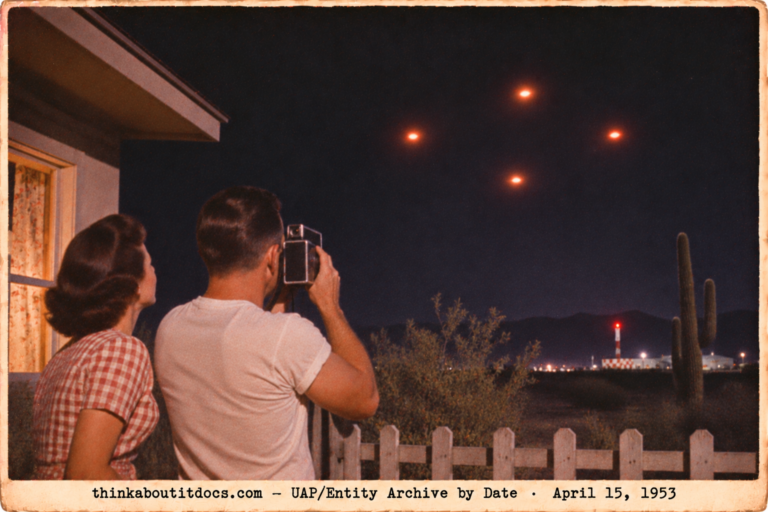
Summary: A 24-year-old staff sergeant of the 358th Bomb Squadron, 303d Bombardment Wing, a former Navy and USAF radar observer and plotter, reported four separate sightings of bright lights from his Tucson home, with his wife also watching. At 2145 an orange-red light came from the north heading south for about three minutes, slowed, and turned northwest at what he judged was extreme altitude on a definite, non-erratic path at about the speed of a shooting star, with no trail, sound or visible structure. At 2200 a brighter light followed the same path for about a minute, and he took three 15-second box-camera exposures that came out blank. At 2207 a blinking bluish light made a very fast turn and vanished within seconds, and a fourth exposure showed nothing. At 2210 a final orange light was seen briefly on a northwest heading. His wife saw two aircraft heading northwest at about 2202, and base operations confirmed a C-46 left Davis-Monthan for Travis AFB at 2159. [Full Report]
Source: Air Intelligence Information Report, 303d Bombardment Wing, April 20, 1953 (Blue Book file 6384618); Gross, “UFOs: A History, 1953: March-July”
Source Status: The report found no known meteorological activity that could have caused the sightings and made no positive identification; the observer suggested the third light could have been a very high-speed aircraft. Cross-reference: Berliner’s April 15 Tucson entry (BBU #2542, S/Sgt. V.A. Locey, three orange lights) above may describe the same witness, but the name is illegible in the scan and the times differ.
Date: April 15, 1953
Location: Ongaonga, New Zealand
Time: Unknown
Summary: Fine, whitish filaments (“angel hair”) covered branches, power lines and the ground, then evaporated within minutes.
Source: Gross, Loren E., “UFOs: A History, 1953: March-July”
Source Status: A substance report, not a sighting; no witnesses are named and no object is described.
Date: April 16, 1953
Location: East Prairie, Missouri
Time: 3:10 p.m. (CST)
Summary: Four civilians (Gross gives 4 to 7 objects) observed UFOs for 25 minutes at an estimated 40,000 ft, appearing to be in trail behind a B-36 bomber. The objects were circular, about 230 ft in diameter, and silver in color, with speed estimated at 400-600 mph.
Source: Gross, “UFOs: A History, 1953: March-July”; Project Blue Book list
Source Status: The witnesses wrote to Major Webb at Scott AFB. Project Blue Book evaluated this report as aircraft.
Date: April 19, 1953
Location: Calumet, Michigan (Lake Superior area)
Time: 7:18 p.m. (CST), with the main series of targets between 8:18 and 9:15 p.m. (EST)
Summary: A series of targets was sighted by the 665th AC&W Squadron at Calumet, Michigan. The plots originated at approximately 50 miles from the station, sweeping from 50° to 251° clockwise. Target speed was calculated at between 1,800 mph and 8,400 mph. The sighting was radar-only, using an AN/FPS-3 search radar; several individual targets were noted and appeared as normal returns except for their extreme speed.
Source: McDonald list; Project Blue Book list
Source Status: Project Blue Book evaluated this radar-only report as inversion effects. ATIC compared it with the April 19 Old Baldy, Korea reports and doubted a link because the reported speeds differed greatly.
Date: April 19, 1953
Location: Old Baldy and Pork Chop Hill area, western Korean front
Time: About 1:00 p.m.
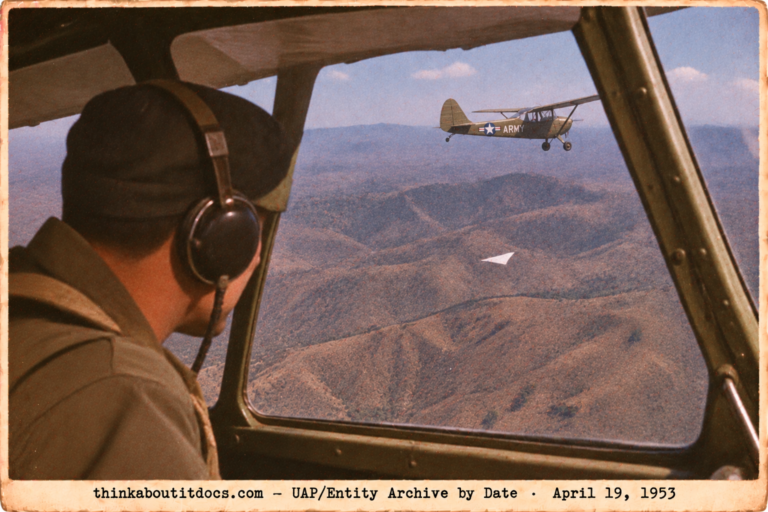
Summary: Four U.S. Army reconnaissance observers in two aircraft, including Lts. Julius T. Morgan, James O. Rymer (spelled Rymus in one source) and Jack E. Myers, reported a white, rounded, delta-shaped object 5 to 7 feet across moving at 60 to 80 mph over Communist-held territory. Press accounts also said radar had tracked objects at supersonic speed. An ATIC follow-up with the 7th Infantry Division G-2, the 7th Artillery S-2 and the 502nd Tactical Control Group found no record of any such radar tracks, and Project Blue Book reported having no information on the Korean or the Lake Superior (Calumet) reports. [Full Report]
Source: AP, April 19-20, 1953; Washington Star, April 20, 1953; ATIC report TIC-4979; Gross, Loren E., “UFOs: A History, 1953: March-July”; Sparks, Blue Book Unknowns catalogue (Case 961)
Source Status: Cross-reference: ATIC considered a possible link to the Calumet, Michigan radar reports of the same day and doubted it because the reported speeds differed greatly. One newspaper headline placed the sighting over Japan rather than Korea.
Date: April 20, 1953
Location: Sheffield, England
Time: About 7:30 p.m.
Summary: Three 16-year-old boys watched a disc-shaped “flying saucer” for about 25 minutes while raising pheasants. It showed a trail of flame and smoke that stopped when the object halted. The newspaper report appeared April 24.
Source: Gross, Loren E., “UFOs: A History, 1953: March-July”
Date: April 21-22, 1953
Location: Ano Ilioupolis, East Athens, Greece
Time: Night (Apr 21); Afternoon (Apr 22)
Summary: On the night of April 21, witness Vassiliki F. encountered a strange woman on the streets — large protruding eyes, a high forehead, an unusually thin waist, dressed in old-fashioned gray clothing over transparent trousers, leading what appeared to be a small dog that was actually a piece of shadow hovering near the ground on a transparent cord. The woman glared and vanished when questioned. The next afternoon, word spread that an aluminum, hut-shaped craft had landed nearby; a shepherd saw incredibly ugly dwarfs through its windows, including one with an animal’s head. A dwarf emerged holding a golden plate; the same strange woman reappeared, the dwarf bowed to her, and she filled the plate with dirt before both returned inside. The craft then departed with a loud bang. [Full Report]
Source: Panayotis Skayannis
Date: April 24, 1953
Location: Columbus, Ohio
Time: About 10:00 p.m.
Summary: M/Sgt. Ralph E. Brown reported being approached by an unidentified man who claimed that Wright-Patterson AFB held three flying saucers and alien bodies. The report was made April 25-27, and no sighting of any object is described.
Source: Gross, Loren E., “UFOs: A History, 1953: March-July”
Source Status: A secondhand claim passed on by one witness; the unidentified man is never named.
Date: April 25, 1953 (day partly illegible in source)
Location: Pacific Ocean, aboard the USNS Brewster
Time: About 5:00-5:05 p.m.
Summary: Maj. Henry L. Brown, USAF, and 2nd Lt. Lloyd V. Jan, Army, reported a metallic silver object that approached the ship erratically, circled, then turned and climbed away at speeds the report compared to a jet.
Source: Gross, Loren E., “UFOs: A History, 1953: March-July”
EXECUTIVE SUMMARY
Civilian Strangeness and a Navy Crew Shadowed Over the Sea of Japan
April 1953 splits into two records. The civilian entity cases, Bagley, Angatuba and Ano Ilioupolis, rest on single accounts with no radar, no film and no official file, and read more like folklore and contactee literature than Blue Book reports. The military cases come with instruments and crews: Pichon’s F-94B over Fukuoka, a P2V crew that logged about 70 passes by about ten objects while radar and direction-finding gear tracked them, and a C-47 crew that watched ten metallic discs wheel past their aircraft over Nevada.
Only two of the month’s cases, Fukuoka (BBU #2535) and Tucson (BBU #2542), stand as Blue Book unknowns, while Sweetwater was evaluated as possible aircraft, the Manchuria objects as balloons with radar reflectors, and the Lake Superior radar returns as inversion effects. The thin Fort Monmouth “crashed disc” claim attached to April is unrelated to that base’s well-documented 1951 radar case.
“He became angry and broke free from the control of the entities”
— Craig R. Lang, MUFON (Bagley, Minnesota)