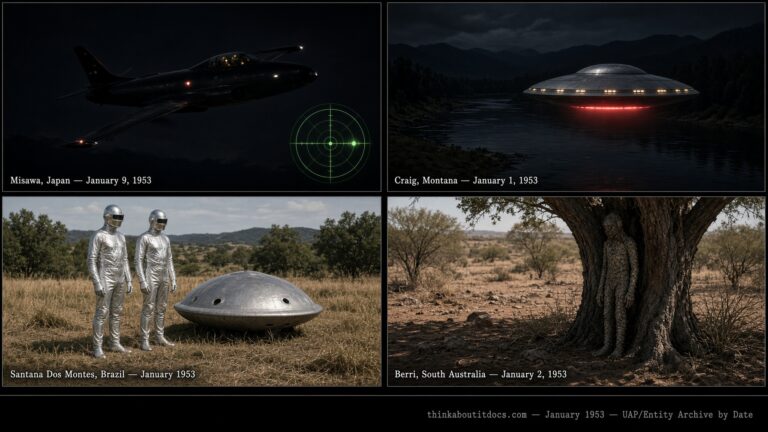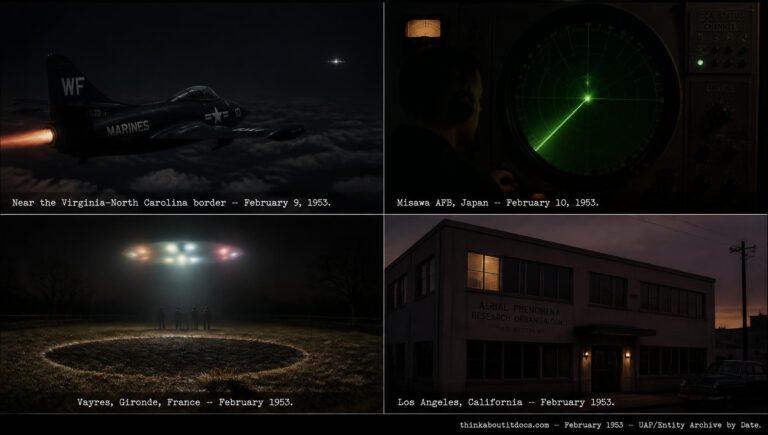
March 1953's documented pursuits, radar chases, and the Tujunga Canyon entity encounter, archived by date.
1953: March UFO|UAP & Entity Sightings Archive
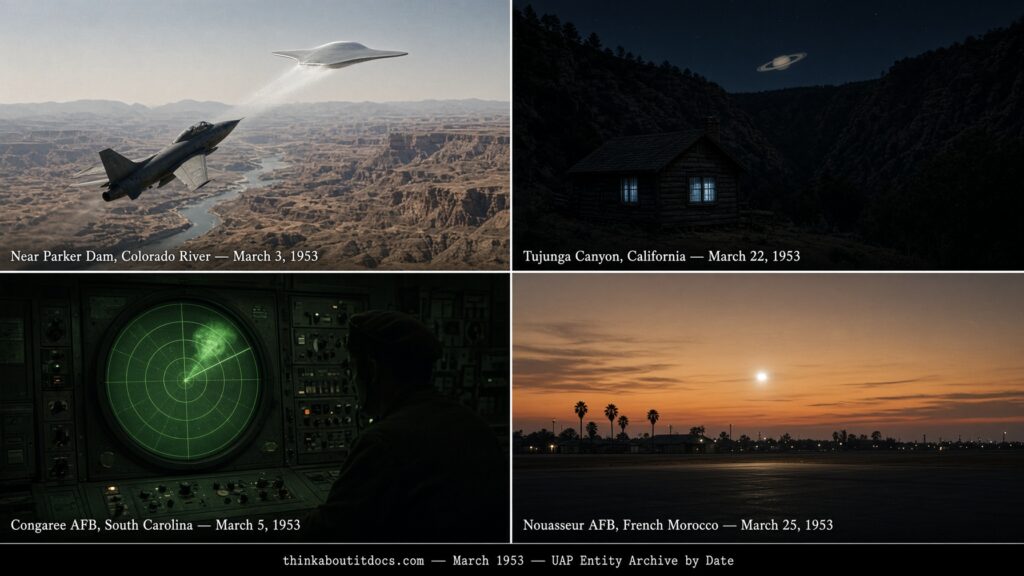
March 1953 gave Project Blue Book something it rarely got: film. When Capt. Roderick Thompson chased a manta-ray-shaped object over the Colorado River in his F-84, he came back with gun camera footage — one of the best-documented military pursuits of the year. Three weeks later, in a remote cabin in Tujunga Canyon, California, two women lost more than two hours of memory in an encounter that would eventually become the subject of an entire book. Between those two cases, the month is thick with radar tracks from South Carolina to Japan to French Morocco, and a landed craft outside a U.S. air base in North Africa that simply blinked out on the ground.
Date: March 3, 1953
Location: 130 miles west of Luke AFB, Phoenix, Arizona, near Blythe, California
Time: 1:25-1:32 p.m. (MST)
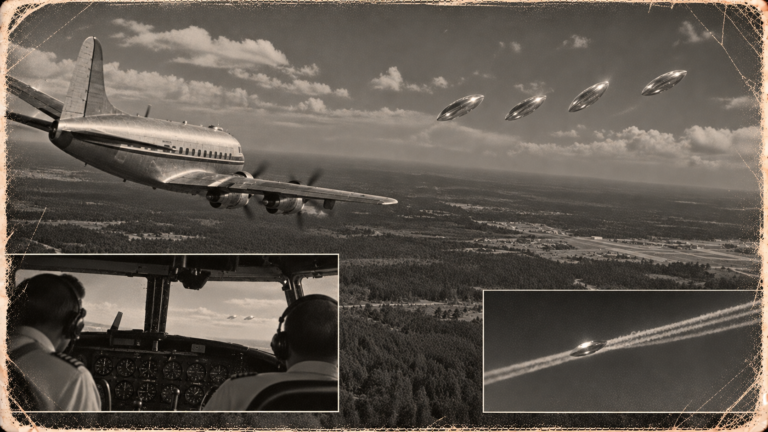
Summary: USAF Capt. Roderick D. Thompson, an F-84 instructor pilot with the 3600th Fighter Training Group, spotted a thin, manta-ray-shaped object crossing his path at higher altitude, visible mainly by its condensation trail. Two accompanying student pilots also saw it but did not pursue. Thompson climbed to 30,000 ft and closed to within 5-10 miles of the object over the Colorado River north of Parker Dam, capturing 151 frames of 16mm gun camera film before the pursuit ended. [Full Report]
Source: BB Rpt 11; NICAP website; McDonald list; Ruppelt pp. 229-230; FUFOR Index
Date: March 5, 1953 BBU
Location: Congaree AFB, South Carolina
Time: 3:45 p.m. EST
Summary: The assistant director of security at the Savannah River Project, J. Howard Jones, observed a silver, crescent-shaped object at very high altitude over the project. The 727th AC&W Squadron at Congaree was notified and picked up an unidentified plot on AN/ASP-5 radar at 5:07 p.m., roughly 65 miles southwest of Congaree over the Savannah River Project. An ANG F-51 attempted interception until 5:25 p.m., when the blip faded northwest of Congaree. At 5:52 p.m., a detachment of the same squadron at Camden, South Carolina picked up a blip on AN/TPS-1B radar, due west of Congaree; an F-80 was scrambled but could not be located on the scope during an identification turn. The blip, first seen roughly 100 miles west of Congaree, reversed direction to 85 miles out heading northwest, then east, then west, then east again, fading at 115 miles. Across both radar sightings, interception attempts continued for a total of 68 minutes with negative results. The object held an estimated 20,000 ft altitude throughout, moving at 200-220 mph.
Source: Dan Wilson, footnotes.com
Date: March 5, 1953 BBU
Location: Shaw AFB, South Carolina
Time: 5:07 p.m. (EST)
Summary: Unknown — no further detail survives beyond the case being logged at this time and location, alongside the same-day Congaree AFB radar activity above.
Source: McDonald list
Date: March 7, 1953
Location: Yuma, Arizona
Time: Unknown
Summary: Air Force officers at a gunnery meet observed about 12 disc-shaped objects that dove down and hovered over the base during the meet.
Source: AP story, March 9; UFOE, III
Date: March 9, 1953 BBU
Location: Ashiya AFB, Kyushu, Japan
Time: 6:30 a.m.
Summary: Unknown — no further detail survives beyond the case being logged at this time and location.
Source: McDonald list; FUFOR Index
Date: March 10-11, 1953 BBU 2490
Location: Hackettstown, New Jersey
Time: Approximately 2-4 a.m. (EST)
Summary: Mrs. Nina Cook, an experienced private pilot and wife of a Pan Am flight engineer, saw a large light blinking 10-15 times per minute, moving up and down along a mountain range. A possible earlier sighting around 9 p.m. is noted but not confirmed.
Source: Berliner; FUFOR Index
Date: March 12, 1953
Location: RCAF Station Chatham, New Brunswick, Canada
Time: 12:55 (Atlantic Standard Time)
Summary: Similar to the January 29, 1953 Presque Isle, Maine occurrence, this event took place roughly 125 miles east of the New Brunswick base. A brilliant silver disc traveling at 500 knots was observed both from an officer in the control tower and from an airborne Harvard (T-6 Texan) trainer pilot, transitioning from level flight to a steep climb. Photos were attempted from the Harvard but did not turn out. The object was observed continuously for an estimated four minutes.
Source: Don Ledger
Date: March 14, 1953 BBU 2496
Location: North of Hiroshima, Japan
Time: 11:45 p.m.
Summary: The nine-man crew of a U.S. Navy P2V-5 patrol plane — pilot Lt. Wooton, copilot Lt. J.S. Rose, navigator Lt. D.W. Carey, Capt. G.E. Truelove, radarmen G.F. Delmel and R.D. Kelly, radiomen J. Schaefer and J.L. Chavers, and crewmen L.B. Brown and G.E. Noiseux — saw groups of 5-10 colored lights, totaling an estimated 90-100, moving slowly aft along the left side of the aircraft at a range of 3-7 miles as estimated by the copilot. An unidentified target was tracked at 7 miles range by the airborne APS-20 radar, moving from 45° to 250° relative bearing.
Source: Jan Aldrich; NICAP
Date: March 20, 1953 BBU
Location: Pork Chop Hill / Old Baldy, Korea
Time: 11 p.m.
Summary: An AP radio news service summary dated April 5, 1953 reported that luminous objects traveling at supersonic speeds had been observed and tracked on radar in the days prior in the Pork Chop and Old Baldy Hills area of the Western Korean Front.
Source: McDonald list; FUFOR Index
Date: March 21, 1953 BBU 2511
Location: Elmira, New York
Time: 3:05 p.m. (EST)
Summary: Four Ground Observer Corps observers at an observation post saw six discs flying in a group, high and fast.
Source: Berliner; FUFOR Index
Date: March 21, 1953
Location: Prescott, Arizona
Time: Unknown
Summary: A sighting made from aircraft, recorded only as the “Beers case,” with no further surviving detail.
Source: Unknown
Date: March 22, 1953
Location: Tujunga Canyon, California
Time: 02:00A
Summary: Sarah Shaw and Jan Whitley, staying in a remote cabin, awoke to total outside silence and a blue-white light moving outside, casting shadows through the windows. Both experienced giddiness and confusion, with conscious memory not resuming until 04:20A. Under later hypnosis, Sarah recalled eight humanoid beings entering the cabin through a closed window and door, taking both women aboard a hovering, Saturn-shaped craft, and conducting an extensive physical examination in a domed interior room. [Full Report]
Source: Ann Druffel, Idabel Epperson & D. Scott Rogo
Date: March 23, 1953 BBU
Location: Pasadena, Texas
Time: 9:55 p.m.
Summary: Lt. Robert K. Smith observed an object with a red light traveling in large circles over Pasadena. Information was passed to the 747th AC&W Squadron, who radar-scanned the area without locating the object. Members of the squadron went outside and personally saw the object over Pasadena. Around 10:12 p.m., the object was sighted on the radar screen and held for 25 seconds. Total length of observation was 30 minutes.
Source: McDonald list; FUFOR Index
Date: March 25, 1953 BBU 2521
Location: San Antonio, Texas
Time: 3:05 p.m. (possibly 11:15 p.m. CST)
Summary: USAF Capt. and Mrs. D.E. Cox saw several lights, some moving in straight lines, others making 360° turns.
Source: Berliner; FUFOR Index
Date: March 25, 1953 BBU
Location: Nouasseur AFB, Rabat, French Morocco
Time: 9:23-10:15 p.m. (GMT)
Summary: Majors Radin and Rend, along with the crew of a C-47 at 5,000 ft, saw a white light above at 7,000-8,000 ft maneuvering in a spiral pattern over the airfield. The light descended and landed on the airbase south of the runways at 9:28 p.m., remaining visible until it suddenly blinked out on the ground around 10:15 p.m.
Source: Hynek UFO Rpt pp. 83-87; FUFOR Index
Date: March 27, 1953 BBU 2524
Location: Mount Taylor, New Mexico
Time: 7:25 p.m. (MST)
Summary: The pilot of a USAF F-86 jet fighter, flying at 600 knots (700 mph), saw and chased a bright orange circle flying at an estimated 800 knots (900 mph), which executed three fast rolls.
Source: Berliner; FUFOR Index
Date: March 29, 1953 BBU 2526
Location: Spooner, Wisconsin
Time: 3:45 p.m. (CST)
Summary: L.C. Gillette saw an aluminum, circular object fly high and fast, reversing course twice. Gillette noted he had seen a similar object in 1938.
Source: Berliner; FUFOR Index
Date: March 31, 1953
Location: 16 miles west of Williams AFB, Arizona
Time: 1:45 p.m. (MST)
Summary: A civilian test pilot flying northwest at 4,000 ft and 175 mph observed a silver, disc-shaped object traveling north to south at a terrific rate of speed, estimated at 3 feet or larger. A pibal weather balloon had been scheduled for launch 15 minutes after the sighting. The observation lasted 10 seconds; recorded as a CIRVIS report with the date-time group 31/2045Z.
Source: Dan Wilson
Date: March 31, 1953 BBU
Location: Honshu, Japan
Time: 7:35 p.m. local time
Summary: Major Eugene S. Williams, flying an F-84 at 30,000 ft and 300-350 mph, observed a very bright, round white object about 20° above the horizon on a magnetic bearing of 330°, with a red “leg” protruding from its lower left side and a blue one from the lower right. The object dropped to a lower altitude, growing bigger and brighter, and appeared to “pull off and leave” as Williams pursued it from 330° to 290° bearing. The chase lasted 10 minutes before the object moved out of sight; total observation time was 30 minutes.
Source: Dan Wilson, McDonald list; FUFOR Index
EXECUTIVE SUMMARY
The Month Blue Book Got Film — and a Cabin Lost Two Hours
March 1953’s strongest cases share an unusual trait for this era: physical documentation. Capt. Thompson’s gun camera footage of the Blythe pursuit is one of the only cases in this whole archive with surviving film, and the RCAF Chatham radar-visual case had photographs attempted (if not preserved) from the air. Set alongside the persistent radar chases across South Carolina, Japan, and French Morocco — including an object that landed and simply vanished from view on a runway apron in North Africa — the month reads as one where the phenomenon kept showing up on instruments as well as in testimony.
Against that backdrop, the Tujunga Canyon case stands apart entirely. No radar, no film — just two women, a cabin, and over two hours neither could account for until hypnosis surfaced a fuller narrative years later. It would go on to become one of the most thoroughly investigated entity cases of the decade, examined in book-length detail rather than a paragraph in a Blue Book file.
“Immediately began to form a heavy condensation trail behind it for roughly 1,000 ft and split in two for about 1,000 ft but which ended abruptly and moved with the object, the trail not being left behind.”
— Case summary, Blue Book Report 11, March 3, 1953