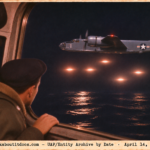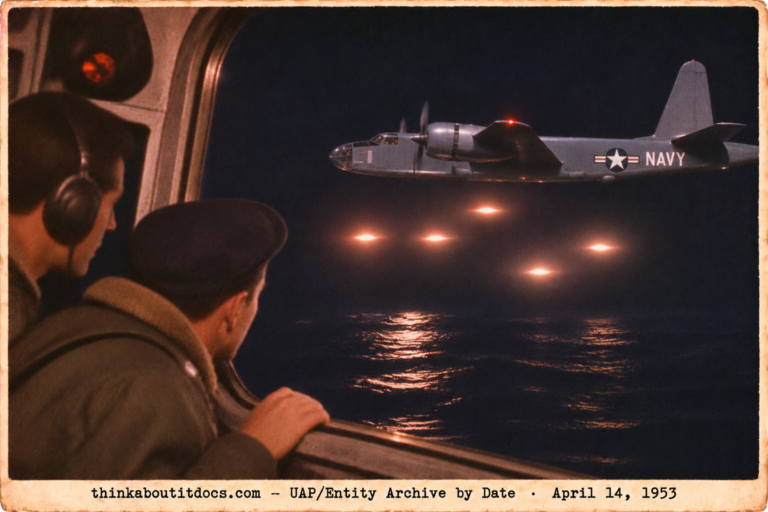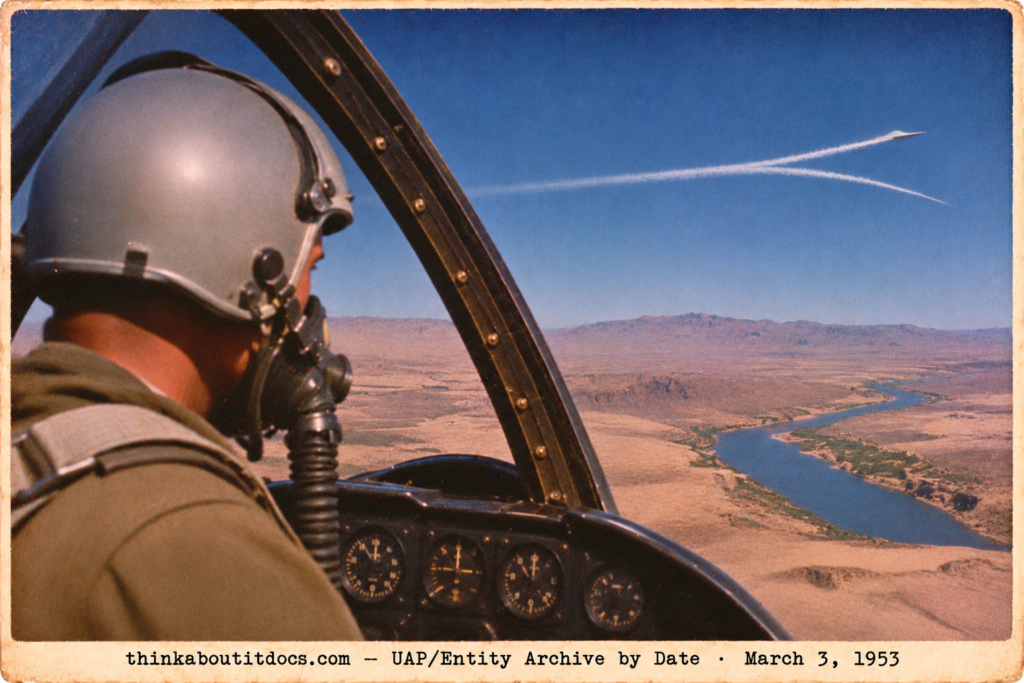
March 3, 1953: an F-84 pilot photographs what he chased over the Colorado River.
THINK ABOUTIT UFO|UAP SIGHTINGS REPORT
1953: The Thompson Gun Camera Pursuit — Near Blythe, California
An F-84 instructor pilot at 25,000 feet watched something cross his path that he did not believe was an aircraft: thin, manta-ray shaped, visible mostly by the vapor condensing off it. When Capt. Roderick Thompson broke off training and gave chase, he closed to within an estimated five to ten miles over the Colorado River north of Parker Dam and did something almost no other 1953 witness managed: he got 151 frames of it on gun camera film.
Date: March 3, 1953
Sighting Time: 1:25-1:32 p.m. (MST)
Day/Night: Day
Location: About 130 miles west of Luke AFB, Arizona, near Blythe, California; pursuit ended over the Colorado River north of Parker Dam, about 70 miles north of Blythe
Urban or Rural: Rural (desert and river airspace)
No. of Entity(‘s): 0
Entity Type: Not Applicable
Entity Description: Not Applicable
Hynek Classification: DD (Daylight Disc, used broadly for a daylight non-conventional object; this one was not disc-shaped)
Duration: About 7 minutes (1:25-1:32 p.m.)
No. of Object(s): 1
Description of the Object(s): A thin, manta-ray-shaped, flat-surfaced object seen mainly by the condensation vapor from its surface
Shape/Size/Color of Object(s): Manta-ray/flat; estimated 300-500 ft wide; color not given beyond the white trail
Distance to Object(s): Closed to roughly 5-10 miles
Height & Speed: First seen at 35,000-45,000 ft at about 400 mph TAS; climbed at about 20 degrees after Thompson began pursuit, while Thompson climbed at full power at about 560 mph to 30,000 ft
Number of Witnesses: 3: Capt. Roderick D. Thompson and student pilots Lt. Jack E. Brasher and Lt. Thomas W. Hale, who saw the object but did not pursue
Special Features/Characteristics: A condensation trail formed abruptly, split in two for about 1,000 ft, then ended abruptly and moved with the object rather than trailing behind; 151 frames (about 30 ft) of 16mm gun camera film were exposed
Case Status: Officially recorded as Project Blue Book Report 11 and evaluated “Other (contrails)”; Sparks’ Blue Book Unknowns catalogue still lists it as an unknown (Case 942); discussed by Ruppelt
Source: Blue Book Report 11; NICAP; McDonald list; Ruppelt, “The Report on Unidentified Flying Objects,” pp. 229-230; FUFOR Index
Summary/Description: USAF Capt. Roderick D. Thompson of the 3600th Fighter Training Group, Luke AFB, flying an F-84 at 25,000 ft, saw a thin, manta-ray-shaped object cross his path at higher altitude, visible mainly by its condensation trail. Two student pilots also saw it. Thompson chased it at full power to 30,000 ft, closing to an estimated 5-10 miles over the Colorado River, and shot 151 frames of gun camera film.
Related Cases: None known
Detailed Report
The afternoon of March 3, 1953 began as a routine training flight. Capt. Roderick D. Thompson, an instructor pilot with the 3600th Fighter Training Group at Luke AFB, was flying an F-84 at 25,000 feet, heading 305 degrees magnetic at roughly 500 mph true airspeed, with student pilots Lt. Jack E. Brasher and Lt. Thomas W. Hale nearby in their own F-84s.
At about 1:25 p.m. an object crossed Thompson’s path at his 10 o’clock high position, moving left to right at an estimated 35,000 to 45,000 feet and about 400 mph TAS. It was thin and flat-surfaced, shaped something like a manta ray, and visible mainly through the condensation vapor streaming off it. Both student pilots saw it but neither followed.
Thompson turned to pursue, climbing at full power at about 560 mph. The object made a slight dipping turn to the northwest and began climbing at about 20 degrees. A heavy condensation trail formed behind it for roughly 1,000 feet, split in two for another 1,000 feet, then ended abruptly and moved with the object instead of trailing behind it.
Thompson reached 30,000 feet and closed to an estimated 5 to 10 miles over the Colorado River north of Parker Dam, about 70 miles north of Blythe. Using a 16mm N-9 gun camera at an estimated 16 frames per second and a 1/40-second exposure, he exposed about 151 frames, roughly 30 feet of film.
The case entered the record as Project Blue Book Report 11 and was discussed by Capt. Edward Ruppelt in his book. The Blue Book evaluation is Other (contrails), and a summary of the record card attributes to the Photographic Reconnaissance Laboratory at Wright-Patterson the conclusion that the object producing the trail did not appear in the film.
RESEARCHER’S NOTES
The Thompson Pursuit: The Case With Film, and What the Film Showed
- Gun camera footage exists: Very few 1953 cases have any film at all, which sets this one apart from testimony-only reports.
- What the analysis reportedly found: A summary of the Blue Book card says the laboratory found the trail but not the object. This comes from an AI-written summary of a scanned card and should be checked against the card itself.
- A contrail that did not behave like one: The trail forming abruptly, splitting, and staying with the object is a specific detail, though Blue Book’s evaluation was contrails.
- Three pilot witnesses: Three trained pilots saw the object and only one chased it, so the sighting does not rest on Thompson alone.
- Disagreement over status: Blue Book calls it contrails; Sparks’ Blue Book Unknowns catalogue lists it as unknown. Both are recorded here and the question is left open.
This is one of the better-documented military cases of early 1953: named pilots, a formal Blue Book designation, and film. The Blue Book evaluation of contrails and the reported finding that the object itself was invisible in the film are part of the record and are stated here beside the pilots’ account rather than in place of it.
“Immediately began to form a heavy condensation trail behind it for roughly 1,000 ft and split in two for about 1,000 ft”
— Case summary, Blue Book Report 11