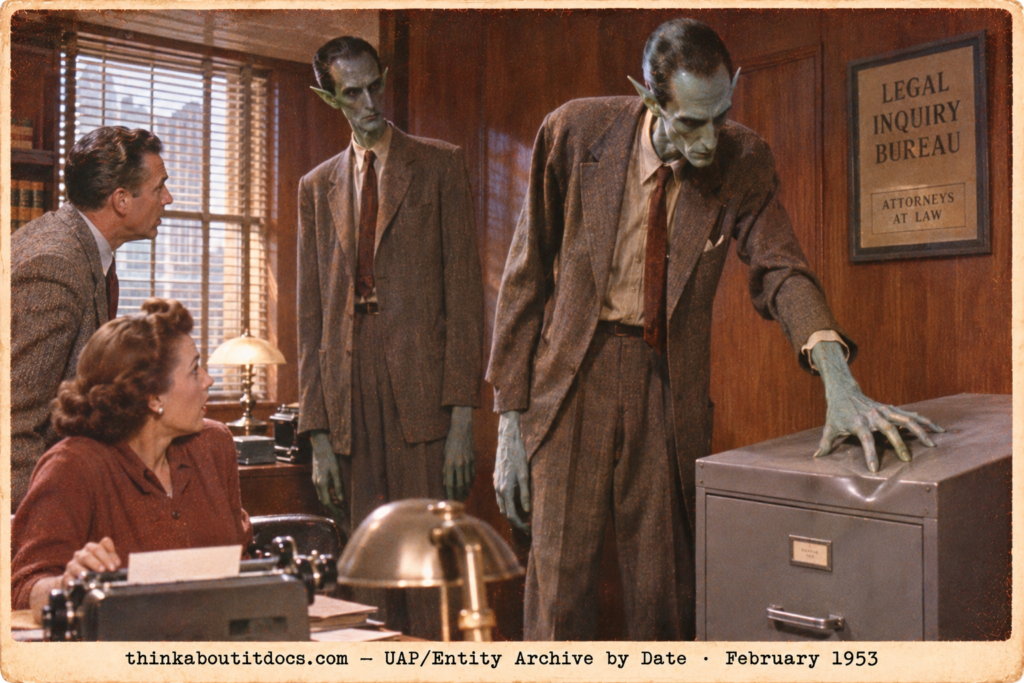
February 1953: two tall visitors reportedly dented steel in a Los Angeles attorney's office.
THINK ABOUTIT ENTITY ENCOUNTER REPORT
1953: The Los Angeles Attorney’s Office Visitors
No craft was ever seen. No lights in the sky, no radar return, nothing overhead at all, just two impossibly tall, bluish-green strangers who, by the account of author Harold T. Wilkins, were hired in January 1953 by an official in a Los Angeles attorney’s office to trace missing persons, pressed a curved hand a half inch into a steel filing cabinet, and were gone by mid-February, before the FBI could question them.
The story has a second life in the federal record: a Texas reader sent a summary of it to J. Edgar Hoover in November 1964, and that letter now sits in the FBI’s UFO file released in 2026. What the file shows, and what it does not, is the heart of this report.
Date: February 1953 (hired about January 20, 1953; vanished by mid-February 1953)
Sighting Time: Not recorded (one retelling places the visit in the afternoon)
Day/Night: Day
Location: Los Angeles, California (a local attorney’s office, a legal inquiry bureau that traced lost and missing persons)
Urban or Rural: Urban
No. of Entity(‘s): 2
Entity Type: Humanoid
Entity Description: Two men about 6 ft 6 in tall, emaciated, poorly clothed, bluish-green in complexion, with pointed ears and a “curiously curved” hand; described as extremely successful investigators
Hynek Classification: Not Applicable
Duration: About four weeks of employment (hired about January 20; gone by mid-February 1953)
No. of Object(s): 0 (the visitors said they arrived in a small flying saucer, but no craft was ever seen)
Description of the Object(s): Not Applicable
Shape/Size/Color of Object(s): Not Applicable
Distance to Object(s): Not Applicable
Height & Speed: Not Applicable
Number of Witnesses: Unknown (the attorney’s-office official who hired them and office staff are implied but unnamed)
Special Features/Characteristics: One of the men leaned over the steel top of a filing cabinet and made an indentation at least 1/2 inch deep with his hand; a metallurgical chemist reportedly said it would take about 2,000 lbs of force per inch and found traces of more than a dozen unknown elements in the dents; the cabinet is said to be locked in a vault; FBI agents were reportedly sent but the men had vanished
Case Status: Unresolved — secondhand and uncorroborated; the account reaches the record through Wilkins, who credits an anonymous Los Angeles reporter, and the FBI file contains no confirmation
Source: Harold T. Wilkins, “Flying Saucers on the Attack” (Citadel Press, 1954), as condensed in a November 9, 1964 summary filed in FBI file 62-HQ-83894, Section 9 (PURSUE Release 01); Scott Corrales
Summary/Description: Two tall, bluish-green men with pointed ears were reportedly hired about January 20, 1953 by an official in a Los Angeles attorney’s office concerned with tracing lost and missing persons, and proved extremely successful investigators. They said they had landed a small flying saucer in the Mojave Desert about 200 miles east of Los Angeles in mid-December 1952 and had learned English from radio and television. One pressed an indentation at least half an inch deep into a steel filing cabinet with his curved hand. FBI agents were reportedly sent, but by mid-February 1953 the men had disappeared.
Related Cases: The Mojave Desert landing the visitors described, mid-December 1952 (their own account; no independent report)
Detailed Report
The account as it survives begins with a 1954 book. Harold T. Wilkins, in the appendix of “Flying Saucers on the Attack,” told of two men hired on or about January 20, 1953 in Los Angeles by an official in an attorney’s office concerned with tracing lost and missing persons, a legal inquiry bureau. The two, he wrote, said they had come from another planet in the middle of December 1952, landing a small flying saucer on the Mojave Desert about 200 miles east of Los Angeles, and had learned to speak English by listening to radio and television broadcasts.
They were 6 ft 6 in tall, emaciated and not well clothed, with bluish-green complexions and pointed ears, and they proved extremely successful investigators. At some point one of them leaned over the steel top of a filing cabinet and, with a curiously curved hand, made an indentation in the steel at least half an inch deep. The indented steel was sent to a metallurgical chemist, who reportedly said that producing such a dent would take a force of some 2,000 lbs to the inch, and that traces of more than a dozen unknown elements were found in the dents.
According to the story the FBI sent several agents to investigate the two men, but by the time they arrived, in mid-February 1953, the visitors had disappeared. The steel cabinet is said to be locked in a vault. Wilkins reportedly had the tale from a Los Angeles reporter who wished to remain anonymous.
The federal record adds only the next chapter. On November 9, 1964, Charles F. Bilbo of Orange, Texas wrote to FBI Director J. Edgar Hoover enclosing a one-page condensed summary of Wilkins’ appendix and asking whether the story was true or whether the Bureau had a report. The Bureau’s reply declined to say either way, citing the confidentiality of its files, and an internal routing note records that its files contained nothing identifiable regarding Wilkins or his book. A separate Bureau letter in the same file, answering another correspondent’s inquiry about a similar claim, stated that the FBI had not conducted an investigation as described, and that any agent’s presence would have been only to determine whether a violation within its jurisdiction had occurred.
No craft, light or aerial phenomenon accompanies the Los Angeles episode itself; the saucer appears only in what the visitors reportedly said about their arrival.
RESEARCHER’S NOTES
The Los Angeles Visitors: A Story That Reached the FBI Only as Hearsay
- What the FBI file actually contains: The documents are a 1964 reader’s letter, a condensed summary of Wilkins, and the Bureau’s polite refusals. There is no field report, no agent interview and no evidence log. The statement that the FBI “sent several agents” appears only inside Wilkins’ own story.
- A physical claim that cannot be checked: A dented cabinet is a specific, falsifiable detail, and the account adds a metallurgist, a force estimate and “a dozen unknown elements.” None of it is named, dated or documented; the cabinet is said to sit in a vault no one identifies.
- The secondhand chain: Anonymous Los Angeles reporter to Wilkins (1954), Wilkins to a Texas reader’s summary (1964), summary to the FBI, and later Scott Corrales’ retelling. No named attorney, office, reporter or employee appears at any link.
- Versions differ: The Wilkins summary gives the height as 6 ft 6 in and says the men were hired and later vanished. Later retellings give “over 6’2″,” place the visit on an afternoon, and have alarmed employees phoning the FBI. Those details are not in the Wilkins summary in the FBI file.
- Timeline: The story’s own dates run mid-December 1952 (landing), about January 20, 1953 (hired) and mid-February 1953 (vanished). This archive files the case under February 1953 because that is when the men were said to have disappeared and the FBI to have been called.
By any conventional evidentiary standard this is one of the weakest cases in the 1953 archive: a story told by an anonymous reporter to an author, passed to a reader, and filed by the FBI without comment. It is preserved here because it is a real piece of mid-century flying-saucer literature, because the federal file shows exactly how thin the paper trail is, and because a pure entity visitation with no craft attached deserves to be recorded as reported rather than smoothed into a more familiar shape.
“with his curiously curved hand, made an indentation in the steel”
— Summary of Harold T. Wilkins, “Flying Saucers on the Attack,” filed with the FBI, November 9, 1964