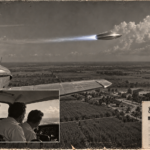
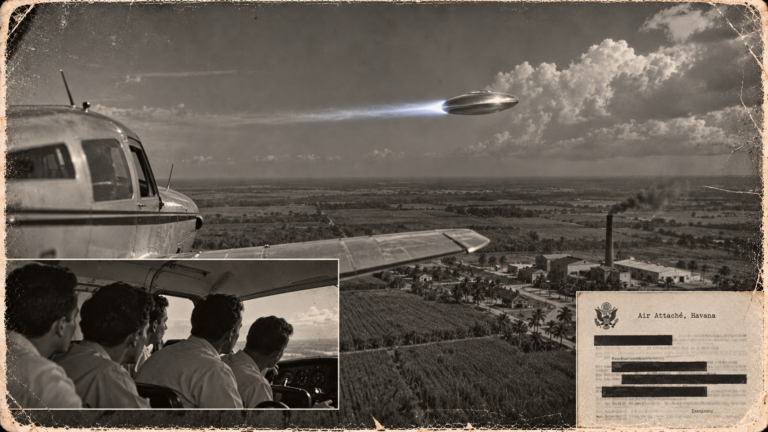
John B. Bean's satin-aluminum disc outclimbs a jet near the AEC's Livermore facility, January 27, 1953.
THINK ABOUTIT UFO|UAP SIGHTINGS REPORT
1953: Round Metallic Object Near Livermore, California
A veteran flyer with seventeen years in the air knows what a jet contrail looks like — and knows what it looks like when something flies circles around one without leaving a trace of its own. On January 27, 1953, just outside the fence line of the Atomic Energy Commission’s brand-new research facility near Livermore, California, John B. Bean had three different aircraft in view at once: a jet, a second plane, and a silent white disc that outclimbed and outmaneuvered both of them before vanishing at a rate of ascent Bean would later call the most terrific he had ever witnessed.
Date: January 27, 1953
Sighting Time: Afternoon (exact clock time not recorded in the source letter)
Day/Night: Day
Location: Livermore, California (along the road paralleling the eastern fence of the Atomic Energy Commission Research Facilities)
Urban or Rural: Rural
No. of Entity(‘s): 0
Entity Type: Not Applicable
Entity Description: Not Applicable
Hynek Classification: DD (Daylight Disc)
Duration: Under a minute (not precisely timed by the witness)
No. of Object(s): 1
Description of the Object(s): A round, disc-shaped object with a metallic sheen similar to satin-finished aluminum
Shape/Size/Color of Object(s): Disc; white with an aluminum-like satin sheen; precise size not stated
Distance to Object(s): Not precisely stated
Height & Speed: Not given in exact figures; witness stated the disc had “far more power and far more rapid maneuverability” than either of the two conventional aircraft he had in simultaneous view, and departed in “the most terrific rate of ascent” he had ever witnessed
Number of Witnesses: 1 (single witness)
Special Features/Characteristics: No contrail, despite a jet at higher altitude in the same field of view leaving a distinct one; no sound was heard from the disc or either conventional aircraft, though wind direction may partly explain the latter
Case Status: Unresolved — cataloged by NICAP as a “Standard Case”; single witness, but the witness’s aviation background and the simultaneous-comparison-aircraft detail lend it unusual evidentiary weight for an uncorroborated report
Source: Richard Hall, UFO Evidence (NICAP), 1964, quoting a witness letter dated February 7, 1953
Summary/Description: John B. Bean, a flyer with seventeen years of experience, was driving north along the road bordering the eastern fence of the AEC Research Facilities near Livermore after visiting the Purchasing Office there. He had a jet aircraft and a second plane in view at higher altitude when a round, white, satin-aluminum-finished disc appeared and quickly demonstrated capabilities well beyond either conventional craft, closing distance and outclimbing them before departing at extreme speed.
Related Cases: None known
Detailed Report
On the afternoon of January 27, 1953, John B. Bean had just left the Purchasing Office of the Atomic Energy Commission Research Facilities near Livermore, California — the site that would soon formally become Lawrence Livermore National Laboratory — and was driving north along the road running parallel to the facility’s eastern perimeter fence.
What made Bean’s sighting unusually valuable as a piece of testimony was not the disc alone, but the company it kept. Bean had three distinct aircraft within his sight range at the same time: a jet leaving a visible contrail at high altitude, a second conventional aircraft, and the object itself. That simultaneity let him do something few UFO witnesses can — directly compare speeds and flight characteristics against known quantities in the same field of view, in real time.
By his account, there was no question the disc-like object had far more power and far more rapid maneuverability than either of the other two aircraft. It was perfectly round, with a metallic sheen he compared to satin-finished aluminum. Where the jet at higher altitude left a distinct contrail, the white disc left none at all. Neither of the two conventional aircraft made any sound that reached him — though Bean noted the wind was blowing from his position toward them at roughly 15 to 20 knots, which may account for that detail rather than pointing to anything unusual.
The disc’s departure was the detail that stayed with Bean: it began climbing at what he called the most terrific rate of ascent he had ever witnessed in seventeen years of flying. He wrote up the account in a letter dated February 7, 1953 — eleven days after the sighting — which later reached NICAP researcher Richard Hall and was published in his 1964 UFO Evidence compilation.
RESEARCHER’S NOTES
The Livermore Sighting — 1953 and the Value of a Built-In Yardstick
- An unusual evidentiary structure: Most single-witness cases live or die on the witness’s word alone. Bean’s account is unusual in that he wasn’t asked to estimate the disc’s speed in a vacuum — he was comparing it directly, in the same moments, against two conventional aircraft whose approximate performance he understood as a professional flyer.
- The AEC backdrop: The location — bordering a federal atomic research facility barely a year into operation — sits at the intersection of two Cold War-era anxieties (nuclear research sites and aerial phenomena) that recur throughout this archive, without implying any documented connection between the two.
- The contrail discrepancy: The absence of a contrail on the disc, set against the jet’s visible one at similar or higher altitude, is the kind of physical detail that’s easy to overlook in summary but is exactly the sort of thing a trained observer would notice and find odd.
- An eleven-day gap: The letter was written eleven days after the event — not immediate, but not a decades-later recollection either. Worth weighing against cases elsewhere in this archive reconstructed from testimony given years or decades after the fact.
- No corroboration found: No search has turned up a second witness, a radar track, or any independent confirmation. This remains, and likely will remain, a single-witness case.
There’s no way to verify Bean’s account independently, and NICAP’s own “Standard Case” designation reflects that. What can be said honestly is that the witness had professional aviation experience, gave himself a built-in comparison against known aircraft rather than relying on estimation alone, and put his account in writing within days rather than years. Whether that adds up to more than an unusually well-told anecdote is left to the reader.
“It was perfectly round and had a metallic sheen somewhat similar to that of aluminum with a satin finish… it began to climb at the most terrific rate of ascent that I have ever witnessed.”
— John B. Bean, letter dated February 7, 1953