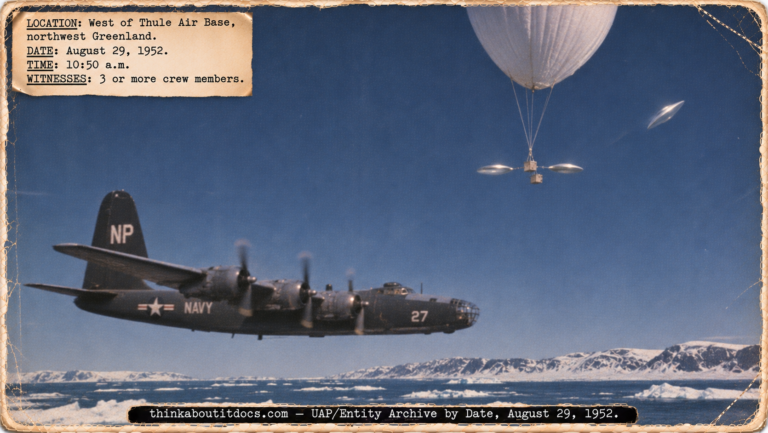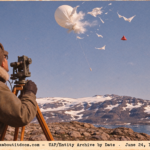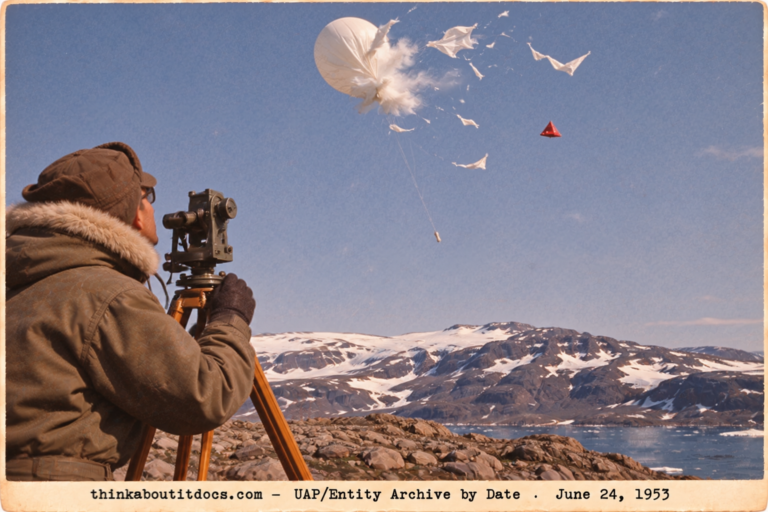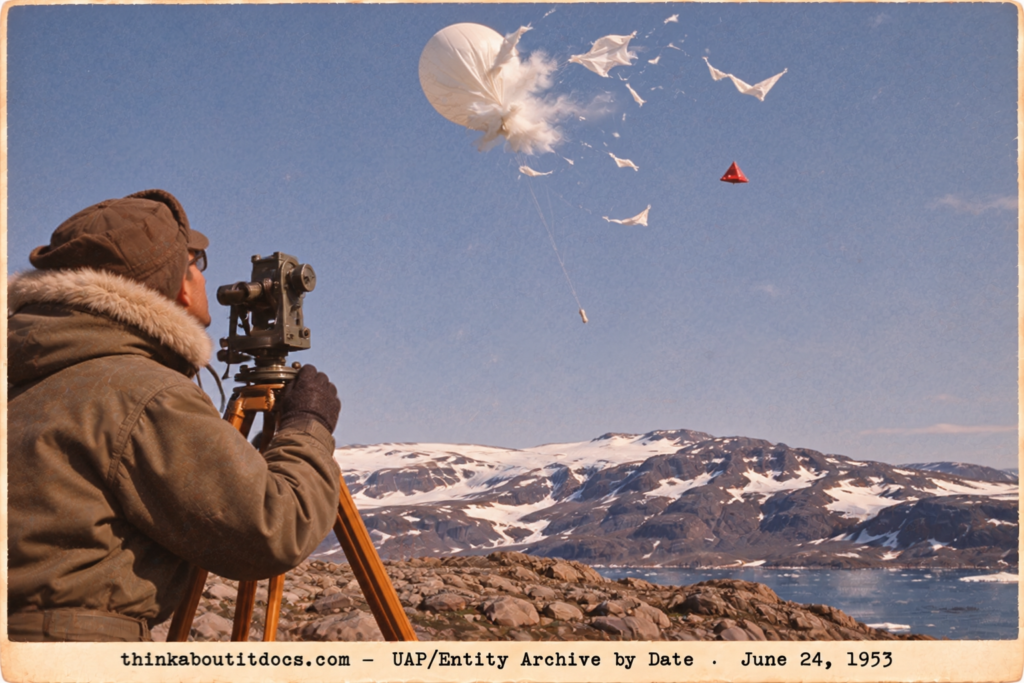
June 24, 1953: a red object appears where a pilot balloon burst over Simiutak.
THINK ABOUTIT UFO|UAP SIGHTINGS REPORT
1953: The Simiutak, Greenland Red Object After a Balloon Burst
At 1430Z on June 24, 1953, A/2C Richard A. Hill, a weather observer with three and a half years of experience, was tracking a 100-gram pilot balloon through a theodolite at Simiutak, Greenland. The balloon burst at about 18,000 ft and, he said, a red object appeared in its place.
It was about twice the balloon’s size, roughly triangular, and rotated as it hovered for about 15 seconds before climbing away to the northwest. Hill was the only witness. The Blue Book card and the NEAC Director of Intelligence both evaluate it as Unidentified.
Date: June 24, 1953
Sighting Time: 1430Z (about 11:30 a.m.)
Day/Night: Day
Location: Simiutak, Greenland
Urban or Rural: Remote
No. of Entity(‘s): 0
Entity Type: Not Applicable
Entity Description: Not Applicable
Hynek Classification: DD (Daylight Disc)
Duration: About 5 minutes
No. of Object(s): 1
Description of the Object(s): A red, somewhat triangular rotating object that appeared where a pilot balloon burst, hovered and climbed away as a red ball-shaped dot with no trail
Shape/Size/Color of Object(s): Triangular or delta, red; about twice the size of a 100-gram balloon (about 4 ft)
Distance to Object(s): About 3 miles from the observer, at about 18,000 ft by theodolite
Height & Speed: Hovered about 15 seconds, then climbed to the northwest, picking up speed rapidly (theodolite 301 degrees)
Number of Witnesses: 1 (A/2C Richard A. Hill, weather observer)
Special Features/Characteristics: Seen only through the theodolite; the object appeared instantly when the balloon burst; 3/10 cirrus at 20,000 ft; winds at 18,000 ft about 280 degrees at 12 knots
Case Status: Unidentified (Blue Book and NEAC evaluation); Blue Book Unknown
Source: Project Blue Book file 6385499 (6611th ABG, Narsarsuaq, INT-9-53; NEAC TR-36-53; Hill sworn statement, attachment to NEACR 2068); Patrick Gross, Blue Book Unknowns list
Summary/Description: A weather observer tracking a pilot balloon saw a red triangular object appear where it burst, hover, then climb away for five minutes. Single witness; Blue Book: Unidentified.
Related Cases: June 24, 1953: the Iwo Jima KB-29 radar contacts (also a Blue Book unknown that day)
Detailed Report
A/2C Richard A. Hill was following the 1430Z pilot balloon through the theodolite on June 24, 1953 when the balloon burst. In his sworn statement, witnessed by Major Ralph Wallace Jr., he said that in its place was a red object that seemed to be twice as large as a 100-gram balloon, which is about 4 ft across. The balloon was at about 18,000 ft and about three miles from the observation point.
The object held about the same position for 15 seconds, making slow circular movements “such as a loop.” It did not show structure but had a definite shape that seemed somewhat triangular. Then it moved toward the northwest, picking up speed rapidly, and appeared as a red ball-shaped dot. It left no trail, seemed to be gaining altitude at a tremendous rate and disappeared after five minutes. Theodolite readings of 301 degrees were taken for five minutes.
The 1500Z pilot-balloon winds were 120 degrees at 14 knots at 10,000 ft and 200 degrees at 7 knots at 16,000 ft, with a marked wind shift between 16,000 and 18,000 ft; the 500 millibar chart gave 280 degrees at 12 knots at 18,000 ft and northwesterly winds of about 15 knots from 18,000 to 20,000 ft, so the object disappeared into the wind. Cloud was 3/10 cirrus at 20,000 ft and 1/10 altocumulus at 8,000 ft.
NEAC’s preparing officer noted that the object was seen by one person only, that it was observed through an instrument, and that it appeared instantly after the burst in the same position. He added that the idea that the balloon burst was involved is strengthened by the timing, and that one cannot conclude that it went into the wind without continuous altitude measurements. ATIC asked whether the supposed collision could be seen by the naked eye, whether a 100-gram balloon could be seen at 18,000 ft under those conditions, and whether the balloon carried instruments, and said it could not find an answer. Hill later said he did not see the balloon and the object together through the theodolite. NEAC evaluated the incident as an unidentified aerial object.
RESEARCHER’S NOTES
Simiutak: A Trained Observer, an Instrument and a Burst Balloon
- Single witness: Hill was the only observer, and that is the main weakness the preparing officer cited.
- The balloon link: The object appeared instantly in the balloon’s position; the preparing officer judged coincidence unlikely, which suggests a balloon-related effect.
- The wind argument: The first message said it went into the wind; the preparing officer said that cannot be concluded without altitude measurements.
- ATIC’s questions: ATIC asked whether a 100-gram balloon is visible at 18,000 ft and whether it carried instruments.
- Hill’s clarification: He did not see the balloon and the object together at the same moment.
A trained weather observer saw a red object where his balloon burst, and neither NEAC nor ATIC could explain it. The file lists the evaluation as Unidentified and a balloon effect remains the obvious suspect.
“Unidentified aerial object”
— NEAC Director of Intelligence, evaluation of Simiutak incident