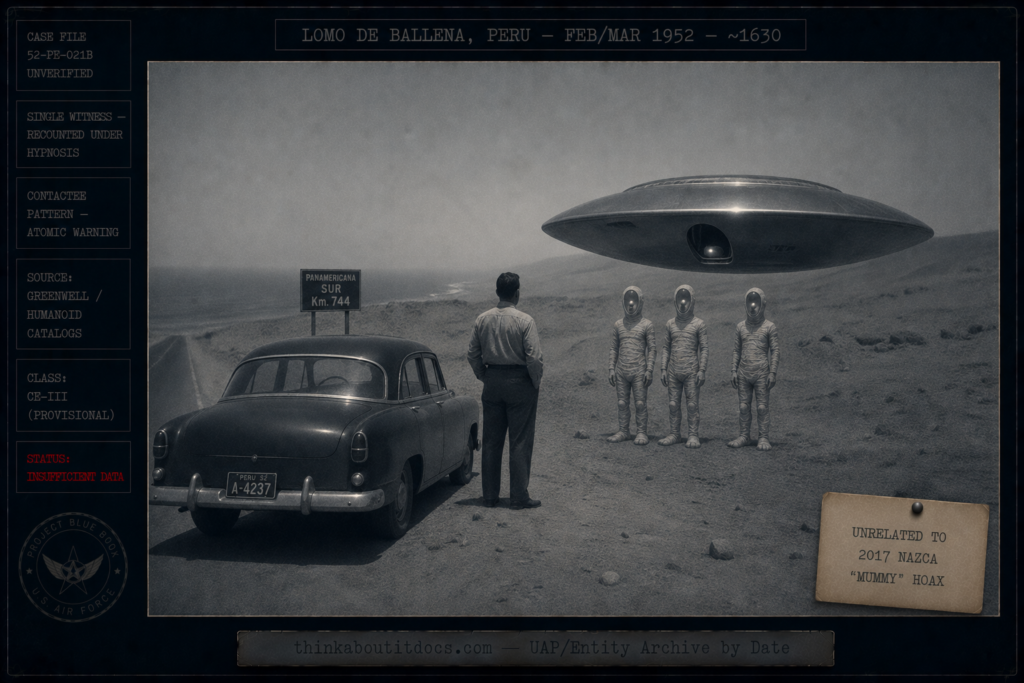
The 1952 "C.A.V." encounter near Lomo de Ballena, Peru — three faceless "mummy-like" beings warning of atomic danger, recounted under hypnosis by a single witness. A contactee-pattern account; logged Insufficient Data. (thinkaboutitdocs.com — UAP/Entity Archive by Date)
THINK ABOUTIT UFO|UAP|ENTITY SIGHTINGS REPORT
1952: Three “Mummy-Like” Beings at Lomo de Ballena, Peru (the “C.A.V.” Contact)
CONTACTEE-PATTERN ACCOUNT — single witness, recounted under hypnosis.
Read as the early-1950s “Space Brother” template, not a documented landing.
It is one of the strangest entries in the South American files, and one of the most clearly templated. A businessman known only as “C.A.V.,” driving the Pan-American Highway toward Lima in 1952, said he saw a grayish metallic disc hovering over the desert near Lomo de Ballena, stopped, ran toward it, and met three five-foot “mummy-like” beings — faceless, with a bubble of transparent jelly where a face should be, jointed legs ending in a single foot, skin like toweling. They asked, first in English then in Spanish, to be taken to his “chief,” said they came from another star, warned about the dangers of atomic energy, explained that they were asexual and reproduced by fission — one reportedly doing so mid-conversation — and invited him aboard a transparent, machineless craft for a flight down the coast. He recounted it under hypnosis. Every load-bearing beam of that story is a fixture of the 1950s contactee genre, it rests on one witness, and it cannot be corroborated. The archive keeps it as a notable catalog entry, flags it for what it is, and files it as Insufficient Data.
Date: February or March 1952 (exact date not recorded)
Sighting Time: About 16:30 (4:30 p.m.)
Day/Night: Afternoon
Location: Lomo de Ballena, on the Pan-American Highway south of Lima, Peru (coastal desert)
Urban or Rural: Rural (open desert beside the highway)
No. of Entity(‘s): 3
Entity Type: “Mummy-like” humanoids — contactee-style beings
Entity Description: About 5 feet tall, with jointed legs ending in a single large foot; no faces, only a sort of transparent jelly with a bubble in the middle; no clothing, but a “towel-like” skin
Hynek Classification: CE-III (animate beings associated with a craft) — provisional; the account is single-witness, hypnosis-derived, and follows the contactee pattern
Duration: Not recorded (the account includes a conversation and a claimed flight)
No. of Object(s): 1
Description of the Object(s): A grayish, shining metallic disc hovering a few feet above the desert; the witness described its interior as transparent and containing no visible machinery
Shape of Object(s): Disc
Size of Object(s): Not recorded
Color of Object(s): Grayish, shining metallic
Distance to Object(s): Very close — the witness said he approached and was taken inside
Height & Speed: Hovering a few feet above the ground; a coastal “flight” is claimed but not quantified
Number of Witnesses: 1 (“C.A.V.”)
Special Features/Characteristics: Beings spoke English, then switched to Spanish on being told they were in South America; asked to be taken to the witness’s “chief”; said they came from another star and warned of atomic-energy dangers; claimed to be asexual and to reproduce by fission, one reportedly doing so during the conversation; invited the witness into a transparent, machineless craft for a coastal flight; the account was recounted under hypnosis
Case Status: Insufficient Data
Source: Richard Greenwell; the case appears in the standard humanoid-catalog literature (the Vallée/HUMCAT lineage and the Bowen-edited “The Humanoids,” 1969, via Gordon Creighton’s “Humanoids in Latin America”)
Summary/Description: In early 1952, a Peruvian businessman known as “C.A.V.” reported that, while driving toward Lima near Lomo de Ballena, he saw a grayish metallic disc hovering over the desert, approached it, and met three five-foot faceless “mummy-like” beings. They spoke to him in English and then Spanish, asked to be taken to his “chief,” said they came from another star and were concerned about atomic energy, described themselves as asexual reproducers by fission, and invited him aboard a transparent craft for a flight down the coast. He recounted the experience under hypnosis. The account is single-witness, hypnosis-derived, and follows the contactee pattern; it is logged as Insufficient Data.
Related Cases: 1952: Contact in the Angatuba Mountains (Dino Kraspedon) | the early-1950s “Space Brother” contactee accounts of George Adamski and Truman Bethurum | 1972: Disc Lands Near Nazca, Peru
DETAILED REPORT
The account, sourced to the researcher Richard Greenwell and carried in the standard humanoid-encounter catalogs, runs as follows. One afternoon in February or March 1952, around half past four, a Peruvian businessman identified only by the initials “C.A.V.” was driving north toward Lima on the Pan-American Highway when, near Lomo de Ballena, he saw a grayish, shining metallic disc hovering a few feet above the coastal desert. He stopped his car and ran toward it. An opening appeared, and out came three beings about five feet tall, which he described as “mummy-like”: faceless, with a kind of transparent jelly and a bubble where a face would be, legs that were jointed and ended in a single large foot, no clothing but a skin like toweling.
They spoke to him — first, he said, in English, asking whether they were in North America; told it was South America, the voice switched to Spanish. They asked C.A.V. to take them to his “chief,” said they came from another star, and expressed concern about the dangers of atomic energy. They told him they were asexual and reproduced by fission, and during the conversation, he said, one of them did exactly that. Finally they invited him into the craft, which he described as transparent and containing no machinery, and took him on a flight down the coast. The story was recounted under hypnosis.
Read structurally, this is not a puzzling sighting but a near-perfect specimen of the early-1950s contactee narrative, and naming that is the most useful thing the archive can do with it. The defining features of that genre are all present: beings who speak the witness’s language, who ask to be taken to a leader, who announce an extraterrestrial origin, and above all who deliver a warning about humanity’s atomic weapons. This is the same script that runs through the famous contactee accounts of the period — George Adamski’s Venusians, Truman Bethurum’s Captain Aura Rhanes — in which the encounter exists to carry a message about nuclear danger. The page’s own earlier text conceded the resemblance; the correction here is to put it at the center rather than treat the “atomic concern” as an incidental detail.
The exotic biological flourishes — the fission reproduction performed on cue, the towel skin, the jelly-and-bubble faces — do not strengthen the case; they mark its register. The prior version of this page treated them as data, speculating that they implied “a biology fundamentally different from carbon-based life” and a sensory system based on “light or vibration.” That is the page arguing for the literal truth of an unverifiable single account, and it has been removed. A claim that an entity divided itself in two during a roadside chat is not biological evidence; it is a narrative motif, and an archive’s job is to note the motif, not to reverse-engineer an alien physiology from it.
Two further cautions belong on the record. First, the account was elicited under hypnosis, which is not a reliability-enhancing procedure: it is well established that hypnosis can increase a subject’s confidence without increasing accuracy and can generate richly detailed but confabulated narratives. A story recovered or rehearsed under hypnosis must be weighted accordingly. Second — and importantly for anyone searching the term — this 1952 narrative has nothing to do with the modern “Peru alien mummies” promoted from 2017 onward by Jaime Maussan, the three-fingered Nazca figures that forensic scientists in Peru determined were fabricated dolls assembled from human and animal bone with modern glue. The shared word “mummy” is a coincidence of description; the cases are unrelated, and the modern ones are a demonstrated fraud, not a precedent for this one.
None of this proves C.A.V. invented his story; sincere contactee experiences can have psychological rather than dishonest origins. But between a single unidentified witness, a hypnosis-derived narrative, no corroboration, and a textbook contactee structure, there is nothing here that can be confirmed and nothing that rises to a documented anomaly. The honest verdict is Insufficient Data, with the contactee character flagged plainly.
RESEARCHER’S NOTES
The Lomo de Ballena Contact — Peru 1952 and the Space-Brother Template
- Classification, held but provisional: CE-III is technically defensible, since the account does pair animate beings with a craft, and it is retained as the report-type label. But it sits on weak ground: one witness, no corroboration, and a narrative recovered under hypnosis. More to the point, the case is really a contactee account, a category that overlaps CE-III formally but differs in spirit — the encounter is built around a delivered message rather than an observed object. The classification is kept as provisional, with the contactee nature flagged as the dominant feature.
- The contactee template as the core finding: The single most clarifying observation is that every major beat of this story is a genre convention. Beings who speak the local language, request an audience with leaders, declare an interstellar origin, and warn against atomic energy are the standard furniture of the 1950s Space-Brother literature, not the typical content of brief, frightened occupant reports. When an account reproduces a template this completely, the template is the most likely explanation for its shape, whatever its origin in the witness’s mind. The prior page’s instinct to analyze the beings’ biology inverted the proper order of inquiry.
- Source-chain assessment: The provenance is respectable as catalog material: Richard Greenwell was a serious investigator, and the case is preserved in the mainstream humanoid literature, including the Bowen-edited “The Humanoids” (1969) and its survey of Latin American cases. That means the entry is real and properly attributed — it is not a fabricated database line. But respectable cataloguing of an account is not corroboration of its contents; the catalogs record that C.A.V. told this story, not that the events occurred. The hypnosis element further weakens the evidentiary value of the details.
- Two necessary separations, and why Insufficient Data: The archive must keep two things apart from this case: the credulous biological speculation the prior page added, which has been stripped as editorializing; and the modern Maussan “Nazca alien mummies,” a forensically-determined fraud that shares only the word “mummy” and must not be allowed to lend this older account false weight. With those removed, what remains is a single hypnosis-derived contactee narrative from an unnamed witness, uncorroborated and textbook in form. That is neither a documented anomaly (Unexplained) nor a demonstrated hoax or mundane event (Explained). It is Insufficient Data, and the contactee flag is the most important thing the entry carries.
The Lomo de Ballena contact is a vivid story and a legitimate piece of catalog history, and it deserves to sit in the record — accurately labeled. Told straight, it is not evidence of fission-reproducing visitors worried about the atom bomb; it is a 1952 Peruvian businessman’s hypnosis-recounted, single-witness account that follows the Space-Brother script point for point, preserved by real researchers but corroborated by no one. Stripped of the invented biology, walled off from the unrelated modern mummy fraud, and flagged as the contactee narrative it is, it stands as Insufficient Data — kept, named honestly, and left no heavier than the evidence allows.