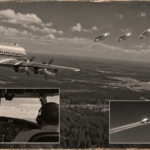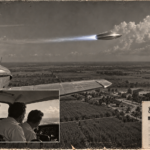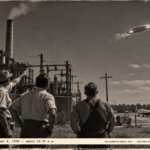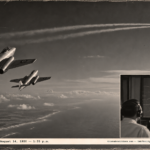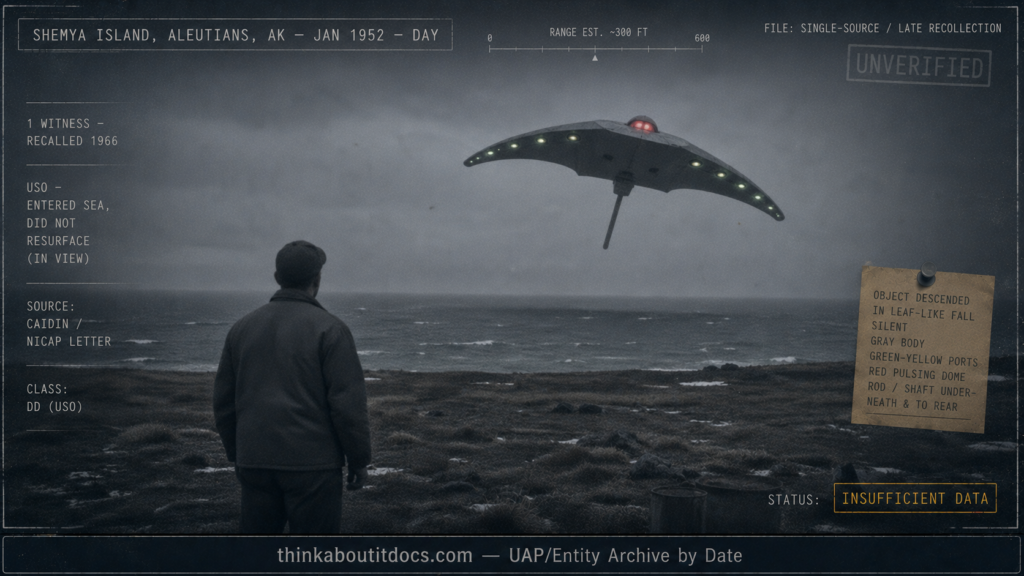
The January 1952 Shemya Island encounter — rigger Eldon White watched a 30-ft bat-shaped craft with glowing ports glide into the sea and never resurface. A single-witness USO account, written in 1966. Logged Insufficient Data. (thinkaboutitdocs.com — UAP/Entity Archive by Date)
THINK ABOUTIT UFO|UAP|ENTITY SIGHTINGS REPORT
1952: Bat-Shaped Object Enters the Sea off Shemya Island, Alaska
On a day off in January 1952, a rigger named Eldon L. White was walking the bleak tundra of Shemya, a tiny island near the western tip of the Aleutian chain, looking for blue fox burrows, when a whirring, whining sound made him look up. Falling toward the water “leaf-like,” about 300 feet above him, was a gray, bat-shaped craft some thirty feet across, its leading edges studded with glowing ports and a red light pulsing inside a dome on its back. It steadied into a brief hover above the waves, banked into a steep glide, and slipped beneath the sea. White watched a long while; it never came back up. It is a vivid and coherent account of an unidentified submerged object, from a named witness with a concrete reason to be where he was. It is also a single witness, writing fourteen years after the fact, with no corroboration and no official record on what was then an active Air Force island. The archive keeps it, strips the speculation later writers built on it, and files it as Insufficient Data.
Date: January 1952 (the witness’s account was written in 1966; see Researcher’s Notes)
Sighting Time: Afternoon (daylight)
Day/Night: Day
Location: Shemya Island, near Drella Point on the western Aleutian chain, Alaska
Urban or Rural: Rural (a remote island, then an active US military installation)
No. of Entity(‘s): None reported
Entity Type: Not applicable
Entity Description: Not applicable
Hynek Classification: DD (Daylight Disc) — a structured object clearly seen in daylight; its defining feature is a water entry (USO). The prior “CE-I” is imprecise: there is no entity and no interaction, so “close encounter” adds nothing, and the water entry is the salient element
Duration: A few seconds of hovering within a brief total observation
No. of Object(s): 1
Description of the Object(s): A gray, bat- or flying-wing-shaped craft about 30 feet across, descending “leaf-like”; the leading edges of the wings were spaced with round openings emitting a greenish-yellow glow; a dome at the top center of the wing emitted a pulsating red glow from within; underneath and to the rear was a long rod or shaft. It hovered briefly about 75 feet above the water, then glided down at a steep angle and went beneath the surface, making a whirring/whining sound
Shape of Object(s): Bat-shaped / flying wing
Size of Object(s): About 30 feet across
Color of Object(s): Gray, with greenish-yellow leading-edge ports and a pulsating red dome
Distance to Object(s): About 300 feet above the witness at first sighting; it entered the water roughly 75 feet above the surface
Height & Speed: Descended from about 300 feet to the sea; hovered, then glided steeply into the water; speed not quantified
Number of Witnesses: 1 (Eldon L. White)
Special Features/Characteristics: A USO (unidentified submerged object) event — the craft entered the sea and did not resurface within the witness’s view; glowing leading-edge ports; a pulsating red dome; a whirring/whining sound; a “leaf-like” falling descent followed by a controlled hover and steep glide
Case Status: Insufficient Data
Source: Martin Caidin, “Hydrospace,” quoting Eldon L. White’s letter to NICAP dated April 4, 1966 (a recollection of a January 1952 event)
Summary/Description: In January 1952, rigger Eldon L. White, off-duty and searching for fox burrows on Shemya Island in the Aleutians, reported that a whirring sound drew his eye to a gray, bat-shaped craft about 30 feet across descending toward the sea about 300 feet above him, its leading edges glowing greenish-yellow and a red dome pulsing on top. It hovered briefly about 75 feet up, then glided steeply into the water and did not resurface while he watched. The account, a single-witness recollection written in 1966 and published by Martin Caidin, has no corroboration or official record, and is logged as Insufficient Data.
Related Cases: 1948: Unusual Sightings Along the Aleutian Chain (declassified) | 1950: Major Air Force Encounter with a UFO in Alaska (Kodiak) | the broader corpus of USO (unidentified submerged object) reports
DETAILED REPORT
Shemya is a small, flat, treeless island at the far western end of the Aleutians, in 1952 the site of an active US military airfield (later Eareckson Air Station). Eldon L. White was working there as a rigger. On a day off in January 1952, by his account, he was out on the tundra looking for blue fox burrows when a whirring, whining sound made him look up. About 300 feet above him, descending toward the water in a “leaf-like” falling motion, was a gray craft shaped like a bat or flying wing, roughly thirty feet across.
He described it in mechanical detail. The leading edges of the wings were spaced with round openings that emitted a greenish-yellow glow; at the top center of the wing was a dome from which a red light pulsed from inside; underneath and to the rear ran a long rod or shaft. About seventy-five feet above the sea the craft stopped and hovered for a few seconds, then dropped off into a steep, angled glide and passed beneath the surface of the water. White kept watching, expecting it to come back up, and waited quite some time. It never reappeared.
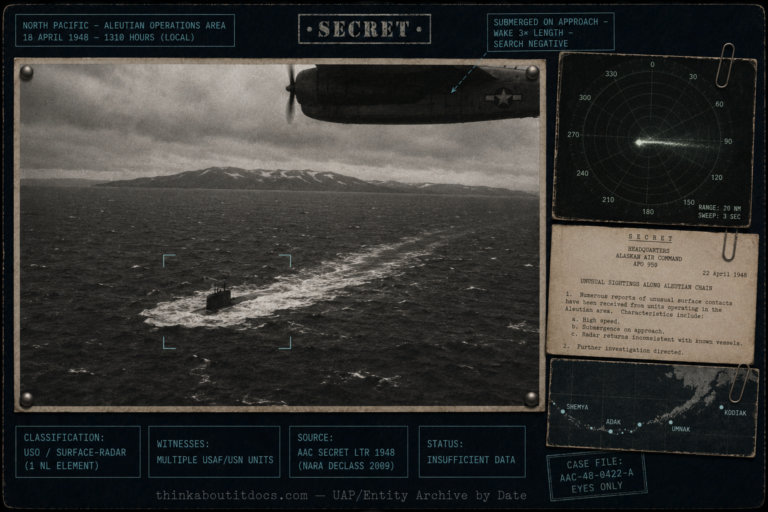
As an account, it has real strengths. The witness is named, and he had an ordinary, specific reason to be out where he was; the description is coherent and concrete rather than vague; it occurred in daylight; and it belongs to a recognized category — the unidentified submerged object, or USO — with other reports clustered in the same Aleutian waters, including the 1948 declassified Alaskan Air Command memo on “unusual sightings along the Aleutian chain.” A trans-medium object that flies and then submerges is exactly the sort of report the archive’s USO category exists to hold.
But the documentary basis needs to be stated precisely, because it sets the limits. The account does not come from a 1952 record. It reaches print through the aviation writer Martin Caidin, who quoted it in his book “Hydrospace,” from a letter White wrote to NICAP dated April 4, 1966 — fourteen years after the event. Unlike the era’s anachronistic abduction tales, there is nothing culturally implausible about the content for 1952, and a fourteen-year gap is far less corrosive than the decades-late recoveries seen elsewhere; but it is still a recollection, not a contemporaneous report, and memory of a few-seconds event across fourteen years carries its own softness. More tellingly, the sighting is uncorroborated. Shemya was a working military base; a thirty-foot craft entering the sea just offshore in daylight is the kind of event that, had anyone else seen it or had White reported it through channels at the time, might have generated a second account or an official record. None is known — no Blue Book file, no second witness, nothing but the one man’s later letter.
The prior page went well beyond the account, and that overreach has been removed. It presented the case as evidence that such craft “utilize the vast, unmonitored depths of the Pacific for concealment,” endorsed “trans-medium travel” and “high-energy propulsion theories” as if established, and treated the craft’s failure to resurface as proof of an underwater base. None of that is supportable from a single shore-side observer. That White did not see it resurface establishes only that he did not see it resurface — in the few minutes he watched, from one vantage, on a large and moving sea. It could have surfaced elsewhere, or simply sunk; a genuine craft, a misjudged conventional aircraft ditching, or a misperception are all left open by what one witness could observe. The honest report records the vivid, specific thing White said he saw, names its real and limited source, and declines to build a theory of oceanic alien bases on top of it.
RESEARCHER’S NOTES
The Shemya USO — Aleutians 1952 and a Vivid Account on a Single Thread
- Classification, refined (CE-I to DD/USO): The prior CE-I is imprecise. A close encounter of the first kind denotes a nearby object with no interaction or physical effect, but the salient and defining feature here is a water entry — a USO event — and there is no entity to push it toward a higher close-encounter class. Within Hynek’s scheme the cleanest fit is DD: a structured object, clearly seen, in daylight. The entry is labeled DD with USO noted as the defining characteristic, which describes the event more accurately than “close encounter,” a phrase that adds nothing to a distant-but-clear daylight sighting.
- Source-chain assessment: The provenance is real and traceable: aviation author Martin Caidin’s “Hydrospace,” quoting Eldon White’s April 1966 letter to NICAP. That is a legitimate chain, and Caidin was a serious writer on aerospace and undersea subjects. The two honest qualifications are timing and singularity: the account is a 1966 recollection of a 1952 event, fourteen years after the fact, and it has no corroboration. Neither defeats the report, but together they cap how much weight it can bear. Importantly, and unlike the period’s abduction cases, the content carries no anachronism — a bat-winged craft with glowing ports does not borrow from later UFO culture, so the late writing date does not poison the substance the way a retrofitted Grey narrative would.
- The “didn’t resurface” claim, weighed honestly: The most over-read detail in the prior page is the failure to resurface, which it treated as evidence of deliberate underwater concealment. This is exactly the kind of inference a single observer cannot support. A man on a shoreline watching “quite some time” can confirm only that he did not personally see the object come back up; he cannot establish that it did not surface beyond his sightline, sink as a disabled object would, or otherwise leave the area underwater. The detail is genuinely interesting and is retained as reported, but as an observation, not as proof of a trans-medium concealment strategy.
- Why Insufficient Data: In favor of the case: a named, plausibly-placed witness; a coherent, specific, daylight description; a recognized USO category with regional company; and no anachronism. Against a firm verdict: a single uncorroborated witness, a fourteen-year recall gap, and no official record on an active military base where one might be expected. That balance is Insufficient Data — not a documented anomaly to call Unexplained, since nothing corroborates it, and not a demonstrated misperception or hoax to call Explained. The classification refinement and the removal of the concealment theorizing are the entry’s main repairs.
The Shemya bat-wing is one of the more atmospheric USO reports of the early 1950s, and it has a rightful place in the record: a named rigger on a fog-bound Aleutian island watching a glowing, finned craft fall out of the sky and vanish into the North Pacific. Told straight, it is a single vivid recollection committed to paper fourteen years later, uncorroborated and unrecorded by the base around him — strong enough in its specificity to keep and take seriously, too thin in its support to call more than open. Reclassified as the daylight USO event it is, and stripped of the oceanic-base theorizing later writers hung on it, it stands as Insufficient Data.