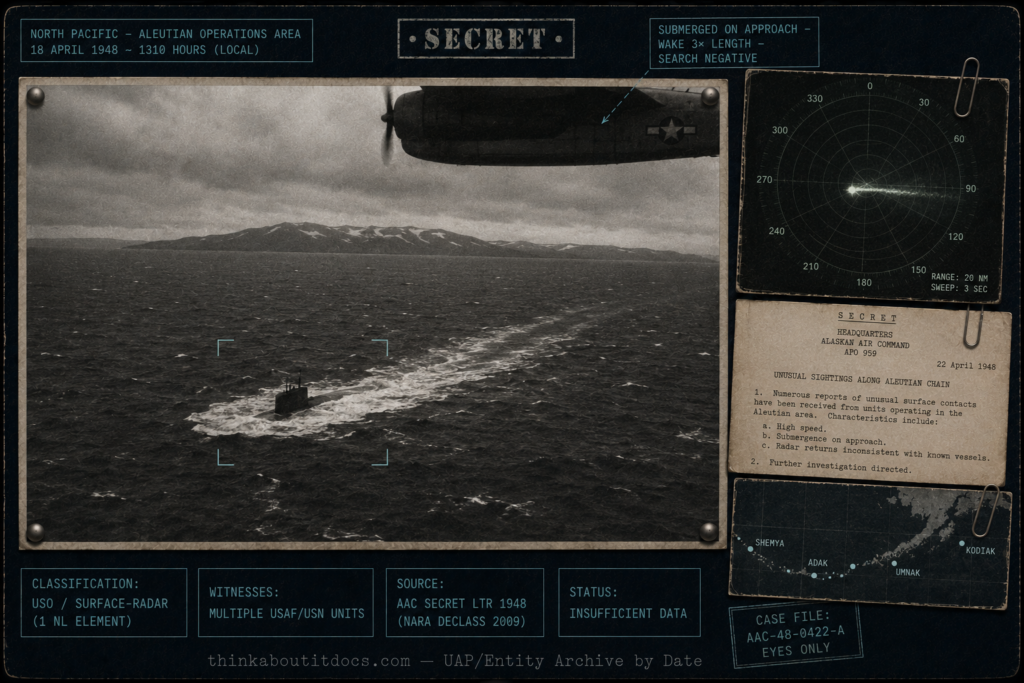
The Aleutian chain contacts, Territory of Alaska, 8 March–10 April 1948 — eight submarine-like and radar contacts logged by Alaskan Air Command and never identified; classified USO/surface-radar, status Insufficient Data.
THINK ABOUTIT UFO | UAP SIGHTING REPORT
1948: Unusual Sightings Along the Aleutian Chain — Declassified Document
In the spring of 1948, as the Cold War hardened across the North Pacific, the intelligence office of the Alaskan Air Command found itself logging something its aircrews could not explain. Beginning on March 8 and running for a month, pilots and radar operators up and down the Aleutian chain kept reporting dark, submarine-like shapes that surfaced and dove leaving wakes three times their own length, fast white vessels that submerged when approached, surface radar contacts that melted off the scope at close range, and at least one blue-white flare that climbed to seven thousand feet before falling away orange. Every time the Navy sent Privateers, photo-reconnaissance flights, or sonobuoy patrols to the spot, the result came back the same: negative. On April 22, 1948, the command’s intelligence director gathered all eight episodes into a single SECRET letter to Air Force intelligence in Washington — and ordered every aircraft on the chain to start carrying binoculars and a loaded camera. Declassified by the National Archives in 2009, that letter is reproduced and assessed here.
Date: Series of 8 sightings, 8 March – 10 April 1948 (summary letter dated 22 April 1948)
Sighting Time: Various, day and night (Zulu times recorded in the document)
Day/Night: Mixed
Location: Aleutian Islands chain and surrounding waters, Territory of Alaska — contacts plotted near Adak, Shemya, Umnak/Fort Glenn, the Tanaga Peninsula, the Koniuji Islands, and the Kodiak approaches
Urban or Rural: Remote — open ocean and uninhabited island waters of the far western Aleutians
No. of Entity(‘s): None reported
Entity Type: Not applicable
Entity Description: Not applicable — surface/submerged object and radar-contact series, no occupants
Hynek Classification: Outside the standard Hynek aerial scale — predominantly USO (Unidentified Submerged Objects) and surface-radar contacts; one NL (Nocturnal Light) element, the 10 March flare
Duration: Individual events ranged from a 5-second flare to radar contacts held for 25+ minutes; the series spanned roughly five weeks
No. of Object(s): At least eight discrete contacts (some possibly the same object)
Description of Object(s): Black superstructures or “conning towers” protruding from the sea that submerged leaving large foam patches and long wakes; fast-moving white surface vessels with long narrow wakes; surface objects that submerged on approach; surface radar returns that faded at close range; and a single blue-white flare that rose to ~7,000 ft before falling away deep orange
Shape: Submarine-like (conning-tower / elongated hull) for most contacts; a luminous flare for the 10 March event
Size: Not established; wakes reported up to three times the length of the visible object
Color: Black/dark superstructures; one white vessel; blue-white-to-orange flare
Distance: Contacts observed from as close as ~4 miles (radar) and ~5–8 miles (visual)
Height & Speed: Surface/submerged; radar-tracked surface speeds ~14–16 knots; the flare reached ~7,000 ft
No. of Witnesses: Multiple credentialed military observers — USAF aircrews (aircraft AF5889, AF6368, AF2537 and others), a Navy patrol aircraft crew, Ground Control Approach radar operators at Shemya, and the commanding officer of naval vessel ATA-192 (USS Tillamook)
Special Features/Characteristics: Repeated submarine-like surfacing and submerging; wakes three times object length; objects vanishing from radar at close range; every military follow-up search (Navy Privateers, 72nd Photo Reconnaissance Squadron, sonobuoy patrols) returned negative; the 7 April contact’s follow-up detected machinery-like undersea sounds alongside two or three whales; the command issued a standing order to photograph all future contacts with K-20 cameras
Case Status: Insufficient Data — no positive identification was ever made and all follow-up searches were negative; the leading conventional candidates are Soviet submarine activity and marine fauna (whales), and the 7 April contact was partly attributed to whales
Source: Declassified SECRET letter, Headquarters Alaskan Air Command (file AAOIN-3 312), “Unusual Sightings along Aleutian Chain,” 22 April 1948, from Lt. Col. A.M. Clark, Director of Intelligence, to the Director of Intelligence, USAF, Washington, D.C.; declassified by the National Archives (Authority 0017218), 9 January 2009
Summary/Description: Between 8 March and 10 April 1948, aircraft and vessels of the Alaskan Air Command logged eight unusual contacts in the waters of the Aleutian chain. They included submarine-like black superstructures that submerged leaving large wakes (8 March, near Shemya), a fast white vessel resembling the first object (10 March, off Umnak), pairs of conning-tower-like shapes seen between cloud breaks (13 March), surface radar contacts that faded at close range (2 and 3 April, the latter reported by the USS Tillamook), a surface object that submerged near the Koniuji Islands (7 April), and a steady radar target tracked off Shemya (10 April). A blue-white flare rising to 7,000 feet was also logged (10 March, off the Tanaga Peninsula). Repeated Navy and photo-reconnaissance searches found nothing; one sonobuoy patrol detected both whale sounds and machinery-like noises. The command summarized all eight in a SECRET letter to Washington and ordered aircrews to begin photographing future contacts.
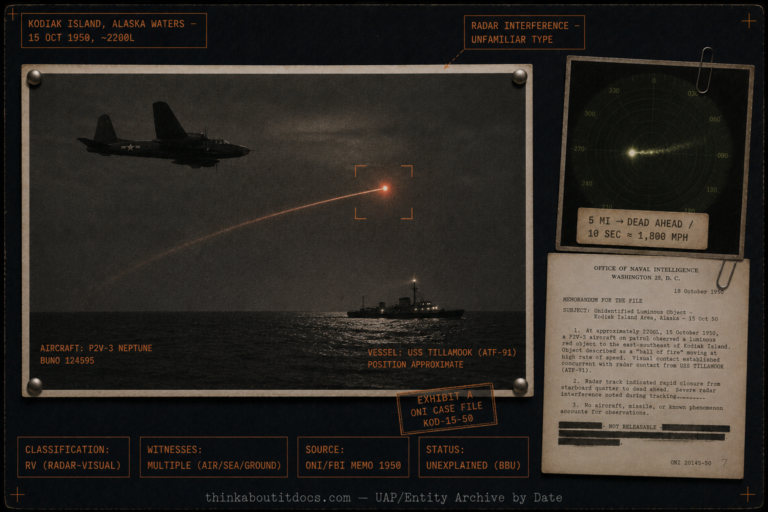
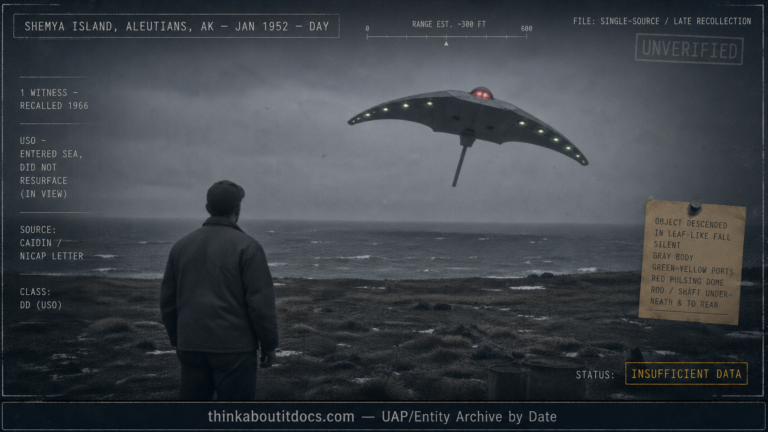
Related Cases: 1950 — Kodiak, Alaska radar-visual (same naval vessel, USS Tillamook / ATA-192) | 1952 — bat-shaped object/USO over Shemya Island, Alaska | Cold War–era Aleutian submarine and USO reports
Full Report
This is a primary military intelligence document, and its value lies in its sobriety: it is a careful, unsensational log kept by professionals who plainly wanted to know what was intruding into their waters and could not find out. The eight contacts divide naturally into submarine-like surface objects, radar-only contacts, and a single aerial flare.
The submarine-like contacts open the series. On 8 March, the crew of AF5889, flying from Adak to Shemya, spotted a black superstructure breaking the surface, identified it as a submarine, and closed to within about eight miles over five minutes of observation — whereupon it submerged on a 120-degree heading, throwing up a large foam patch and a wake reported at three times the object’s own length. A dawn search by three Navy Privateers the next day found nothing. On 10 March, AF2537 saw a fast white vessel off Umnak whose shape, the report notes pointedly, matched the 8 March object. On 13 March, a cargo flight saw two black shapes resembling submarine conning towers between breaks in the cloud. And on 7 April, a flight from Fort Glenn to Adak watched a small “vessel” near the Koniuji Islands that, on closer inspection, appeared to submerge while trailing a narrow wake.
The radar contacts form the second group. On 2 April a Navy patrol aircraft out of Kodiak held a surface radar target from nineteen miles in to four miles, where it vanished from the scope; visual and radar search came up empty. On 3 April the commanding officer of naval vessel ATA-192 — the ocean tug USS Tillamook — tracked a surface contact on radar for twenty-five minutes as it closed from thirteen to eleven miles before disappearing. On 10 April, a Ground Control Approach radar operator at Shemya logged a steady target at eight and a half miles moving fourteen to sixteen knots, in two separate windows totaling nearly forty minutes.
The lone aerial event is the 10 March flare: a blue-white light that rose from the south tip of the Tanaga Peninsula to about seven thousand feet, then dropped sharply and fell away in deep orange, all in roughly five seconds, watched from eighteen miles off.
What gives the document its character is the consistency of the follow-up: negative, negative, negative. Navy Privateers searched. The 72nd Photo Reconnaissance Squadron flew long-range coverage on 17 March, finding only three partially sunk Japanese wrecks in Kiska Harbor and one in Gertrude Cove — relics of the recent war, not the reported objects. A scheduled 18 March flight was scrubbed by deep snow on the Ladd Field runways. Sonobuoy-equipped patrols worked the 5th and 6th contact areas with no result. The single partial explanation came on 7 April, when a Navy PB4Y dropping sonobuoys detected undersea-craft-like sounds — but also observed two or three whales surfacing and submerging within the pattern, and the listening operator believed he could distinguish the whale noises from a separate “machinery-like” sound. The command’s practical response says the most: a new standing order that every aircraft on the chain carry binoculars and a loaded K-20 aerial camera, with instructions to photograph anything unidentified.
The context frames the likeliest answer without confirming it. In early 1948 the Aleutians were the front porch of the emerging Cold War, a short reach from the Soviet Far East, and submarine-like objects surfacing and diving in those waters point first and naturally toward Soviet submarine reconnaissance — which is exactly what the aircrews themselves assumed when they called the first object a submarine. Whales account for some surface disturbances and at least part of the 7 April contact; sea-clutter and surface vessels can produce fading radar returns; the flare could be a meteor, a marine pyrotechnic, or test ordnance. None of this was ever pinned down, because the objects did what submarines and whales do — they left before they could be caught.
RESEARCHER’S NOTES
The Aleutian Contacts — Alaska 1948 and the Cold War Sea
- Classification. This series sits largely outside J. Allen Hynek’s aerial taxonomy, which was built for things in the sky. The bulk of the contacts are USOs — Unidentified Submerged Objects — and surface-radar returns: black superstructures, conning-tower shapes, fast wakes, and scope contacts on the sea. Only the 10 March flare is a true aerial event, properly an NL (Nocturnal Light). Forcing the whole series into a Daylight-Disc or Close-Encounter box would misrepresent it; the honest label is a USO and surface-radar series with a single NL element, and that is how it is catalogued here.
- Source chain. The provenance is about as strong as documentary evidence gets. This is a contemporaneous, internally generated SECRET intelligence summary, written within weeks of the events by the Alaskan Air Command’s own intelligence director, Lt. Col. A.M. Clark, addressed to USAF intelligence in Washington, and declassified through the National Archives in 2009 under a traceable authority. The witnesses are named units and aircraft, the positions are given in latitude and longitude, and the failures are recorded as candidly as the sightings. There is no enthusiast intermediary and no embellishment.
- Pattern context. The Aleutians and the Bering and Gulf of Alaska waters produced a recurring thread of military marine-and-air anomaly reports across the early Cold War, and this document is the documentary anchor of that thread on this site. It connects directly forward to the 1950 Kodiak radar-visual — which involved the very same vessel, the USS Tillamook (ATA-192) — and to the 1952 Shemya Island report. The motif of submarine-like objects that cannot be relocated is itself a Cold War signature, equally consistent with real foreign submarines and with the difficulty of catching anything in those vast, foul-weather waters.
- Physical / evidentiary weight. High as a document, indeterminate as a phenomenon. The record is authoritative and detailed, but it resolves nothing: no object was ever positively identified, no photograph was obtained (the camera order came after the fact), and every search was negative. The behavior described — surfacing, submerging, fast wakes, radar contacts fading at close range — fits Soviet submarines and marine fauna at least as well as anything exotic, and the one partially explained contact pointed to whales. The disciplined disposition is Insufficient Data: the document proves the military saw and could not identify these contacts, but it provides no basis for calling them anything more unusual than the Cold War sea was already full of.
The Aleutian sightings letter is one of the more valuable kinds of artifact in the early record — not a dramatic close encounter but a calm, contemporaneous, official acknowledgment that trained crews repeatedly saw things in their waters they could neither identify nor catch. The likeliest explanation, Soviet submarines threaded through with whales and sea returns, hangs over the document plainly, yet the command itself never confirmed it, and a few elements never fit neatly into any single answer. It belongs in the chronological record exactly as it reads: a credible, well-provenanced, and unresolved series of marine and radar contacts from the opening months of the Cold War — preserved here in full, and weighed as Insufficient Data.
— Declassified Document (Transcript) —
SECRET
Headquarters, Alaskan Air Command APO 942, c/o Postmaster, Seattle, Washington
Declassified — Authority 0017218 by KJ, NARA Date 01/09/09
22 April 1948 AAOIN-3 312
Subject: Unusual Sightings along Aleutian Chain To: Director of Intelligence, United States Air Forces, National Defense Building, Washington 25, D.C.
- Beginning 8 March 1948, numerous sightings have been made in waters surrounding the Aleutian Islands by aircraft of this command. The following report is a summary of all the unusual sightings made to this date.
1st Sighting — 8 March 1948. During a routine flight from Davis Air Force Base to Shemya Air Force Base at 090050Z, the pilots of aircraft AF5889 observed a black superstructure protruding from the surface of the ocean at 177°40′E, 51°57′N. The pilots recognized the object as a submarine and immediately headed in its direction at an altitude of 500 feet above sea level. When approximately 8 miles from the object, and after five minutes of continuous observation, the object submerged on a 120° heading, creating a large area of foam and leaving a wake which appeared to be three times the length of the object. A thorough visual search was made in the area where the object submerged, with negative results. It was reported simultaneously while attempting to make voice contact with Shemya radio on 4220 kcs. Weather: visual contact, 20 miles visibility, choppy sea with occasional whitecaps, surface winds 12 to 15 knots.
2nd Sighting — 10 March 1948. While on a local flight from Davis Air Force Base at 1945Z, the pilots of aircraft AF6368 observed a blue-white flare ascend from the south tip of Tanaga Peninsula (177°55′W, 51°35′N) to a height of 7,000 feet, dropping off sharply and falling to the ground in a deep orange color. The observation was made 18 miles away at 7,000 feet. The duration of the observed light was approximately 5 seconds.
3rd Sighting — 10 March 1948. While on a routine flight to Cape Air Force Base, Umnak Island, Alaska, the pilots of aircraft AF2537 observed from 5 miles distance and 3,000 feet a white vessel at 167°50′W, 53°27′N, proceeding outbound from the shore of Umnak Island on a course of 30°. No curiosity arose upon the sighting of the vessel, except that it appeared to be proceeding exceptionally fast with a long narrow wake trailing behind. (Interest was taken in this report for the following reason: the shape of the vessel as described by the pilot was identical to the description submitted by the pilots of the 1st sighting, who sighted an object resembling a submarine.) Weather: ceiling and visibility unlimited.
4th Sighting — 13 March 1948. While on a routine cargo flight, the pilots of an aircraft of this command sighted, from 8,000 feet and between breaks in a broken cloud layer, two black objects on the surface of the water (55°58′N, 160°50′W and 55°56′N, 160°54′W) which appeared to have the shape of a submarine conning tower.
5th Sighting — 2 April 1948. Surface radar contact was made by a Navy patrol aircraft operating from Kodiak, Alaska, while at 1,000 feet altitude, in position 53°03′N, 170°35′W at 0115Z. The target was under observation while the aircraft proceeded from 19 miles to 4 miles of the target, where it disappeared from the scope. A thorough visual and radar search was made with negative results. Weather: visibility 15 miles, southeast wind at 18 mph.
6th Sighting — 3 April 1948. The commanding officer of naval vessel ATA-192 reported a surface radar contact at 0305Z while in position 53°05′N, 171°10′W. True bearing of the target was 330° at 13 miles distance. Target bearing remained constant for 25 minutes while the distance decreased to 11 miles, then disappeared from the scope at 0330Z. Weather: visibility 5 to 8 miles, 10-foot seas.
7th Sighting — 7 April 1948. On a scheduled flight from Fort Glenn to Adak, Alaska, the pilots sighted from 5,000 feet at 072254Z an unidentified surface object in the vicinity of the Koniuji Islands (52°14′N, 175°05′W). The object appeared to be a small vessel proceeding on a heading of 120°. Upon closer inspection, the object appeared to be submerging and trailing a narrow wake.
8th Sighting — 10 April 1948. A Ground Control Approach radar operator at Shemya Air Force Base, Shemya, Alaska, made positive radar contact from 0750Z to 0812Z and 0907Z to 0920Z. The range and azimuth of the target was 8½ miles at 172°. The known altitude coverage of the radar at that range was 1,000 to 4,000 feet, and the bearing was 95° magnetic. The approximate speed of the target was 14 to 16 knots. Weather: ground fog.
- The following operational action was taken as a result of the above sightings.
1st Sighting: Three Navy Privateers dispatched from Adak, Alaska, to search the area at dawn on 9 March 1948. Results: negative.
4th Sighting: Navy reconnaissance conducted on 16 March 1948. Results indicated one large grayish-brown building at 55°56′N, 161°19′W, with two adjacent derrick-like structures about 50 feet high. The pilot who made the 4th sighting conducted reconnaissance of the area on 19 March 1948; the area the pilots had searched and reported objects in did not correspond, and the objects were not there when he conducted the search on 19 March 1948.
1st, 2nd, 3rd, 4th Sightings: Field orders were issued to the 72nd Photo Reconnaissance Squadron (VLR), and long-range reconnaissance was conducted on 17 March 1948 with the following results: no positive targets sighted; visual search made in the area of the No. 1 and No. 4 sightings; radar search in the area of the No. 3 sighting; the No. 1 sighting area was not completely covered due to lack of fuel and strong winds aloft. Three partially sunk Japanese vessels were sighted in Kiska Harbor and one in Gertrude Cove, Kiska Island. Reconnaissance scheduled for 18 March 1948 was canceled due to deep snow on the Ladd Field runways.
5th Sighting: Visual and radar search made immediately by the same aircraft that made the sighting. Results: negative.
5th and 6th Sightings: Detailed reconnaissance conducted by a Navy Privateer from NOB Kodiak on 4 April 1948 between 169°W and 174°W. Aircraft equipped with sonobuoys. Results: negative.
7th Sighting: A Navy PB4Y aircraft, proceeding on the same course as the reporting aircraft and twelve minutes’ flight time to the east, intercepted the message and requested the reporting aircraft to indicate the last observed position of the surface craft. The PB4Y prepared a sonobuoy pattern and detected sounds similar to those made by an undersea craft. Two or three whales were observed surfacing and submerging within the sonobuoy pattern. The listening-device operator was able to differentiate between the sounds attributed to the whales and a machinery-like sound. The PB4Y remained in the general vicinity for approximately one hour.
8th Sighting: No action taken.
- In order that objects such as those described above can be more positively identified, it is now standard operating procedure for all scheduled aircraft flying the Aleutian Chain to carry one pair of binoculars and one loaded K-20 camera. Instructions have been given to aircrews to utilize the binoculars for search and to photograph all unidentified objects sighted with the K-20 camera.
A.M. Clark Lt. Colonel, USAF Director of Intelligence