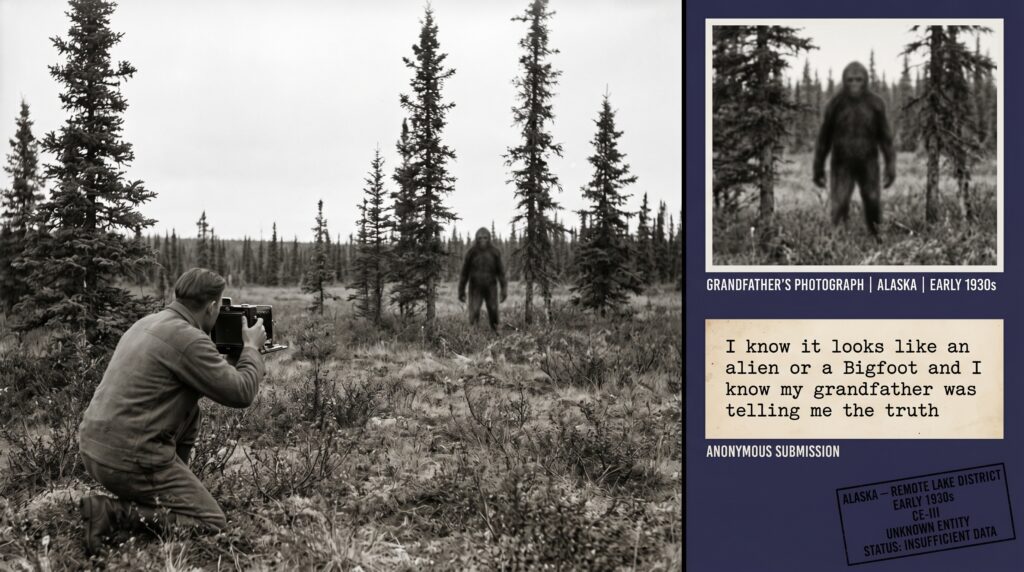
Alaska, early 1930s — an unnamed man chased an unknown entity near a remote lake and obtained one photograph. The film took four months to develop. He kept the image for approximately 70 years before giving it to his grandchild on the last day of his life. Submitted anonymously to UFOCasebook.com, August 14, 2003. Source: UFOCasebook.com, B.J. Booth editor. Case status: Insufficient Data.
THINK ABOUTIT ALIEN ENCOUNTER REPORT
1930: Alien captured on film in Alaska
Sometime in the early 1930s, somewhere in rural Alaska, a man was walking to a lake when he saw something he felt was worth chasing. He chased it. He got close enough to take one photograph. The film sat undeveloped for four months in a remote area before anyone could process it. Decades later his grandchild inherited the photograph, scanned it the week they received it, and sent it to UFOCasebook.com — then never made contact again. The grandfather died the day after giving up the photograph and telling his story. What is in the image does not obviously belong to the Alaskan wilderness. What it is has not been determined. The archive holds the photograph and the story that came with it and applies to both exactly the level of confidence the evidence supports — which is precisely the same approach the grandfather apparently took for the rest of his life: he kept the photograph and he told the story once, at the end.
Date: Early 1930s — submitted as 1930; exact year and date unknown
Sighting Time: Daytime — exact time not recorded
Day/Night: Day
Location: Alaska — rural, remote area near a lake; exact location not recorded
Urban or Rural: Rural — remote, sparsely populated area of Alaska
No. of Entity(‘s): 1
Entity Type: Unknown — described by submitter as looking like an alien or a Bigfoot; classification withheld pending any further analysis; retained as unknown entity
Entity Description: Figure visible in the photograph — bipedal, standing, in a wilderness environment. The submitter specifically noted the figure looks like an alien or a Bigfoot, acknowledging both possibilities without asserting either. No verbal or physical interaction recorded. No physical description of height, build, coloration, or features beyond what is visible in the photograph is recorded in the available letter.
Hynek Classification: CE-III (Close Encounter III) — close observation of an animate non-human figure at close enough range for a photograph to be taken; no craft associated; the entity was actively pursued by the witness. The absence of an associated craft and the possible Bigfoot identification make this a dual-classification candidate — CE-III for an entity encounter and high strangeness cryptid classification. The archive retains both possibilities and makes no determination.
Duration: Sufficient for a chase and a single photograph — exact duration not recorded; four months elapsed before the film was developed
No. of Object(s): None — no craft observed or reported
Description of the Object(s): N/A
Shape of Object(s): N/A
Size of Object(s): N/A
Color of Object(s): N/A
Distance to Object(s): Close enough to photograph — exact distance not recorded; the grandfather chased the entity until he was close enough to get one photograph
Height & Speed: Unknown — the entity was moving fast enough to require a chase before the photograph could be taken; exact height not discernible without a reference scale in the photograph
Number of Witnesses: 1 — unnamed grandfather; account transmitted to anonymous grandchild submitter; submitted to UFOCasebook.com in 2003; grandfather died the day after transmitting the photograph and story
Special Features/Characteristics: Four-month film development delay, consistent with remote Alaskan conditions of the early 1930s; deathbed transmission — the grandfather gave the photograph to his grandchild and told his story immediately before his death; anonymous submission with explicit refusal of follow-up contact; the photograph is the only evidence — no corroborating witnesses, no location specifics, no date precision, no formal analysis documented
Case Status: Insufficient Data — anonymous submitter, unnamed photographer, unknown location, unverified date; photograph exists in three versions (full frame, two close-up crops); no formal photographic analysis documented; the deathbed transmission structure and the remote development delay are internally consistent details; the figure in the photograph has not been identified
Source: UFOCasebook.com (B.J. Booth, editor) — anonymous letter submission, August 14, 2003
Summary/Description: In the early 1930s, an unnamed Alaskan man chased an unidentified figure near a remote lake and obtained one photograph before the entity moved out of range. The film remained undeveloped for four months due to the remote location. The photograph was retained privately for decades before being given to the man’s grandchild on what proved to be the last day of his life. The grandchild scanned the image and submitted it anonymously to UFOCasebook.com in 2003, requesting no follow-up contact. The figure in the photograph has not been formally identified. Case status: Insufficient Data.
Related Cases: 1912: Australian Humanoid Sighting — Currockbilly Range | 1893: Fayette County Pennsylvania Monster | Alaska Sightings Archive
Detailed Report
The Photograph From the Lake — Alaska, Early 1930s
The complete source for this case is the letter submitted to UFOCasebook.com on August 14th, 2003. The submitter’s words are the record:
“The included picture was taken by my grandfather in the early 1930s. I scanned the image immediately after he gave it to me last week. I wish to remain anonymous since I don’t want anything to do with any research or whatever on this. I know it looks like an alien or a Bigfoot and I know my grandfather was telling me the truth about him taking this picture. That’s why I think it should be in the right hands. You are the only one I’m sending this to, so please respect my privacy and don’t contact me about this.”
The account as recorded in the post summary provides additional detail: the grandfather was on his way to a lake when he first saw the entity. He chased it until he got close enough to take one photograph. The area was remote and sparsely populated, and it was some four months before the film could be developed. The grandfather died the day after giving the photograph to his grandchild and relating his story. Three images were submitted: the full photograph, and two close-up crops of the figure. The figure in the photograph stands in what appears to be a wilderness setting and is bipedal. Beyond that the archive does not describe what the photograph shows beyond what is visible — the three images are present in the post for the reader to examine directly.
RESEARCHER’S NOTES
The Photograph From the Lake — Alaska 1930s and the Anonymous Deathbed Transmission Case
- Source Chain Assessment — The Weakest Structure in the Archive: The source is an anonymous letter submitted to a UFO website in 2003 describing a photograph taken by an unnamed man in an unspecified Alaskan location in an imprecisely dated year in the early 1930s. The primary witness is dead. The secondary witness — the grandchild — is anonymous and refused follow-up contact. No location, no date, no formal analysis, no corroborating witnesses. This sits at the low end of Insufficient Data — a step below the Ward Colorado photograph and two steps below the Cave Junction photograph, both of which had named witnesses and primary publication sources. The archive retains the case because the photograph exists and the figure in it has not been explained.
- The Deathbed Transmission as a Credibility Pattern: The grandfather held this photograph privately for approximately seventy years before transmitting it to his grandchild on the last day of his life. This deathbed transmission pattern — a witness who carries an anomalous experience privately for decades and releases it only at the end of life — appears across the archive, including Clark Linch’s 35-year silence in Mount Pleasant, Iowa. People who have experienced something genuinely anomalous and socially unspeakable frequently hold it until the social penalty for speaking no longer applies to them personally.
- Bigfoot or Alien — The Submitter’s Own Honest Framing: The submitter’s statement that the figure looks like an alien or a Bigfoot is the most analytically useful sentence in the case — an honest acknowledgment of ambiguity from someone who believed their grandfather was telling the truth but could not themselves identify what the photograph showed.
- Four Months to Development — Remote Alaska Evidentiary Context: The four-month film development delay roots the account precisely in the physical reality of remote Alaskan life in the early 1930s, when most territory had no road system and remote areas operated by riverboat, dog sled, and bush plane. This kind of incidental logistical precision — not dramatic, not embellishing — is the sort of detail authentic accounts preserve and fabricated accounts rarely bother with.
An unnamed man in Alaska chased something near a lake in the early 1930s and got close enough to take one photograph and kept that photograph for the rest of his life and gave it to his grandchild the day before he died. The grandchild sent it to the only place they thought might understand it and asked to be left alone. The archive holds the photograph and the story and applies the only honest label available: Insufficient Data. Something is in that picture. What it is, the record does not know. The grandfather knew. He kept it for seventy years and then he let it go.
Images

Full picture.

Close-up and cropped picture #1.

Close-up and cropped picture #2.