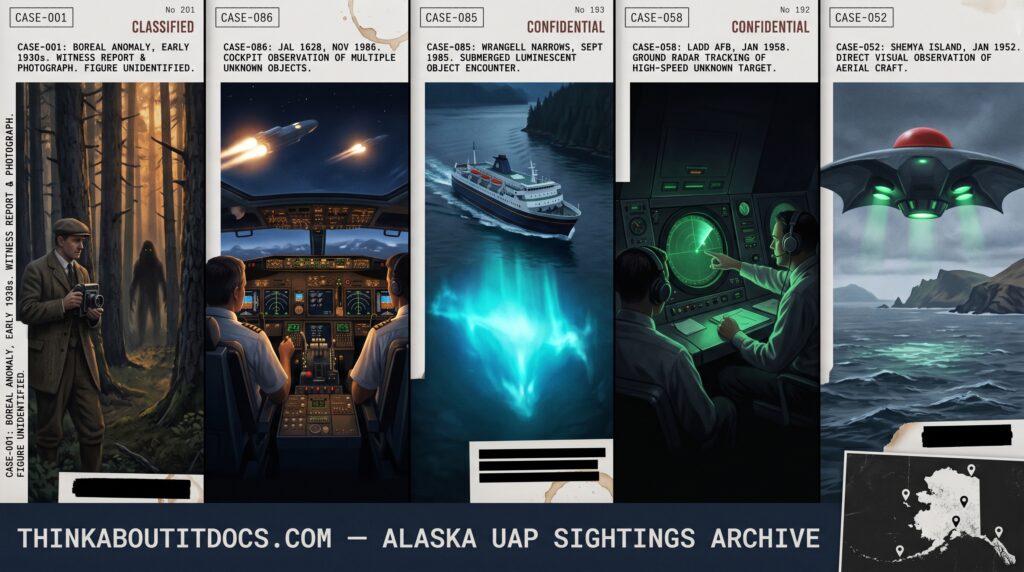
Alaska UAP archive: early 1930s rural Alaska boreal entity photograph, JAL Flight 1628 November 1986 FAA radar-confirmed 50-minute encounter (anchor case), 1985 Juneau Wrangell Narrows USO illuminating a 300-foot vessel from below, 1958 Fairbanks Ladd AFB multi-radar 5000+ MPH four-hour track, and 1952 Shemya Island Aleutian bat-shaped USO descent. 17 documented cases 1930–2006.
Alaska UFO|UAP & Alien Sightings Archive
Alaska occupies a unique position in the UAP record that no contiguous U.S. state can replicate. It is simultaneously the most militarily instrumented remote territory in North America — Cold War radar networks, Alaskan Air Command intercept stations, naval installations stretching the full length of the Aleutian Island chain — and one of the least populated landmasses on the continent, where civilian witnesses are separated by hundreds of miles of wilderness and reports that would generate a crowd of corroborating observers in any other state instead arrive as single-witness accounts from subsistence hunters, bush pilots, and isolated military personnel. That combination of dense military instrumentation and extreme geographic isolation produces a case record unlike any other state’s: Alaska’s UAP events are disproportionately documented by radar, by military observers with formal reporting obligations, and by commercial aviation crews operating over some of the most strategically sensitive airspace on the planet. The January 1950 Kodiak/Bering Sea Air Force encounter — a multi-witness military CE-I with formal documentation — and the 1948 Alaskan Air Command SECRET report on Aleutian chain sightings, declassified and now in the archive, establish the institutional baseline. The January 1958 Fairbanks multi-radar track of an object performing 5,000+ MPH flight from 03:00 to 07:00 across a four-hour observation window represents one of the most duration-significant radar-confirmed UAP events in the Cold War military record.
The anchor case for the Alaska archive — and one of the most rigorously documented commercial aviation UAP encounters in history — is Japan Air Lines Flight 1628, November 17, 1986. Captain Kenjyu Terauchi and his crew, operating a Boeing 747 cargo flight from Paris to Tokyo via Anchorage, reported a structured formation of objects that matched their aircraft’s speed and heading for fifty minutes over Alaska, one of which was estimated to be as large as an aircraft carrier. The FAA confirmed the encounter on primary radar. The FAA’s own air traffic control supervisor described the objects on radar as solid returns. The Federal Aviation Administration subsequently conducted an official investigation, made an unprecedented public statement acknowledging the encounter, and then — under pressure — reversed its position and removed Terauchi from flight status. The removal was later rescinded. The case remains officially unexplained. Alaska’s seventeen documented cases span seventy-six years, extend from the early 1930s boreal wilderness entity photograph through the Cold War military radar-track era to the 2006 Knik triangle, and distribute across four geographic zones: the Aleutian chain, the Interior, the Southcentral/Cook Inlet region, and the Southeast.
- 1930: Alien captured on film in Alaska
- 1936: Sighting in Eklutna
- 1948: Unusual Sightings along Aleutian chain – Declassified – Document
- 1950: A major Air Force encounter with a UFO in Alaska
- 1952: Bat Shaped Object seen over Shemya Island
- 1958: Object tracked on multiple radar flying at 5,000+ MPH
- 1966: Anchorage, Alaska UFO|UAP Sighting
- 1972 or 1973: Adak Island Military Man With Top Secret Clearance Spots UFO
- 1973: Chugiak, Alaska Possible Abduction
- 1980: Glennallen, Alaska UFO Sighting
- 1985: Inside Passage, southeastern Alaska UFO Sighting
- 1986: Japan Air Lines Flight 1628
- 1988 or 1989: Homer, Kenai Peninsula, Alaska UFO
- 1995: Dramatic sighting in the outskirts of Cordova, Alaska
- 2004: Fairbanks, Alaska Circular Object
- 2004: Kodiak Island, Alaska Object Over Coast Guard Base
- 2006: Large triangle over Alaska
- 1945: The USAT Delarof Sphere — Aleutian Islands
- 1952 Beluga Lake, Alaska Case: An F-94 Radar Intercept That Vanished Twice
- 1955: Fairbanks, Alaska: The ADC Radar Chase With a Quadrupling Target Speed
EXECUTIVE SUMMARY
The Instrumented Wilderness — Alaska’s Military and Aviation Record
Alaska’s UAP case record is defined by a single structural reality: the state has been among the most heavily radar-monitored airspaces in North America since the 1940s, and that instrumentation has produced a series of multi-source confirmations that most UAP records never achieve. The 1948 Alaskan Air Command document — classified SECRET at the time of the sightings along the Aleutian chain, declassified and publicly accessible — gives the archive a primary government source record predating the formation of Project Sign. The January 22/23 1950 Kodiak encounter documents a formal military report filed within the early Project Grudge period. The January 1958 Fairbanks multi-radar track — four hours, 5,000+ MPH performance, multiple independent radar returns — is one of a small number of Cold War radar cases in which both the duration and the instrumented confirmation are simultaneously documented. None of these cases were made public voluntarily; all reached the archive through declassification or FOIA processes. Alaska’s military witnesses were trained observers with formal reporting obligations, which gives the state’s institutional record a source-quality profile that civilian-report-dependent state archives cannot match.
The JAL 1628 case extends that institutional record into the commercial aviation domain with an additional layer of evidence: a named, senior captain with an unblemished professional record; two additional crew members; FAA radar confirmation; an official FAA investigation with a public statement acknowledging the encounter; and a subsequent institutional reversal under apparent pressure that itself became an evidentiary data point. The case is analytically significant not only for what was observed but for the institutional response it generated — the removal and subsequent reinstatement of Captain Terauchi, the public-then-retracted FAA acknowledgment, the pattern of official confirmation followed by official retreat that characterizes the most consequential cases in the U.S. government’s UAP record. The 1985 Juneau Wrangell Narrows USO — a massive submerged glowing object illuminating a 300-foot marine vessel from below the waterline — adds a USO dimension to the archive consistent with Alaska’s position at the Pacific/Arctic maritime interface. Seventeen cases across seventy-six years; the Aleutian chain, the Interior, Cook Inlet, and Southeast Alaska each contribute. The archive is a military record first, a civilian record second, and one of the most instrumentally corroborated state UAP records in the database.