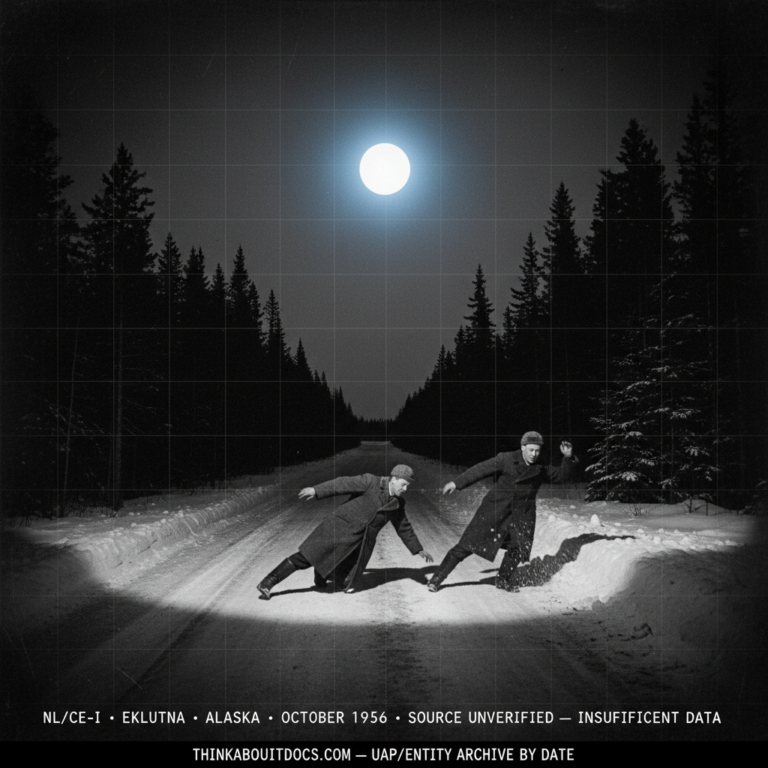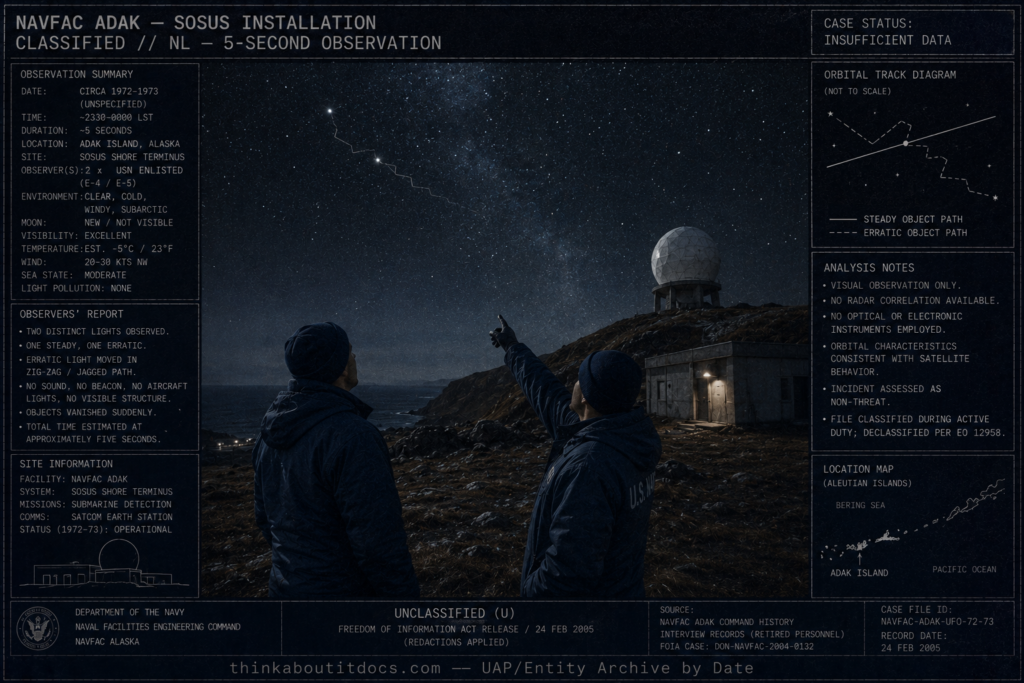
Circa 1972–73: Two Navy radiomen with TS clearances at the classified SOSUS station on Adak Island watched a point of light execute apparent zig-zag maneuvers around an orbiting American spacecraft in a 5-second naked-eye observation. Classified NL — Insufficient Data.
THINK ABOUTIT UFO|UAP SIGHTING REPORT
1972 or 1973: Adak Island Military Man With Top Secret Clearance Spots UFO
In late 1972 or early 1973, two Navy personnel stationed at NAVFAC Adak — a classified SOSUS submarine listening post on one of the most remote islands in the Aleutian chain — went outside on a clear night to watch an American spacecraft pass overhead in orbit. As the capsule came around for a second pass, both men observed a second pinpoint of light approach at high speed, execute what appeared to be zig-zagging right-angle maneuvers around the spacecraft, and then shoot away. The entire event lasted approximately five seconds.
The account was self-reported decades later to an unspecified UFO database. The witness is anonymous, and the observation — a five-second naked-eye sighting of two pinpoints of light at orbital altitude — has several strong mundane candidates including satellite conjunctions, tumbling debris catching sunlight, and bolide meteors crossing the visual field near a tracked spacecraft.
Date: Late 1972 or early-to-mid 1973 (witness uncertain — possibly as late as May 1973)
Sighting Time: Night (specific time not provided)
Day/Night: Night
Location: Adak Island, Andreanof Islands, Aleutian Islands, Alaska
Urban or Rural: Military installation (remote island)
No. of Entity(‘s): 0
Entity Type: Not applicable
Entity Description: Not applicable
Hynek Classification: NL (Nocturnal Light)
Duration: Approximately 5 seconds
No. of Object(s): 1 (anomalous object — the spacecraft was the reference point, not the subject)
Description of the Object(s): A pinpoint of light comparable in apparent magnitude to the American spacecraft being tracked. The object approached the spacecraft rapidly, executed what appeared to be zig-zagging right-angle maneuvers around it, and then departed at high speed. No structure, color, or surface detail was resolved — purely a point source at orbital altitude observed with the naked eye.
Shape of Object(s): Point source only — no structure resolved at orbital distance
Size of Object(s): Not determinable (point source at orbital altitude)
Color of Object(s): Not specified
Distance to Object(s): Orbital altitude (naked-eye observation from ground)
Height & Speed: Orbital altitude; apparent high rate of speed on approach and departure; apparent right-angle maneuvering around the tracked spacecraft during the 5-second observation
Number of Witnesses: 2
Special Features/Characteristics: Object appeared to interact with or maneuver around an orbiting American spacecraft (possibly Apollo 17 or early Skylab mission). Zig-zag and right-angle maneuvers reported. Entire event lasted approximately 5 seconds. Both witnesses held Top Secret clearances and declined to report the observation through official channels.
Case Status: Insufficient Data
Source: Anonymous self-report to an unspecified online UFO database (date of filing unknown, estimated 2000s)
Summary/Description: Two Navy personnel with TS clearances at the classified SOSUS submarine listening station on Adak Island went outside on a clear night to watch an American spacecraft pass overhead. On its second orbit, a second point of light approached at high speed, appeared to zig-zag around the spacecraft with right-angle maneuvers, and departed — all in approximately five seconds. Anonymous self-report filed decades later. A five-second naked-eye observation of a point source at orbital altitude has several strong mundane candidates including satellite conjunctions and tumbling debris.
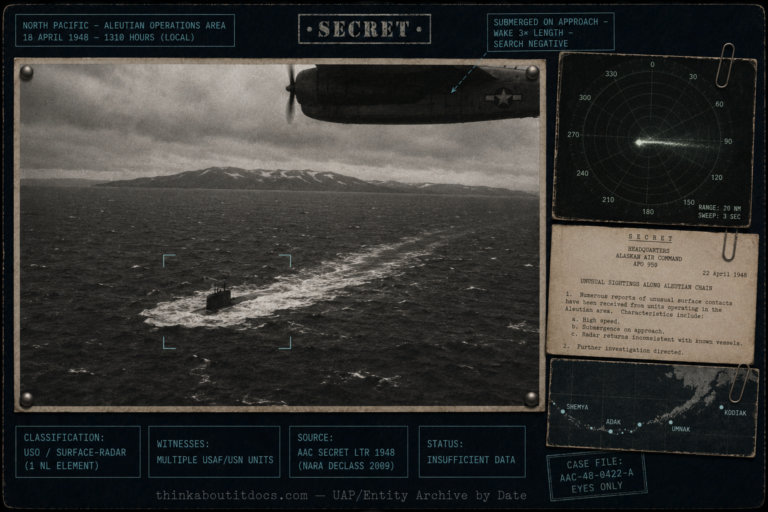
Related Cases: 1948: Unusual Sightings along Aleutian Chain
Detailed Report
The witness, who has not publicly identified himself, states that he was a U.S. Navy radioman holding a Top Secret clearance, stationed at the NAVFAC unit on Adak Island, Alaska, during 1972 or 1973. NAVFAC Adak was one of the Navy’s classified SOSUS (Sound Surveillance System) submarine detection facilities, part of a network of undersea passive sonar listening stations that monitored Soviet submarine activity across the North Pacific. Personnel at these facilities held TS clearances and worked alongside Ocean Systems Technicians — the specialized rating for SOSUS operators.
The witness states that personnel who operated the large microwave satellite communication dish antennas on the island told him and a friend that on clear nights they could observe American astronauts passing overhead in orbit — meaning they could see the spacecraft as a moving point of light, which is a well-known naked-eye phenomenon for objects in low Earth orbit.
On one clear night, the two men went outside and successfully spotted the American spacecraft on its first pass. They waited for it to come around on a subsequent orbit. When it did, a second point of light — appearing about the same size as the spacecraft — came shooting in at a high rate of speed, appeared to zig-zag around the spacecraft making right-angle maneuvers, and then departed rapidly. The entire sequence lasted approximately five seconds.
The witness states that both men looked at each other and confirmed they had seen the same thing. He says they understood they could not discuss it because of their security clearances. He is uncertain whether the spacecraft he was watching was the final Apollo mission (Apollo 17, December 7–19, 1972) or one of the unmanned or early crewed Skylab missions (Skylab 1 launched May 14, 1973; Skylab 2 launched May 25, 1973).
Researcher’s Notes
Five Seconds at Orbital Altitude Through the Naked Eye
- Source Chain: This case rests on a single anonymous self-report filed decades after the event to an unspecified online UFO database. No investigator interviewed the witness. No corroborating testimony from the second observer has been recorded. The witness’s name, service record, and identity remain unverified. His institutional knowledge — NAVFAC, Ocean Systems Technicians, TS clearance, satellite dish operations — is internally consistent with the known operations of SOSUS installations on Adak in the early 1970s, but internal consistency is not verification.
- What Was Actually Observed: The core observation is a five-second naked-eye sighting of a pinpoint of light appearing to maneuver near another pinpoint of light at orbital altitude. At that distance and duration, with no optical aids described, the witness had no ability to determine the anomalous object’s actual trajectory, speed, altitude, or proximity to the spacecraft. Apparent motion — especially apparent relative motion between two points of light against a featureless night sky — is highly susceptible to perceptual error. The perceived zig-zagging and right-angle turns may reflect the observer’s interpretation of a complex relative-motion track rather than the object’s actual behavior.
- Mundane Candidates: Several conventional explanations fit the described observation. A satellite conjunction — two objects in different orbits appearing to cross paths from the observer’s perspective — is the most straightforward. By the early 1970s, hundreds of satellites and thousands of pieces of tracked debris were in low Earth orbit. A tumbling piece of space debris catching sunlight irregularly as it rotated would appear to change brightness and apparent direction, mimicking zig-zag motion. A bolide or bright meteor crossing the visual field near the tracked spacecraft could also produce the appearance of rapid approach and departure. None of these candidates requires the anomalous object to have been anywhere near the spacecraft — only that it appeared near it from Adak’s line of sight.
- Assessment: The witness is treated as sincere. His institutional claims are plausible. But a five-second naked-eye observation of a point source at orbital distance cannot support conclusions about anomalous maneuvering, and the case has no corroborating evidence, no second-witness testimony, and no identified reporting pathway. Classified Insufficient Data — the observation is real but the data is too thin to distinguish between anomalous and conventional explanations.
Two sailors on one of the most isolated military installations in the Western Hemisphere watched a point of light do something apparently impossible near an American spacecraft. The observation lasted five seconds, was never reported through official channels, and came to light decades later through an anonymous online submission. Whether the light was a satellite, a piece of tumbling debris, or something genuinely anomalous, the data cannot determine — and after five decades, it never will.