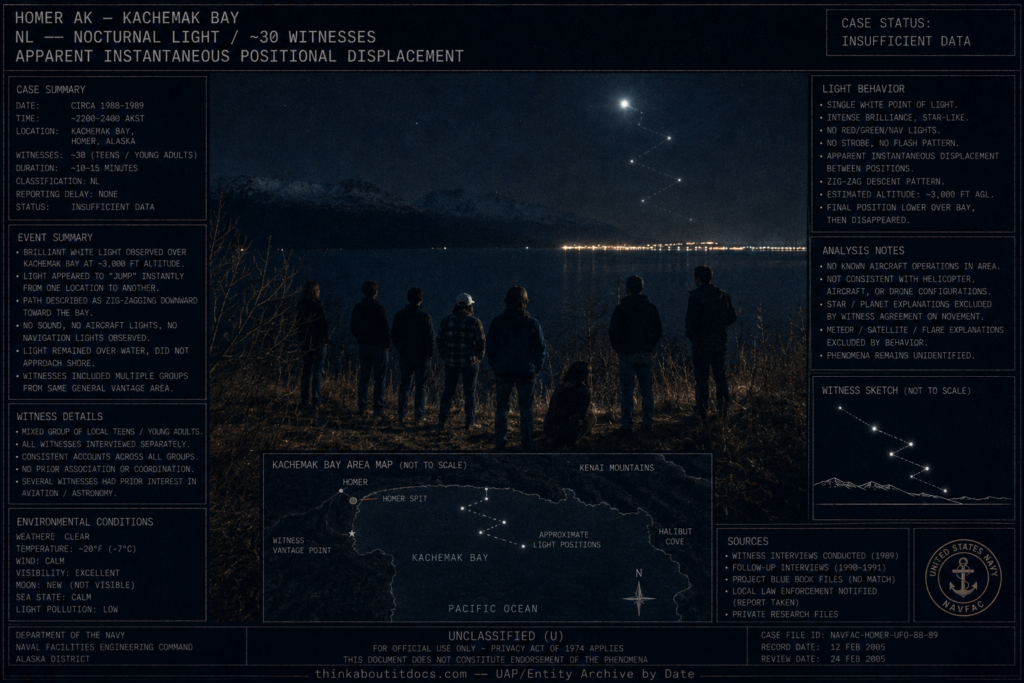
Circa 1988–89: A flashing white light over Kachemak Bay appeared to jump hundreds of feet between pulses, witnessed by approximately 30 people at a hillside party above Homer, Alaska. Single anonymous report filed years later. Classified NL — Insufficient Data.
THINK ABOUTIT UFO|UAP SIGHTING REPORT
1988 or 1989: Homer, Kenai Peninsula, Alaska UFO
On an August night in 1988 or 1989, approximately thirty teenagers at a hillside party above Homer watched a single white light flash at precise intervals over Kachemak Bay — unremarkable until it began appearing in completely different positions between flashes, making apparent vertical zig-zag jumps of several hundred feet while maintaining its exact pulse rhythm. One anonymous witness filed a report years later. No other attendees have come forward.
Date: August 1988 or 1989 (witness uncertain of year)
Sighting Time: Approximately 11:30 PM
Day/Night: Night
Location: Hillside above Homer, Kenai Peninsula, Alaska — observed over Kachemak Bay between Homer Spit and Halibut Cove
Urban or Rural: Rural
No. of Entity(‘s): 0
Entity Type: Not applicable
Entity Description: Not applicable
Hynek Classification: NL (Nocturnal Light)
Duration: Approximately 4–5 minutes total (roughly 1 minute stationary, 1 minute of anomalous jumping, 2–3 minutes tracking up the bay before losing sight)
No. of Object(s): 1
Description of the Object(s): A single pure-white point-source light flashing at precise regular intervals of approximately 0.75 seconds. No structure, surface detail, or color variation was resolved at any point. Between flashes the object was completely invisible. The witness compared its apparent brightness to a large stadium light pack.
Shape of Object(s): Point source — no structure resolved at 8 miles
Size of Object(s): Not determinable at distance; witness speculated refrigerator-sized to produce the observed brightness at 8 miles, but acknowledged this was a guess
Color of Object(s): Pure white
Distance to Object(s): Approximately 8 miles (across Kachemak Bay)
Height & Speed: Estimated altitude 3,000–4,000 feet; stationary for approximately 1 minute, then apparent instantaneous positional jumps of 500–600 feet between flashes; overall track moved up Kachemak Bay before disappearing
Number of Witnesses: Approximately 30 (teenagers and young adults at an outdoor party; only one filed a report)
Special Features/Characteristics: Object visible only during its flash — invisible between pulses. During movement phase, light appeared to relocate instantaneously between flashes in a vertical zig-zag pattern. Flash interval remained constant throughout both stationary and movement phases.
Case Status: Insufficient Data
Source: Anonymous self-report to an unspecified online UFO database (date of filing unknown)
Summary/Description: A teenager at a hillside party above Homer observed a flashing white light over Kachemak Bay that, after approximately one minute of stationary pulsing, began appearing in different positions between flashes — making apparent jumps of hundreds of feet in under a second — before tracking up the bay and disappearing. Approximately thirty people saw the light; only one filed a report, years later. No structure was observed, only a distant point source at roughly eight miles.
Related Cases: 1980: Glennallen, Alaska — Polarized Light on Road | 1958: Eielson AFB Multi-Radar Tracking
Detailed Report
The witness was attending an outdoor party on a hillside above Homer, Alaska on an August night in either 1988 or 1989. He estimates approximately thirty teenagers and young adults were present. He states he had consumed one small cup of beer at the time of the observation.
Someone at the party jokingly pointed out a light, calling it a UFO. Most attendees looked. The witness observed a single pure-white light at an estimated altitude of 3,000 to 4,000 feet, positioned over Kachemak Bay between the end of the Homer Spit and Halibut Cove — roughly eight miles from the hillside vantage point. The light was flashing at what the witness estimated as precise 0.75-second intervals. In its stationary phase it appeared unremarkable — a large, steady, regularly flashing white light.
After approximately one minute, the light began to appear in different positions between flashes. It was completely invisible between pulses — it would simply reappear at the next flash in a new location. The positional changes formed a vertical zig-zag pattern, with some apparent jumps estimated at 500 to 600 feet. The flash interval appeared to remain constant throughout the movement phase.
After about another minute, the light began moving generally up Kachemak Bay, still jumping positions between flashes. A tree line was about to block the witness’s view. He considered repositioning but stayed put. After two to three minutes with no reappearance, he jogged approximately 150 yards to a clearing offering an unobstructed panorama of the entire bay, the Homer Spit, and surrounding area. The light was gone. He waited several minutes, then returned to the party.
The witness notes that no piloted aircraft could have survived the G-forces implied by the apparent positional changes, though he also questions why a UFO would behave this way. He has not reported any other unexplained phenomenon in his life.
Researcher’s Notes
The Homer Spit Light — Kenai Peninsula 1988/89 and the Limits of Distant Point-Source Observation
- Source Chain: This case has no verifiable source chain. It consists of a single anonymous self-report to an unspecified online database at an unknown filing date. No investigator interviewed the witness or any of the approximately thirty other attendees. No aviation, maritime, or military authority was contacted. The witness’s name, age, and identity are entirely unknown. The approximately twenty-nine other witnesses who reportedly saw the same light have never filed corroborating reports.
- Observational Limitations: The core observation is a distant point-source light at approximately eight miles, viewed by dark-adapted eyes across open water at night. No structure, shape, surface detail, or color variation was observed at any point. At that distance, the witness had no ability to determine the object’s actual trajectory, speed, altitude, or size. The apparent positional jumps between flashes may reflect actual instantaneous displacement, or they may reflect a different phenomenon — such as a rotating multi-element light source where sequential elements flash at different positions, a moving light whose track between flashes is invisible against the sky, or atmospheric scintillation and refraction over cold Alaskan water distorting the apparent position of a light between observations.
- Mundane Candidates: Several conventional sources could produce this appearance at eight miles across open water. A fishing vessel or Coast Guard cutter traversing the bay with a rotating beacon or high-intensity strobe would flash at regular intervals and appear to shift position as the vessel moved — the vessel itself invisible at eight miles in the dark. A helicopter operating over the bay with an anti-collision strobe, banking and maneuvering between flashes, would produce apparent positional jumps when only the strobe is visible. Military flare exercises would produce bright, drifting point sources. The regular flash interval and the object’s eventual departure up the bay are both consistent with a vessel or aircraft transiting the area.
- Assessment: The witness’s tone is notably self-aware and appropriately uncertain — he uses question marks frequently, qualifies his estimates, and does not overclaim. The observation of approximately thirty witnesses is contextually significant but evidentiarily inert without corroborating reports. A single anonymous observer watching a point-source light at eight miles for approximately one minute of anomalous behavior is the thinnest possible evidence base for an anomalous claim. Classified Insufficient Data — the observation is real but the data is too thin to distinguish between conventional and anomalous explanations, and the probability of resolving the case after three decades with no other witnesses on record is effectively zero.
A white light pulsed over Kachemak Bay on an August night, jumped positions between flashes for about a minute, then tracked up the bay and was gone. Thirty people saw it from a hillside party above Homer. One filed a report. Whatever it was — maritime beacon, helicopter strobe, or something harder to name — the data from a point of light at eight miles cannot determine, and after more than three decades, it never will.