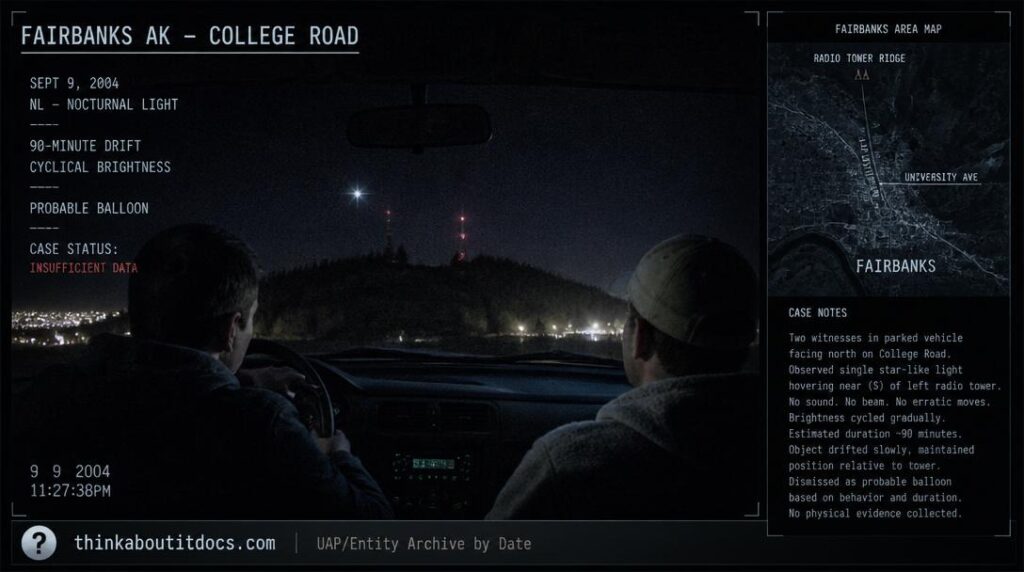
September 9, 2004: Two witnesses on College Road in Fairbanks watched a slowly drifting, cyclically brightening light near radio towers for 90 minutes before it faded to nothing. Probable weather balloon. NL — Insufficient Data.
THINK ABOUTIT UFO|UAP SIGHTING REPORT
2004: Fairbanks, Alaska Circular Object
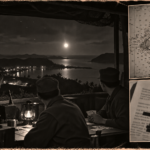
On September 9, 2004, a man and his girlfriend parked near a field adjacent to the Alaska Department of Fish and Game on College Road in Fairbanks watched a distant light near two radio towers approximately two miles away slowly brighten, dim, and drift south and west toward their location over approximately ninety minutes before fading to nothing and vanishing. They sat in the car for another forty minutes in stunned silence.
Date: September 9, 2004
Sighting Time: 12:30 AM – 3:00 AM
Day/Night: Night
Location: Fairbanks, Alaska — parked near the Alaska Department of Fish and Game (Department of Wildlife Management) on College Road, facing north toward radio towers on the ridge approximately 2 miles away
Urban or Rural: Urban (University Avenue and College Road is central Fairbanks)
No. of Entity(‘s): 0
Entity Type: Not applicable
Entity Description: Not applicable
Hynek Classification: NL (Nocturnal Light)
Duration: Approximately 1.5 hours of active observation, plus 40 minutes sitting in silence afterward
No. of Object(s): 1
Description of the Object(s): A light that initially resembled a star but emanated a glow the witness compared to a flashlight shined through a crystal. The light slowly moved south of a blinking radio tower marker, brightened significantly, then cycled between bright and dim repeatedly. It drifted very slowly south and west toward the witnesses’ location over 90 minutes before gradually shrinking and fading until it vanished completely.
Shape of Object(s): Circular (per the page title; the witness describes only a point-source light)
Size of Object(s): Appeared star-like at 2 miles; no angular size estimated
Color of Object(s): Not specified beyond a “glow” compared to light through a crystal
Distance to Object(s): Initially approximately 2 miles (near the radio towers); slowly closed toward the witnesses’ location before vanishing
Height & Speed: Initially appeared at altitude near radio towers; moved very slowly south and west over 90 minutes — rate of closure not estimated
Number of Witnesses: 2
Special Features/Characteristics: Cyclical brightening and dimming. Extremely slow apparent drift. The light appeared to move relative to the fixed blinking radio tower marker, ruling out a stationary star or planet. Vanished by gradually shrinking and fading rather than departing at speed.
Case Status: Insufficient Data
Source: HBCC UFO Research (Brian Vike)
Summary/Description: Two witnesses parked on College Road in Fairbanks observed a distant star-like light near radio towers approximately 2 miles away that slowly brightened and dimmed in cycles, drifted south and west toward them over 90 minutes, then gradually shrank and vanished. NL observation at distance with no structure resolved. The behavior — slow drift with cyclical brightness changes — is consistent with several conventional explanations including high-altitude balloons, aircraft in a holding pattern at distance, or atmospheric lensing of a celestial object.
Related Cases: 2004: Kodiak Island — Stationary Object Near Coast Guard Base
Detailed Report
The witness and his girlfriend had stopped at Taco Bell on University Avenue in Fairbanks, then drove north on University and east on College Road. While driving, the witness noticed a light in the sky with an unusual glow he compared to a flashlight shined through a crystal. They parked in a field adjacent to the Alaska Department of Fish and Game (referred to as the Department of Wildlife Management), still facing north.
Two radio towers stood approximately 2 miles away with standard blinking aviation warning lights. The anomalous light was visible just above the towers, initially looking like a distant star. The witness confirmed the light was moving when it slowly drifted south of the blinking tower marker — proving it was not a fixed celestial object.
The light began to brighten significantly, then dimmed, then brightened again in a repeating cycle. The witnesses sat watching for approximately ninety minutes as the light drifted very slowly south and then west toward their location. The girlfriend became frightened, but the witness convinced her to stay. The light eventually stopped moving, began to grow dimmer and smaller, and vanished completely.
The witnesses sat in silence for approximately forty minutes afterward. The girlfriend, described as a staunch UFO skeptic, was reportedly shaken for days.
Researcher’s Notes
The College Road Light — Fairbanks 2004 and the Distant NL Problem
- Source Chain: This case is a single anonymous report filed with HBCC UFO Research (Brian Vike’s now-defunct Canadian UFO database). No investigator visited the site. No photographs, video, or physical evidence exist. The girlfriend has not filed a separate report. The witness’s name is not provided.
- Location Correction: The original page lists “Rural” for the Urban/Rural field. University Avenue and College Road is the commercial core of Fairbanks — one of the most urban locations in interior Alaska. The correct classification is Urban. The “Alaska State Troopers” tag on the original page appears to be a data entry error and should be removed.
- Mundane Candidates: A slowly drifting, cyclically brightening and dimming light at approximately 2 miles’ distance over 90 minutes has multiple strong conventional candidates. A high-altitude weather balloon catching intermittent moonlight or city light glow as it rotates would produce exactly this behavior — slow drift, cyclical brightness changes, gradual fading as it gains altitude and distance. An aircraft in a distant holding or training pattern, viewed end-on at low angular rate, could also produce this appearance. Atmospheric scintillation and refraction of a bright star or planet near the horizon — particularly in September in Fairbanks when temperature inversions are common — could create apparent motion relative to the fixed radio tower markers. The gradual shrinking and vanishing is more consistent with a balloon gaining altitude than an object departing at speed.
- Assessment: The witnesses are treated as sincere. The observation is a classic NL — a distant point-source light watched at length with no structure, sound, or close-range detail resolved. The behavioral profile (slow drift, cyclical brightness, gradual fade to nothing) is entirely consistent with a weather balloon or atmospheric optical effect. Classified Insufficient Data — the observation is real but the data is too thin to distinguish between conventional and anomalous explanations, and the conventional candidates are strong.
A light drifted slowly across the Fairbanks night sky for ninety minutes, brightened and dimmed in cycles, and then quietly faded to nothing. Two people watched it from a parking area on College Road. It may have been a weather balloon. It may have been something else. The data — a single online report with no photographs, no measurements, and no follow-up — cannot tell us which.