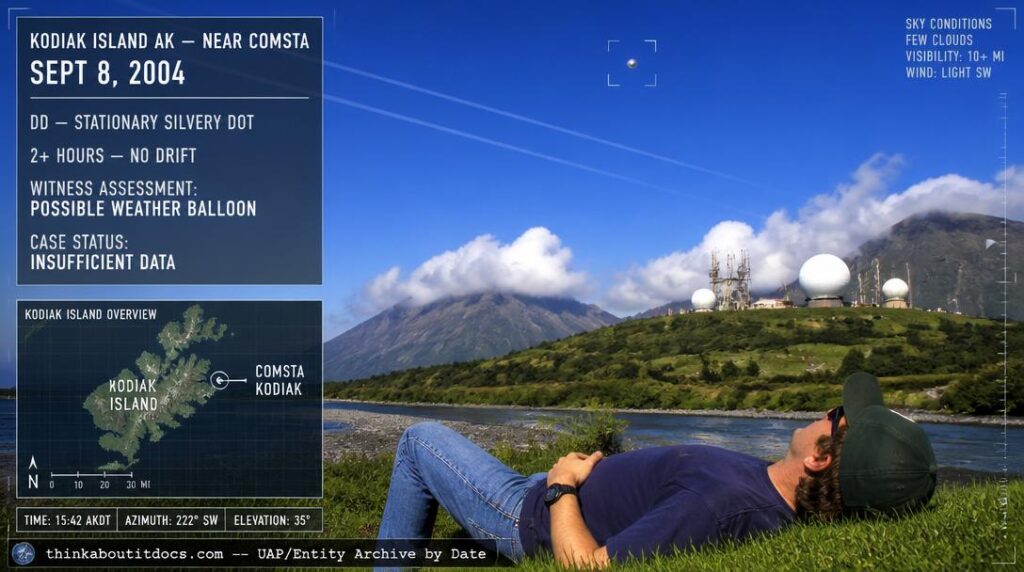
September 8, 2004: A single witness near USCG COMSTA Kodiak observed a silvery dot at high altitude maintaining a perfectly stationary position for at least 2 hours while contrails drifted past it. The witness himself suggested a weather balloon. DD — Insufficient Data.
THINK ABOUTIT UFO|UAP SIGHTING REPORT
2004: Kodiak Island, Alaska Object Over Coast Guard Base
On September 8, 2004, a visitor to Kodiak Island lay on his back near the Coast Guard Communications Station (COMSTA) while salmon fishing and watched a silvery dot maintain a perfectly stationary position in the sky for at least two hours while jet contrails drifted and lower clouds moved across the mountaintops. The witness himself noted that a weather balloon would normally drift and wondered if that ruled one out — though he acknowledged it could well have been exactly that.
Date: September 8, 2004
Sighting Time: Approximately 2:00 PM – 3:00 PM (and continued for at least 2 hours)
Day/Night: Day (afternoon)
Location: Kodiak Island, Alaska — near USCG Communications Station (COMSTA) Kodiak
Urban or Rural: Rural
No. of Entity(‘s): 0
Entity Type: Not applicable
Entity Description: Not applicable
Hynek Classification: DD (Daylight Disc) — though “disc” overstates what was observed; the witness describes only a silvery dot at altitude with no resolved shape
Duration: At least 2 hours
No. of Object(s): 1
Description of the Object(s): A single silvery dot at high altitude, stationary, maintaining a precise position in the sky while jet contrails drifted and lower clouds moved. No structure, shape detail, or features were resolved. The object appeared to be at or above contrail altitude (approximately 30,000–40,000 feet based on the jet traffic described as departing Anchorage for Hawaii or the Philippines).
Shape of Object(s): Dot — no structure resolved
Size of Object(s): Not determinable (point source at high altitude)
Color of Object(s): Silvery
Distance to Object(s): Extremely high — at or above contrail altitude (30,000+ feet)
Height & Speed: High altitude, completely stationary for at least 2 hours. The witness noted it was “in the contrails and out” as trails drifted past it, but the dot itself never moved across the sky.
Number of Witnesses: 1
Special Features/Characteristics: Perfect stationarity for at least 2 hours while surrounding atmospheric phenomena (contrails, clouds) moved. The witness noted the object was too high for a tether. Warm, nearly windless weather at ground level. Near USCG Communications Station Kodiak.
Case Status: Insufficient Data
Source: Unspecified online UFO database (no source credited on the original page)
Summary/Description: A single witness lying on his back while salmon fishing near COMSTA Kodiak observed a silvery dot maintaining a perfectly stationary position at high altitude for at least 2 hours. No structure was resolved — only a point source. The witness himself suggested a weather balloon as a possible explanation but noted that balloons normally drift. A high-altitude research balloon, a geosynchronous satellite catching afternoon sunlight, or a radiosonde at near-neutral buoyancy are all conventional candidates. The witness’s own uncertainty is appropriate.
Related Cases: 2004: Fairbanks, Alaska — Circular Object Near Radio Towers
Detailed Report
The witness, visiting Kodiak Island, went salmon fishing in a river near the U.S. Coast Guard Communications Station (COMSTA Kodiak). The weather was warm and nearly windless at ground level — unusual conditions for Kodiak. While resting on his back, the witness watched contrails from jets departing Anchorage and flying southwest toward Hawaii or the Philippines.
He noticed a silvery dot maintaining a fixed position in the sky. As he watched, jet contrails drifted across the sky and lower clouds moved across the mountaintops, but the dot remained precisely stationary. He observed it for at least two hours. The object appeared to be at or above contrail altitude. It did not move, change brightness, change shape, or exhibit any behavior other than remaining perfectly fixed.
The witness considered a weather balloon as an explanation but noted that even in mild weather, balloons normally drift at least a short distance. He also observed that the object was too high to be tethered. He filed a brief report to an unspecified online UFO database, acknowledging that it might well have been a balloon despite the apparent stationarity.
Researcher’s Notes
The Kodiak Silvery Dot — Alaska 2004 and the High-Altitude Stationary Object
- Source Chain: This case is a single brief anonymous report with no credited source database, no investigation, no photographs, and no second witness. The entire content of the report is approximately 150 words. It is among the thinnest cases in the Alaska file.
- Classification Note: The original page classified this as DD (Daylight Disc). No disc shape was observed — only a silvery dot at extreme altitude. DD requires a resolved metallic or whitish object with discernible shape. A point source at contrail altitude does not meet this threshold. The correct classification is DD only in the loosest sense; practically, this is an unresolved aerial point source in daylight.
- Mundane Candidates: The strongest mundane candidate is a high-altitude research or military balloon at near-neutral buoyancy. Such balloons can hover at stable altitudes for hours or days, appearing stationary from the ground. At contrail altitude (30,000–40,000 feet), even a large balloon would appear as a silvery point source. The National Weather Service launches radiosondes from Kodiak — though standard radiosondes ascend and burst rather than hovering. A high-altitude superpressure balloon or a military surveillance platform would explain the behavior precisely. A geostationary satellite catching afternoon sunlight is another candidate — such satellites appear as stationary points even through changing atmospheric conditions — though they are typically too high (22,000 miles) to be visible as silvery dots in daylight without optical aid. The witness’s own suggestion of a weather balloon, qualified by his observation about drift, reflects sound reasoning.
- Assessment: The witness is appropriately uncertain and does not overclaim. A stationary silvery dot at high altitude for two hours, with no resolved structure and no anomalous behavior beyond stationarity, is one of the weakest possible foundations for an anomalous claim. The conventional candidates — particularly a high-altitude research balloon at neutral buoyancy — are strong. Classified Insufficient Data, with the practical assessment that a balloon is the most likely explanation.
A man lay on his back on Kodiak Island on a warm September afternoon, watched the contrails drift, and noticed a silvery dot that didn’t move. He watched it for two hours. It didn’t do anything. It was probably a balloon. He said so himself.