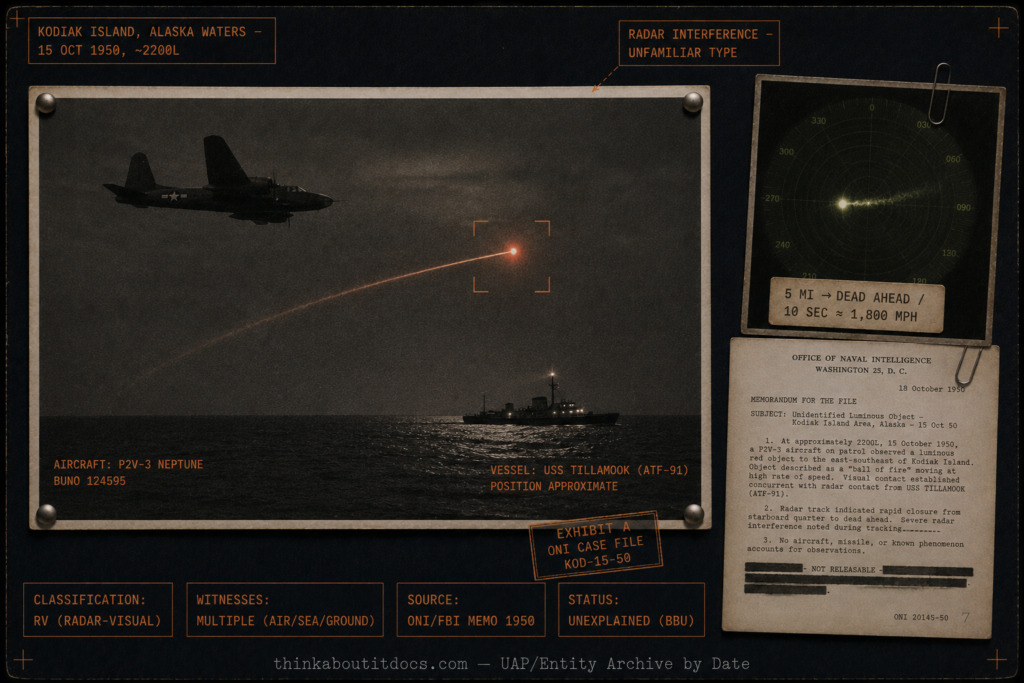
The Kodiak radar-visual, off Kodiak Island, Alaska, January 22/23, 1950 — tracked by a Navy patrol crew, the USS Tillamook's watch, and base radar; classified RV, status Unexplained (Blue Book Unknown).
THINK ABOUTIT UFO | UAP SIGHTING REPORT
1950: The Kodiak, Alaska Radar-Visual — A Major Air Force/Navy UFO Encounter
For two hours before dawn on January 23, 1950, an unidentified intruder worked the airspace and waters around the Kodiak Naval Air Station while three separate sets of experienced military observers — a Navy patrol crew in the air, a tug’s watch on the sea, and a base radar room — tracked it independently. It registered on radar as a contact so fast it smeared a trail across the scope, closing a five-mile gap in ten seconds. It appeared to the eye as a silent ball of orange fire that circled the island. And when the patrol pilot turned to chase it, the thing turned and came straight at his aircraft, prompting him to kill his lights and let it pass. The Navy printed at least three dozen copies of the report and routed them to the CIA, the FBI, Air Force Intelligence, and the State Department — and then said nothing publicly. It remains, three-quarters of a century later, an officially unexplained radar-visual: one of the cleanest of its kind in the entire record.
Date: January 22/23, 1950 (event spanned roughly 02:40–04:40 local) — BBU
Sighting Time: First contact 2:40 a.m.; principal visual-radar encounter 4:40 a.m.
Day/Night: Night
Location: Vicinity of Kodiak Naval Air Station, Kodiak Island, Alaska (Gulf of Alaska)
Urban or Rural: Rural — military airspace and coastal waters off Kodiak Island
No. of Entity(‘s): None reported
Entity Type: Not applicable
Entity Description: Not applicable — radar-visual encounter, no occupants observed
Hynek Classification: RV (Radar-Visual) — instrumented radar tracking corroborated by independent visual observation
Duration: Intermittent over approximately two hours; the climactic visual-radar pass lasted seconds, the earlier orange-fire transit about 30 seconds
No. of Object(s): One or more (multiple radar contacts and visual events; possibly a single maneuvering object)
Description of Object(s): On radar, a target showing extreme speed that left a trail on the scope; visually, a fast red/orange “ball of fire” of an exhaust-like nature, and later two orange lights rotating about a common center, likened to two aircraft doing slow rolls in formation
Shape: Not resolved visually beyond luminous source(s); no structured form discerned at night
Size: Not established
Color: Red to orange
Distance: Radar contacts at 20 miles (north), ~10 miles (southeast), and a closing pass from 5 miles to dead ahead
Height & Speed: Indicated speed on the closing pass on the order of 1,800 mph (five miles in ten seconds); high maneuverability, including a sharp turn directly toward the patrol aircraft
No. of Witnesses: Multiple credentialed military personnel across three platforms — the P2V-3 air crew, the USS Tillamook’s watch, and the Kodiak base radar room
Special Features/Characteristics: Radar interference of a kind the operator said he had never before experienced; complete silence from the luminous object; an apparent aggressive turn toward the pursuing aircraft; at least 36 copies of the Navy report distributed to federal security agencies; a truncated FBI copy released via FOIA in the 1970s
Case Status: Unexplained
Source: “Unexplained Phenomena in the Vicinity of Kodiak, Alaska,” ONI/FBI memorandum, 10 February 1950; Fawcett & Greenwood, Clear Intent, pp. 165–166; Randles, The UFO Conspiracy, pp. 30–32; Ruppelt, The Report on Unidentified Flying Objects, pp. 19, 99–100; catalogued as NARCAP RADCAT Case 2 and in the Project 1947 NavCat
Summary/Description: On the night of January 22/23, 1950, Lt. Smith, USN — patrol plane commander of a Lockheed P2V-3 Neptune (aircraft No. 4, Patrol Squadron One) — was flying a routine security patrol near Kodiak when, at about 2:40 a.m., his radar showed a contact 20 miles north that quickly vanished. Roughly eight minutes later a second contact appeared to the southeast, and radar operator Gaskey reported severe, unfamiliar interference. The control tower confirmed no known traffic. Around 3 a.m., crewmen aboard the ocean tug USS Tillamook, south of Kodiak, watched a fast red exhaust-like light circle the island clockwise and depart to the southeast, in view about half a minute and entirely silent; a second observer described it as a large ball of orange fire. At 4:40 a.m. Lt. Smith obtained a radar return five miles off his starboard bow that closed to dead ahead in ten seconds — an indicated 1,800 mph — and his crew visually acquired two orange lights rotating about a common center. When Smith attempted pursuit, the object turned toward his aircraft; he doused his lights and it passed and disappeared. The Navy’s report was distributed widely within the federal security apparatus and never publicly released in full.
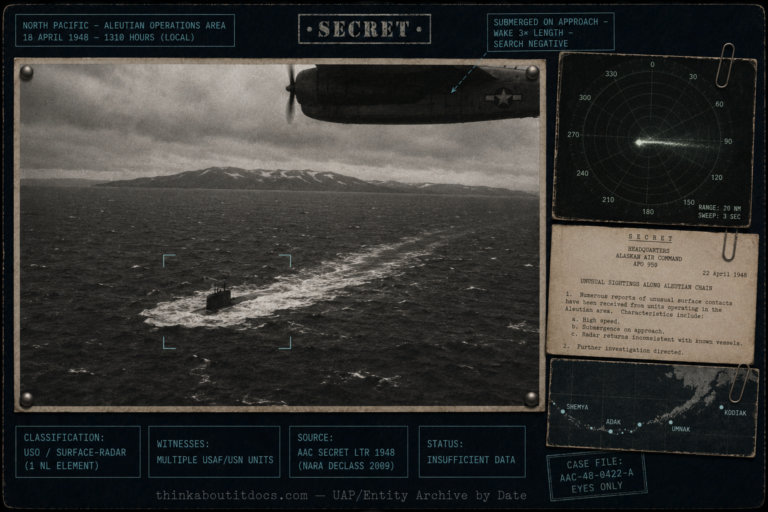
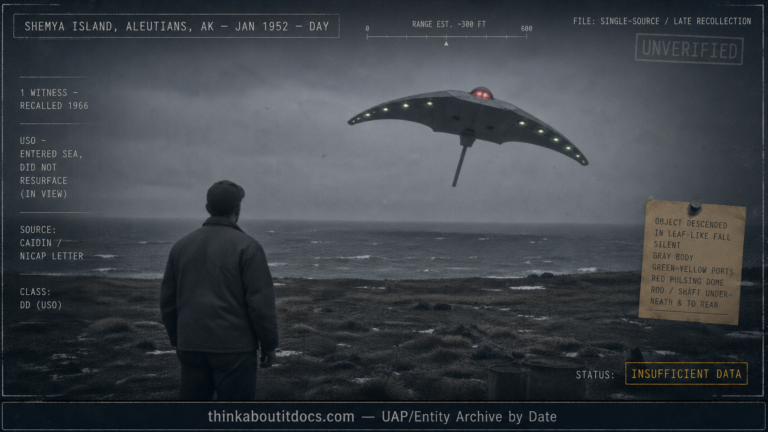
Related Cases: 1948 — Unusual Sightings along the Aleutian Chain, Alaska (declassified) | 1952 — Washington, D.C. radar-visual incident | 1952 — Bat-shaped object over Shemya Island, Alaska
Full Report
The Kodiak encounter unfolded in three movements over roughly two hours, and its strength lies in how those movements were observed by different people using different means, none of whom could have coordinated their accounts in real time.
The first movement was instrumental. Lt. Smith, commanding a P2V-3 Neptune of Patrol Squadron One on a routine night security flight, picked up a radar contact about twenty miles north of the Naval Air Station at roughly 2:40 a.m. It faded almost at once. Some eight minutes later a contact registered to the southeast. Smith queried the tower and was told there was no known traffic aloft. It was at this point that his radar operator, Gaskey, reported interference unlike anything in his experience — a detail that matters, because it places an anomaly on the equipment independent of any light in the sky.
The second movement was visual and came from the sea. Near 3 a.m., crewmen standing watch aboard the ocean tug USS Tillamook, positioned south of Kodiak, saw a very fast red light “of an exhaust nature” approach from the southeast, swing clockwise in a wide circle around Kodiak, and return the way it came. A second man came on deck and watched it for about thirty seconds, describing a large ball of orange fire. Both stressed that it made no sound — a significant point for an object moving at the speed its circuit implied.
The third movement combined both and was the most pointed. At 4:40 a.m., Smith — now flying clean, with no radar trouble — acquired a target five miles off his starboard bow that closed to dead ahead in ten seconds, an indicated speed near 1,800 mph that left a trail on his scope. His crew visually confirmed two orange lights rotating about a common center, like two aircraft in formation doing slow rolls. Smith turned to pursue; the object was far too maneuverable, and at one point it broke sharply and bore straight at his aircraft. Reading the move as hostile, he switched off his lights. The object swept past and was gone.
What happened to the paperwork is part of the story. The Office of Naval Intelligence assessment ran to several pages and was reproduced in at least thirty-six copies routed to the CIA, the FBI, Air Force Intelligence, the Department of State, and other agencies. None was released publicly at the time. Only in the 1970s, through a Freedom of Information Act request, did a truncated FBI copy surface — the document that allows the case to be reconstructed at all. Its own conclusion declined to identify the cause, holding that the objects had to be regarded as phenomena whose exact nature could not be determined.
That assessment is sharpened by the bureaucratic backdrop. Air Force Captain Edward Ruppelt, who would later run Project Blue Book, recorded that official UFO work in early 1950 had been cut to “minimum effort,” the old Project Grudge files literally boxed and shelved, with reports missing when he reviewed them later. He also noted that around this time the Director of Air Force Intelligence — one of the recipients of the Kodiak report — wrote to the Air Technical Intelligence Center stating he had never ordered Grudge shut down, and ATIC answered awkwardly that it had merely downgraded the effort. The Kodiak case sat squarely in the middle of that confusion.
RESEARCHER’S NOTES
The Kodiak Radar-Visual — Alaska 1950 and the Anatomy of an Unknown
- Classification. This is a model RV (Radar-Visual): the defining feature is instrumented radar detection corroborated by independent human observation, and Kodiak delivers both in unusual abundance. Radar carried the contacts and recorded the high-speed closing pass; the eye supplied the orange fireball circuit and the paired rotating lights. The two evidence streams originated on separate platforms — aircraft, ship, and ground radar — which is exactly the cross-confirmation the RV category is meant to capture. There are no occupants or landing traces, so no Close Encounter designation applies; RV is the precise and complete label.
- Source chain. The provenance here is, for a 1950 case, exceptionally strong. The root document is a contemporaneous Office of Naval Intelligence report, generated within days of the event by the military participants themselves, and preserved in the FBI’s files. It is reinforced by Ruppelt’s first-hand institutional account from inside Blue Book, and it has been independently catalogued by serious researchers — Fawcett and Greenwood in Clear Intent, the Project 1947 NavCat, and NARCAP’s radar-visual catalog, which lists it as Case 2. This is a chain of primary military documentation, not a witness recollection relayed through enthusiast bulletins.
- Pattern context. Kodiak belongs to the early Cold War cluster of military radar-visual events in sensitive airspace, and it sits among other Alaskan and Aleutian reports of the same period that the armed services took seriously enough to document and classify. It predates by two years the far more famous Washington, D.C. radar-visual flap of 1952, and it shares that case’s central signature: targets that behaved aerodynamically impossibly while being watched simultaneously by radar and trained observers. It is a regional and methodological cousin of the 1948 Aleutian Chain sightings and the 1952 Shemya Island report already in this archive.
- Physical / evidentiary weight. High, by the standards of any era. The case offers instrumented radar data, anomalous radar interference noted independently of any visual, multiple credentialed observers on three platforms, mutually consistent timing and geometry, an indicated speed and maneuver set far beyond 1950 aircraft, and a documented chain of official handling. There is no photograph and no recovered material, and the visual descriptions are necessarily limited by darkness — but the convergence of instrument and eye, across separated witnesses who could not have rehearsed, is what keeps this on the Blue Book Unknown list rather than in the explained column. Unexplained is the disposition the evidence earns.
The Kodiak encounter is the kind of case that the radar-visual category was invented to describe: machines and trained eyes agreeing, independently, that something was present that none of them could account for. Its witnesses were Navy professionals, its data instrumented, its documentation contemporaneous and official, and its conclusion — reached by the military itself — was that the nature of the objects could not be determined. Seventy-five years on, nothing has changed that verdict. It stands in the chronological record as one of the strongest early radar-visual Unknowns, neither inflated nor explained away.