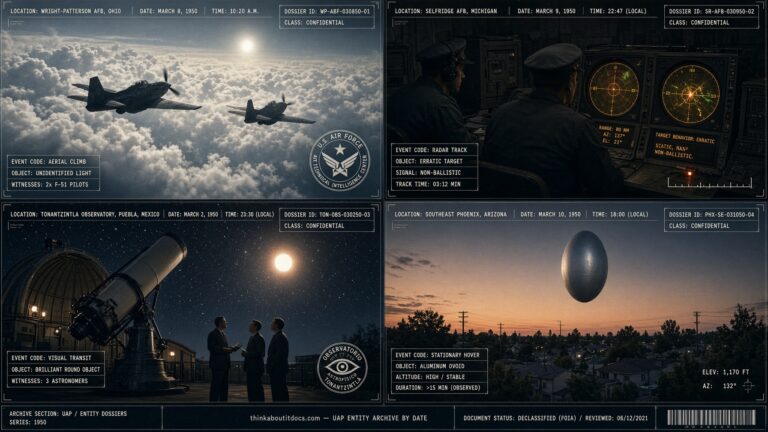
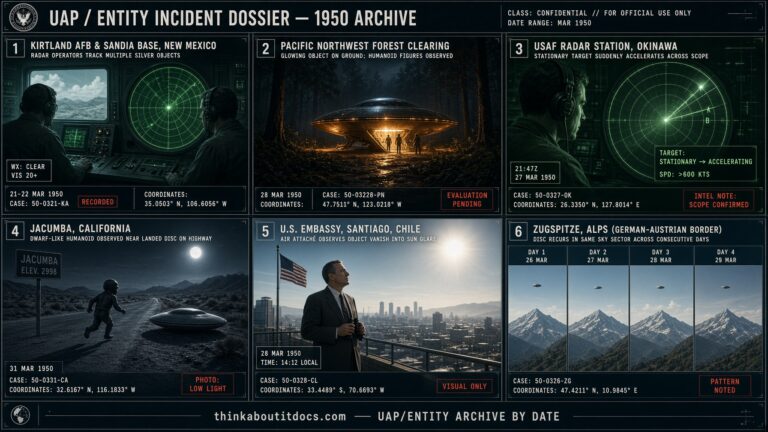
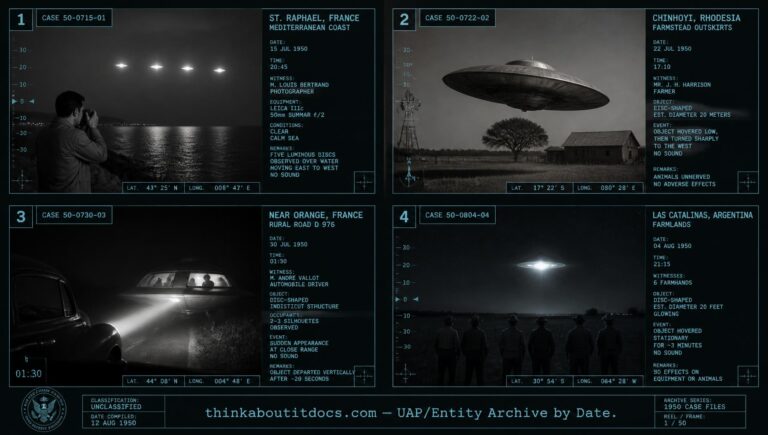
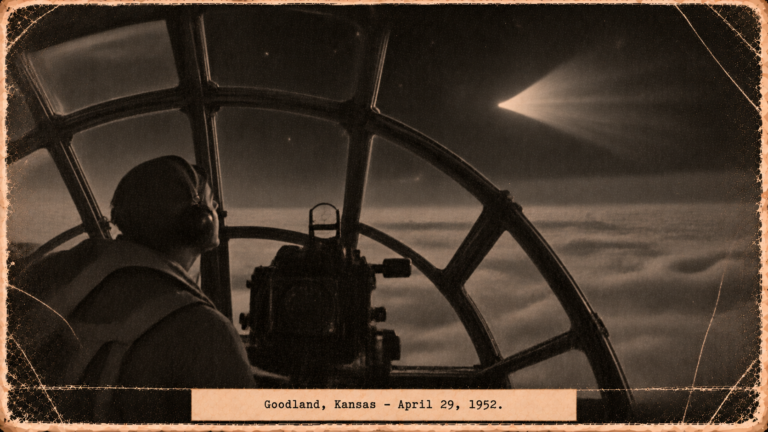
January 1950 — four cases opening the new decade: the Gulf of Mexico radar case; the Blackstone, Virginia encounter; the Kodiak, Alaska radar case; and the Mojave Desert crash claim.
1950: January UFO|UAP & Entity Sightings Archive
January 1950 UFO sightings open the decade just days after the Air Force announced it was closing its flying saucer project, and the reports kept coming. A B-29 crew over the Gulf of Mexico watched objects circle their aircraft on radar for half an hour, a Navy patrol pilot near Kodiak, Alaska was closed on by a fast radar target, and the crew of a C-45 carrying Pentagon officers pursued a dark, parachute-shaped object near Blackstone, Virginia. Across the Rockies and the Great Plains, seven pilots in four aircraft watched a fast flame over eastern Colorado, three Air Force officers saw a silver, football-shaped object near Howard, Kansas, and Holloman AFB personnel logged a string of green-and-red lights and a ten-second fireball near Corona, New Mexico. Air Force files later assigned most of those reports to meteors, planets, stars and aircraft, and this archive records those evaluations beside the original accounts. Running alongside the sightings is a layer of crashed-saucer rumor, including a Mojave Desert “FBI memo” and a Venus story from a Kansas newspaper, all of it unverified.
Date: January 1950
Location: Rio Gallegos, Santa Cruz, Argentina
Time: Night
Summary: Listed as a nautical UFO sighting; no further detail survives.
Source: Undocumented
Date: January 1, 1950 (as claimed)
Location: Mojave Desert, California
Time: Not specified
Summary: A purported FBI memo circulating online claims a disc crashed in the Mojave Desert and that 18 alien bodies were recovered. Its trail runs through Steven Greer/CSETI-affiliated website material and commentary attributed to a pen-named writer, “Branton.” No original FBI record, named witness or chain of custody has been located. [Full Report]
Source: Steven Greer/CSETI-affiliated website (Disclosure Project material); commentary attributed to “Branton”
Source Status: Insufficient Data. Authenticity of the document has not been established.
Date: January 6, 1950
Location: Kansas City, Kansas (Kansas Avenue at First Street)
Time: Early morning
Summary: A 33-year-old driver told police that “a flying saucer or a ball of fire” flashed across First Street in front of his car and blinded him. He lost control and struck a parked truck, and was treated for cuts and arrested for reckless driving and driving while intoxicated. Police were skeptical.
Source: Kansas City Star, 6 January 1950, as reproduced in the AFOSI Kansas City report
Source Status: Single witness; arrested for driving while intoxicated.
Date: January 6, 1950
Location: Near Howard, Kansas (seen from a C-47 seven miles west of the town)
Time: 2:10 p.m. CST
Summary: Capts. Robert E. Zimmerman and Frederick E. Howard and 1st Lt. Harold G. Simpson of Headquarters Eighth Air Force, flying a C-47 at 5,500 feet from Carswell AFB, Texas, to Offutt AFB, Omaha, saw a bright silver, football-shaped object with a red nose, 30 to 60 feet long, in straight, level flight below them at about 2,000 feet on a heading of 90 to 100 degrees. Estimates of its speed ran from 300 to 500 mph and of its distance from 2 to 10 miles. It was in sight under two minutes in cloudless weather and faded from view. AFOSI investigated at the request of the Strategic Air Command’s Inspector General and closed the file. [Full Report]
Source: AFOSI 13th District Report of Investigation (Special Agent Cass W. Riddle, 18 January 1950); Project Blue Book record card; Loren E. Gross, UFOs: A History, 1950: January–March; NICAP 1950 UFO Chronology
Source Status: Blue Book’s record card carries a handwritten conclusion that appears to read “A/C” (aircraft). NICAP lists the case as a Blue Book unknown.
Date: January 6, 1950
Location: Kansas City, Kansas
Time: ?
Summary: The Wyandotte Echo reported that a Kansas City auto dealer, Rudy Fick, had been told in Denver by an engineer that two crewed flying saucers had crashed at a radar station near the New Mexico–Arizona border, that about fifty such craft had been found in two years, and that they were assumed to have come from Venus. Air Force investigators found no “United States Research Bureau” in California, where forty craft were supposedly held.
Source: Wyandotte Echo (Kansas City, Kansas), January 6, 1950; AFOSI; Loren E. Gross, UFOs: A History, 1950: January–March
Source Status: Disputed. Part of the Frank Scully crashed-saucer legend. Gross connects the story to George Koehler, a Denver radio announcer relaying a tale from Silas Newton and Leo GeBauer.
Date: January 6, 1950
Location: United States (national media)
Time: ?
Summary: Historical context rather than a sighting: researcher Brad Sparks has argued this period saw a deliberate AFOSI-linked disinformation effort using Frank Scully-style crashed-saucer stories, spread through outlets like Time and Newsweek, intended to pre-emptively discredit any genuine leak connected to the 1947 Roswell incident.
Source: Brad Sparks (NICAP 1950 Chronology)
Source Status: Sparks’s interpretation, not a documented sighting.
Date: January 6, 1950
Location: Kansas City, Missouri (Bendix Aviation plant, 95th and Troost; also reported over Kansas City, Kansas and Olathe)
Time: About 7:26-7:30 p.m. CST
Summary: Two Bendix Aviation employees leaving work, a supervisor of office services and a co-worker (one of them a pilot, according to the Lowry Flight Service report), saw a bright object in the southwest that at first looked like a star. It appeared round and brilliant white, with a bright red flash from its center or edge, and stayed in view about 25 minutes. They put it first at 8,000 to 10,000 feet, sinking to 3,000 or 4,000. It seemed to hover for stretches of about ten minutes, then moved off west-southwest, without sound. Both said it was unlike any airplane, dirigible or balloon, and one compared it to Saturn. OSI agents checked with Olathe Naval Air Base, which had released no balloons or flares that day; the weather was clear with 12 miles visibility. Blue Book’s record card concludes “Astro (Venus).”
Source: AFOSI 13th District Report of Investigation (Special Agent Lawrence A. Applebee, 19 January 1950), with signed witness statement; 2472nd Air Force Reserve Training Center (Fairfax Field) and Lowry Flight Service Center reports to Air Materiel Command; Project Blue Book record card
Date: January 6, 1950
Location: Alamogordo, New Mexico (observed at Holloman AFB from 1607 Hawaii Avenue)
Time: 10:30 p.m. MST
Summary: S/A Russell O. Womack Jr., commander of the AFOSI detachment at Holloman, and six airmen (Ritchie, Greseth, Hamilton, Gusich, Leroy and Rollins) watched a star-like white light, slightly larger than Venus, for 45 minutes. It changed erratically to green and red and drifted east to west about 15 to 20 degrees at roughly 15 degrees elevation, with small erratic changes in altitude, and was still in sight when the observation ended. A theodolite fix was blocked by an obstruction, a Q-13 radar search found nothing, and no test devices were aloft. Blue Book’s record card concludes “Astro (Canopus).”
Source: AFOSI 17th District Report of Investigation (file 24-8-13, S/A Womack, 18 January 1950); Project Blue Book record card
Date: January 7, 1950
Location: South of Corona, New Mexico (seen from a moving automobile)
Time: 10:15 p.m. MST
Summary: Holloman AFB’s assistant motor maintenance officer, a captain (name obscured in the file; NICAP gives Risley), driving at night, saw a round, ball-shaped light at about 45 degrees elevation. It stayed in view about ten seconds, far longer than a typical green fireball, and looked about the size of a cup at arm’s length. It descended at roughly 60 degrees, shifting from yellowish-white to orange with a trail of flame, then leveled off near a mountain range, turned bright blue-green, traveled about 10 degrees east and dropped behind the ridge. Warren Ratliff, manager of the telephone company at Carrizozo, is listed as a second witness. No radar was operating, the weather was normal and no test devices were aloft. Blue Book evaluated it as a meteor. [Full Report]
Source: AFOSI 17th District Report of Investigation (file 24-8-14, 19 January 1950); Project Blue Book record card (“Astro (METEOR)”); Loren E. Gross, UFOs: A History, 1950: January–March
Date: January 9, 1950
Location: Los Alamos, New Mexico
Time: 19:40, 20:15 & 21:50
Summary: Three separate observations the same night: at 19:40, a green fireball moving north to south; at 20:15, a similar green object moving east to west; at 21:50, a third green fireball moving south to north. Each was reported by observers rated reliable, with durations of one to two seconds.
Source: AFOSI
Date: January 10, 1950
Location: Las Vegas AFB, Nevada
Time: 10:10 a.m.
Summary: Two civilian pilots, a father and son, watching two F-80 jets approach to land, saw a round, pure-silver, balloon-like object 25 to 30 feet across at about 1,500 to 2,000 feet. It looked solid, with no fittings, antennas or exhaust, and after moving slowly accelerated rapidly and disappeared over mountains to the east in about 25 seconds. AFOSI found no balloons had been launched.
Source: AFOSI files; Project Blue Book; NICAP 1950 Chronology (Brad Sparks)
Date: January 11, 1950
Location: Ipswich, England
Time: Night
Summary: One object was observed by a male witness.
Source: BUFORA
Date: January 11, 1950
Location: Norwood, Ohio
Time: ?
Summary: Ohio Air National Guard personnel manning a searchlight (Sgt. Berger) illuminated the large “space platform” object seen over Ohio since late 1949. It stayed visible for about fifteen minutes and again released small bodies that passed in and out of the beam. The seventh known incident in the recurring Ohio searchlight pattern, and the first to fall outside 1949. [Full Report]
Source: Stringfield, Leonard H. CRIFO Newsletter & CRIFO Orbit; Loren E. Gross, UFOs: A History, 1950: January–March
Date: January 12, 1950
Location: Holloman AFB, New Mexico
Time: About 7:00 p.m. (five minutes) and again at 9:00 p.m. MST
Summary: Pfc John M. Gusich, a file clerk in the Air Provost Marshal’s office, saw a very bright, Venus-like light in the north change erratically to green and red, first for about five minutes near azimuth 353-355 degrees true and again at 9:00 p.m. near 325 degrees, 10 to 15 degrees above the horizon, moving relatively slowly. The sky was extremely cloudy except to the north. No radar was operating and no test devices had been released. Blue Book’s record card concludes “Astro (Venus).”
Source: AFOSI 17th District Report of Investigation (file 24-8-15, S/A Russell O. Womack Jr., 13 January 1950); Project Blue Book record card
Source Status: Brad Sparks, cited by NICAP, argues the evening light could not have been Venus, which had already set behind clouds; Blue Book’s card says Venus.
Date: January 12, 1950
Location: Holloman AFB, New Mexico
Time: 20:45
Summary: One observer, rated reliable, saw a round, orange object descend in a shallow arc before disappearing behind the horizon. Duration approximately three seconds.
Source: AFOSI
Date: January 12, 1950
Location: Gulf of Mexico (24°00′ N, 85°20′ W)
Time: 11:25 p.m. EST
Summary: The radar operator, aircraft commander, navigator and bombardier of a B-29 (No. 1723, 307th Bombardment Wing, 368th Bombardment Squadron) watched three objects orbit the aircraft on radar. One stayed with the plane for about 30 minutes, went off roughly 100 miles, turned and came back as if to attack, and twice closed to within 20 miles and appeared to hover for 5 to 15 seconds, at an estimated 2,500 to 3,000 mph. When the crew changed course the object vanished and the radar was jammed for about ten minutes. No visual sighting was made. Project Blue Book’s record card carries the comment “Very probably interference or malfunction.” [Full Report]
Source: Air Intelligence Information Report, 307th Bombardment Wing (prepared by 1st Lt. Reuben N. Norman, dated 27 January 1950, information dated 13 January); Project Blue Book record card; Loren E. Gross, UFOs: A History, 1950: January–March
Source Status: NICAP lists the case as a Blue Book unknown; the card’s own comment attributes it to probable interference or malfunction.
Date: January 13, 1950
Location: Holloman AFB, New Mexico
Time: 6:05 a.m. MST
Summary: Pfc John M. Gusich saw the same bright, starlike light due north, 10 to 15 degrees above the horizon, apparently unmoved, until it disappeared with the coming of daylight. It was his third sighting reported in a week. OSI listed no celestial candidate, but Blue Book’s record card concludes “Probably Capella.” No radar was operating and no test devices had been released.
Source: AFOSI 17th District Report of Investigation (file 24-8-16, 27 January 1950); Project Blue Book record card. This is probably the record cited elsewhere as “OSI Case 166.”
Date: January 14, 1950
Location: Peoria, Illinois
Time: Night
Summary: One object was observed briefly.
Source: Newspaper
Date: January 14, 1950
Location: Oak Ridge, Tennessee
Time: 4:45 p.m.
Summary: Fairchild plant workers at the nuclear research facilities watched a brilliant fiery ball of light hover over restricted military airspace for about two minutes, consistent with a recurring pattern of sightings in this area.
Source: Loren E. Gross, UFOs: A History (via NICAP 1950 Chronology)
Date: January 15, 1950
Location: Argentia, Newfoundland, Canada
Time: ?
Summary: A 15-meter saucer was reported rotating just above the sea and shooting upward as an aircraft passed. A flying disc was observed.
Source: FSR
Date: January 15, 1950
Location: Comechingones (Sierra de Comechingones), Argentina
Time: ?
Summary: A cigar-shaped object was reported in the sky. One of the earliest reports of the 1950 wave in Latin America.
Source: Loren E. Gross, UFOs: A History, 1950: January–March
Date: January 15, 1950
Location: Tacoma, Washington
Time: Night
Summary: Several objects were observed by several witnesses.
Source: Newspaper
Date: January 16, 1950
Location: Portland, Oregon
Time: 9:00 p.m.
Summary: One object was observed by two witnesses, a married couple, for two hours.
Source: Newspaper
Date: January 17, 1950
Location: Kauai, Hawaii
Time: Night
Summary: A bright light was reported over the island.
Source: Undocumented
Date: January 18, 1950
Location: Tebessa, Algeria
Time: Night
Summary: A disc-shaped object was reported.
Source: Undocumented
Date: January 18, 1950
Location: Summit, New Jersey
Time: Night
Summary: One object was observed briefly.
Source: Newspaper
Date: January 18, 1950
Location: Eastern Colorado (near Denver, Akron and La Junta)
Time: 6:59 p.m. MST (1859; individual times 1858-1905)
Summary: Seven of eight USAF pilots flying four aircraft (two T-6s and two C-47s) at separate points over eastern Colorado saw a fast, cylindrical flame or light, rounded in front and tapering to the rear, reddish-white to orange or light blue, moving southwest for about 5 to 20 seconds. They were 1st Lts. Webb and Drysdale, Capt. Daniel and 1st Lt. Romberg, Capt. Kreitz, and Capt. Ehlinger and 1st Lt. Legg; Maj. Avery did not see it. OSI at Lowry AFB plotted the sightings, found the Lowry-area radar was off and no experimental aircraft on record, and noted the course extended toward the Holloman AFB area. Blue Book’s record card concludes “Astro (Meteor).” [Full Report]
Source: AFOSI 14th District Report of Investigation (file 24-48, 24 January 1950); Project Blue Book record card; NICAP 1950 UFO Chronology (Project 1947; Dan Wilson)
Source Status: NICAP lists two Denver entries (6:19 and 6:59 p.m.); both trace to this single report.
Date: January 19, 1950
Location: Hastings, Nebraska
Time: Night
Summary: One object was observed briefly.
Source: Newspaper
Date: January 19, 1950
Location: Spencer, Indiana
Time: Night
Summary: A bright light was reported by local residents.
Source: Newspaper
Date: January 22/23, 1950
Location: Near Kodiak, Alaska
Time: 2:40 a.m. (January 22); 4:35 a.m. (January 23)
Summary: Navy patrol pilot Lt. Smith, on a routine Kodiak security patrol in a P2V-3, obtained a radar contact 20 miles north that quickly vanished; eight minutes later a second contact appeared southeast, and radar officer Gaskey reported unusual interference. On the USS Tillamook, watch officers Morgan and Carver saw a fast red ball of fire circle Kodiak. At 4:40 a.m. Smith’s radar picked up a fast target at five miles that closed to overhead in about ten seconds (roughly 1,800 mph) and appeared as two orange lights rotating about a common center; when it came up on his quarter in what he took as a threatening move, he turned off the aircraft’s lights, and the object left to the southeast after four minutes. At 4:35 a.m. the next day, Lts. Causer and Barco and plane captain Paulson watched a pulsating orange-yellow, flame-shaped object 62 miles south of Kodiak for ten minutes, with no radar contact. The case reportedly led the Director of Air Force Intelligence to question whether Project Grudge had really ended, since Ruppelt later noted that the old Grudge files had simply been stored away in a case. [Full Report]
Source: “Unidentified phenomena in the vicinity of Kodiak, Alaska,” FBI Memo, 10 February 1950; Naval Intelligence summary; NICAP lists as a Blue Book unknown (BBU); Fawcett & Greenwood, Clear Intent; Randles, The UFO Conspiracy; Ruppelt, Report on Unidentified Flying Objects; Loren E. Gross, UFOs: A History, 1950: January–March
Date: January 24, 1950
Location: Near Blackstone, Virginia
Time: 4:50-5:05 p.m. EST
Summary: The crew of a C-45 flying from Pope AFB, North Carolina, to Bolling AFB, Washington, Capt. Theron C. Fehrevach and Capt. Edwards, and passengers including 1st Lt. John H. Van Santen, watched a dark, hemispherical or parachute-shaped object 200 to 250 feet across, trailing black smoke, at about 7,000 feet. It moved side to side without any turning radius, receded at high speed, reappeared about a minute and a half later and oscillated before vanishing again. [Full Report]
Source: AFOSI; NICAP lists as a Blue Book unknown (BBU); Loren E. Gross, UFOs: A History, 1950: January–March; NICAP 1950 Chronology (Jan Aldrich)
Date: January 26, 1950
Location: Elmendorf AFB, Alaska
Time: Night
Summary: A light was reported in the sky over the base.
Source: Undocumented
Date: January 28, 1950
Location: Almansa, Spain
Time: Night
Summary: A luminous disc was reported.
Source: Undocumented
Date: January 29, 1950
Location: South Table Mountain, Colorado
Time: ?
Summary: Mr. Quintana of Denver crept up a steep slope after hearing a loud whirring and saw a silvery-green, flattened sphere over fifty feet across, with a wide revolving band around its middle and a flashing green light underneath, hover about 15 meters above the slope and settle slowly into a small ravine. It touched down lightly, hesitated, then shot skyward, stirring the air and leaving a pungent odor.
Source: Magonia #72 (FS, July 1959); Loren E. Gross, UFOs: A History, 1950: January–March
Source Status: Single witness; contemporary 1950 press coverage not located.
Date: January 30, 1950
Location: Lima/Callao, Peru
Time: ?
Summary: An object was observed.
Source: Undocumented
Date: January 31, 1950
Location: North of the Aleutian Islands, Alaska
Time: 6:55 p.m.
Summary: A USAF pilot saw a three-foot red and white elliptical object flying east.
Source: NICAP lists as a Blue Book unknown (BBU); Project 1947
EXECUTIVE SUMMARY
The Month After Project Grudge Closed
The Air Force announced at the end of December 1949 that its saucer investigation was ending, and on January 12 the Pentagon voided a series of earlier memoranda on reporting flying discs. Yet aircrew and base personnel kept reporting objects through ordinary channels, and Air Force investigators kept answering. OSI agents at Offutt, Lowry, Kansas City and Kirtland interviewed witnesses, filled out the Unconventional Aircraft questionnaire, plotted positions on charts, and checked for balloons, radar and test flights. On January 30, OSI field offices were told to send UFO information as spot intelligence reports and to investigate actively only when a competent authority asked.
What survives lets January’s cases be weighed against the Air Force’s own conclusions. Project Blue Book’s record cards assign the Holloman lights and the Kansas City report to Canopus, Venus and Capella, the Corona and Denver flames to meteors, the Howard object to an aircraft, and the Gulf of Mexico radar case to probable interference or malfunction. NICAP lists the Kodiak and Blackstone encounters among Blue Book’s unknowns, and both remain open in the sources consulted. A second thread is rumor: Frank Scully-style crashed-saucer stories in the press, a Kansas newspaper’s Venus tale and the Mojave Desert “FBI memo,” all unverified. Reports from Argentina, Algeria, Spain, Peru, Newfoundland and Hawaii show the 1950 wave already spreading beyond the United States by the end of January.
“…turn and come in as if for an attack.”
— Air Force report on the January 12, 1950 Gulf of Mexico B-29 radar case, which Project Blue Book’s record card later attributed to probable interference or malfunction