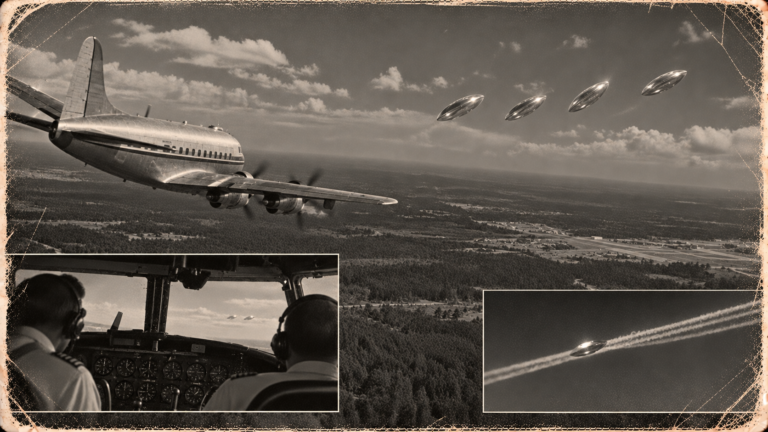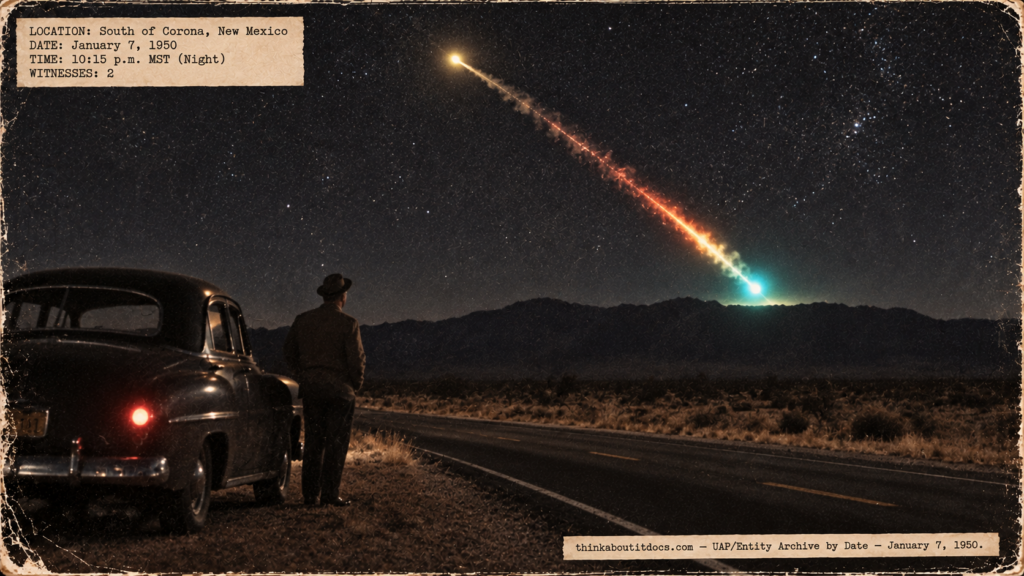
A Holloman AFB captain watched a ten-second fireball change from yellowish-white to orange to blue-green near Corona, New Mexico, on January 7, 1950.
THINK ABOUTIT UFO|UAP SIGHTINGS REPORT
1950: Corona New Mexico green fireball
At 10:15 p.m. on January 7, 1950, a Holloman Air Force Base captain driving south of Corona, New Mexico, saw a round ball of light about 45 degrees above the horizon begin to fall. It was yellowish-white at first, turned orange with a trail of flame streaming behind it, leveled off above a mountain range as a bright blue-green ball, and dropped out of sight, all in about ten seconds.
Ten seconds is long for one of the green fireballs of the Southwest, and in January 1950 the Air Force’s Office of Special Investigations was paying close attention: the fireballs over New Mexico’s atomic installations were an active worry, and a report from a Holloman officer, with a second witness at Carrizozo, went up the chain to Air Materiel Command. The Project Blue Book card that summarized the Corona, New Mexico green fireball is blunt about the answer: evaluated as a meteor.
Date: January 7, 1950
Sighting Time: 10:15 p.m. MST (2215 hours)
Day/Night: Night
Location: South of Corona, New Mexico, USA (34°13′ N, 105°35′ W; the file lists the two coordinates under reversed labels), seen from a moving automobile
Urban or Rural: Rural
No. of Entity’s: Not Applicable
Entity Type: Not Applicable
Entity Description: Not Applicable
Hynek Classification: NL (Nocturnal Light)
Duration: Approximately 10 seconds
No. of Object(s): 1
Description of the Object(s): A round, ball-shaped light that descended, changed color, leveled off and dropped behind a mountain range, with a trail of flame to its rear while it fell
Shape/Size/Color of Object(s): Round, ball-shaped; about the size of a cup 6 inches across at arm’s length; yellowish-white at first, more orange during the descent, then bright blue-green after leveling off
Distance to Object(s): Undeterminable
Height & Speed: First seen at 45 degrees elevation; descended at about 60 degrees to just above the horizon defined by the mountain range, then traveled about 10 degrees east before dropping out of sight; altitude undeterminable; speed about that of a fast jet fighter, slowing as it leveled off
Number of Witnesses: 2 (a Holloman AFB captain, the assistant motor maintenance officer, whose name is obscured in the file copy and given by NICAP as Risley; and Warren Ratliff, manager of the Mountain States Telephone & Telegraph Co. at Carrizozo, New Mexico, rated reliable)
Special Features/Characteristics: Flame trail during descent; color change from yellowish-white to orange to blue-green; leveling off before disappearing; no sound; no radar in operation at Holloman; no unusual weather; no test devices aloft
Case Status: Explained. Project Blue Book’s record card gives the conclusion “Astro (METEOR)” and states the case was evaluated as a meteor observation.
Source: AFOSI 17th District Report of Investigation (file 24-8-14), 19 January 1950, with the observer interviewed on 10 January 1950; Project Blue Book (Project 10073) record card; Loren E. Gross, UFOs: A History, 1950: January–March; NICAP 1950 UFO Chronology
Summary/Description: A Holloman AFB captain driving south of Corona, New Mexico, saw a round light fall at a 60-degree angle for about ten seconds, changing from yellowish-white to orange with a flame trail, then level off as a bright blue-green ball and drop behind a mountain range. A telephone company manager at Carrizozo was listed as a second witness. No radar was operating and no test devices were aloft. Blue Book evaluated it as a meteor.
Related Cases: Green fireballs over Los Alamos (January 9, 1950); Holloman AFB lights (January 6, 12 and 13, 1950); The Green Fireballs Begin (December 5, 1948); Starvation Peak, New Mexico (December 12, 1948)
Detailed Report
The Sighting
The observer, a captain who served as assistant motor maintenance officer at Holloman AFB, was interviewed by OSI on January 10, 1950. He was driving south of Corona, New Mexico, on the night of January 7 when he saw a ball of light at 45 degrees elevation. It descended at roughly a 60-degree angle toward the horizon, where a mountain range cut off the view. The light was yellowish-white when first seen, looked more orange during the descent, and trailed flame from its rear. When it leveled out just above the ridge it turned bright blue-green, traveled about ten degrees to the east and dropped behind the range. It was in view about ten seconds. The captain compared its size to a cup six inches across held at arm’s length, and said it fell at about the speed of a fast jet fighter and seemed to slow when it leveled off. He heard no sound.
The Observer and the Second Witness
OSI rated the captain’s ability to judge what he saw as average and his reliability as reliable. He told the agent he had noticed objects like this before, but had taken them for some natural phenomenon of no significance. The report lists a second witness, Warren Ratliff, manager of the Mountain States Telephone & Telegraph Company at Carrizozo, New Mexico, also rated reliable. The report does not set out Mr. Ratliff’s own account.
The Checks
The OSI agent checked with the Electronics and Atmosphere Research Branch at Holloman, which had no radar operating at the time; with the Base Weather Station, which recorded no unusual conditions; and with the Operations and Projects Division at Holloman and the Research Section at White Sands Proving Ground, both of which reported that no testing devices had been sent aloft in the area. The case was marked closed. The 17th OSI District at Kirtland AFB forwarded it to Air Materiel Command at Wright-Patterson on January 19, 1950, noting that reports of this kind from the West Texas, New Mexico and Arizona area were continuing.
The Blue Book Card
The Project 10073 record card lists one object seen for 10 seconds, ground-visual, descending to the east, no photographs and no physical evidence. Its conclusion is “Astro (METEOR),” with the note that the case was evaluated as a meteor observation, and its summary repeats the OSI description of the color change and the flame trail.
The Fireball Background
Loren Gross noted that the usual green fireball of the period streaked horizontally for only a few seconds, so ten seconds of visibility stood out. Dr. Lincoln LaPaz, in a February 20, 1950 letter quoted by Gross, divided the fireballs into two groups: most were meteorite falls of unusual size and frequency, and a minority, in his view, were U.S. guided missiles under test near sensitive installations. The Air Force’s Project TWINKLE, authorized in March 1950, was set up to photograph such objects. The Corona sighting predates it and was closed as a meteor.
RESEARCHER’S NOTES
A Ten-Second Fireball, Two Witnesses, and a One-Word Verdict
- The Meteor Verdict and What Sits Awkwardly With It: Blue Book’s meteor call rests on a bright descending ball that changes color and drops behind a ridge. What sits awkwardly with an ordinary meteor is the report’s own description: a ten-second duration, a leveling-off after a steep descent, and a slowing near the end. The file offers no discussion of these points.
- A Second Witness Who Isn’t Quoted: Warren Ratliff of Carrizozo is listed as a reliable witness, which means the sighting was not one man in a car. The report does not record what he saw or where he was, so the two accounts cannot be compared.
- The Checks Were Negative: Holloman had no radar running, the weather was normal, and neither the Operations and Projects Division nor White Sands had anything aloft. Those checks rule out the local sources the agents could think of. They do not test the meteor explanation.
- Coordinates With Swapped Labels: The report lists 34°13′ as longitude and 105°35′ as latitude. Those are clearly reversed, and the location matches the Corona area of central New Mexico.
- The Observer’s Name: The file copy obscures the captain’s name, and the OCR text is unreliable there. NICAP’s chronology gives the name Risley. This page uses the name only as NICAP’s attribution.
- The Wider Pattern: January 1950 has a cluster of Holloman and Los Alamos green and blue-green lights, including Los Alamos on January 9 and the Holloman airmen’s star-like light in the north on January 6, 12 and 13. Blue Book assigned that Holloman light to Canopus, Venus and Capella. The Corona ball is a different sort of report, a moving ball with a flame trail.
The Corona, New Mexico sighting is a vivid ten-second event, seen by a Holloman captain and listed with a second witness, that Project Blue Book closed as a meteor. It is filed here as Explained. The description in the OSI file, with its flame trail, its color change and its level-off, is what makes it worth reading, and the checks that agents ran are the reason this archive can state what it was not: not a radar target, not a weather effect, not a test device that Holloman or White Sands knew about.
“Evaluated as a Meteor observation.”
Project Blue Book (Project 10073) record card for the January 7, 1950 Corona, New Mexico sighting.