December 5, 1948 — two aircrews near Albuquerque, New Mexico, watched an unexplained green fireball, 22 minutes and dozens of miles apart — the opening night of a wave that would defeat astronomer Lincoln LaPaz's own investigation.
THINK ABOUTIT UFO|UAP SIGHTINGS REPORT
1948: The Green Fireballs Begin
On the night of December 5, 1948, two separate military aircrews over northern New Mexico watched a brilliant green fireball tear across the sky — 22 minutes and dozens of miles apart, too flat, too bright, and too strange to be a meteor. It was the opening night of a phenomenon that would haunt America’s nuclear weapons program for years: the Green Fireballs, a sustained wave of unexplained aerial lights concentrated almost exclusively around Los Alamos and Sandia Base, investigated in real time by one of the country’s leading meteor experts — who searched for wreckage again and again, and found nothing at all.
Date: December 5, 1948 (the phenomenon’s effective public/institutional onset; earlier “green flare” reports circulated locally from late November 1948)
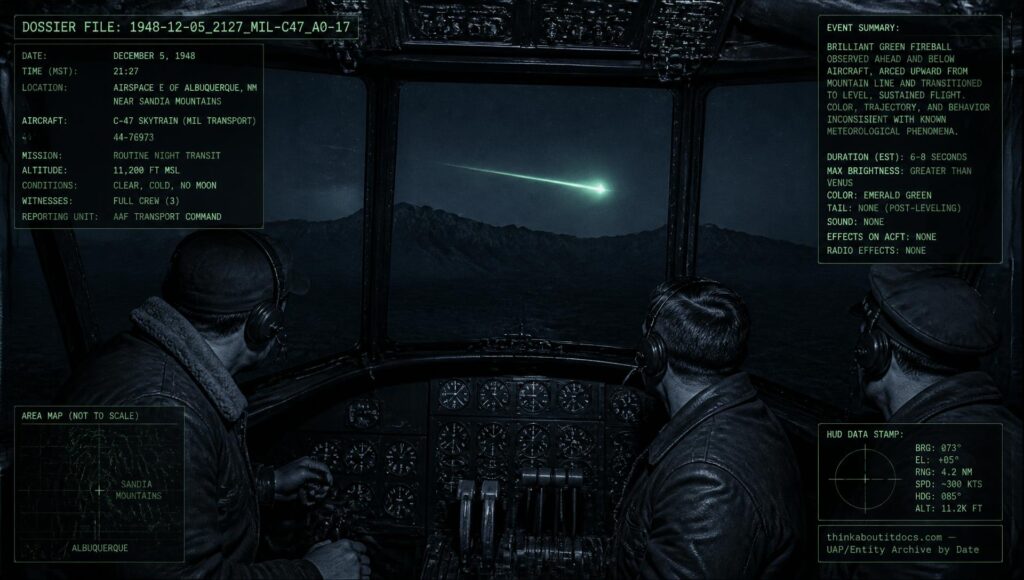
Sighting Time: 21:27 (first C-47 sighting); 21:05 (Las Vegas, NM sighting, 22 minutes earlier); 21:35 (Pioneer Airlines Flight 63 sighting)
Day/Night: Night
Location: Airspace over northern New Mexico, concentrated around Albuquerque, the Sandia Mountains, and Las Vegas, NM; the phenomenon’s broader wave centered on Los Alamos and Sandia Base, within 100 miles of both
Urban or Rural: Airborne over a mix of urban (Albuquerque) and rural northern New Mexico terrain
No. of Entity(s): Not Applicable
Entity Type: Not Applicable
Entity Description: Not Applicable
Hynek Classification: NL — Nocturnal Light, though the phenomenon’s institutional significance and sustained, investigated character set it apart from a typical single NL case.
Duration: The individual December 5 sightings each lasted seconds; the broader green fireball wave continued nightly for weeks through December 1948 and into 1949 and 1950
No. of Object(s): At least 2 separate fireballs on December 5 alone; Dr. LaPaz’s investigation determined 8 separate fireballs had been observed that single night across northern New Mexico
Description of the Object(s): A brilliant green fireball, larger and brighter than any meteor familiar to the experienced military aircrews who saw it, following a notably flat trajectory rather than the typical downward arc of a meteor; it started low near the eastern slopes of the Sandia Mountains, arched upward slightly, then leveled out — a flight profile inconsistent with a natural meteor.
Shape of Object(s): Fireball/spherical, meteor-like in general appearance but atypical in behavior
Size of Object(s): Described by the Pioneer Airlines crew as, at its largest apparent size just before evasive maneuvering, as big as or bigger than a full moon
Color of Object(s): Bright green, with the Pioneer Airlines crew specifically noting a color shift from orange-red to green as the object approached
Distance to Object(s): Close enough in the Pioneer Airlines encounter that the pilot believed a collision was imminent and executed a tight evasive turn
Height & Speed: The C-47 crew’s fireball was observed from 18,000 feet; a later December 12 fireball tracked separately by LaPaz was triangulated at an altitude of 8-10 miles and a horizontal speed of 39,000-43,000 mph — far exceeding any known aircraft or conventional meteor of the era
Number of Witnesses: On December 5 alone: a full C-47 aircrew (Capt. William Goede, copilot Maj. Roger Carter, and a flight engineer), the crew of Pioneer Airlines Flight 63 (Ernest Van Lloyd and James Smith), and dozens of additional independent civilian witnesses phoned in from across northern New Mexico overnight — LaPaz’s own investigation determined 8 separate fireballs had been seen and reported that single night
Special Features/Characteristics: The fireballs’ flight paths were consistently flatter and more level than natural meteors, which typically arc downward toward the earth; multiple witnesses across separate incidents specifically noted the complete absence of sound, which Dr. LaPaz himself later called “the most implausible feature of all,” given that meteorites bright enough to be seen at extreme distances typically produce audible sonic effects and widespread animal alarm reactions — neither of which reliably accompanied the green fireball sightings; Dr. LaPaz, an accomplished University of New Mexico meteoriticist with a proven track record of successfully triangulating and locating actual meteorite debris fields, applied his standard methodology to the green fireballs and repeatedly failed to locate any wreckage at the calculated impact sites, despite extensive searching; the fireballs were heavily concentrated geographically around two of the most sensitive nuclear weapons facilities in the United States — Los Alamos and Sandia Base — a pattern that alarmed military intelligence given the surrounding presence of radar stations, fighter-interceptor bases, and other high-security defense installations; the wave was sustained rather than a single incident, continuing nightly through December 1948 and persisting, in reduced but ongoing form, through 1949 and into 1950.
Case Status: Unexplained
Source: Brad Sparks; declassified FOIA case records; Edward J. Ruppelt, The Report on Unidentified Flying Objects, Doubleday, 1956, Chapter 4
Related Cases: 1948: December UFO|UAP & Entity Sightings Archive | 1948 Estimate of the Situation (institutional predecessor) | forthcoming Project Twinkle coverage (1949-1951, the classified Air Force investigation the green fireball wave directly prompted)
Detailed Report
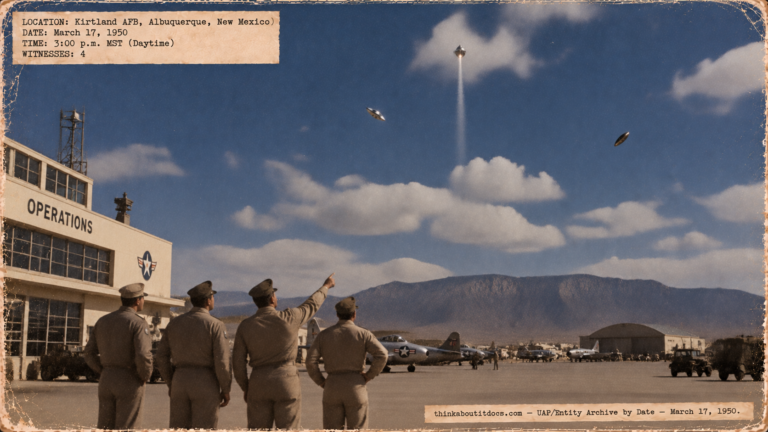
Scattered reports of “green flares” low on the horizon had begun circulating around Albuquerque, New Mexico in late November 1948, but the night of December 5 marked the phenomenon’s decisive shift into a matter of formal military and scientific concern. At 9:27 PM, a USAF C-47 transport, flown by Capt. William Goede with copilot Maj. Roger Carter and a flight engineer, was cruising at 18,000 feet roughly 10 miles east of Albuquerque when the crew was startled by a brilliant green ball of fire flashing across the sky ahead of them. It resembled a huge meteor in general character, except for its color and, more tellingly, its flight profile: rather than arcing downward as meteors typically do, it started low near the eastern slope of the Sandia Mountains, arched upward slightly, then leveled off into what looked like sustained flight.
Crucially, this was not the crew’s first such sighting that night. Twenty-two minutes earlier, they had seen an essentially identical green fireball near Las Vegas, New Mexico. After a hasty in-flight discussion, the crew decided the sighting was significant enough to report, and Captain Goede radioed Kirtland AFB’s control tower with a full account. Word was relayed to local intelligence officers.
Minutes later, an entirely independent report arrived from a different aircraft. Pioneer Airlines Flight 63, piloted by Ernest Van Lloyd with copilot James Smith, had also seen a green ball of fire near Las Vegas, New Mexico at 9:35 PM — this encounter considerably more alarming than the C-47’s distant sighting. Approaching the DC-3 nearly head-on, the object changed color from orange-red to green as it grew larger, close enough that Van Lloyd, convinced a collision was imminent, threw the aircraft into a tight evasive turn. The fireball then dropped toward the ground, dimming until it disappeared — at its largest, Van Lloyd estimated, as big as or bigger than a full moon.
By the time Pioneer’s DC-3 taxied up to the passenger ramp at Kirtland, intelligence officers were already waiting to interview the crew. Overnight, additional reports flooded in from across northern New Mexico, phoned in by dozens of independent civilian observers. By morning, a full investigation was underway — driven by more than curiosity: within 100 miles of Albuquerque sat Los Alamos and Sandia Base, the twin backbones of the American atomic weapons program, surrounded by radar installations, fighter-interceptor bases, and other high-security defense sites the military had no interest in seeing overflown by anything unidentified.
Because the fireballs superficially resembled meteors, Kirtland’s intelligence officers brought in Dr. Lincoln LaPaz, a University of New Mexico astronomer with an established record of successfully triangulating and physically locating genuine meteorite falls. LaPaz agreed to apply his standard methodology: using the carefully gathered directional, elevational, and timing data from the multiple December 5 witnesses, he attempted to calculate the fireballs’ true flight paths and project where any resulting debris should have landed. The December 5 wave was, in this respect, an unusually good dataset — witnesses across a wide area had independently reported consistent locations, directions, elevations, and times, allowing LaPaz’s team to determine that eight separate fireballs had actually been observed that single night, one of them bright enough and widely enough seen that LaPaz’s team could trace its apparent path from northern New Mexico across the state line into west Texas.
They searched the calculated impact area. They found nothing. They searched again. Still nothing. As LaPaz later recounted to Ruppelt directly, this repeated failure to locate any physical debris, despite a methodology that had worked reliably for him on genuine meteorite falls, marked the first time he seriously doubted that the green fireballs were meteorites at all. Within days, the fireballs were appearing almost nightly.
The wave that followed through the remainder of December 1948 only deepened the mystery. On December 8, two AFOSI special agents flying their own investigative aircraft encountered a green fireball directly, watching it shoot past them and apparently disintegrate into glowing fragments — a subsequent daylight aerial search of the presumed debris site again found nothing. On December 12, LaPaz himself, alongside two other officers, observed and precisely triangulated a fireball’s flight path near Starvation Peak, calculating a horizontal velocity of 39,000 to 43,000 miles per hour — a speed with no explanation in either conventional meteoritics or any known aircraft technology of 1948. Throughout, LaPaz emphasized what he considered the single most implausible feature of the entire phenomenon: the fireballs made no sound, despite being bright enough to be seen from as far as 400 miles in some cases — a scale of luminosity that, for a genuine meteor, would reliably produce an explosive report and trigger widespread animal alarm. Neither occurred.
RESEARCHER’S NOTES
A Meteor Expert Who Kept Finding Nothing
- On why LaPaz’s specific expertise makes this case unusual: Most anomalous aerial phenomena are assessed, if at all, by observers without specialized training in distinguishing them from natural events. This case is different: Dr. LaPaz was not a UFO investigator brought in after the fact to rationalize a mystery, but a credentialed meteoriticist with a demonstrated, successful track record locating real meteorite debris using the exact triangulation methodology he applied here. His inability to reproduce that success against the green fireballs — not once, but repeatedly, across multiple separate incidents in December 1948 alone — is a far more significant negative result than an equivalent failure by an untrained observer would represent.
- On the silence as the most analytically important detail: LaPaz’s own emphasis on the fireballs’ complete silence, despite their extreme brightness, deserves particular weight precisely because it came from him rather than from this archive’s own analysis. A trained meteor scientist singling out the absence of sound — rather than the color, the trajectory, or the speed — as the single most implausible element of the entire phenomenon is a specific, expert-level judgment about what does and does not fit known physics, not a layperson’s general sense of strangeness.
- On the significance of the phenomenon’s location: The green fireballs’ geographic concentration around Los Alamos and Sandia Base, rather than any random distribution across the American Southwest, is a pattern that alarmed military intelligence for a straightforward reason — whatever was producing the fireballs was doing so specifically in the airspace above two of the most closely guarded nuclear weapons facilities on Earth, at the height of the earliest Cold War atomic anxiety. Whether this concentration reflects genuine targeted interest in those facilities, a mundane factor specific to the region (unusual local atmospheric conditions, a nearby but unidentified conventional source), or simply a reporting bias from a population unusually attentive to unusual aerial activity given their proximity to sensitive installations, this archive cannot determine — but the pattern itself is not in dispute.
- On the phenomenon’s institutional legacy: The green fireball wave documented here directly prompted a formal, classified Air Force investigation, Project Twinkle, which ran from 1949 through 1951 and involved specialized camera stations specifically constructed to photographically triangulate future fireball events. That a single month’s sighting wave generated a multi-year, purpose-built federal investigation is itself a measure of how seriously the phenomenon was taken at the time — a seriousness this archive’s own account aims to reflect honestly.
Two aircrews, twenty-two minutes and dozens of miles apart, watched the same impossible green light tear across the New Mexico sky on a December night in 1948 — and by morning, the country’s most sensitive nuclear weapons facilities had a problem nobody could explain and nobody could find. Dr. Lincoln LaPaz brought the same tools that had always found him real meteorites. This time, again and again, they found him nothing at all. The green fireballs kept coming anyway — through the rest of that December, through 1949, and into a classified federal investigation that would run for years without ever settling the question LaPaz first asked himself on a cold desert road outside Bernal, New Mexico: what, exactly, had he been chasing?