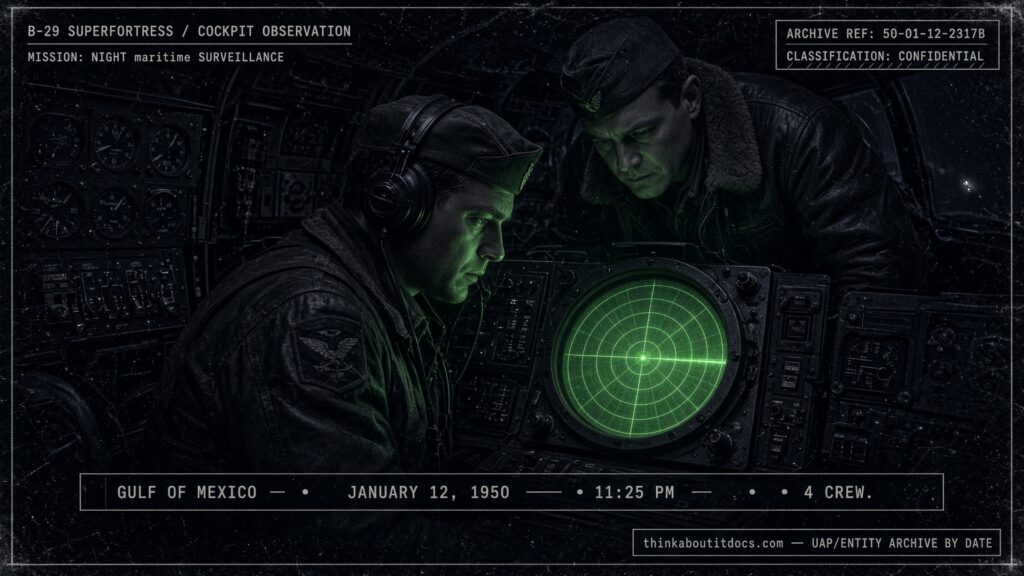
January 12, 1950 — a B-29 crew's 30-minute radar encounter over the Gulf of Mexico, including apparent hovering and post-encounter jamming.
THINK ABOUTIT UFO|UAP SIGHTINGS REPORT
1950: The Gulf of Mexico B-29 Radar Case
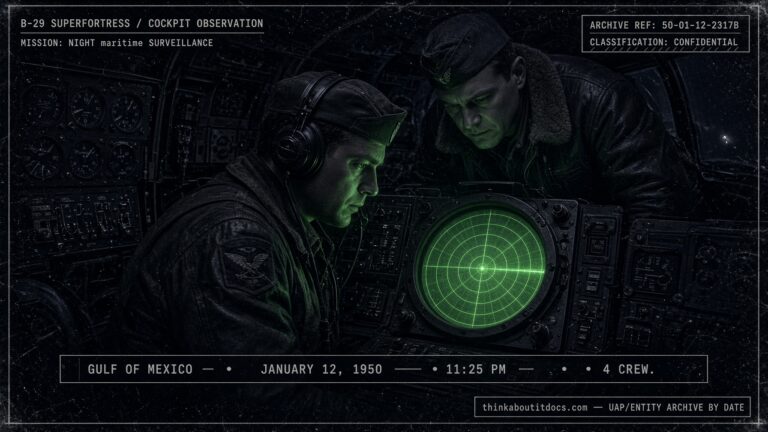
For thirty minutes over the Gulf of Mexico, a B-29’s entire crew watched an object outmaneuver their aircraft on radar — closing to within 20 miles twice, apparently hovering in place for up to 15 seconds at a stretch, and jamming their radar for ten minutes after it finally broke contact.
Date: January 12, 1950, BBU
Sighting Time: 11:25 p.m. (EST)
Day/Night: Night
Location: Over the Gulf of Mexico, aboard a USAF B-29 on a course of 260°
Urban or Rural: Not Applicable (over water)
No. of Entity(‘s): Not Applicable
Entity Type: Not Applicable
Entity Description: Not Applicable
Hynek Classification: RV (Radar/Visual) — radar contact only; no visual sighting of the object itself is described in the source
Duration: Approximately 30 minutes for the primary object; radar jamming continued about 10 minutes after contact was lost
No. of Object(s): 3 total (one persistent, joined briefly by two others)
Description of the Object(s): Large and well-defined on the radar scope at short range; no visual description is recorded, as the object was never confirmed visually
Shape of Object(s): Not visually determined
Size of Object(s): Not specified
Color of Object(s): Not Applicable (radar contact)
Distance to Object(s): Ranged from about 100 miles out to as close as 20 miles at two points during the encounter
Height & Speed: Estimated speed 2,500-3,000 mph; the object twice appeared to hover in place, with scope movement ceasing for 5-15 seconds at a time
Number of Witnesses: 4 (radar operator, aircraft commander, navigator, bombardier)
Special Features/Characteristics: Multi-Crew Radar Corroboration, Apparent Hovering Behavior, Attack-Pattern-Like Approach and Withdrawal, Multiple Radar Range Settings Confirmed the Contact, Post-Encounter Radar Jamming
Case Status: Unexplained
Source: Dan Wilson (Blue Book research)
Summary/Description: A USAF B-29 was flying over the Gulf of Mexico on a course of 260° when three objects were noted on radar orbiting the aircraft from all quadrants, seen independently by the radar operator, aircraft commander, navigator, and bombardier. One object was first picked up on a bearing of 330°, traveling south, crossing the scope in 15-20 seconds at the 100-mile range setting; within a few minutes it was joined by two others, which then disappeared. At shorter ranges the primary object appeared large and well-defined on the scope. Its flight pattern was described as going out to about 100 miles, turning, and coming back in “as if for an attack,” passing through the center of the scope and emerging on the other side, at an estimated 2,500-3,000 mph. The object remained on the scope for about 30 minutes, following the B-29 throughout; the radar operator confirmed the contact by switching between the 20, 50, and 100-mile range settings. Twice the object closed to within 20 miles of the aircraft and then appeared to hover, with scope movement ceasing for 5-15 seconds each time. After the B-29 altered course, the object no longer appeared on the scope, but the radar was jammed for approximately 10 minutes afterward.
Detailed Report
This case is unusual among 1950 radar cases in this archive for the number of independent crew positions that corroborated the same contact: the radar operator tracking the scope, plus the aircraft commander, navigator, and bombardier, each in a position to be briefed on or observe the unfolding contact. The deliberate range-setting changes — cycling between the 20, 50, and 100-mile scales — indicate an operator actively working to confirm a genuine contact rather than a fixed artifact or scope malfunction, which would typically behave differently across range settings.
The described flight profile — repeated outbound legs to about 100 miles, a turn, and a return pass through the aircraft’s position “as if for an attack” — is a specific, repeatable behavior pattern rather than a single ambiguous blip. The apparent hovering (scope movement ceasing for 5-15 seconds on two occasions) is difficult to reconcile with the extreme estimated speed (2,500-3,000 mph) attributed to the object during its transits, a tension the source record does not resolve.
The radar jamming reported immediately after the B-29 changed course, lasting about 10 minutes, is the case’s most concrete secondary data point: a specific instrument effect with a specific duration, rather than a vague claim of “interference.”
RESEARCHER’S NOTES
The Gulf of Mexico Radar Case — 1950 and the Limits of Radar-Only Evidence
- Classification issues/corrections: Filed as RV despite no visual confirmation of the object itself, since radar contact with described behavior (hovering, attack-pattern approach) is this archive’s basis for the RV tier even without a corresponding visual sighting.
- Source chain assessment: The account is attributed to Dan Wilson’s Blue Book research, without a specific cited document number in the source material reviewed for this report; the level of operational detail (range settings, bearings, timing) suggests derivation from an original incident report rather than a secondhand retelling, though this could not be independently confirmed.
- Pattern context/comparative cases: Multi-crew radar-only contacts with described maneuvering behavior are less common in this archive’s record than visual sightings; this case’s attack-pattern-like approach and apparent hovering both recur as motifs across other Cold War-era military radar cases without a settled explanation for either.
- Physical evidence/evidentiary weight: No photograph or independently recorded radar tape is documented. The case’s evidentiary weight rests on multiple crew positions corroborating the same scope behavior and on the operator’s active range-cycling to confirm the contact — a stronger basis than a single-witness account, but still short of independently verifiable physical evidence.
- Geographic/historical context: This case occurred amid a broader run of Gulf Coast and Gulf of Mexico military aviation activity in the early Cold War period; no source consulted for this report connects it to any other specific incident.
A radar contact corroborated by an entire bomber crew, cycling through range settings to confirm what they were tracking, followed by ten minutes of jamming the moment the aircraft changed course — this case offers more instrumented detail than most 1950 sightings in this archive, and no conventional explanation in the source record accounts for all of it.
“The object would go off for about 100 miles, turn and come in as if for an attack.”
Dan Wilson, describing the January 12, 1950 Gulf of Mexico B-29 radar case.