January 1958: USAF radar controllers at Eielson AFB tracked an object at 5,000+ mph on four independent radar systems over 4–5 hours. Intercept aircraft found only a temperature inversion ice cloud over Ladd AFB. Single-source retroactive witness account. Classified Explained.
THINK ABOUTIT UFO|UAP SIGHTING REPORT
1958: Object tracked on multiple radar flying at 5,000+ MPH
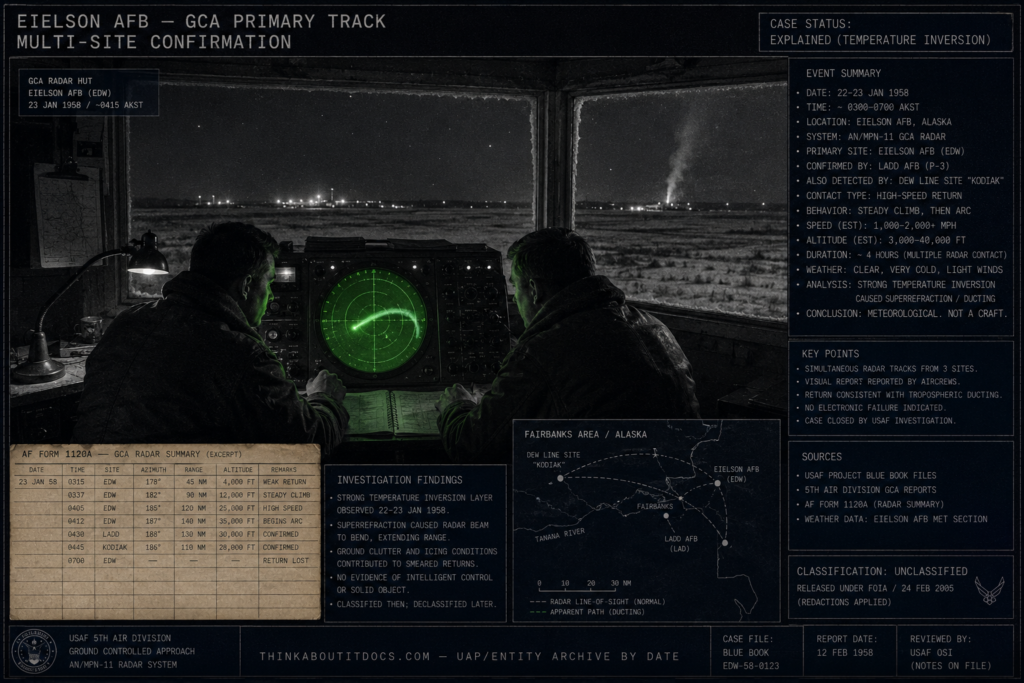
In January 1958, a USAF radar air-traffic controller at Eielson Air Force Base — one of the Cold War’s most sensitive reconnaissance hubs in interior Alaska — tracked an object on multiple independent radar systems executing maneuvers that no known aircraft could replicate: sustained speeds exceeding 5,000 mph and instantaneous 90-degree turns. The contact was confirmed by at least four separate radar installations over a four-to-five-hour period before intercept aircraft dispatched at dawn reported only an ice cloud hanging over the Ladd AFB power station.
The case rests entirely on the retroactive testimony of Gerald G. Flood, who reported the incident to UFOEvidence.org approximately fifty years after it occurred. His operational knowledge of the base, its aircraft, and its radar equipment checks out against the historical record, but no surviving contemporary documentation — shift logs, Blue Book files, or official reports — has surfaced to corroborate the account.
Date: January 1958 (witness also references “Jan/Feb 1958”)
Sighting Time: Approximately 2:00 AM – 7:00 AM
Day/Night: Night, extending into early morning
Location: Eielson Air Force Base, approximately 20 miles south of Fairbanks, Alaska
Urban or Rural: Military installation
No. of Entity(‘s): 0
Entity Type: Not applicable
Entity Description: Not applicable
Hynek Classification: RV (Radar/Visual)
Duration: Approximately 4–5 hours
No. of Object(s): 1
Description of the Object(s): A single radar target tracked on an AN/MPN-11 GCA search radar and confirmed by at least three additional independent radar installations. The target displayed sustained speeds exceeding 5,000 mph and instantaneous 90-degree turns. Not visually observed by the reporting witness at Eielson — radar contact only at that station. Intercept aircraft dispatched to the target’s apparent hover point over Ladd AFB found only an ice cloud (temperature inversion) above the base power station.
Shape of Object(s): Not visually observed by reporting witness (radar contact only at Eielson)
Size of Object(s): Not determined
Color of Object(s): Not applicable (radar contact)
Distance to Object(s): 15–50 miles (radar range)
Height & Speed: Maximum radar ceiling approximately 55,000 feet; target displayed speeds exceeding 5,000 mph with instantaneous 90-degree directional changes; also observed hovering stationary over Ladd AFB
Number of Witnesses: 20+ (multiple radar operators across four installations, plus intercept aircrew)
Special Features/Characteristics: Multi-site radar confirmation across four independent installations (Eielson GCA, Ladd AFB GCA, DEW Line station ~50 miles north, Army radar-directed AAA battery on Eielson). Target maintained extreme speed and maneuvering characteristics for 4–5 hours. Intercept aircraft (helicopter + T-33) found only an ice cloud at the target’s apparent hover location. Operators ordered not to discuss incident due to classified operations at Eielson.
Case Status: Explained
Source: Gerald G. Flood, self-reported via UFOEvidence.org (circa 2005–2006)
Summary/Description: A USAF GCA radar controller at Eielson AFB tracked an object at 5,000+ mph on four independent radar systems over a 4–5 hour period in January 1958. Intercept aircraft found only a temperature inversion ice cloud over the Ladd AFB power station. Single-source retroactive account filed approximately fifty years later by Gerald G. Flood, whose operational knowledge of the base checks out historically. The USAF attributed the event to anomalous radar propagation caused by extreme subarctic temperature inversion — a plausible explanation given interior Alaska’s winter conditions.
Related Cases: 1950: Kodiak, Alaska — Navy Radar/Visual | 1948: Unusual Sightings along Aleutian Chain
Detailed Report
Gerald G. Flood was a USAF Ground-Controlled Approach (GCA) radar air-traffic controller stationed at Eielson Air Force Base, roughly 20 miles south of Fairbanks, Alaska. Eielson in the late 1950s was a major staging point for Cold War reconnaissance operations, hosting rotations of Lockheed U-2 high-altitude spy planes, Douglas RB-66 Destroyer tactical reconnaissance aircraft, Convair RB-36 Peacemaker strategic reconnaissance bombers, and Boeing B-47 Stratojet medium bombers assigned to Strategic Air Command.
On a midnight shift in January or February 1958, Flood was working with two other operators when he observed a target on the unit’s AN/MPN-11 search radar — a mobile GCA system with an adjustable antenna that could be raised and lowered to refine altitude and distance readings, with a maximum effective range of approximately 20–30 miles and a ceiling of roughly 55,000 feet. The target appeared to be moving at speeds in excess of 5,000 mph and executing instantaneous turns of 90 degrees or more.
Flood alerted his teammates, who confirmed the contact. As the first unit to detect the target, Eielson GCA became the primary tracking station per USAF protocol. Flood’s team then coordinated with at least three additional radar facilities: the GCA unit at Ladd Air Force Base in Fairbanks (now Fort Wainwright / Fairbanks International Airport), a Distant Early Warning (DEW) Line radar station approximately 50 miles to the north, and an Army radar-directed anti-aircraft gun emplacement on the Eielson base itself. All four installations independently confirmed the target and its anomalous speed and maneuvering characteristics.
The operators continued tracking the object for several hours. When it appeared to hover over Ladd AFB, a helicopter and a Lockheed T-33 Shooting Star jet trainer were dispatched from Ladd to make a visual intercept. The aircrews reported that the only thing visible in the area was an ice cloud — a temperature inversion — hanging above the Ladd AFB power station. By that point the radar contact had ceased for approximately an hour.
Flood and his team documented the event in their shift log as required. He states that because of the highly classified reconnaissance operations conducted at Eielson during that period, they were ordered not to discuss the incident further. No follow-up interview was conducted.
Researcher’s Notes
A Credible Witness, a Single Source, and a Plausible Explanation
- Source Chain: This case exists entirely in Gerald Flood’s retroactive testimony, filed approximately fifty years after the event. No contemporary documentation has surfaced — no shift logs, no Blue Book case file, no Alaskan Air Command intelligence reports. The account was self-reported to UFOEvidence.org, a public-submission database, circa 2005–2006. Without corroborating records, the case cannot be independently verified.
- Witness Credibility: Flood’s operational knowledge is internally consistent and historically accurate. Eielson AFB did host U-2, RB-66, RB-36, and B-47 operations in the late 1950s, confirmed by USAF organizational histories and the documented presence of SAC and reconnaissance detachments at the base. The AN/MPN-11 was a standard USAF mobile GCA radar of the era. Ladd AFB was an active Army/Air Force installation in Fairbanks. DEW Line stations and anti-aircraft emplacements were positioned in the Fairbanks defense complex during this period. Flood’s claim of congressional testimony on fire suppression following the 1996 ValuJet Flight 592 disaster provides a verifiable identity anchor, though it has not been independently confirmed for this report.
- The Temperature Inversion Explanation: Interior Alaska in January regularly experiences extreme temperature inversions, with surface temperatures plunging to -40°F or below while warmer air layers sit aloft. These conditions are well-documented as a source of anomalous radar propagation — radar beams refracted by sharp temperature gradients can produce false returns that appear to move at extreme speeds, change direction instantaneously, and persist for hours. The effect can simultaneously affect multiple radar systems operating in the same atmospheric environment. The intercept aircraft’s confirmation of an ice cloud over the Ladd power station — exactly the kind of localized thermal plume that would intensify inversion effects — supports this explanation. The USAF’s attribution of the event to temperature inversion is consistent with known atmospheric physics for subarctic conditions.
- Classification Rationale: This case is classified Explained based on the USAF’s contemporary determination and the strong environmental candidacy of subarctic anomalous propagation. The multi-radar confirmation, while initially compelling, does not rule out the inversion explanation — all sites operated under the same atmospheric conditions. The visual intercept found no anomalous object. The witness disputes the explanation but provides no technical rebuttal beyond the implicit argument that trained operators should have recognized weather returns. Experienced radar operators of the era were indeed trained to distinguish weather clutter, but extreme subarctic inversions can produce returns with characteristics unlike typical weather artifacts.
The case is retained in the archive as a documented military radar event with a named, credentialed witness, even though the explanation is conventional. Flood’s account preserves institutional details about Cold War radar operations at Eielson that have independent historical value.
Gerald Flood’s account stands as a single-source retroactive military witness report of a multi-radar event at one of the Cold War’s most operationally sensitive installations. The USAF’s temperature inversion explanation is the cleanest mundane candidate and is consistent with the extreme atmospheric conditions of interior Alaska in midwinter. What survives is not evidence of an anomalous object but a detailed firsthand description of how such events were handled — and suppressed — at classified Cold War facilities.
Source
I was a US Air Force GCA radar air traffic controller working a midnight shift with 2 other people. This was in Jan/Feb 1958 at Eilson AFB, 20 miles south of Fairbanks Alaska. Our principal duties at this base was to host several types of recon aircraft including U-2’s, RB 66’s, RB 36’s and a group of SAC B 47’s. About 2-3 am I observed a target on our search radar (MPN-11) which was able to fly over 5,000 mph and make turns instantly of over 90 degrees! I called my team mates and we all observed the target.
We contacted other radar sites including the GCA site @ Ladd AFB in Fairbanks, a Dew line radar station about 50 miles north and even an Army radar directed Anti aircraft gun site on our base. All confirmed the sightings including the radar guns which tracked the target. Air Force practice is that the first contact (us0 becomes the primary and all other sites coordinate through us.
Our search radar antenna could be both raised and lowered and gave us a max range of about 20-30 miles and 50-55,000 feet. This feature enabled us to more accurately tell height and distance from our sight. The target continued to stay in the area and we continued to follow it within the limitations of our equipment. As the primary contact, we received reports from the others who would confirm the extreme speed and turns of the target when it was out of our range.
We continued to track the target and observe its speed and turning until about 6-8 am when both a helicopter and a T33 from Ladd AFB (now Fairbanks Int’l) where dispatched to visually inspect since the target seemed to be hovering over Ladd AFB. We couldn’t believe our ears when they reported that all they observed was an ice cloud(temperature inversion) over the Ladd AFB power station!
At that time, we had observed nothing for an hour or so. We were required to write up all the details on our shift log before we signed off our shift. Because of the extremely secret operations conducted at Eilson AFB during that period, we were told to shut up and not discuss any further. Since I was a 20 year old kid directing spy planes during the Cold War, I didn’t argue. We were never interviewed again about the incident.
Personal Background
I was an AF air traffic controller rated to work both tower and GCA (radar) form 1956 -1960. After that date, I worked in a variety of occupations mainly sales. I am currently semi retired and operate my own fire suppression company. I was on the FAA task group for cargo bay fire suppression and testified in the U.S. Congress regarding aircraft fire suppression after the ValuJet tragedy.
Reported Sighting? Yes
Reported To: USAF
Name: Gerald G. Flood
Location: Birmingham, Michigan USA
Age: 67