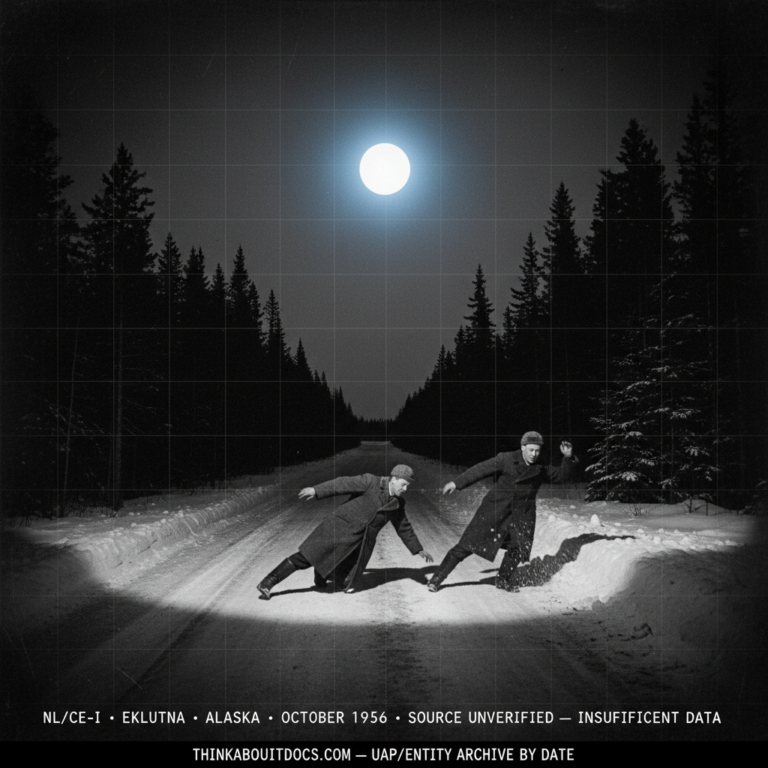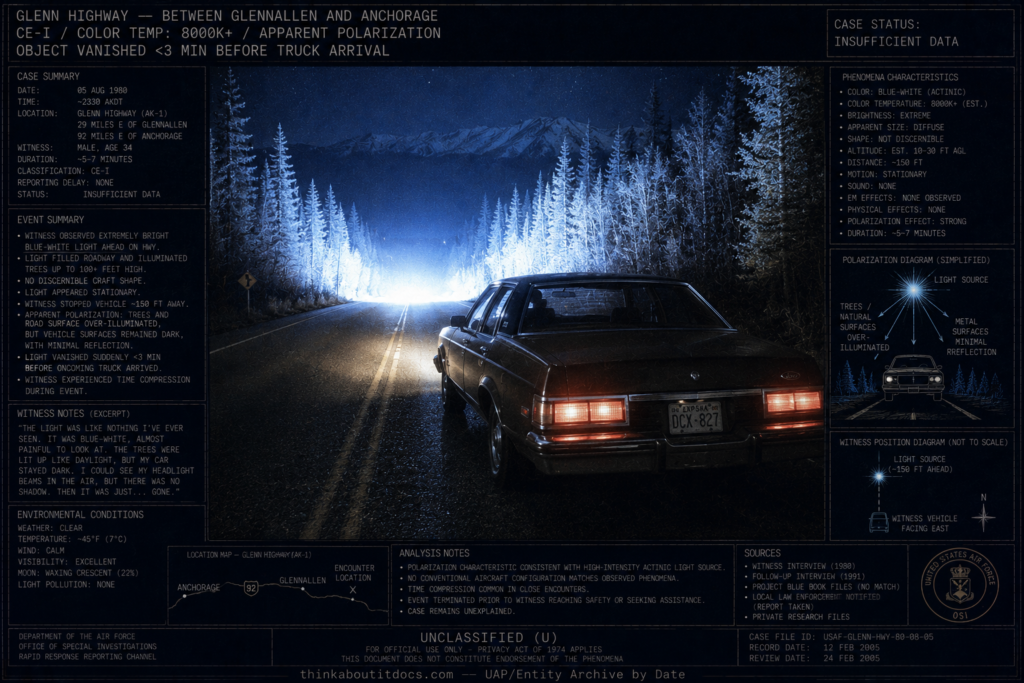
August 5, 1980: A stationary wall of actinic blue-white light with apparent polarization sat on the Glenn Highway between Glennallen and Anchorage, blinding witnesses at 150 feet. It vanished without trace before a semi-truck reached the spot. CE-I — Insufficient Data.
THINK ABOUTIT UFO|UAP SIGHTING REPORT
1980: Glennallen, Alaska UFO Sighting
On August 5, 1980, at least two people driving from Glennallen to Anchorage on a remote stretch of the Glenn Highway encountered a stationary light source on the road so blindingly brilliant — an actinic blue-white with a color temperature the witness estimated above 8,000 Kelvin — that it destroyed their dark-adapted vision and forced them to a complete stop at approximately 150 feet. The witness noted that the light intensely illuminated the surrounding trees but reflected only weakly off the car’s metal surfaces, suggesting some form of polarization. The light vanished without trace before an approaching semi-truck reached its location, and a return visit later that week found nothing on the pavement.
Date: August 5, 1980
Sighting Time: 11:15 PM
Day/Night: Night
Location: Glenn Highway between Glennallen and Anchorage, Alaska (remote wilderness section)
Urban or Rural: Rural
No. of Entity(‘s): 0
Entity Type: Not applicable
Entity Description: Not applicable
Hynek Classification: CE-I (Close Encounter of the First Kind) — close-range visual observation of an unidentified luminous object without verified physical traces
Duration: Approximately 15–20 minutes total across multiple approaches and observations
No. of Object(s): 1
Description of the Object(s): A painfully brilliant, unwavering light source sitting on or just above the road surface. At close range (150 feet) it appeared to be a uniform rectangular source approximately 30 by 20 feet. From the hilltop vantage point (approximately 2.5 miles away and several hundred feet above), it appeared oval. The light had a color temperature the witness estimated at 8,000 Kelvin or higher — an actinic blue-white. The witness observed that the light intensely illuminated trees along the road for as far as line-of-sight carried, but reflected off the car’s metal surfaces only weakly, which he interpreted as evidence of polarization. The light produced no audible sound.
Shape of Object(s): Rectangular at close range (approximately 30 × 20 feet); appeared oval when viewed from above and at distance
Size of Object(s): Approximately 30 feet by 20 feet
Color of Object(s): Actinic blue-white (estimated color temperature 8,000K+)
Distance to Object(s): Approximately 150 feet at closest approach; approximately 2.5 miles from hilltop observation point
Height & Speed: Stationary — sitting on or immediately above the road surface; the witnesses described it as an “Unidentified Sitting Object”
Number of Witnesses: At least 2 (the narrator consistently uses “we” throughout; additional passengers possible but not specified)
Special Features/Characteristics: Apparent polarization of light output — trees illuminated intensely but car metal reflected light only weakly. Object vanished completely between the time the witnesses last confirmed it from the hilltop and the time they returned to its location following a semi-truck, a window of less than three minutes. No debris, marks, or residue found on the pavement on a return visit later that week. Multiple high-beam flashes from the witnesses’ vehicle produced no response or change. Witnesses reported the car was “bumped” or “jostled” during their second close approach, but acknowledge this occurred during extreme adrenaline response.
Case Status: Insufficient Data
Source: NUFORC (National UFO Reporting Center) — filed approximately 20 years after the event (circa 2000–2001)
Summary/Description: Two or more people driving the Glenn Highway at night encountered a stationary, blindingly bright blue-white light source on the road in a remote wilderness area. They approached to within 150 feet, observed it for approximately five minutes, fled at high speed, returned to observe from a hilltop, and ultimately followed a semi-truck back to the location — where the light had vanished without trace. The witness’s technical observations (color temperature, apparent polarization) suggest scientific literacy. Filed to NUFORC approximately twenty years after the event. No physical evidence was found on a return visit.
Related Cases: 1988/89: Homer, Kenai Peninsula — Jumping Light | 1958: Eielson AFB Multi-Radar Tracking
Detailed Report
On the night of August 5, 1980, at least two people were driving from Glennallen toward Anchorage on the Glenn Highway. From a high ridge approximately 2.5 miles away and several hundred vertical feet above the valley floor, they observed a very bright light apparently on the road below. As they descended the ridge, they lost sight of the light. The road at the bottom of the hill made an approximately 90-degree right turn, then climbed perhaps 30 feet vertically over a quarter-mile before the light became visible again.
The light was so intensely bright that it destroyed the witnesses’ dark-adapted vision, forcing them to slow progressively and finally stop completely at approximately 200 feet. Multiple flashings of their high beams produced no response. They crept forward in small increments to approximately 150 feet from the light source and waited roughly five minutes for it to change in some manner.
During this close observation, the narrator made several technical observations: the light had a color temperature he estimated at 8,000 Kelvin or higher — an actinic blue-white. He noted that the light illuminated trees along the road for as far as line-of-sight carried, but reflected off the car’s metal surfaces only weakly. He interpreted this differential as evidence that the light was somehow polarized — a technically specific observation that distinguishes this account from typical bright-light reports. The object appeared to be a uniform rectangular source approximately 30 by 20 feet at close range.
As the strangeness of the situation became fully apparent, the witnesses’ irritation turned to fear. They backed up approximately 50 feet, approached again slowly, then panicked. During the second approach, they felt the car was “bumped” or “jostled” — though the narrator acknowledges this occurred during an extreme adrenaline response and may not have been physically real. They turned the car around and fled at speeds exceeding 90 mph.
After traveling approximately five miles away from the light, they pulled over and considered contacting the Alaska State Troopers. Instead, deciding they had been cowardly, they returned to the hilltop to observe the light from a safe distance. It was still there. They watched for what felt like a long time, attempting to make systematic observations — the stadium-brightness, the color temperature, the rectangular-at-close-range-but-oval-from-above apparent shape change.
They decided to return to Glennallen. Within two minutes, they encountered a large semi-truck heading toward Anchorage at approximately 65 mph. They stopped, let the truck pass, then followed it. From the hilltop, they could still see the light, less than three minutes away by truck. They followed the rig down the hill, around the 90-degree turn, and to the exact location — where nothing was there. They scanned the area but stayed close to the truck. No lights, no objects, nothing. They continued toward Anchorage and passed several oncoming cars within the next five minutes without seeing anything remotely resembling the light.
On a return trip later that week, the narrator personally walked the pavement at the location. He found nothing out of the ordinary — no marks, no residue, no scorching, no debris.
Researcher’s Notes
The Glenn Highway Light — Glennallen 1980 and the Technically Literate Observer
- Source Chain and Witness Credibility: This is a NUFORC filing submitted approximately twenty years after the event. The witness is anonymous but demonstrates unusual technical literacy for a UFO report — his observations about color temperature (8,000K+ actinic blue-white), apparent polarization (trees lit but metal not reflecting proportionally), and shape-versus-distance effects are specific, un-embellished, and consistent with someone who has at least a working understanding of optics or lighting. The narrative tone is self-critical: the witness calls their flight “embarrassing” and “cowardly,” acknowledges the adrenaline-compromised nature of the “bump” perception, and apologizes for inaccuracies after twenty years. These are credibility markers. The multi-witness element (consistently “we” throughout) adds weight, though no second witness has filed a report.
- Mundane Candidates: The most frequently proposed mundane explanations for bright stationary lights on remote roads include road construction equipment with high-intensity work lighting, military vehicles or equipment, and natural phenomena such as ball lightning. The construction hypothesis is weakened by the August 5 date (peak highway season, but the witness describes this as a truly remote stretch with no other traffic in either direction), the absence of any equipment noise, and the complete disappearance within minutes. Ball lightning, while theoretically possible, does not typically produce sustained, unwavering illumination of this brightness and duration (15+ minutes of observation). The polarization observation, if accurate, is particularly difficult to explain with any conventional light source — selective illumination of organic surfaces over metallic ones is not a characteristic of any standard industrial or natural light. No satisfying conventional explanation has been proposed.
- Assessment: This is one of the more analytically interesting cases in the Alaska file despite its single-source, decades-late reporting. The witness’s technical observations — particularly the polarization detail and the color-temperature estimate — elevate it above a standard bright-light report. The object’s clean disappearance in a sub-three-minute window before a truck arrival, with no trace found on a return visit, eliminates many mundane candidates. However, the twenty-year filing delay, the anonymous reporting, and the absence of any corroborating witness report or physical evidence prevent a classification above Insufficient Data. The case is retained as a notable CE-I with anomalous optical characteristics, pending any future corroboration.
Two people stopped their car on a dark stretch of the Glenn Highway and stared at something on the road that shouldn’t have been there — a wall of actinic blue-white light that lit up the trees for miles but barely touched the metal of their car. They fled, came back, watched it from a hilltop, and then followed a semi-truck straight to the spot where it had been. Nothing. No light, no marks, no trace. The witness walked the pavement later that week and found the same answer: nothing. What sat on that road on August 5, 1980 left no evidence it had ever been there except two people’s memory of something they couldn’t explain, written down twenty years later.