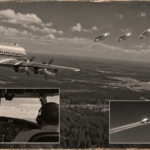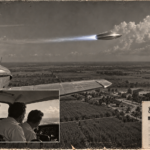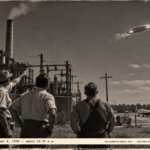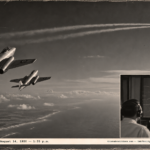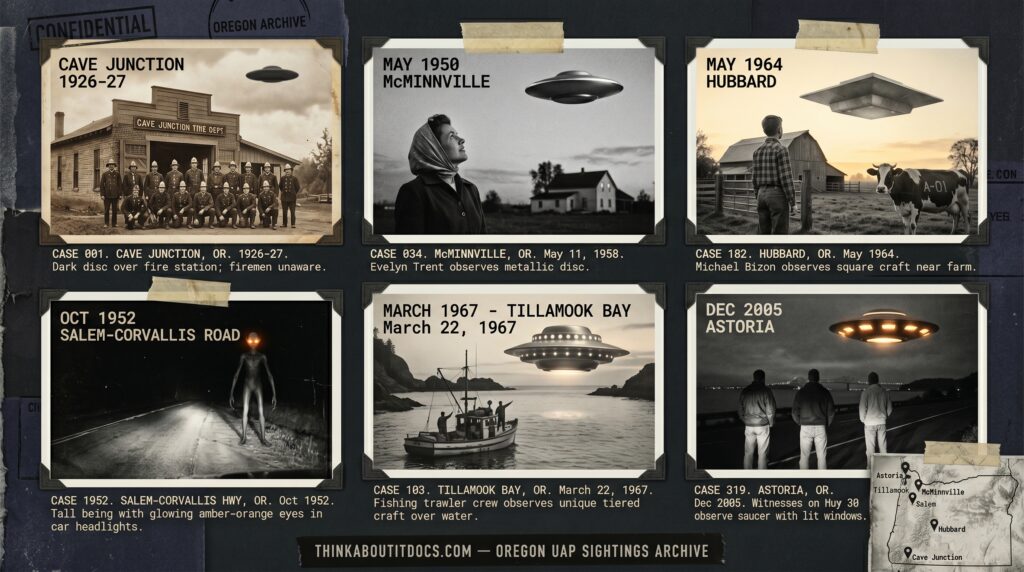
Oregon UAP archive: Cave Junction Josephine County pre-1947 firemen photograph c.1927, McMinnville Yamhill County Trent photographs May 1950 (Condon Committee unresolved, 75 years unrefuted), Salem-Corvallis Willamette Valley 8-foot roadside entity October 1952, Hubbard Marion County square-craft CE-II with Deputy Sheriff official sketch May 1964, and Astoria Coast Range saucer-with-windows December 2005. 13 documented cases 1927–2014.
Oregon UFO|UAP & Alien Sightings Archive
Oregon holds a distinction shared by no other state in the archive: three separate UAP photographic records spanning twenty-three years, each independently significant, together forming the most concentrated photographic evidence cluster in the pre-modern and early modern UAP record for any single state. The Cave Junction photograph, taken by volunteer firemen in Josephine County around 1926 or 1927, shows a dark disc-shaped object above a group of men posing in front of their fire station — a pre-1947 group photograph with an unintended aerial anomaly documented by named community witnesses before any cultural framework for flying saucers existed. The Rogue River disc, observed on May 24, 1949 by aeronautical laboratory employees and documented in Project Blue Book Special Report #14, brings the state’s photographic record into the formal institutional response era with a case that carried enough credibility to earn a named Blue Book entry. The McMinnville photographs of May 11, 1950 — taken by Paul and Evelyn Trent on their farm in Yamhill County and subsequently analyzed by the Condon Committee, the Ground Saucer Watch, and independent photogrammetric experts over seven decades — remain among the most rigorously examined UAP photographic evidence in the record. The Condon Committee’s own analysis, despite its institutional mandate to debunk, concluded the McMinnville images showed a real, distant, solid object and could not be explained as a hoax or misidentification by the photographic evidence. No subsequent analysis has overturned that finding.
The state’s 1952 record adds a distinct and underappreciated dimension: three separate entity encounters within the Willamette Valley corridor in a single two-month window. September 1952 brought three white, amorphous Shmoo-shaped figures crossing a rural road in Central Point in front of a car, forcing the driver to stop. October 1952 produced an eight-foot man with glowing eyes standing on the road between Salem and Corvallis. The Hubbard, Oregon case of May 1964 — a square-shaped craft observed by a boy and his cow at 7:30 AM, with an official sketch by Deputy Sheriff Shirlie H. Davidson — documents law enforcement involvement at the investigative level. The Astoria saucer with windows (December 30, 2005) adds a CE-I with three witnesses and a structured craft description to the modern file. Oregon’s thirteen cases span eighty-seven years, distribute across the Willamette Valley, the Rogue River Valley, the Coast, and the High Desert, and carry a photographic evidence density unmatched in the national state-level archive.
- 193?: Large” Ball Of White Light Overhead
- 193?: West Virginia Red Glowing Fireballs
- 1952: Allen, West Virginia Abduction
- 1952: Charleston West Virginia Sighting
- 1952: Creature in Weston West Virginia
- 1952: Pointy-Head Alien in Sutton, West Virginia
- 1952: The Flatwoods Monster
- 1952: Wheeling West Virginia Monster
- 2013: Big Foot Spotted in West Virginia
- 2014: Close Encounter in West Virginia
- 1952: The Frametown, West Virginia Encounter — The Day After Flatwoods
EXECUTIVE SUMMARY
The Photography State — Oregon’s Pre-Modern Visual Evidence Record
Oregon’s UAP archive is defined by its photography. The three-photograph sequence — Cave Junction 1927, Rogue River/Blue Book 1949, McMinnville 1950 — represents a twenty-three-year run of visual documentation that predates or coincides with the earliest years of the modern UFO era and provides the state’s analytical core. The McMinnville case is the national benchmark. The Trent photographs were submitted to the Condon Committee in 1968 and emerged as one of the handful of cases the Committee’s own analysts found genuinely unresolved — a finding that the Committee’s politically motivated negative conclusion attempted to bury but could not eliminate from the scientific record. The Ground Saucer Watch’s computer enhancement analysis in the 1970s confirmed the objects as genuinely distant and three-dimensional. Subsequent independent photogrammetric work has estimated the objects’ size at roughly the scale of a small aircraft based on the shadow geometry and the Trents’ farmyard reference elements. After seventy-five years of scrutiny, the McMinnville photographs remain unrefuted by the physical evidence record.
The 1952 Willamette Valley entity cluster — three independent CE-III reports from the same geographic corridor within approximately two months — is Oregon’s most analytically underappreciated feature. The Central Point three-entities-crossing-a-road event and the Salem-Corvallis eight-foot glowing-eyes roadside encounter are both from the same dense wave period that produced the Flatwoods Monster in West Virginia, the Sutton and Weston creatures, and dozens of other entity reports nationally in August through October 1952. Oregon’s contribution to that wave is documented on the archive but rarely analyzed in the national pattern context. The 1964 Hubbard case with the Deputy Sheriff’s official sketch adds law enforcement documentation to the state’s physical evidence thread. Oregon’s thirteen-case archive is lean by count but exceptionally deep in evidentiary quality — three photographs, one Blue Book entry, one law enforcement sketch, and a 1952 entity cluster that places the state squarely in the most anomalously active period in the modern record’s first decade.