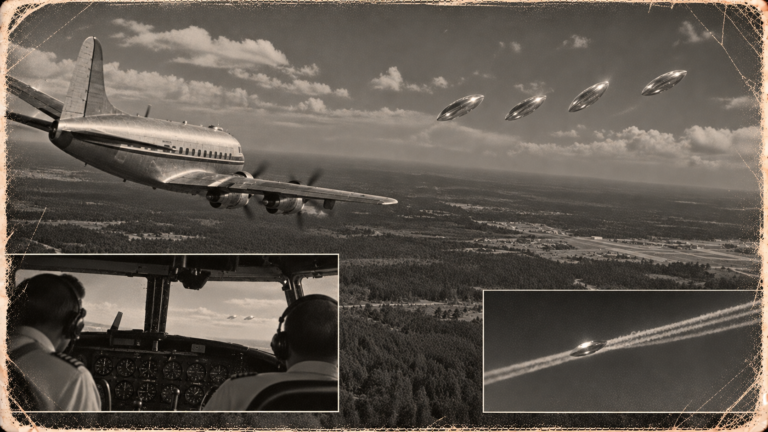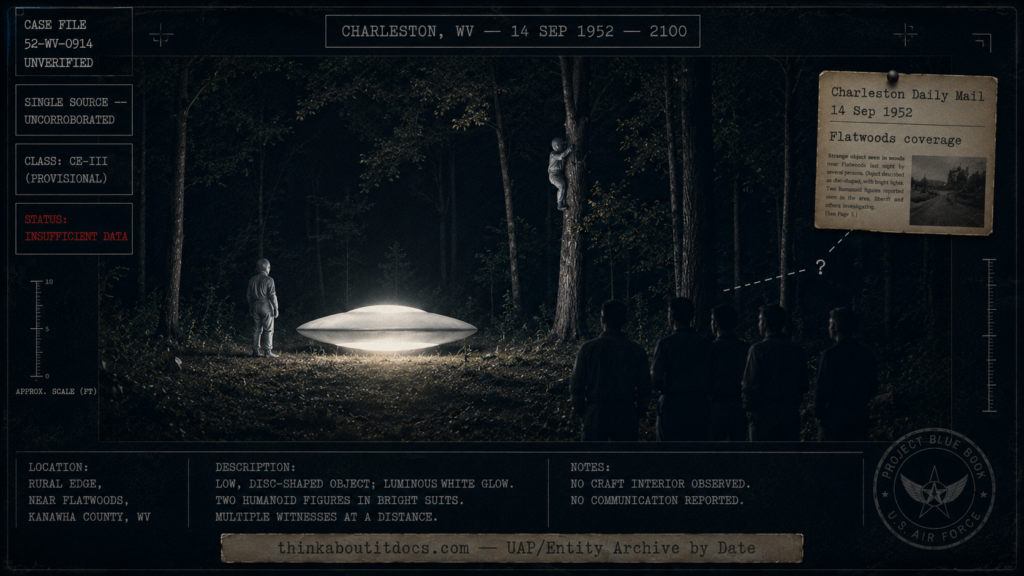
The reported September 14, 1952 Charleston, West Virginia encounter — logged as uncorroborated and Insufficient Data, with its date tying it to the Flatwoods Monster news cycle. (thinkaboutitdocs.com — UAP/Entity Archive by Date)
THINK ABOUTIT UFO|UAP|ENTITY SIGHTINGS REPORT
1952: Charleston West Virginia Sighting
It is one of the strangest occupant reports of the 1952 wave — a luminous white disc setting down outside the West Virginia capital, two figures in bright suits stepping out and, of all things, climbing a tree — and it may not be a separate event at all. The lone date attached to it, September 14, 1952, is the very day the Charleston Daily Mail splashed the Flatwoods Monster across its pages, two days after that encounter and one county away. The archive logs the report because it sits in the chronological record under a named source, but the honest finding comes first: it cannot be corroborated, the cited volume does not appear to carry it as a distinct Charleston sighting, and what survives is a single thin entry that may be an echo of the louder story breaking around it.
Date: September 14, 1952
Sighting Time: 2100 (9:00 PM)
Day/Night: Night
Location: Charleston, West Virginia (no specific sub-location recorded)
Urban or Rural: Not clearly recorded; Charleston is the state capital, while the report implies a wooded setting
No. of Entity(‘s): 2
Entity Type: Humanoid (reported craft occupants)
Entity Description: Two men described as wearing bright suits, reported to have emerged from the object and climbed a nearby tree
Hynek Classification: CE-III (Close Encounter III) — animate beings associated with the object; provisional, as the report is uncorroborated
Duration: Not recorded
No. of Object(s): 1
Description of the Object(s): A luminous white, disc-shaped object reported to have descended and landed in a rural area, allowing close observation of its occupants before the encounter ended
Shape of Object(s): Disc
Size of Object(s): Not recorded
Color of Object(s): Luminous white
Distance to Object(s): Not recorded
Height & Speed: Not recorded
Number of Witnesses: Several (not named or enumerated in available sources)
Special Features/Characteristics: Reported occupant behavior — two figures climbing a tree — is an unusual motif in the occupant literature; no craft departure, duration, or witness names preserved in available summaries
Case Status: Insufficient Data
Source: Attributed to Loren E. Gross, “UFOs: A History,” 1952 (September–October); not independently corroborated in the catalogs or in the cited volume’s index (see Researcher’s Notes)
Summary/Description: A report attributed to the Gross compilation places a luminous white disc on the ground near Charleston, West Virginia, on the night of September 14, 1952, with two occupants in bright suits emerging and climbing a nearby tree before the encounter ended. The report carries no named witnesses, no duration, and no recorded departure, and could not be corroborated against independent sources. Its date coincides exactly with the Charleston newspaper’s Flatwoods Monster coverage, raising the possibility that it is a derivative of that story rather than a separate event.
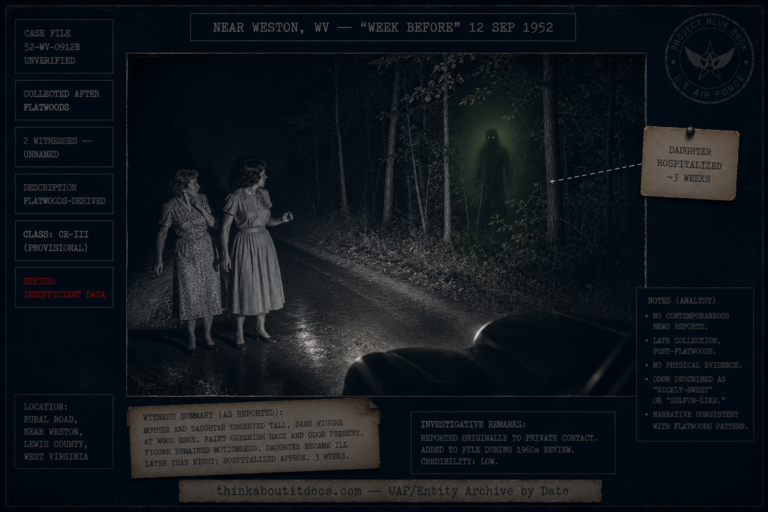
Related Cases: 1952: The Flatwoods Monster (Sept 12, WV) | 1952: Creature in Weston, West Virginia | 1950: Oscar Linke / Hasselbach, Germany (two men in silvery suits beside a landed disc) | the broader 1952 UFO wave occupant reports
DETAILED REPORT
As it has come down through the literature, the encounter is brief and vivid. On the night of September 14, 1952, during the most intense UFO wave the country had yet seen, several witnesses near Charleston, West Virginia, are said to have watched a luminous white, disc-shaped object descend and come to rest in a rural area. From the glowing craft two figures emerged, described as wearing bright suits. Rather than approaching the witnesses or examining the ground — the behavior recorded in most landing-and-occupant cases — the two men reportedly climbed a nearby tree. The witnesses are said to have watched from a distance until the encounter ended. No duration, no manner of departure, and no witness names survive in the available summaries.
That is the whole of it, and the thinness is the point. The report carries the marks of a catalog fragment rather than an investigated case: a date, a place name, a craft, two occupants, one odd action, and nothing else. The tree-climbing detail is genuinely unusual and is the only element that gives the entry any distinctiveness, but distinctiveness is not corroboration.
The verification problem is serious. The case is attributed to Loren E. Gross, whose multi-volume “UFOs: A History” is a respected day-by-day chronology assembled largely from period newspaper clippings. But the index to the relevant Gross volume — September–October 1952 — lists “Charleston, W. Va.” only as the home of the Charleston Daily Mail, the paper that reported the Flatwoods Monster, and not as the site of a separate disc-and-occupant landing. No independent occupant catalog surfaced carries a Charleston tree-climbing case for that date, while the same catalogs carry Flatwoods (September 12) in detail. And the single date attached to the Charleston report, September 14, is precisely the date the Daily Mail ran its Flatwoods coverage. Taken together, these point to a real possibility that the “Charleston sighting” is a confused derivative of the Flatwoods reporting — a story that traveled, shed its origins, and acquired a new location and a new detail along the way.
None of that is proof the event did not happen. Gross logged many obscure items, and a small local report could exist in the full text that a search of the catalogs and the volume index does not surface. But on the evidence that can actually be examined, there is not enough here to call this a solid unexplained encounter. It is logged, dated, and sourced — and explicitly marked as uncorroborated.
RESEARCHER’S NOTES
The Charleston Phantom — West Virginia 1952 and the Limits of a Single Source
- Classification, held but provisional: CE-III correctly describes the type of report — animate beings associated with a landed craft at close range — and so it stays as the nominal class. But a Hynek class describes the claim, not the reliability of the event behind it, and that distinction matters here. With no named witnesses, no investigation, and no corroboration, the CE-III label should be read as “this is the kind of report it would be if it occurred,” not as a vouched-for close encounter. The classification and the Insufficient Data status are doing two different jobs, and both are needed to describe this entry honestly.
- Source-chain assessment, the core problem: The attribution is to a credible compiler, Loren Gross, but the chain breaks on inspection. The index to the cited Gross volume carries Charleston only as the location of the Charleston Daily Mail — the Flatwoods paper — not as a sighting site, and no independent occupant catalog corroborates the Charleston tree-climbing report for September 14, 1952. The previously published version of this page compounded the weakness by citing “the initial NUFORC summaries,” an impossibility for a 1952 case since NUFORC was not founded until 1974; that anachronism and the page’s interpretive padding have been removed. What remains is a single uncorroborated entry, presented as such.
- Pattern and comparative context: The 1952 wave produced a cluster of West Virginia activity — Flatwoods on September 12, the Weston creature report, and others — and occupant cases were beginning to appear worldwide, including the 1950 Oscar Linke account in Germany of two men in silvery suits beside a landed disc. The Charleston report fits that motif loosely, but the tree-climbing behavior has no clear parallel in the better-documented cases of the era, and the date and place sit squarely inside the Flatwoods news cycle. The most economical reading is not a second West Virginia landing two days after Flatwoods, but a fragment that budded off the Flatwoods coverage. That reading is a hypothesis, not a verdict.
- Evidentiary weight and why Insufficient Data: There is no physical evidence, no photograph, no named witness, no investigative file, and no independent confirmation — only a dated catalog entry with one distinctive detail. That is not enough to support “Unexplained,” which the archive reserves for events that are documented yet resist explanation, and there is no positive evidence of a hoax or misidentification to support “Explained.” Insufficient Data is the precise call: the record is too thin and too entangled with a louder neighboring story to classify the event itself. The archive’s value here is in saying so plainly rather than dressing a fragment up as a landing.
The Charleston sighting of September 14, 1952 endures in the catalogs as a single strange sentence — a white disc, two men in bright suits, a tree — and almost nothing else. It cannot be corroborated, the source that anchors it does not appear to carry it as a distinct event, and its date places it inside the Flatwoods Monster news cycle one county over. The archive keeps the entry because it belongs to the chronological record and is honestly attributed, but it keeps it for what it is: an uncorroborated fragment, possibly an echo of Flatwoods, logged as Insufficient Data and left open rather than inflated into a landing the evidence cannot support.