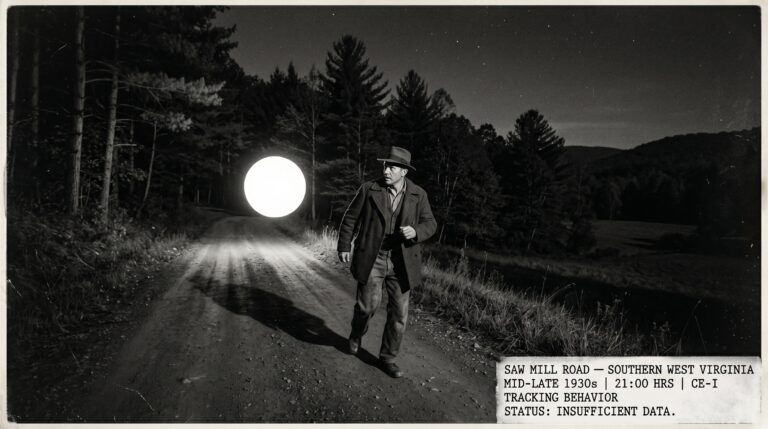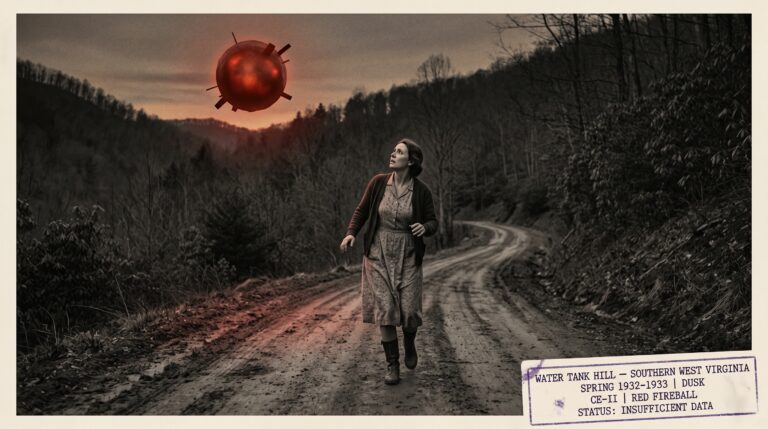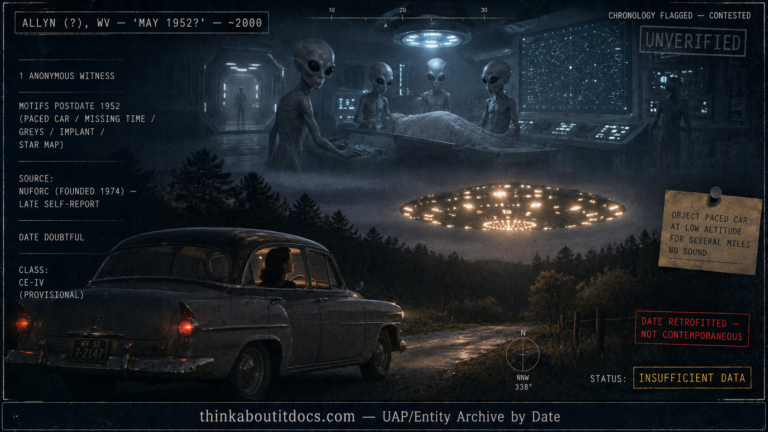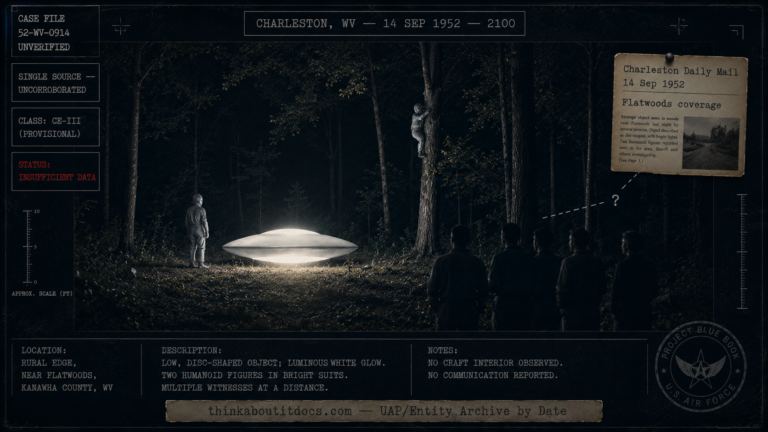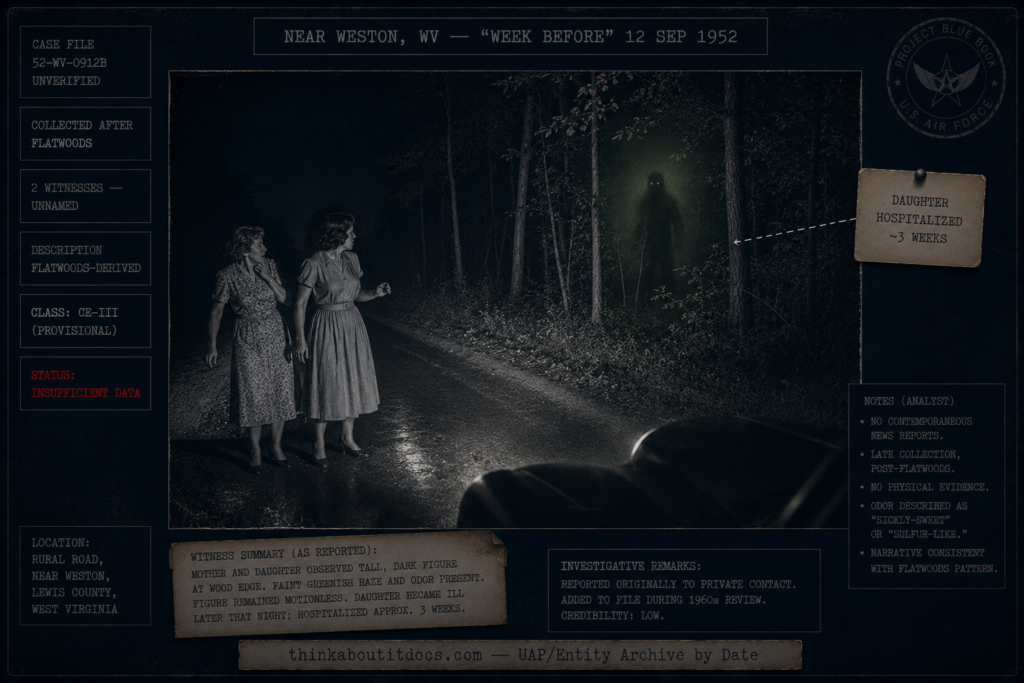
The Weston "week before Flatwoods" creature — a second-hand account collected after the September 12 event, its description borrowed from Flatwoods, logged as Insufficient Data. (thinkaboutitdocs.com — UAP/Entity Archive by Date)
THINK ABOUTIT UFO|UAP|ENTITY SIGHTINGS REPORT
1952: Creature in Weston, West Virginia
It is almost always told as the warning shot before Flatwoods — a mother and daughter near Weston meeting a towering, foul-smelling figure a week before the famous monster appeared five miles south. But the order in which the story actually entered the record runs the other way. No one reported this encounter on September 5; it surfaced only after September 12, when the Flatwoods sighting made the news and investigators from a California saucer group fanned out collecting “similar” accounts. The mother and daughter described a creature of the same look and the same sickening odor as the Flatwoods entity — and the daughter’s weeks in the hospital are the one concrete, repeated detail. What the archive holds, told straight, is not an independent precursor sighting but a second-hand recollection gathered in the wake of a sensation, dated by working backward and described in borrowed terms.
Date: Reckoned as “about a week before September 12, 1952” (often written September 5; no firm date is on record)
Sighting Time: Not recorded
Day/Night: Not clearly recorded
Location: Near Weston, West Virginia (about 5 miles north of Flatwoods)
Urban or Rural: Rural
No. of Entity(‘s): 1
Entity Type: Large humanoid figure — described by the witnesses as similar to the Flatwoods creature
Entity Description: A tall figure with the same appearance and odor the witnesses associated with the Flatwoods entity; specific features (cowl-like or “ace of spades” head, glowing eyes) in the literature are drawn from the Flatwoods description rather than independently established here
Hynek Classification: CE-III (animate being associated with the phenomenon) — provisional, given the account is second-hand and retroactively collected
Duration: Not recorded
No. of Object(s): None reported (entity only; no craft described in this account)
Description of the Object(s): Not applicable — no object reported
Shape of Object(s): Not applicable
Size of Object(s): Not applicable
Color of Object(s): Not applicable
Distance to Object(s): Not applicable
Height & Speed: Not recorded
Number of Witnesses: 2 (a mother and her adult daughter, reported as about 21; neither named in the sources)
Special Features/Characteristics: A strong, nauseating odor matching later Flatwoods reports; the daughter was reportedly hospitalized for roughly three weeks (Clarksburg Hospital in some accounts) following the fright; account collected after the September 12 event, not at the time
Case Status: Insufficient Data
Source: Collected by William and Donna Smith of Civilian Saucer Investigation (Los Angeles) during their post–September 12 inquiry; carried in Jerome Clark’s “Unexplained!” and throughout the Flatwoods literature
Related Cases: 1952: The Flatwoods Monster (Sept 12, the central event) | 1952: Pointy-Head Alien in Sutton, West Virginia | the Frametown / Frame-area “day after” creature accounts
DETAILED REPORT
The account describes a mother and her grown daughter near Weston, West Virginia, encountering a tall, frightening figure that gave off a powerful, sickening odor. The fright was severe enough that the daughter, reported as about twenty-one, was hospitalized afterward — by several accounts for roughly three weeks, at Clarksburg Hospital in some tellings. That hospitalization is the most consistent and concrete element of the story across sources.
The crucial fact is when and how the account was recorded. It was not reported on or around September 5, 1952. It came to light after September 12, when the Flatwoods Monster sighting drew national attention and a flurry of “me too” accounts followed. Investigators William and Donna Smith of Civilian Saucer Investigation, a Los Angeles research group, gathered a series of related reports during their inquiry into Flatwoods, and the Weston mother-and-daughter story was one of them — explicitly logged as an encounter with a creature of the same appearance and odor as the Flatwoods entity, said to have occurred about a week earlier. The “September 5” date that circulates is simply “a week before September 12” turned into a calendar entry; no firmer date exists in the record.
That sequence matters for how the description should be read. The vivid particulars attached to this case in the popular literature — a figure eight or nine feet tall, cloaked in black, with blazing eyes, gliding above the ground — are the Flatwoods Monster’s signature features. The Weston witnesses are reported to have described something like the Flatwoods creature, which is precisely what one expects from an account solicited after the Flatwoods story had already supplied the template. The single detail that does not simply mirror Flatwoods is the daughter’s lengthy hospitalization, which is why it carries more evidentiary weight than the creature’s appearance.
None of this means nothing happened near Weston that early-September week. A genuine fright with a real physical aftermath — three weeks in a hospital is not nothing — may well sit underneath the story. But as it reaches the archive it is a second-hand, retroactively collected, undated account from unnamed witnesses, its monster described in terms borrowed from the more famous event it is said to precede. It is best understood as part of the Flatwoods cluster, not as a cleanly independent sighting that happened to come first.
RESEARCHER’S NOTES
The Weston Precursor — West Virginia 1952 and a Story Collected Backward
- Classification, held but provisional: CE-III fits the type of claim — a close encounter with an animate being — and so it stands. But the qualifier matters more than usual here. The class is being applied to a second-hand account with no named witnesses, no firm date, and a creature description imported from Flatwoods. CE-III therefore marks what the report claims, not a vouched-for observation, and it sits alongside an Insufficient Data status that captures how little can actually be confirmed.
- Source-chain assessment: The prior page cited only “Jerome Clark, Unexplained!” That is where many readers meet the story, but it is not where the story originates. The account was gathered by William and Donna Smith of Civilian Saucer Investigation during their post-Flatwoods field inquiry, as one of several similar reports that emerged once the September 12 event was public. Naming that chain changes the case’s character: it is not a contemporaneous September 5 report later written up, but a recollection collected after the fact, in the middle of a regional sensation, by investigators specifically looking for matching encounters.
- Pattern and the contamination problem: This is a textbook example of how a famous case seeds satellite reports. Once Flatwoods supplied a vivid, widely-published creature — tall, dark, foul-smelling, glowing-eyed — accounts of “the same thing, a week earlier” and “the same thing, the next night, fifteen miles away” (the Frametown couple) followed naturally. Some may reflect real experiences; all are now described in Flatwoods’s vocabulary, which makes it impossible to separate independent observation from narrative borrowing. The archive’s job is to flag that the Weston description is Flatwoods-derived rather than to present it as corroboration of Flatwoods.
- Evidentiary weight and why Insufficient Data: Against the case: no named witnesses, no firm date, no contemporaneous report, and a creature described in borrowed terms. For the case: a specific, repeated, and unusual aftermath — a multi-week hospitalization attributed to shock and the odor. That single concrete detail keeps the story from being dismissable outright, but it is nowhere near enough to call the encounter documented. Insufficient Data is the honest status: a real fright may lie behind it, but the record cannot establish what was seen, when, or by whom.
The Weston creature is remembered as the prologue to Flatwoods, and in a sense it is — but as a story, not as a verified event that happened first. It entered the record only after the main sighting, collected by out-of-state investigators amid a wave of similar claims, undated except by counting backward, its monster wearing Flatwoods’s face. The archive keeps it within the Flatwoods cluster where it belongs, holds the CE-III as provisional, notes the one solid detail of the daughter’s hospitalization, and files the rest honestly as Insufficient Data.