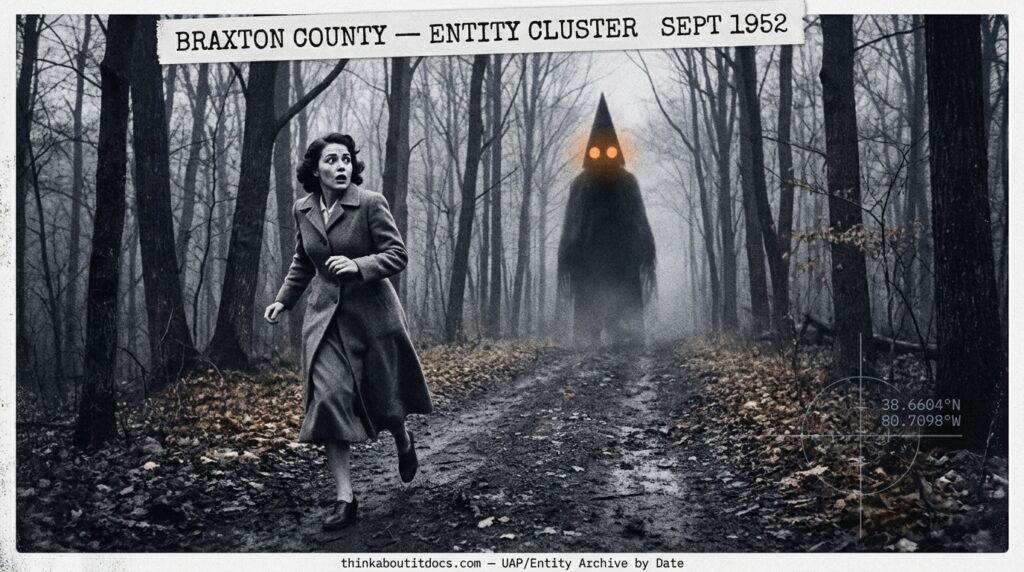
September 1952 — A lone witness on a wooded ridge near Sutton, West Virginia confronted a massive entity with a pointed head and glowing orange eyes. Same county, same month as the Flatwoods Monster.
THINK ABOUTIT ENTITY ENCOUNTER REPORT
1952: Pointy-Head Alien in Sutton, West Virginia
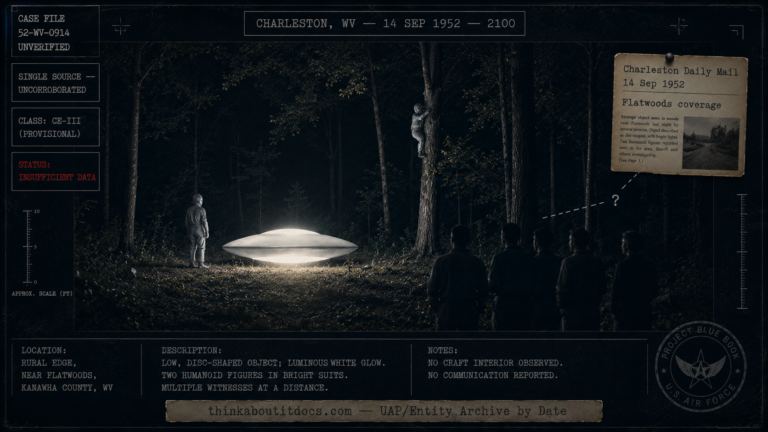
On a September evening in 1952, during the most intense UFO flap in American history, a lone woman walking home along a wooded ridge near Sutton, West Virginia heard something following her through the leaves. When she stopped and turned, she was face-to-face with a massive figure — pointy-headed or helmeted, with large glowing orange eyes — accompanied by a pungent, overpowering odor. She ran home screaming. The encounter, documented decades later by researcher William L. Moore in Farout magazine, occurred in the same county and the same month as the world-famous Flatwoods Monster incident, and the entity description — the pointed cowl, the glowing eyes, the chemical stench — matches the Flatwoods type with disturbing precision.
This Sutton ridge encounter is one of several lesser-known entity reports from Braxton County during September 1952 that collectively indicate the Flatwoods incident was not an isolated event but part of a localized cluster of CE-III activity across the region.
Date: September 1952 (exact date not specified)
Sighting Time: 7:00 p.m. (1900 hours)
Day/Night: Dusk / evening
Location: Wooded ridge near Sutton, Braxton County, West Virginia
Urban or Rural: Rural
No. of Entity(‘s): 1
Entity Type: Large humanoid, Flatwoods-type
Entity Description: Huge figure with a pointy head or helmet and large glowing orange eyes. No further anatomical details described (arms, legs, body structure not specified — the witness fled before extended observation). A very strong, pungent odor accompanied the entity.
Hynek Classification: CE-III (Close Encounter III) — Close observation of an animate being. No associated craft was directly observed by this witness, but the encounter occurred during a period and in a location where multiple aerial objects were reported by others in the same county.
Duration: Seconds (the witness fled immediately upon seeing the entity)
No. of Object(s): 0 (no craft observed by this witness)
Description of the Object(s): No craft directly observed. However, aerial objects were reported by multiple witnesses throughout the Braxton County area during September 1952, including the pulsating reddish sphere associated with the Flatwoods Monster incident on September 12.
Shape of Object(s): N/A
Size of Object(s): N/A
Color of Object(s): N/A
Distance to Object(s): N/A
Height & Speed: N/A (entity only; no craft observed)
Number of Witnesses: 1
Special Features/Characteristics: Entity appeared to follow or track the witness through the woods before revealing itself. Pungent chemical odor accompanied the entity — consistent with the sulfurous or burning-metal smell reported by Flatwoods Monster witnesses. The witness became hysterical and fled. The pointed head/helmet and glowing orange eyes match the spade-shaped cowl and luminous features described independently by the Flatwoods group on September 12.
Case Status: Unexplained
Source: William L. Moore, Farout magazine, Winter 1993
Summary/Description: A lone female witness walking home along a wooded ridge near Sutton, West Virginia on a September evening in 1952 was confronted by a huge entity with a pointy head or helmet, large glowing orange eyes, and a powerful chemical odor. She ran home in hysterics. The encounter occurred in Braxton County during the same month as the Flatwoods Monster incident and the entity description closely matches the Flatwoods type. Documented by William L. Moore.
Related Cases: 1952: The Flatwoods Monster, Flatwoods, WV — September 12 | 1952: Wheeling, WV Monster — September 15 | 1952: Weston, WV encounter (one week before Flatwoods — woman hospitalized) | 1952: John Keel-documented couple encounter (10-foot entity, stalled car, luminous sphere, 10–15 miles southwest of Flatwoods)
Detailed Report
The account is brief but stark. On a September evening in 1952, a woman was walking home along a footpath on a wooded ridge near Sutton, the county seat of Braxton County, West Virginia. As she walked, she began hearing noises behind her — sounds in the leaves and underbrush suggesting she was being followed. She stopped and looked back several times but saw nothing. The sounds continued. Frightened, she quickened her pace.
Then she stopped once more and turned around. This time, something was there. The witness was confronted by a huge figure — far larger than a man — with a pointy head or helmet and large glowing orange eyes. An overpowering, pungent odor accompanied the entity. The witness’s reaction was immediate and visceral: she became hysterical and ran home screaming.
The encounter was documented by researcher William L. Moore and published in the Winter 1993 issue of Farout magazine. Moore did not specify the exact date within September 1952, the witness’s name, or whether any follow-up investigation was conducted at the time. The account is presented as a standalone report — no craft observation, no additional witnesses, no physical evidence recovery. Its significance lies almost entirely in its geographic, temporal, and descriptive alignment with the Flatwoods Monster cluster.
Researcher’s Notes
The Ridge Stalker — Sutton 1952 and the Braxton County Entity Cluster
- Temporal and Geographic Correlation: This encounter occurred in Sutton, the county seat of Braxton County, during September 1952 — the same county and the same month as the Flatwoods Monster incident of September 12. Flatwoods is a small community within Braxton County, approximately 10 miles from Sutton. The Wheeling encounter followed on September 15, roughly 200 miles to the north. A Weston woman (Lewis County, adjacent to Braxton) reportedly encountered a similar entity one week before the Flatwoods incident and was hospitalized with fright. Writer John Keel later documented yet another encounter 10–15 miles southwest of Flatwoods, on the evening following September 12, involving a ten-foot entity near a stalled car. The Sutton ridge encounter fills out a picture of concentrated entity activity across central West Virginia during September 1952 that the Flatwoods case alone does not fully capture.
- Entity Description Convergence: The witness described a “huge figure with a pointy head or helmet and large glowing orange eyes” accompanied by “a very strong odor.” The Flatwoods witnesses independently described an entity with a spade-shaped or ace-of-spades cowl surrounding a round face, with luminous eyes emitting pale blue beams, and an acrid mist or chemical stench that caused nausea and throat irritation. The Wheeling entity on September 15 was described as ten feet tall with glowing green eyes and a foul odor. The core features converge: extreme height, pointed or cowled head structure, luminous eyes (orange, blue, or green depending on the witness), and a chemical odor. The color variation in the eye descriptions may reflect viewing conditions, angle, or individual perception; the structural consistency — pointed head, massive height, glowing eyes, chemical smell — is the more analytically significant pattern.
- Source Chain Limitations: The sole source for this encounter is William L. Moore’s account in Farout magazine, published in Winter 1993 — forty-one years after the event. Moore was a respected researcher (co-author of The Roswell Incident with Charles Berlitz), but his later career became controversial due to his acknowledged role as an intermediary between intelligence agencies and the UFO community in the 1980s. This does not invalidate the Sutton report, but it means the source chain is thin: a single researcher publishing a single witness’s account four decades after the fact, with no named witness, no contemporaneous documentation, and no corroborating investigation. The report’s value is contextual — it adds another data point to the Braxton County cluster — rather than standalone.
- The 1952 Flap Context: September 1952 fell within the largest documented UAP wave in American history. The Washington, D.C. overflights of July 1952 had generated national headlines, Project Blue Book was overwhelmed with reports, and the Robertson Panel was convened in January 1953 specifically to address the 1952 wave. West Virginia was not a peripheral zone during this period — the state produced multiple high-quality CE-III reports within a concentrated geographic area. The Sutton ridge encounter, the Flatwoods incident, the Wheeling entity, and the Weston hospitalization all occurred within a three-week window in a region spanning roughly 200 miles. Whether these represent a single phenomenon operating across central West Virginia or independent events sharing coincidental timing remains an open analytical question. The entity description consistency favors the former interpretation.
The Sutton ridge encounter is a thin report elevated by its context. Taken alone, it is a single unnamed witness, a single source published four decades late, and a few sentences of description. Taken alongside the Flatwoods incident three days later, the Wheeling encounter three days after that, the Weston hospitalization the week before, and the Keel-documented sighting the evening after, it becomes part of a pattern that no single case can fully represent. The pointy head, the orange eyes, and the chemical stench are the Flatwoods signature written onto a different ridge by a different witness who had no reason to fabricate consistency with an event that may not have occurred yet. Whatever moved through Braxton County in September 1952, it left its mark on more than one wooded path.