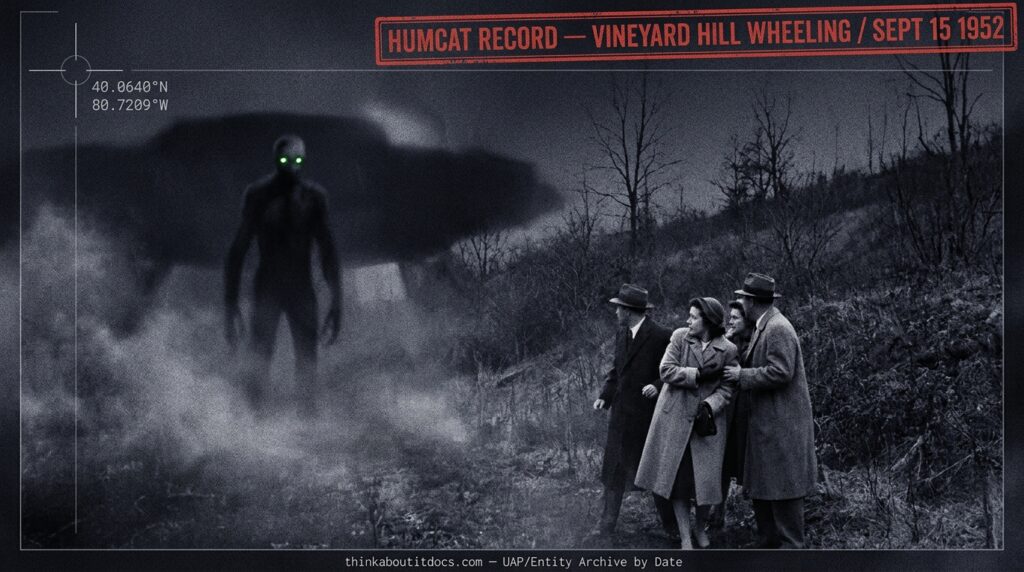
September 15, 1952 — Three days after Flatwoods, a ten-foot entity with glowing green eyes and a chemical stench confronted witnesses on Vineyard Hill near Wheeling, West Virginia. A female witness reported being burned.
THINK ABOUTIT UFO|ENTITY ENCOUNTER REPORT
1952: Wheeling West Virginia Monster
Three days after the Flatwoods Monster made national headlines, a separate group of witnesses on Vineyard Hill in the rural outskirts of Wheeling, West Virginia — roughly 200 miles to the north — reported the landing of an aerial craft from which a ten-foot entity with glowing green eyes emerged. The creature emitted the same kind of foul, nauseating chemical odor documented at Flatwoods. A female witness reported being physically burned during the encounter. The Wheeling case, preserved in the Humcat cataloging system from contemporary newspaper accounts, adds a physical injury claim and a second geographic anchor to the September 1952 entity cluster that the Flatwoods incident alone cannot fully define.
The convergence of core features — extreme height, glowing eyes, chemical stench, landed craft, and a terrified witness group — across two independent locations separated by 200 miles and three days argues either for an extraordinarily specific contagion of identical hallucination or for a physical phenomenon operating across central and northern West Virginia during the most intense UFO flap in American history.
Date: September 15, 1952
Sighting Time: Night (exact time not specified)
Day/Night: Night
Location: Vineyard Hill, rural outskirts of Wheeling, Ohio County, West Virginia
Urban or Rural: Rural
No. of Entity(‘s): 1
Entity Type: Large humanoid / Flatwoods-type
Entity Description: Approximately ten feet tall. Glowing green eyes. Emitted a foul, nauseating odor. One female witness reported being physically burned during the interaction. Further anatomical details (head shape, limb structure, clothing or covering) were not preserved in the surviving Humcat record.
Hynek Classification: CE-III (Close Encounter III) — Close observation of an animate entity that emerged from a landed aerial craft.
Duration: Not specified in the surviving record
No. of Object(s): 1
Description of the Object(s): An aerial craft that landed on Vineyard Hill. Shape, size, and color were not preserved in the surviving Humcat record. The entity reportedly emerged from this craft.
Shape of Object(s): Not specified
Size of Object(s): Not specified
Color of Object(s): Not specified
Distance to Object(s): Not specified
Height & Speed: Not specified (craft had landed when observed)
Number of Witnesses: Several
Special Features/Characteristics: Entity emerged from a landed craft. Approximately ten feet tall. Glowing green eyes. Foul nauseating odor — consistent with the chemical smell reported at Flatwoods three days earlier. One female witness reported being physically burned. Physical contact / injury claim elevates the case above purely observational CE-III reports. Occurred three days after the Flatwoods Monster incident, 200 miles to the north, during the same regional entity cluster.
Case Status: Unexplained
Source: Humcat (Humanoid Catalogue) quoting contemporary newspaper source (specific newspaper not identified in the surviving record)
Summary/Description: On September 15, 1952, several witnesses on Vineyard Hill outside Wheeling, West Virginia observed the landing of an aerial craft from which a ten-foot entity with glowing green eyes and a foul odor emerged. A female witness reported being physically burned during the encounter. The incident occurred three days after the Flatwoods Monster sighting 200 miles to the south and shares core features: extreme entity height, glowing eyes, chemical stench, and landed craft. Preserved in Humcat from newspaper sources.
Related Cases: 1952: The Flatwoods Monster, Flatwoods, WV — September 12 | 1952: Sutton, WV — Pointy-head entity on wooded ridge | 1952: Weston, WV encounter (one week before Flatwoods) | 1952: John Keel-documented couple encounter (evening after Flatwoods)
Detailed Report
The surviving record of the Wheeling Vineyard Hill encounter is frustratingly thin compared to the Flatwoods case that preceded it by three days. What exists comes from the Humcat (Humanoid Catalogue) system, which indexed entity encounters from newspaper and researcher accounts. The original newspaper source is not specifically identified in the surviving Humcat entry, which limits the ability to verify details or trace the original reporting chain.
On the night of September 15, 1952, several witnesses in the rural outskirts of Wheeling, West Virginia — specifically on Vineyard Hill — reported the landing of a mysterious aerial craft. From this craft emerged a towering entity, estimated at approximately ten feet in height. The creature’s eyes glowed green and it emitted a foul, nauseating chemical odor. A female witness claimed to have been physically burned during the encounter — a detail that, if verified, would place this case in the rare category of CE-III reports involving direct physical injury from entity contact.
The specifics that a researcher would most want — the craft’s shape, the exact circumstances of the burn, the distance between the witnesses and the entity, the duration of the encounter, the number and names of the witnesses, and the investigative follow-up — are not preserved in the surviving record. The Humcat entry captures the core incident but not the supporting detail that would allow independent verification or deep analysis.
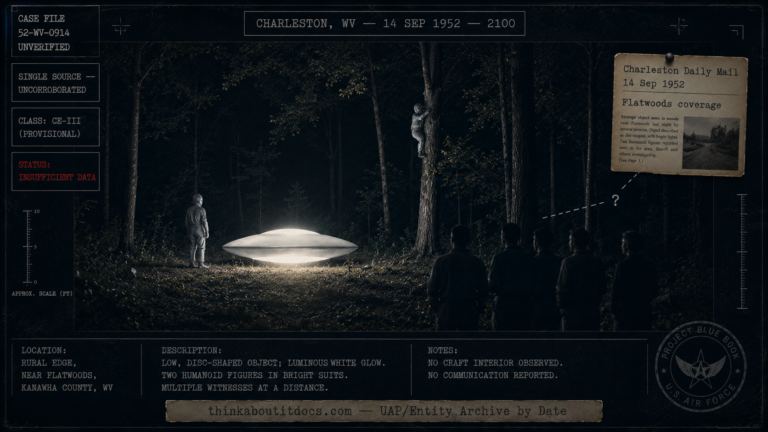
What the record does capture is the convergence with the broader September 1952 pattern. Wheeling is approximately 200 miles north of Flatwoods and Braxton County. The September 15 date places it exactly three days after the Flatwoods Monster incident. The entity description — ten feet tall, glowing eyes, chemical odor — overlaps substantially with the Flatwoods type (over six feet tall, luminous eyes, acrid mist) and the Sutton type (huge, pointy-headed, glowing orange eyes, strong odor). The green eye color differs from the Flatwoods blue and the Sutton orange, but the structural profile — massive height, luminous eyes, chemical smell, proximity to a landed or hovering craft — is consistent across all three.
Researcher’s Notes
The Vineyard Hill Entity — Wheeling 1952 and the Physical Contact Claim
- The Burn Claim: The report that a female witness was physically burned during the Wheeling encounter is the detail that most significantly distinguishes this case from the Flatwoods incident. Physical injuries allegedly inflicted by entities or their associated craft are rare in the CE-III literature but not unprecedented. The Falcon Lake incident (1967, Manitoba) produced well-documented grid-pattern burns on witness Stefan Michalak’s chest. The Cash-Landrum case (1980, Texas) produced severe radiation-like symptoms. If the Wheeling burn occurred as reported, it would constitute physical trace evidence of direct entity-human interaction. However, the surviving record does not include medical documentation, a description of the burn’s location or severity, or any follow-up verification. The claim is noted but cannot be evaluated without the source data that has not survived.
- Source Chain Assessment: The Humcat cataloging system, maintained by researcher David Webb and later Ted Bloecher, was one of the most systematic attempts to index humanoid encounter reports globally. Its entries were typically derived from newspaper clippings, researcher files, and organizational archives. The Wheeling entry cites a “newspaper source” without specifying which newspaper. This is a single-layer source chain: Humcat citing an unnamed newspaper. Without the original article, the witness names, the reporter’s identity, and any contemporaneous investigative detail are inaccessible. The case is therefore analytically useful as a data point within the September 1952 cluster but cannot stand alone as a well-documented independent case.
- The 200-Mile Problem: The geographic separation between Flatwoods (Braxton County, central WV) and Wheeling (Ohio County, northern WV panhandle) is approximately 200 miles. If the same phenomenon produced both encounters, it was operating across a substantial geographic range within a three-day window. Alternatively, the Wheeling witnesses may have been influenced by the intense media coverage of the Flatwoods incident, which had already generated national headlines by September 15. However, media-influenced fabrication would not typically produce a physical burn claim, and the Humcat entry treats the report as a distinct incident rather than a derivative one. The 200-mile gap actually argues in the case’s favor: a fabricator copying Flatwoods would be more likely to report an event nearby, not in a distant city.
- Entity Feature Convergence: Across the September 1952 West Virginia cluster, the entity descriptions share a stable core with variable details. Height: six to ten feet. Eye luminosity: always present, color varies (blue at Flatwoods, orange at Sutton, green at Wheeling). Chemical odor: present at every site. Associated craft: present at Flatwoods and Wheeling, absent or implied at Sutton. Head structure: ace-of-spades at Flatwoods, pointy at Sutton, not described at Wheeling. The pattern suggests either consistent observation of a real entity type with normal perceptual variation among witnesses, or a culturally transmitted template with improvised embellishments. The physical burn at Wheeling, if genuine, would tip the balance toward the former — cultural templates do not produce burns.
The Wheeling Vineyard Hill encounter is a significant but underspecified case that gains most of its analytical weight from its position within the September 1952 cluster rather than from its own documentation. The ten-foot entity, the green eyes, and the chemical odor place it firmly in the Flatwoods type family. The physical burn claim elevates it above simple observation — if it could be verified, it would be one of the most important CE-III cases of the 1952 wave. But the verification does not exist in the surviving record. The Humcat entry preserves the skeleton of what may have been a profoundly important encounter; what it does not preserve is the flesh. The case deserves further archival research to locate the original newspaper source, which would allow recovery of details that the cataloging system did not capture.