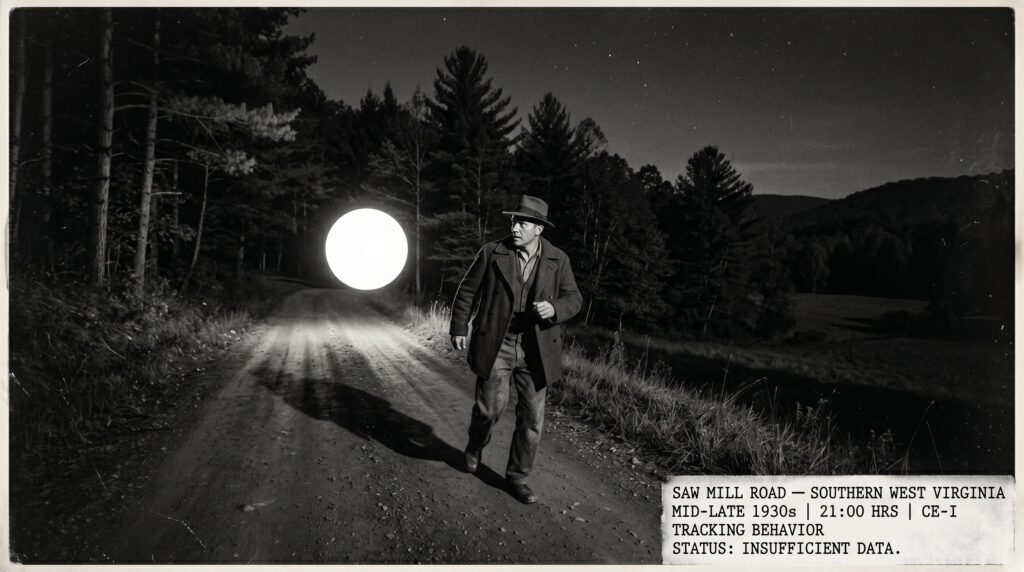
Saw Mill Road, southern West Virginia, mid to late 1930s, 9:00 PM — James, described by his family as afraid of nothing and no one, was followed by a large ball of white light for approximately one mile along a dark country road after church. It matched his exact pace through every turn. At the fork of the road it disappeared instantaneously. Anonymous family submission. Case status: Insufficient Data.
THINK ABOUTIT UFO | UAP | SIGHTING REPORT
193?: Large” Ball Of White Light Overhead
Sometime in the mid to late 1930s, on Saw Mill Road in southern West Virginia, a man named James was walking home from church at nine o’clock at night. He was a no-nonsense kind of person — afraid of nothing and no one was how his family described him. As he crested a steep hill on the dark country road he began to feel uncomfortable. Not frightened. Just wary. He looked around and heard and saw nothing. He descended the hill and had walked less than five minutes further when something made him look behind him. What he saw was a large ball of white light suspended very low and very near him in the dark. It was not the moon. He walked faster. It kept pace exactly. The faster he walked the faster it picked up speed. It followed him for approximately one mile — making every twist and turn of the road — until he reached the forks of Saw Mill Road, where it disappeared. He looked one second and it was there. The next, it was gone. He told his family what happened. He never offered an explanation. He never needed to.
Sighting Time: 9:00 PM — immediately after church let out
Day/Night: Night
Location: Saw Mill Road, southern West Virginia — rural country road approximately 3 miles from the location of a separate sighting by the submitter’s grandmother earlier in the same decade
Urban or Rural: Rural — isolated dark country road, forest on one side, small meadow on the other
No. of Entity(‘s): None observed
Entity Type: None
Entity Description: None
Hynek Classification: CE-I (Close Encounter I) — observation of an object in very close proximity to the witness over an extended distance; active tracking behavior documented over approximately one mile; object maintained position relative to the witness through course changes. Note: the active tracking behavior — the object matching the witness’s pace and maintaining proximity through turns for approximately one mile — exceeds simple CE-I proximity parameters and is consistent with deliberate surveillance behavior. The archive retains CE-I as the minimum classification with the tracking behavior noted as the analytically significant element.
Duration: Approximately one mile of road travel — from the bottom of the hill to the forks of Saw Mill Road; estimated 15 to 20 minutes at walking pace
No. of Object(s): 1
Description of the Object(s): A large ball of white light suspended very low and very near the witness — at close enough range for James to immediately assess it was not the moon. Stationary when first observed — suspended, not moving. Began tracking the witness when he increased pace. Demonstrated precise velocity matching — the faster James walked the faster it picked up speed, maintaining a consistent following distance. Maintained tracking through every twist and turn of Saw Mill Road for approximately one mile. Disappeared instantaneously at the forks of Saw Mill Road — James looked and it was there, then it was gone, with no observed departure direction or method
Shape of Object(s): Ball — spherical
Size of Object(s): Large — described as a large ball of white light
Color of Object(s): White
Distance to Object(s): Very close — suspended very low and very near the witness; exact distance not recorded but sufficient for James to clearly assess it was not the moon and to observe it tracking him at consistent proximity for one mile
Height & Speed: Very low altitude — suspended close to ground level on a dark country road; speed variable and precisely matched to the witness’s walking speed, accelerating when James accelerated; exact altitude not recorded
Number of Witnesses: 1 — James, unnamed, described as a brother-in-law who had married into the submitter’s family; a no-nonsense hard worker known as afraid of nothing and no one; submitter is the family member who received and documented the account
Special Features/Characteristics: Pre-encounter atmospheric unease — James experienced a distinct feeling of discomfort and wariness before any visual stimulus appeared, at the crest of the hill before the object became visible; this pre-event physiological marker is documented across multiple cases in the archive; precise velocity matching — the object matched James’s walking pace exactly and adjusted speed in real time when he accelerated; course-following — the object maintained position through every twist and turn of the road for approximately one mile, not simply floating in a fixed position; instantaneous disappearance at a specific geographic point — the forks of Saw Mill Road; family context — the submitter notes a separate sighting by the grandmother approximately three miles from this location earlier in the same decade, suggesting a geographic area of recurring activity; swamp gas explanation rejected by submitter on behavioral grounds — a ball of swamp gas would not tag along behind someone making every twist and turn of the road
Case Status: Insufficient Data — unnamed witness, anonymous family submission, undated within the decade; witness character is strongly vouched for by family; behavioral details are internally consistent and specific; the tracking behavior over one mile is the decisive analytical element
Source: Anonymous family submission — submitter is a family member of the witness James
Summary/Description: In the mid to late 1930s, James — a no-nonsense southern West Virginia man described by his family as afraid of nothing and no one — was walking home from church along Saw Mill Road at 9 PM when a large ball of white light appeared very low and very close behind him. The object tracked him for approximately one mile, matching his pace exactly and following every turn of the road, before disappearing instantaneously at the forks of Saw Mill Road. James experienced a distinct pre-encounter feeling of unease before the object appeared. He told his family what happened and never offered an explanation. Anonymous family submission. Case status: Insufficient Data.
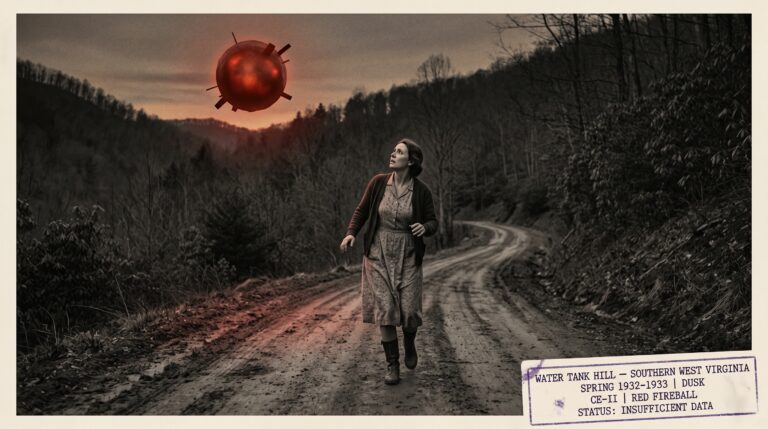
Related Cases: 193?: West Virginia Red Glowing Fireballs | 1929: Chippewa Falls, Wisconsin — Round Light Vertical Departure | 1920: Sacramento Apparition Wandering Through the Atmosphere | West Virginia Sightings Archive
Detailed Report
The Faster I Walked — Saw Mill Road, Southern West Virginia, 193? Source: Anonymous family submission
The account is preserved through family transmission and submitted by a family member of the witness. James had married into the submitter’s family through his brother. He was known in the family as a no-nonsense kind of person — a hard worker who raised a large family and was also known as one who was afraid of nothing and no one. These character details are not incidental. They establish the baseline against which his account is measured.
On the night of the event James had left church, which let out around nine o’clock. He had a long walk home down Saw Mill Road. Whether he had company for the first part of the journey is unknown, but he was definitely alone when the event occurred.
The road had a steep uphill grade as it left the church area, banked by forest on one side and a small meadow below on the right. As James reached the top of the hill he began to feel uncomfortable. Not frightened — uncomfortable. The feeling that caused him to be wary, to put one’s guard up in the family’s phrase, came before any visual stimulus. He looked around as he walked and saw nothing unusual.
He descended the hill and had walked less than five minutes further when something caused him to look behind him. Whether it was a sound, a flash of light, or the feeling that someone was following was never made clear. What he saw was a large ball of white light suspended very low and very near him. He immediately knew it was not the moon.
James’s own words: the faster I walked, the faster it picked up speed.
The object kept right up with him. It never attempted to overcome him or outdistance him. It tagged along behind him on the long road like a wary dog for approximately another mile — making every twist and turn of Saw Mill Road. When James reached the forks of the road the white ball of light had suddenly disappeared. He looked one second and it was there. The next, it was gone.
He had not witnessed whether it sped away or simply blinked out.
A suggestion made in later years that the light might have been swamp gas or a similar phenomenon was rejected by the submitter on behavioral grounds: a ball of swamp gas would not tag along behind someone for a mile making every twist and turn of the road. James himself never offered an explanation. Given his character, the submitter believed he simply reported what had happened.
It never happened to him again.
RESEARCHER’S NOTES
The Faster I Walked — Saw Mill Road 193? and the Tracking Light as Archive Evidence
- Pre-Encounter Atmospheric Unease as Pattern Evidence: The most underanalyzed element of the Saw Mill Road account is the feeling James experienced before the object appeared. At the crest of the hill — before any visual or auditory stimulus — he became wary. Uncomfortable. This pre-event physiological state is documented across multiple cases in the archive including the 1893 Fayette County Pennsylvania monster case, where all the poachers felt watched before they saw anything, and multiple 20th century CE-III cases in Jenny Randles’s Oz Factor research. It is not a literary device. It is a documented physiological response that precedes UAP proximity events in a pattern consistent enough to constitute a data point rather than a narrative flourish. James noted it. The archive notes that he noted it.
- Velocity Matching as the Decisive Behavioral Element: Swamp gas, ball lightning, and conventional atmospheric plasma phenomena share a common characteristic — they do not track a specific individual’s pace. They drift, they dissipate, they behave according to atmospheric physics. The Saw Mill Road object matched James’s walking speed in real time and adjusted when he accelerated. The faster I walked, the faster it picked up speed is not a description of an atmospheric phenomenon. It is a description of an object exhibiting responsive behavior — adjusting its own speed in response to the speed of the observed subject. This behavior requires either intelligent control or some form of proximity-sensing mechanism that maintained a fixed following distance regardless of James’s pace. Neither explanation is consistent with any known natural phenomenon.
- Course-Following Through Turns — Eliminating Fixed-Position Explanations: A fixed light source visible through trees along a winding road can appear to follow a walker as the walker rounds bends — a known visual illusion. The Saw Mill Road account explicitly states the object followed every twist and turn of the road, not simply remained visible. The distinction is operationally significant. A light that genuinely maintains its following position through road curves is not a fixed light source being intermittently obscured and revealed by vegetation. It is a mobile object actively maintaining a relative position to a moving subject over an extended distance. The behavioral description eliminates the fixed-light-through-trees explanation.
- Geographic Clustering — The Grandmother’s Sighting Three Miles Away: The submitter notes a separate sighting by the grandmother approximately three miles from James’s location, earlier in the same decade. The archive does not have that sighting in this post’s record, but the geographic clustering of two independent family-transmitted UAP accounts within three miles and within the same decade in southern West Virginia is a data point the archive flags for cross-reference. Southern West Virginia — Logan, Mingo, McDowell, Wyoming, and Mercer counties and their rural road systems — has a documented pattern of anomalous sightings extending from the 1930s through the Mothman era of the 1960s and into the contemporary record. The Saw Mill Road case sits in that geographic context.
James walked one mile in the dark on a country road in southern West Virginia with a large ball of white light matching his pace behind him, following every turn, and he did not bolt and he did not pretend it wasn’t there and he told his family what happened and never explained it away. That is the record. The archive holds it here — in the no-nonsense voice of a man who was afraid of nothing and no one and was still perfectly willing to admit that something had followed him home.