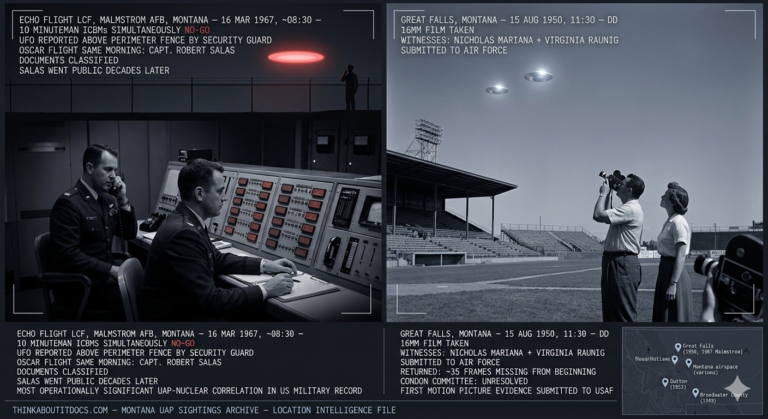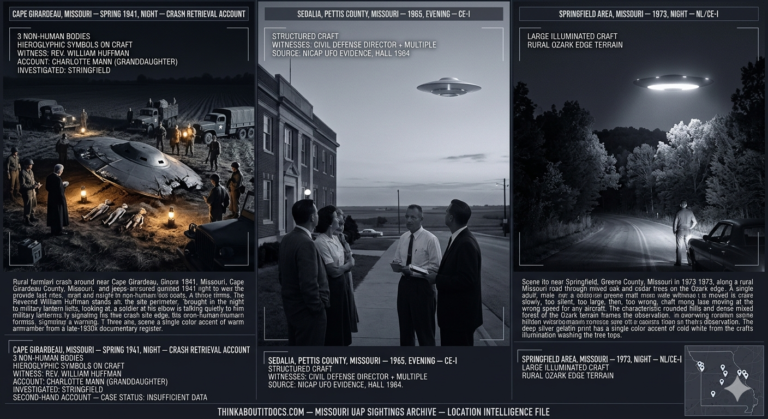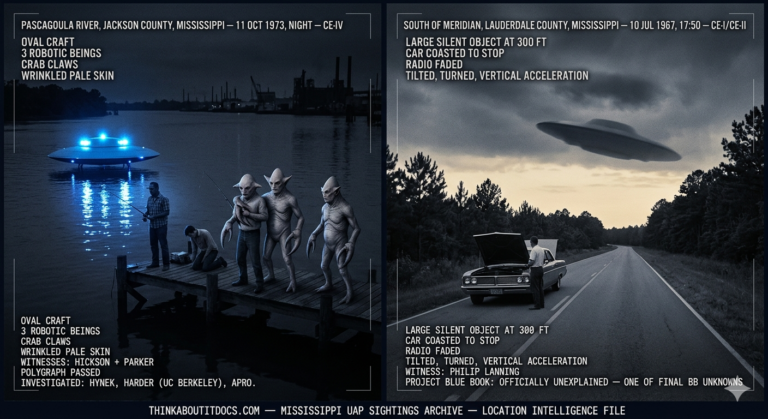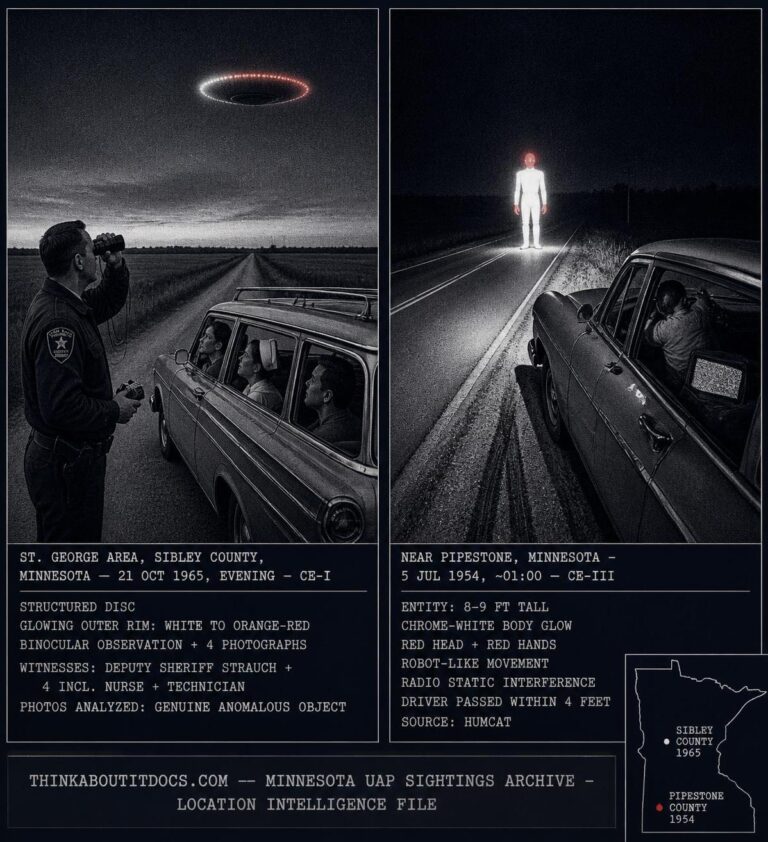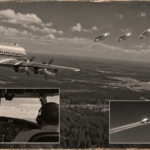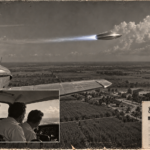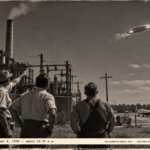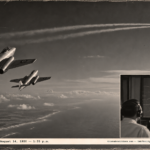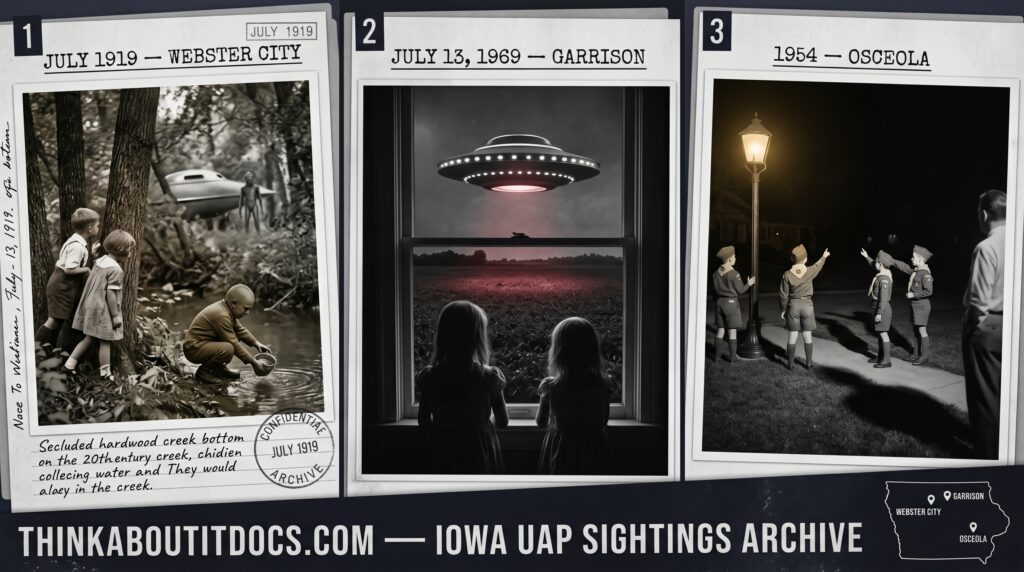
Iowa UAP archive: Webster City Hamilton County July 1919 CE-III with two occupants, water-collection behavior, and physical ground traces (Clark/NICAP sourced, URECAT confirmed), Garrison Benton County July 1969 double-saucer disc with rotating midline lights and glowing red ground trace (Pat Barr and Kathy Mahr), and Osceola Clarke County 1954 pre-Hill CE-IV with multiple small entities escorting witness toward a field. 10 documented cases 1919–2012.
Iowa UFO|UAP & Alien Sightings Archive
Iowa’s anomalous record runs deeper than its case count suggests. The state sits at the center of the pre-1947 occupied-craft record in a way that rarely receives the attention it deserves: the July 1919 Webster City encounter — two children observing a brown-green landed craft, one tall occupant standing guard at the door while a shorter figure runs to collect creek water, the craft ascending vertically through tree branches and leaving ground marks — is one of the most behaviorally detailed CE-III cases in the pre-modern archive, sourced through NICAP files via Jerome Clark and confirmed in URECAT. It predates the modern UFO era by twenty-eight years and carries physical trace evidence that no cultural framework for flying saucers yet existed to contaminate. A year later, in June 1920, a witness six miles northeast of Mount Pleasant encountered a slow-moving, apparently lightweight object in a CE-II landing event sourced to the Iowa City Press-Citizen. He did not tell the story for thirty-five years, describing later why he kept it private: in 1920, he said, you didn’t talk about flying saucers. In 1922, twin eight-year-old girls in Davenport observed a daylight disc. Three separate pre-1947 Iowa cases in four years, across three different counties and two different Iowa river valleys, establish the state’s anomalous baseline well before Kenneth Arnold ever flew over Mount Rainier.
The state’s post-1947 record deepens rather than repeats. The 1954 Osceola abduction — multiple small entities described as resembling boy scouts escorting the witness toward a nearby field late at night — is one of a small number of pre-Hill abduction accounts in the Midwest and carries the pre-contamination entity description profile that makes early CE-IV cases analytically significant. The Garrison crop circle of July 13, 1969 adds physical trace evidence to the modern record: Pat Barr and her cousin Kathy Mahr observed a double-saucer disc — two coffee-saucer shapes placed rim to rim, rotating as it hovered — above a bean field south of Garrison, and when it departed at high speed the ground beneath where it had hovered was found glowing red. Iowa’s flat agricultural landscape and wide-open skies produce both the conditions for clear observation and the cultural tendency toward underreporting — a witness who waited thirty-five years to speak about 1920 is unlikely to be the only one. The archive’s ten documented cases span nearly a century and distribute from the Missouri River bluffs at Council Bluffs to the Iowa River valley at Coralville, tracking the state’s geographic breadth and the consistency of its anomalous record across time.
- 1919: WEBSTER CITY, IOWA CE-III
- 1920: UFO Landing, Mount Pleasant, Iowa
- 1922: DAVENPORT, IOWA DAYLIGHT DISC
- 1954: Osceola, Iowa Abduction
- 1966: Cigar-shaped object lands in Yorktown, Iowa
- 1969: Garrison, Iowa Crop Circle
- 1977: Security guard sees oval UFO with bright headlights
- 2003: Craft appeared as waiting to be inspected on Interstate 29
- 2003: Homestead, Iowa UFO Sighting
- 2008: Altoona, Iowa UFO|UAP Sighting
- 2012: Cedar Rapids, Iowa UFO|UAP Sighting – Video
- 2012: UFO in Coralville, Iowa Sighting – Video
- 1954: The “Moroni” Encounter — Midwest United States
- 1955: Winterset, Iowa 1955: A T-33 Jet’s Head-On Encounter and Failed Pursuit
EXECUTIVE SUMMARY
The Pre-Contamination State — Iowa’s Pre-1947 Occupied Craft Record
Iowa’s contribution to the pre-1947 UAP record is disproportionate for its size and underrepresented in the national literature. Three documented cases between 1919 and 1922 — Webster City CE-III with ground traces, Mount Pleasant CE-II landing, Davenport daylight disc — give the state one of the densest pre-modern anomalous clusters in the Great Plains region. The Webster City case is the most analytically privileged of the three. Two children watching a craft’s crew collect creek water in 1919 could not have been culturally primed to produce that specific behavioral detail: one occupant running with a container, the taller one objecting audibly, the door slamming with a metallic sound, the craft going straight up through tree branches. That interior logic — a crew interrupted in a task, an argument, a hasty departure — has no available cultural source in rural Iowa in 1919. It is the pre-contamination behavioral fingerprint that separates this case from retrospective or culturally-shaped accounts, and the physical ground marks and broken tree branches provide the corroborating trace evidence that moves it beyond pure testimony.
The 1969 Garrison encounter adds a different dimension — two female witnesses, a named farm, a double-saucer rotating disc with a distinctive two-rows-of-lights midline profile, and a glowing red ground trace found at the site after departure. The physical trace evidence at Garrison — the glowing ground beneath the hover point — was investigated and documented. Iowa’s flat agricultural terrain means that when something lands or hovers at low altitude over a farm field, the physical evidence is preserved in open ground rather than forest undergrowth or water. The state’s underreporting tendency, documented explicitly by the Mount Pleasant witness who stayed silent for thirty-five years, means the archive is almost certainly a significant undercount. Ten cases spanning 1919 to 2012, with pre-1947 physical traces, a pre-Hill abduction, a rotating double-saucer with documented ground traces, and the decade’s most behaviorally specific CE-III — Iowa’s record is thin in count and rich in quality.