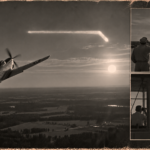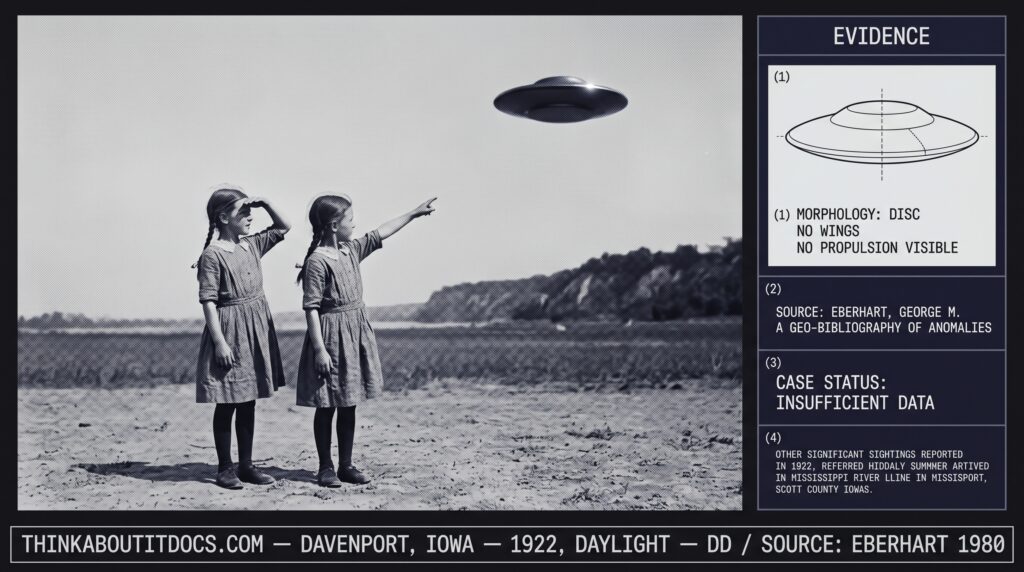
Davenport, Scott County, Iowa — 1922, daylight. Two eight-year-old twin girls observe a disc-shaped unidentified object in daytime sky. No engine, no wings, no propulsion visible. Pre-contamination DD — no cultural source for disc-shaped aircraft in 1922. Source: Eberhart, George M., A Geo-Bibliography of Anomalies, Greenwood Press, 1980. Case Status: Insufficient Data — source expansion pending.
THINK ABOUTIT UFO | UAP | ENTITY | ENCOUNTER REPORT
1922: DAVENPORT, IOWA DAYLIGHT DISC
On a daylight afternoon in 1922, two eight-year-old twin girls in Davenport, Iowa looked up and saw a disc in the sky that should not have been there. No engine. No wings. No framework that 1922 Davenport offered for what they were looking at. They were eight years old, they were together, and they were certain enough of what they saw that the report entered the research record. In a year that also produced the Warsaw Saturn disc with its rotating ring and beam discharge, the Barmouth Wales USO descent, and the Detroit CE-III, the Davenport twins add the American Midwest to the 1922 pre-contamination daylight disc record — young witnesses, no available cultural source, clear conditions, a single clean observation.
Date: 1922
Sighting Time: Daylight
Day/Night: Day
Location: Davenport, Scott County, Iowa, USA
Urban or Rural: Not specified
No. of Entity(‘s): 0
Entity Type: None reported
Entity Description: None
Hynek Classification: DD (Daylight Disc)
Duration: Not reported
No. of Object(s): 1
Description of the Object(s): Disc-shaped unidentified flying object observed in clear daylight sky
Shape of Object(s): Disc
Size of Object(s): Not reported
Color of Object(s): Not reported
Distance to Object(s): Not reported
Height & Speed: Not reported
Number of Witnesses: 2 — twin girls, aged 8
Special Features/Characteristics: Twin witnesses providing mutual corroboration; pre-contamination observation — no cultural source for disc-shaped aircraft available to 8-year-old witnesses in 1922 Davenport; same year as Warsaw Saturn disc (CUFOS), Barmouth Wales USO (Magonia/Fort), Medford Oregon multi-witness sighting (Skylook)
Case Status: Insufficient Data
Source: Eberhart, George M., A Geo-Bibliography of Anomalies, Greenwood Press, Westport, 1980, ISBN: 0-313-21337-2
Summary/Description: In 1922 in or near Davenport, Scott County, Iowa, two eight-year-old twin girls observed a daylight disc-shaped unidentified flying object. The case is catalogued by George Eberhart in his Geo-Bibliography of Anomalies (1980). Detail beyond basic observation parameters is not available in the current source record. The twin-witness structure provides a degree of corroboration atypical for pre-1947 child-witness cases. Case Status is Insufficient Data pending recovery of additional source documentation, most likely from Davenport newspaper archives 1922 or Iowa State Historical Society holdings.
Related Cases: 1922: Warsaw, Poland — Saturn-shaped disc with rotating ring and beam discharge (CUFOS) | 1922: Medford, Oregon — numerous city witnesses observe unusual object (Skylook) |1922: Barmouth, Wales — structured object descends slowly into sea (Magonia/Fort) | 1927: Cave Junction, Oregon — pre-1947 photographic disc case.
DETAILED REPORT
The 1922 Davenport daylight disc is one of the thinner individual entries in the Iowa pre-1947 record — a single-source catalogue notation from Eberhart’s Geo-Bibliography of Anomalies with no supplementary documentation yet recovered. What it offers analytically is not detail but context: two eight-year-old twin girls in Davenport, Iowa, in 1922, observing a disc-shaped object in daylight sky, with no cultural framework available for what they were looking at.
Davenport sits on the Mississippi River in Scott County, the easternmost city in Iowa, part of the Quad Cities metropolitan area straddling the Iowa-Illinois border. In 1922 it was a significant industrial and commercial river city with a population of approximately 56,000. It is not a rural setting. The observation therefore occurs in an urban context with multiple potential observers, yet the Eberhart record shows only the two twin witnesses. Whether other Davenport residents observed the same object and did not report, or whether the girls were uniquely positioned for the observation, is not determinable from the current record.
The twin-witness structure is analytically relevant. Two witnesses who share an observation simultaneously, particularly siblings of identical age who cannot have independently fabricated the same experience without coordination, provide a degree of mutual corroboration that single-witness reports cannot. That both girls reported the same observation gives the case a minimum corroboration threshold that the Eberhart notation alone would not.
The case requires source expansion. Eberhart’s Geo-Bibliography entry for a 1922 Davenport Iowa daylight disc will have a specific original source — a newspaper clipping, a NICAP file, a personal correspondence — and that original source should be traced. The Davenport Democrat and Leader, the Davenport Daily Times, and the Quad-City Times archives for 1922 are the logical research targets. The Iowa State Historical Society’s newspaper digitisation project has made portions of this period accessible. NICAP’s pre-1947 files at the National Archives may also contain the original documentation behind the Eberhart entry.
Eight-year-old twin girls in 1922 Davenport had no available cultural source for a disc-shaped flying object. Hugo Gernsback’s Amazing Stories, which would begin seeding disc and flying machine imagery into popular culture, did not launch until 1926. The observation, whatever its ultimate explanation, cannot be attributed to cultural contamination by science fiction imagery for the simple reason that the relevant imagery did not yet exist in accessible popular form in 1922.
RESEARCHER’S NOTES
The 1922 Disc Record in Context — Davenport and the International Pattern: The 1922 Davenport observation sits in a year with an unusually active pre-contamination disc record internationally. The Warsaw Saturn-disc (August 1922, CUFOS), the Medford Oregon multi-witness city sighting (July 1922, Skylook), and the Barmouth Wales USO descent (September 1922, Magonia/Fort) establish that 1922 produced anomalous craft observations across at least four countries in a single calendar year. The Davenport DD adds the American Midwest to that distribution. Whether this reflects a genuine clustering of phenomena in 1922 or simply the statistical artifact of Eberhart’s systematic cataloguing reaching a density threshold is an open analytical question, but the international distribution makes random coincidence less likely than it would be for a single isolated case.
Child Witnesses and Pre-Contamination Value — 1922: Eight-year-old twin girls in 1922 Davenport had no available cultural source for a disc-shaped flying object. The science fiction pulps that would begin circulating disc and saucer imagery in the late 1920s and 1930s had not yet reached that specific imagery in 1922. The Davenport twins’ observation, whatever its ultimate explanation, cannot be attributed to cultural contamination — the pre-contamination marker is intact.
Source Recovery Priority: This case is a source recovery priority for the Iowa archive. Eberhart’s notation is a reliable secondary catalogue entry but the original source needs to be identified and cited. The Davenport city newspaper archive for 1922 is the first research target. A daylight disc observation by two identified child witnesses in a city of 56,000 in 1922 would have been newspaper-reportable if the girls told their parents and their parents spoke to anyone.
The Minimal Record as Evidence Type: The thinness of the Davenport record is itself analytically informative. In 1922 in Davenport, Iowa, there was no mechanism for reporting an anomalous aerial observation that would have been taken seriously by anyone in a position to investigate it. The girls were eight years old. No Project Sign, no NICAP, no Blue Book existed in 1922. What reached the research record at all reached it through private testimony retained across decades and eventually submitted to a researcher. The survival of even this minimal record is the analytical data point: someone remembered, and the memory was specific enough to be catalogued.
The Davenport case is what the pre-1947 record often looks like at its thinnest edges: two children, a disc in a daylight sky, a year in which no framework existed for either the observation or its reporting, and a single researcher’s notation as the only surviving evidence that it happened at all. The archive holds it for what it is — a minimum-detail Eberhart-sourced DD from 1922, twin witnesses, Davenport Iowa, daylight.