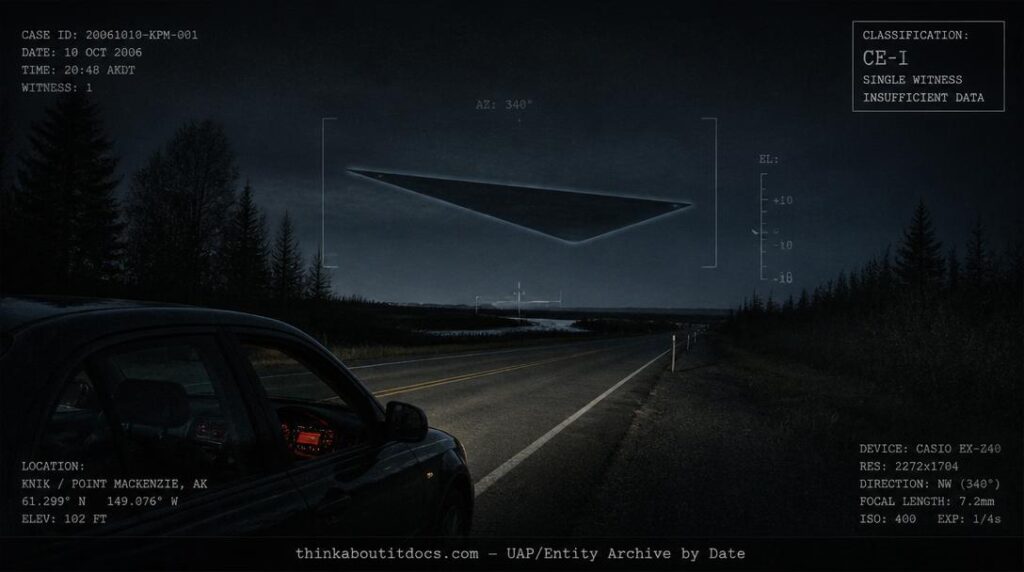
Witness-style dossier image of the reported triangular object seen near Knik / Point MacKenzie, Alaska, on October 10, 2006.
THINK ABOUTIT UFO|UAP SIGHTINGS REPORT
2006: Large triangle over Alaska
On the night of October 10, 2006, a lone driver leaving a friend’s home near Knik and Point MacKenzie, Alaska, noticed lights through the trees and assumed an aircraft was passing over the Matanuska-Susitna backcountry. Then the driver reached an open view and the lights resolved into something else: a triangle UFO at least as big as a 747, moving low and slow across the dark, and making no sound at all.
What happened next is why this Alaska triangle report has stayed memorable. The witness rolled down the window, tried to switch off the radio, and finally shut off the engine to listen, and heard nothing from a craft estimated at a quarter mile away. A whitish glow outlined the triangular form as it turned, and the turn looked less like an airplane banking than like the object sliding sideways. The witness drove on to Becker Lake for a second look before the craft turned toward Point MacKenzie and slipped out of sight. There is no second witness, no radar record and no photograph, only a first-person account and a drawing, which makes this a case to read carefully and not to overstate.
Date: October 10, 2006
Sighting Time: Not Stated
Day/Night: Night
Location: Knik / Point MacKenzie, Alaska, United States
Urban or Rural: Rural
No. of Entity(‘s): 0
Entity Type: None observed
Entity Description: Not Applicable
Hynek Classification: NL (Nocturnal Light)
Duration: Not stated; the witness followed the object across at least two stopping points
No. of Object(s): 1
Description of the Object(s): A large, apparently triangular aerial object outlined by a whitish glow, observed moving silently at low altitude before turning and proceeding toward Point MacKenzie.
Shape of Object(s): Triangle
Size of Object(s): At least as large as a 747 airliner (witness estimate)
Color of Object(s): Whitish glowing light
Distance to Object(s): Approximately 1/4 mile (witness estimate)
Height & Speed: Estimated 300 ft. to 600 ft. altitude; approximately 50 mph (witness estimates)
Number of Witnesses: 1
Special Features/Characteristics: Reported absence of engine noise; radio reportedly stayed on after the off button was pressed twice; turning motion described as sliding rather than banking; whitish glow revealing a triangular outline
Case Status: Insufficient Data
Source: National UFO Reporting Center (NUFORC) witness report, with the witness’s drawing
Summary/Description: A single witness leaving a friend’s home near Knik / Point MacKenzie noticed unusual lights through the trees and at first took them for an aircraft. From the end of the driveway the object looked exceptionally large and silent. With the window down and the radio off, and later with the car shut off, the witness heard no engine noise from a craft estimated at 300 to 600 feet up and about a quarter mile away. When the object turned right, a whitish glow revealed a triangular outline, and the turn looked like sliding instead of banking. The witness then drove along Hazel Road to Becker Lake, stopped, and listened again with the same result. The object turned left toward Point MacKenzie, moving at an estimated 50 mph, and went out of sight.
Related Cases: 2006: Explosions of unknown origin and triangular UFO (Colón, Argentina and Paysandú, Uruguay) | Bridgeton, New Jersey triangle, October 13, 2006 | Highland, Illinois triangle, October 20, 2006
Detailed Report
This report concerns a nighttime sighting on October 10, 2006, in the rural Knik / Point MacKenzie area of Alaska, preserved as a short first-person narrative in the National UFO Reporting Center (NUFORC) database. One witness is involved, and no exact sighting time was recorded. The setting matters: this is sparsely developed country, not a dense urban environment, and that shapes how one weighs background light, sound carry, and the range of ordinary aircraft activity.
According to the narrative, the event began with lights visible through trees outside a friend’s home. The witness first read them as an aircraft, a normal starting assumption that counts in favor of sincerity rather than sensational framing. The account shifts from ambiguous lights to an apparently structured object once the witness gained a better line of sight, first at the end of the driveway and later along Hazel Road toward Becker Lake. The witness estimated the object as at least the size of a 747. Nighttime size estimates are inherently weak without known reference points, but the comparison tells us how large the object appeared to the person who was there.
The most prominent feature is the claimed absence of engine noise. The witness lowered the car window, tried to turn off the radio, and then shut off the car, hearing no engine sound even with the object estimated at 300 to 600 feet in altitude and about a quarter mile away. That detail is central to the report’s mystery value, and it must be handled cautiously. Observers at night often misjudge both range and altitude, and perceived silence can result from a more distant conventional aircraft seen under unusual lighting geometry. Even so, the witness clearly regarded silence as the key anomaly and checked for it at more than one stop.
The object’s form was reportedly revealed during a right turn, when a whitish glowing light made a triangular outline visible. The witness stated that the turn did not look like an airplane banking and appeared “almost like it was sliding.” Motion descriptions of this kind are common in triangle reports, though they can also be shaped by nighttime perspective, sparse visual reference points, and the changing position of an observer in a moving vehicle. Because the witness was driving for part of the observation, the sequence includes shifting angles and intermittent attention, and both complicate any reconstruction.
The witness next drove to Becker Lake to continue the observation. There the object was described as almost parallel to the witness’s position before it turned left toward Point MacKenzie and passed out of sight. The reported speed of around 50 mph is very slow for fixed-wing aircraft if the altitude and range estimates are accurate, but none of those estimates was independently verified. A helicopter is the obvious mundane candidate whenever slow nighttime movement and unusual orientation are reported, though the claimed silence works against that explanation if the witness’s distance estimate is accepted. A more distant airplane seen in foreshortened perspective is also possible, particularly if the witness misjudged angle, approach path, or true lateral movement.
There is also a minor claimed electrical oddity: the witness said the radio did not switch off when the off button was pressed twice, and only went quiet once the car was turned off. Without contemporaneous technical documentation, repeat effects, or damage, this remains anecdotal and carries limited evidentiary weight. Vehicle electronics can behave inconsistently for ordinary reasons, and the report does not establish a causal link between the object and the radio. It belongs in the record as part of the witness narrative, not as physical evidence.
Witness credibility cannot be assessed in any strong sense because the record contains no biographical detail, no follow-up investigation notes, and no corroborating testimony. The narrative itself is straightforward and does not display obvious contactee motifs, embellished conspiracy framing, or impossible internal claims, which supports treating the witness respectfully. But sincerity alone does not convert a single-witness night observation into a strong unknown. Without radar, photographs, independent contemporaneous witnesses, law-enforcement logging, air-traffic cross-checks, or press coverage, the case remains thin.
Nothing in the available record indicates an official response by police, military, FAA, or local media. The documentation consists of the witness account and a witness drawing, entered into a civilian reporting database. That simple source chain is also a weak one, and the absence of secondary investigation is the main reason to resist overstating the case.
The Hynek classification is NL (Nocturnal Light). The witness described more than a point of light, since a low, structured, triangular outline was reported, but the witness’s own estimates place the object about a quarter mile away at 300 to 600 feet of altitude. That is beyond the roughly 500-foot proximity that defines the Close Encounter categories, so the report is classified by what it is: a nighttime observation of a luminous object at a distance, with no entities, no physical traces, and no documented instrumented effect.
Researcher’s Notes
The Silent Triangle Over Knik / Point MacKenzie — Alaska 2006 and the Problem of Single-Witness Night Geometry
- Classification and Range: The report is classified NL because the witness’s own distance and altitude estimates, roughly a quarter mile out and 300 to 600 feet up, fall outside the approximately 500-foot proximity that defines a Close Encounter. The structured, triangular outline the witness describes makes this a richer nocturnal observation than a simple point of light, but it does not change the range. No physical trace or instrumented effect is documented, so CE-II does not apply, and no beings or occupant interaction are reported.
- Source Chain Assessment: The case rests on a single NUFORC witness submission and the witness’s drawing. That is a straightforward chain but a limited one. There is no indication of an independent investigator interview, no named field investigator, no official records request, and no parallel local news coverage. The account therefore has value as preserved testimony and weak value as established fact, and it stands on an uncorroborated witness narrative.
- Pattern Context and Comparative Cases: The report fits the familiar late-20th-century and early-21st-century triangle motif: very large apparent size, low altitude, quiet or silent passage, slow movement, and unusual turning behavior. Other triangle reports from the same month appear in this archive, including a case from Paysandú, Uruguay on October 28, 2006, and entries from Bridgeton, New Jersey on October 13 and Highland, Illinois on October 20. These are independent reports with no established connection to the Alaska sighting. Resemblance alone does not strengthen an individual report, and the strongest triangle cases involve multiple witnesses, independent vantage points, radar or police involvement, or at minimum a denser source trail.
- Physical Evidence and Evidentiary Weight: The radio behavior and the lack of engine noise are the only potentially physical-sounding elements, and neither rises to robust physical evidence. No lasting vehicle malfunction, recorded electromagnetic effect, photograph, ground trace, or corroborating technical data is documented. The witness drawing helps document perception but does not independently verify the event. The evidentiary weight is low to moderate as testimony and low as physical proof.
- Perception and Setting: Sparse lighting, long sight lines, and reduced ambient noise in rural country can make an unusual aircraft look more dramatic, while also making scale and distance harder to judge. Aviation is part of everyday life across Alaska, so ordinary aircraft traffic cannot be ruled out simply because a sight line looked unusual. The witness was also moving for part of the observation, which changes viewing angles and complicates any estimate of true speed or turning behavior.
- Case Handling Standard: This is the kind of report that belongs in the archive but apart from stronger, instrumented cases. The witness may be entirely sincere, and the report may preserve a genuinely strange experience. Respecting the witness is compatible with labeling the case honestly as insufficiently documented, and that distinction keeps thin single-witness narratives from being presented with the same confidence as cases supported by multiple lines of evidence.
In the final archive balance, the Knik / Point MacKenzie triangle report remains an interesting but lightly supported nighttime observation: memorable for its reported silence, low altitude, and clearly perceived triangular form, yet constrained by the limits of a lone witness account. The case is neither dismissible as worthless nor supportable as a high-grade unknown. The honest record position is that something unusual was reported, but the surviving evidence does not permit a stronger conclusion than Insufficient Data.
Media
 Drawing by the witness of the triangle craft seen over Alaska.
“That’s when I knew this was not like any aircraft I have ever seen before.”
— Witness, NUFORC report, Knik / Point MacKenzie, Alaska, October 10, 2006